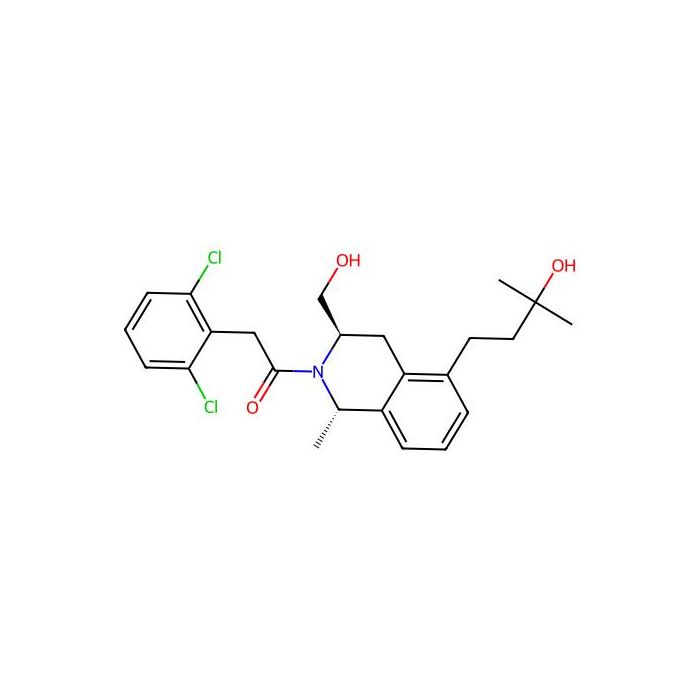
LY3154207 is a potent, subtype selective, and orally available human dopamine D1 receptor positive allosteric modulator (PAM) with minimal allosteric agonist activity ( EC 50 =3 nM)
In Vitro
In HEK293 cells transiently expressing human, dog, rhesus monkey, and mouse D1 receptors, the EC 50 s of LY3154207 are 2.3 nM, 2.0 nM, 2.5 nM, and 62.1 nM, respectively. MCE has not independently confirmed the accuracy of these methods. They are for reference only.
LY3154207 is a potent, subtype selective, and orally available human dopamine D1 receptor positive allosteric modulator (PAM) with minimal allosteric agonist activity ( EC 50 =3 nM).
Condições de armazenamento de armazenamento
Store at -80°C
Enviado em
Dry ice packs + Cold packs
Este produto requer transporte de cadeia fria. Serviços terrestres e outros serviços econômicos não estão disponíveis.
Determine the necessary mass, volume, or concentration for preparing a solution.
Dilution Calculator
Determine the dilution needed to prepare a stock solution.
Reconstitution Calculator
Revisões
Avaliações dos Clientes
Application Protocols
No tested applications or protocols are specified in the Product Data for SKU L656763. The following generic guidance reflects common handling of small-molecule research compounds; adjust to your biology and consult the CoA/SDS.
Suggested starting workflow (general):
Prepare a 10 mM stock in anhydrous DMSO; vortex/sonicate if needed. Record exact concentration by weight-in-volume.
Generate an 8–12 point dilution series (1:3 or 1:2 steps) in assay buffer with matched vehicle controls.
Run replicates (n ≥ 3) and include positive/negative controls. Monitor precipitation visually and by turbidity if feasible.
For LC–MS bioanalysis, develop an MRM/SIM method using a water/acetonitrile gradient with volatile modifiers; confirm linearity and matrix effects.
Documentation:
Capture lot number, preparation date, and storage conditions in your ELN. Attach CoA and SDS for traceability.
Note: These are general practice suggestions, not item-specific performance claims.
Biological Roles
Biological function details are not provided in the Product Data for this specific item. The following notes summarize context commonly encountered with small-molecule research tools; verify applicability to your study design.
Reported in the literature: LY3154207 has been widely described as a small-molecule modulator used in neuroscience research (literature context; consult primary sources to confirm suitability for your application). Aladdin does not assign targets or activities unless explicitly stated in our datasheet.
General uses of small-molecule probes include interrogation of signaling pathways, receptor pharmacology, and structure–activity relationship (SAR) exploration.
When deploying any bioactive compound, incorporate rigorous controls: vehicle controls, inactive analogs if available, concentration-response curves, and orthogonal assays to confirm on-target effects.
Consider ADME liabilities in vitro (solubility limits, nonspecific binding to plastic/protein, and metabolic stability) that can influence observed potency/efficacy.
Important: No medical, diagnostic, or therapeutic use is intended or implied. This product is supplied strictly for research use only (per Product Data).
Buffer Applications
This product is a small-molecule research compound and is not a buffering agent. Traditional buffer-system guidance (e.g., phosphate, HEPES, Tris) is not directly applicable.
Practical notes for assay media (general):
Prepare stocks in DMSO, then dilute into your assay buffer (e.g., HEPES, PBS) ensuring the final DMSO percentage is acceptable for the biology (commonly ≤0.5–1% v/v).
To minimize precipitation in aqueous buffers, consider adding compound last, with vigorous mixing and appropriate co-solvent or carrier protein (e.g., 0.1% BSA) if compatible.
For buffer recipes and pH control, refer to standard buffer guides; the compound itself does not set or maintain pH.
Green Alternatives
Green chemistry considerations are most relevant to the solvents and workflows used with this compound rather than the compound itself.
Stock preparation: Prefer DMSO (widely accepted and recyclable in some workflows) over DMF/NMP, which are higher-hazard reproductive toxins.
Chromatography: Favor acetonitrile or water-rich gradients over chlorinated solvents. Explore supercritical CO₂ for preparative separations when feasible.
Work-up and cleaning: Substitute ethyl acetate or 2-MeTHF for dichloromethane where compatible with solubility.
Illustrative comparison (workflow-level; not item-specific):
DMF/NMP → DMSO or aqueous cosolvent systems when biological compatibility permits.
DCM → 2-MeTHF or EtOAc for extractions and flash chromatography.
Mobile phase modifiers: Use volatile buffers (ammonium formate/acetate) to minimize non-volatile waste.
Trade-offs:
Greener solvents may reduce solubility for some hydrophobic analytes; small additions of DMSO or temperature control can mitigate.
Method revalidation is required when changing solvents (retention, selectivity, and detector response can shift).
Pharmaceutical Uses
No pharmacopeial status, excipient role, or clinical use is provided in the Product Data. This material is supplied for research use only and is not intended for human or veterinary use.
Relevant research/CMC-context notes (general):
Can serve as a reference standard for preclinical bioanalytical methods after identity/purity confirmation.
Useful in formulation screening at the research stage to assess solubilization strategies (cosolvents, cyclodextrins, lipid-based systems) for in vitro or exploratory in vivo studies, subject to institutional approvals.
For early developability profiling, evaluate solubility (pH, cosolvent), chemical stability (acid/base, oxidative, photolytic), and solid-state behavior (hygroscopy/polymorphism), as these factors strongly impact exposure in pharmacology models.
No claims are made regarding therapeutic indications, safety, efficacy, or GMP suitability.
Physical Properties
Item-specific physical constants are not listed in the provided Product Data.
Appearance: Not specified for this item; refer to CoA/Spec Sheet.
Melting point / Boiling point: Not specified for this item; refer to CoA/Spec Sheet.
Density / Refractive index: Not specified for this item; refer to CoA/Spec Sheet.
Solubility: Not specified for this item; refer to CoA/Spec Sheet.
LogP / pKa: Not specified for this item; refer to CoA/Spec Sheet.
General laboratory guidance for small drug-like molecules (literature/good practice; not item-specific):
Many screening compounds are handled as DMSO stock solutions (e.g., 10–50 mM), then diluted into aqueous assay buffers containing 0.1–1% DMSO.
If aqueous work is required, use a co-solvent strategy (DMSO or DMF → aqueous buffer with surfactant, serum, or cyclodextrin as appropriate) to mitigate precipitation.
For analytical development, determine the UV–vis profile and LC–MS ionization behavior empirically; start with ESI± and a water/acetonitrile + 0.1% formic acid system.
Note: For precise constants and any polymorph/salt information, rely on the current lot CoA/Spec Sheet or SDS.
Quality and Grades
The Product Data do not specify a grade or purity for SKU L656763.
Grade/Purity: Not specified for this item; refer to CoA/Spec Sheet.
Appearance: Not specified for this item; refer to CoA/Spec Sheet.
Context and expectations:
For small-molecule screening compounds, suppliers typically provide a research-use-only material with a confirmed identity (NMR/LC–MS) and a purity suitable for biological screening (often ≥95% by HPLC), but the exact specification is lot-specific. Always confirm on the provided CoA.
If low-UV absorbance or chromatographic background is critical (e.g., bioanalytical quantification), request chromatographic traces and residual solvent data for your lot.
Trace metal, water, and residual peroxide specifications are not applicable unless stated. When sensitive assays are planned (e.g., redox biology), request additional testing as needed.
Implications for use:
Validate purity and identity in-house for critical decision-making (SAR, PK screening). Minor impurities can confound biological readouts.
If stability is a concern, perform forced degradation scouting (thermal, oxidative, photolytic) to design robust storage and assay-handling conditions.
Reaction and Applications
Use-case emphasis for LY3154207 is as a small-molecule research tool within screening collections rather than as a synthetic reagent.
Typical applications (general for library compounds):
Primary and secondary screening in biochemical or cell-based assays to probe pathway modulation, followed by dose–response profiling and orthogonal assay confirmation.
Chemical biology: tool-compound studies to assess phenotypic effects, temporal control in signaling cascades, and target-engagement workflows (e.g., CETSA, DARTS) when appropriate controls are available.
Assay development: serving as a positive control or reference standard once its activity in a given assay context is established.
Analytical reference: calibration standards for LC–MS bioanalysis once identity/purity are verified.
Not primarily intended for synthetic transformations: LY3154207 is not provided as a building block, coupling partner, or catalyst; thus common reaction families (cross-coupling, carbonyl chemistry, etc.) are not directly applicable. If your project involves derivatization or SAR expansion, plan de novo synthesis routes from suitable precursors and confirm that any transformations do not compromise the core activity of interest.
Reaction Conditions
Conventional organic reaction conditions are not applicable since LY3154207 is supplied as a final research compound rather than a reagent. The following guidance pertains to solution handling for assays and analytics (general best practice; not item-specific specifications):
Stock solution preparation: Dissolve in anhydrous DMSO at a concentration suitable for your assay (commonly 10–50 mM). Filter (0.2 µm PTFE) if particulate is observed.
Dilution into assay media: Add stocks to pre-warmed buffer with vigorous mixing to achieve the desired final concentration, ensuring the final DMSO is within biological tolerance (e.g., ≤0.5–1% v/v).
Stability checks: Perform short-term stability tests at assay temperature (e.g., 2–6 h at 25–37°C) by LC–MS/UPLC to verify no rapid degradation or precipitation.
Adsorption control: Use low-bind plasticware or glass vials for low-nanomolar work to mitigate nonspecific binding.
If you plan any chemical modification, develop conditions de novo based on the confirmed structure from CoA/literature and standard reaction-scoping practices.
Safety and Handling
Safety classification data are not included in the Product Data and may vary by jurisdiction and lot.
GHS classification / pictograms / H-statements: Not specified for this item; refer to SDS.
Signal word: Not specified for this item; refer to SDS.
General laboratory precautions (good practice; defer to SDS for authoritative guidance):
Handle in a fume hood with standard PPE: lab coat, safety glasses, and appropriate chemically resistant gloves (e.g., nitrile). Avoid inhalation of powders/aerosols.
Prevent skin/eye contact; wash thoroughly after handling. Avoid ingestion and environmental release.
Use dust-minimizing techniques; for potent bioactive small molecules, consider closed transfer, weighing boats in hood, and disposable tips.
Incompatibilities are compound-specific; absent item data, keep away from strong oxidizers/acids/bases until compatibility is established.
First-aid overview (general):
Skin/eye contact: Rinse with water for ≥15 minutes; remove contaminated clothing; seek medical attention as needed.
Inhalation: Move to fresh air; support respiration; seek medical attention.
Ingestion: Rinse mouth; do not induce vomiting; seek medical attention.
Spill and waste:
For small spills, absorb with inert material and collect in a sealable container. Dispose according to institutional chemical waste protocols. Decontaminate surfaces per SDS guidance.
Solvent Selection
Practical solvent choices for small, hydrophobic research compounds typically prioritize DMSO for stock preparation, with miscible organic mobile phases for analytics.
Primary stock solvent (practice): DMSO due to excellent solvating power and assay compatibility at ≤1% v/v final.
Alternative stock solvents: DMF, NMP, or ethanol where compatible with biology; verify cytotoxicity of cosolvents in your system.
Analytical solvents: Acetonitrile and methanol (HPLC/LC–MS), paired with water and volatile modifiers (e.g., 0.1% formic acid or 5–10 mM ammonium acetate).
Aqueous delivery: Use co-solvent addition and slow titration into buffered media to avoid precipitation. Consider cyclodextrin complexation or surfactants (e.g., 0.01–0.1% Tween-20) if needed.
Quick comparison (general):
DMSO: High solvency; biologically acceptable at low %; higher viscosity.
DMF/NMP: Strong solvency; potential bioincompatibility; handle with care.
Ethanol: Lower solvency for many heteroaromatics; good biocompatibility at low %.
Note: Item-specific solubility and partitioning are not provided here; confirm empirically or consult the CoA/SDS.
Storage and Reconstitution
Adhere to the product-specific storage conditions and shipping details to maintain integrity.
Storage (product data): Store at -80°C.
Shipped in (product data):Dry ice packs + Cold packs.
Reconstitution and handling (general best practice; not item-specific specs):
Allow the container to equilibrate to room temperature while sealed to avoid condensation before opening.
Prepare concentrated stocks in anhydrous DMSO. If aqueous stocks are required, confirm stability and solubility; consider pH-adjusted buffers and co-solvents.
Aliquot stock solutions into single-use volumes (e.g., 10–50 µL) to minimize freeze–thaw cycles.
Suggested storage of solutions: keep at -20°C to -80°C in sealed, inert-atmosphere vials; protect from light if the compound is chromophoric. Exact solution stability: Not specified for this item; refer to CoA/Spec Sheet.
Avoid repeated freeze–thaw; thaw rapidly at room temperature, mix gently, and return unused aliquots to storage promptly.
Disposal: Follow institutional chemical waste procedures. Do not discharge to drains.
For definitive stability, hygroscopicity, and solvated form information, consult the current lot CoA and SDS.
Structure and Identity
Compact small-molecule research compound supplied for screening and probe-development workflows.
Product name: LY3154207 (research compound)
CAS: 1638667-79-4 (product data)
PubChem CID: 86290953 (product data)
Molecular formula: Not specified for this item; refer to CoA/Spec Sheet.
Molecular weight: Not specified for this item; refer to CoA/Spec Sheet.
InChIKey: Not specified for this item; refer to CoA/Spec Sheet.
SMILES (canonical): Not specified for this item; refer to CoA/Spec Sheet.
Structural features (general notes):
Item-specific 2D/3D structure is not included in the product data. For structural verification, consult the item’s CoA, Spec Sheet, or the PubChem record (CID 86290953) for literature structure information.
If you require exact stereochemical descriptors, ring systems, or functional-group annotations for method development (e.g., LC–MS MRM transitions), please request the current CoA/SDS to confirm identity formatting and any salt/solvate form.
Identity verification recommendations (general):
Cross-check CAS and supplier lot number with the CoA.
Confirm mass and impurity profile by LC–MS or HRMS as appropriate for your workflow; compare retention time with an authenticated reference if available.
Synthetic Utility
LY3154207 is offered as a finished small-molecule research tool rather than a synthetic intermediate.
It is not positioned as a building block or coupling partner; functional-group reactivity and named-reaction participation are therefore out of scope for routine use.
If derivatization is desired for SAR or tag installation (e.g., photoaffinity, biotinylation), consult the literature structure (e.g., PubChem CID 86290953) to identify modifiable vectors away from activity-determining motifs. Any modification should be empirically validated for retained activity and selectivity.
For analytical probes (e.g., LC–MS tracers, isotopologues), custom synthesis may be required. Coordinate with your synthetic team to design routes that preserve the core scaffold and physicochemical profile.
Because item-specific functional groups are not listed in the Product Data, no reaction conditions or named transformations are recommended here.
Target Specificity
Target, mechanism, and selectivity data are not provided in the Product Data for this item.
Aladdin does not assign biological targets or potencies unless explicitly stated in the product’s datasheet/CoA.
Literature context may discuss putative targets for compounds bearing this name; however, users must consult primary sources and generate in-house confirmation (e.g., binding assays, functional dose–response, off-target panels) before drawing conclusions.
For definitive target specificity, please refer to peer-reviewed publications and your own assay validation. No guarantees or claims are made by the supplier regarding biological activity or selectivity.
Perguntas frequentes
How should this product be stored?
Store at ?80 °C. Ultra-low temperature storage is required to maintain the specified shelf life.
How is this product shipped?
This product ships frozen with dry ice and cold packs. Unpack on arrival and transfer it to the storage condition stated above; handle dry ice with insulated gloves in a ventilated area.
What are the CAS number, molecular formula and molecular weight?
The CAS Number is 1638667-79-4, the molecular formula is C24H29Cl2NO3, and the molecular weight is 450.40 g/mol.
What documentation is provided?
Available product documentation, including Certificates of Analysis (COA), Safety Data Sheets (SDS), and specification sheets, is shown in the product document area. Document availability and access follow the current site policy.
Usamos cookies para garantir o funcionamento adequado do site e, quando permitido, para melhorar a sua experiência. Você pode gerenciar suas preferências a qualquer momento nas Configurações. Saiba mais em nossa Política de Cookies.
Deseja que lhe enviemos uma mensagem quando tivermos descontos disponíveis?
Lembrar-me mais tarde
Obrigado! Por favor, verifique a sua caixa de entrada de e-mail para confirmar.
Products are supplied to verified businesses, institutions, and qualified professionals for research and development use only. Not for use in humans, animals, diagnosis, or therapy.