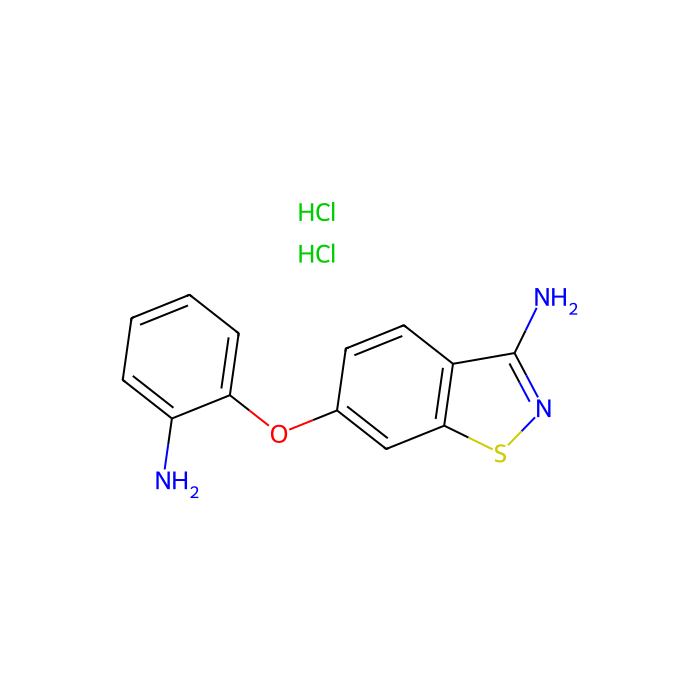
TLR4 inhibitor. Inhibits LPS-induced NF-κB activation in HEK293 cells (IC50= 2.4 μg/mL). Also inhibits LPS-induced cytokine production and procoagulant effects in PBMCs and HUVECs. Prolongs survival in a mouse septic shock model.
Condições de armazenamento de armazenamento
Store at 2-8°C
Enviado em
Wet ice
Este produto requer transporte de cadeia fria. Serviços terrestres e outros serviços econômicos não estão disponíveis.
This compound belongs to the class of organic compounds known as diarylethers. These are organic compounds containing the dialkyl ether functional group, with the formula ROR', where R and R' are aryl groups.
External Descriptors
Not available
1. Djoumbou Feunang Y, Eisner R, Knox C, Chepelev L, Hastings J, Owen G, Fahy E, Steinbeck C, Subramanian S, Bolton E, Greiner R, and Wishart DS. ClassyFire: Automated Chemical Classification With A Comprehensive, Computable Taxonomy. Journal of Cheminformatics, 2016, 8:61.
Solvent:water, Max Conc. mg/mL: 33.02, Max Conc. mM: 100; Solvent:DMSO, Max Conc. mg/mL: 16.51, Max Conc. mM: 50
Peso molecular
330.2
XLogP3
Hydrogen Bond Donor Count
4
Hydrogen Bond Acceptor Count
5
Rotatable Bond Count
2
Exact Mass
329.016 Da
Monoisotopic Mass
329.016 Da
Topological Polar Surface Area
102.000 Ų
Heavy Atom Count
20
Formal Charge
0
Complexity
291.000
Isotope Atom Count
0
Defined Atom Stereocenter Count
0
Undefined Atom Stereocenter Count
0
Defined Bond Stereocenter Count
0
Undefined Bond Stereocenter Count
0
The total count of all stereochemical bonds
0
Covalently-Bonded Unit Count
3
Calculadoras de soluções
Molarity Calculator
Determine the necessary mass, volume, or concentration for preparing a solution.
Dilution Calculator
Determine the dilution needed to prepare a stock solution.
Reconstitution Calculator
Revisões
Avaliações dos Clientes
Application Protocols
Tested applications, recommended dilutions, and positive controls are not provided for this item.
Validated applications (WB, IHC, IF, FC, ELISA, IP, etc.): Not specified for this item; refer to CoA/Spec Sheet.
Working concentrations/dilutions: Not specified for this item; refer to CoA/Spec Sheet.
Antigen retrieval or blocking conditions (if antibody): Not specified for this item; refer to CoA/Spec Sheet.
General guidance (if adapting a protein reagent to assays):
For ELISA/assay standards: Establish a calibration curve using serial dilutions in assay buffer with carrier protein (e.g., 1% BSA) to minimize adsorption.
For binding/biophysical assays: Dialyze or buffer-exchange into low-fluorescence, low-absorbance buffers; verify concentration by orthogonal methods.
For cell-based assays: Ensure low endotoxin and confirm bioactivity prior to routine use; none of these parameters are specified for this item.
Please consult the CoA/Spec Sheet for any product-specific protocols, example data, and troubleshooting tips.
Biological Roles
Item-specific biological identity and function are not provided in the Product Data; therefore, no claims can be made about the physiological roles or pathways for this product.
General (biochemistry) context for proteins:
Proteins act as enzymes, structural elements, transporters, receptors, and signaling molecules. Their roles are dictated by amino acid sequence, post-translational modifications, and higher-order structure.
Binding and catalysis depend on properly folded domains; solution conditions (pH, ionic strength, cofactors, redox) modulate activity.
Cellular localization signals and domains (signal peptides, transmembrane helices, nuclear localization sequences) determine trafficking and compartmentalization; none are specified for this item.
Recombinant proteins may include affinity tags or fusion partners to aid expression, solubility, and purification; the presence or absence of such features for this item is not specified.
If your application requires a specific biological function (e.g., cytokine signaling, receptor-ligand interaction), obtain the definitive identity, sequence, and any bioactivity data from the CoA/Spec Sheet for this SKU before experimental use.
Buffer Applications
This protein product has no item-specific buffer formulation provided, but the storage condition (2–8 °C) suggests it is supplied as a refrigerated material. The following are general, literature-based practices for buffer use with proteins.
Starting buffers: PBS (10–50 mM phosphate, 150 mM NaCl, pH 7.2–7.4), Tris-HCl (20–50 mM, pH 7.5–8.0), or HEPES (10–50 mM, pH 7.0–7.5). Adjust ionic strength (50–300 mM NaCl) to enhance solubility and reduce nonspecific interactions.
Stability additives: 5–20% glycerol or 1–5% trehalose/sucrose can improve stability at 2–8 °C; reducing agents (0.5–2 mM TCEP/DTT) may protect cysteines, but can interfere with maleimide chemistry and certain assays.
Detergents: 0.01–0.1% non-ionic detergents (Tween-20, NP-40 substitute) can limit aggregation for membrane-associated proteins. Verify assay compatibility.
pH range: Screen pH ±1 unit around predicted/known pI for solubility; if pI is unknown, begin at pH 7.4 and adjust based on turbidity/DLS.
Filtration/sterility: Filter reconstituted solutions (0.22 µm) using low-protein-binding membranes; add preservative (e.g., 0.02% sodium azide) only if compatible and permitted.
Analytical checks: Confirm monodispersity by DLS or SEC, integrity by SDS-PAGE, and concentration by BCA/Bradford or A280 (if ε known).
Item-specific buffer composition, reconstitution instructions, and compatible excipients are not specified; refer to the CoA/Spec Sheet for definitive guidance.
Green Alternatives
For protein reagents, “green alternatives” center on buffer systems, preservatives, and process choices rather than solvent replacement.
Greener practice considerations (general literature guidance):
Buffer selection: Favor Good’s buffers (HEPES, MOPS) or phosphate buffers prepared with low-toxicity salts. Avoid excessive organic co-solvents.
Preservatives: Where aseptic technique is feasible, omit azide/mercurials. If preservation is needed, use minimal effective concentrations (e.g., 0.02% sodium azide) and manage waste responsibly; confirm compatibility with downstream assays (e.g., azide inhibits HRP).
Stabilizers: Opt for benign polyols/sugars (glycerol, trehalose) instead of volatile organics. Balance stability with assay compatibility.
Energy use: Store short-term at 2–8 °C (as specified) and consolidate cold-chain shipments to reduce environmental footprint. For long-term storage, evaluate lyophilization to reduce freezer load if the protein tolerates drying.
Single-use plastics: Use low-protein-binding, recyclable materials when possible; pre-rinse to minimize adsorption losses and reduce waste.
Comparison (general):
Organic-rich formulations vs aqueous buffers: Aqueous, minimally preserved formulations reduce VOCs and hazards but may trade shelf-life for environmental benefit.
Azide-containing vs azide-free: Azide-free is safer for wastewater and compatible with HRP-based assays, but may require stricter asepsis.
Item-specific formulation choices are not provided; consult the CoA to align environmental considerations with performance requirements.
Pharmaceutical Uses
No pharmaceutical or excipient designations are provided for this item, and it is explicitly for research use only.
General context (non-clinical, literature-based):
Proteins in pharmaceutical manufacturing can serve as reference standards, process controls, or analytical system suitability materials in development labs. Such uses require documented identity, purity, and stability—none are specified for this product.
Formulation studies may use research-grade proteins to develop methodologies for aggregation analysis (DLS, SEC-MALS), thermal stability (DSC, nanoDSF), and surfactant screening; suitability is case-dependent and requires item-specific characterization.
Regulatory status: No pharmacopeial status or compendial monograph is claimed for this item. Do not use in APIs, clinical formulations, or diagnostics without appropriate qualification.
For any development work, obtain and review the product’s CoA/Spec Sheet and SDS to ensure the attributes (purity, endotoxin, residual host cell components, stabilizers) meet your laboratory’s acceptance criteria.
Physical Properties
Item-specific physicochemical properties are not provided in the Product Data.
Appearance: Not specified for this item; refer to CoA/Spec Sheet.
Molecular Weight: Not specified for this item; refer to CoA/Spec Sheet.
Isoelectric point (pI), extinction coefficient (ε), and purity: Not specified for this item; refer to CoA/Spec Sheet.
Solubility: Not specified for this item; refer to CoA/Spec Sheet.
pH (formulation), buffer composition, and stabilizers (e.g., glycerol, trehalose, BSA): Not specified for this item; refer to CoA/Spec Sheet.
General (literature) considerations for proteins:
Proteins typically dissolve in aqueous buffers; solubility depends on pH relative to pI, ionic strength, and additives (salts, arginine, non-ionic detergents).
Many proteins denature irreversibly above ~45–65 °C (literature) and are sensitive to freeze–thaw cycling.
UV absorbance at 280 nm is commonly used for concentration determination using ε (if sequence is known); lacking sequence, Bradford/BCA assays are alternatives.
Lyophilized proteins are often reconstituted in neutral pH buffers (e.g., PBS, HEPES) with carrier protein and cryoprotectants; specifics for this item are not provided.
Typical storage formulations include 10–50% glycerol for stability at −20 °C or 2–8 °C for short-term; this item’s storage is specified at 2–8 °C.
Note: For any exact numeric properties, stability profiles, and formulation details, rely on the CoA/Spec Sheet for this SKU.
Quality and Grades
Item-specific grade, purity, and analytical specifications are not provided in the Product Data.
Grade/Purity: Not specified for this item; refer to CoA/Spec Sheet.
Appearance: Not specified for this item; refer to CoA/Spec Sheet.
General guidance on protein reagent quality (literature/practice):
Purity descriptions: Terms such as “SDS-PAGE purity,” “HPLC purity,” and “monomer content (SEC)” are used to indicate protein integrity and aggregation state. Without provided values, no item-specific claims can be made.
Endotoxin level: Critical for cell culture or in vivo research; commonly reported in EU/mg by LAL/TAL assay. Not specified for this item.
Activity/biopotency: For enzymes or cytokines, activity is reported in units or EC50 values. Not specified for this item.
Tagging and sequence validation: Many recombinant proteins include affinity tags (His, GST). Verification may include mass spectrometry and N-terminal sequencing. Not specified for this item.
Stabilizers/excipients: Sugars, polyols, BSA, or detergents may be present to enhance stability; their presence can impact downstream applications (e.g., MS, cell assays). Not specified for this item.
Recommendation: Consult the product’s CoA/Spec Sheet for electrophoretic profile, purity metrics, endotoxin level, specific activity (if relevant), host expression system, and residual host cell protein/DNA assessments.
Reaction and Applications
No manufacturer-supplied application notes are provided for this specific item beyond “For research use only.”
General (literature/practice) applications for protein reagents:
Biochemical assays: Enzyme kinetics, binding assays (SPR/BLI/ITC), and ELISA calibrators or capture/detection antigens where the protein identity is known. For this item, no target identity is provided, so such use requires independent verification.
Structural biology: Crystallization, NMR, or cryo-EM typically require high purity and homogeneity; buffer components should be optimized to reduce aggregation. Item-specific suitability is unknown.
Cell biology: Ligands, growth factors, or signaling proteins for cell-based assays require low endotoxin and validated bioactivity; neither is specified here.
Protein-protein/ligand interactions: Pull-downs, co-IP bait, or affinity matrices are possible if the protein identity and tags are defined; not specified for this item.
Practical tips (general):
Thaw on ice, keep at 2–8 °C during handling (consistent with provided storage) and avoid repeated freeze–thaw cycles; aliquot when long-term storage is required.
Validate concentration with an orthogonal method (A280 if ε known; BCA/Bradford otherwise). Confirm integrity by SDS-PAGE and SEC.
If unknown stability, conduct a small-scale buffer screen (pH 6.5–8.5, 50–300 mM NaCl, ±5–20% glycerol) and monitor with DLS.
Given the absence of item-specific details, users should consult the CoA/Spec Sheet and run pilot experiments to confirm applicability to their assay.
Reaction Conditions
Not directly applicable to small-molecule synthetic reactions. For protein-related experimental conditions, only general guidance can be offered due to lack of item-specific details.
General (literature) conditions for handling proteins:
Temperature: Keep on ice or at 2–8 °C during manipulation (aligned with provided storage). Avoid >25 °C unless stability is verified.
pH/Ionic strength: Start with neutral pH (7.0–7.5) and 50–300 mM NaCl to maintain solubility; optimize based on aggregation assays (DLS/SEC).
Redox: Include 0.5–2 mM TCEP or DTT for cysteine-containing proteins if disulfide scrambling is an issue; omit for disulfide-stabilized proteins unless refolding is intended.
Cofactors: Enzymes may require metal ions or organic cofactors; none are specified for this item.
Concentration: Concentrate gently with low-binding centrifugal devices; monitor for aggregation. Add 5–20% glycerol when concentrating at 2–8 °C if compatible.
Sterility: Maintain aseptic technique; 0.22 µm filter if sterility is required.
Because no item-specific formulation, tag, or activity data are available, users should design pilot studies to establish optimal buffer, temperature, and additive conditions for their intended application and consult the CoA/Spec Sheet for any constraints.
Safety and Handling
Safety information provided for this item is limited; always consult the SDS for authoritative guidance.
GHS Classification: Not specified for this item; refer to SDS.
Signal Word / H-Statements / Pictograms: Not specified for this item; refer to SDS.
Research Use: For research use only (as provided). Not for human or animal diagnostic/therapeutic use.
Storage Conditions: Store at 2–8 °C (provided). Shipments are on wet ice.
General laboratory safety for protein reagents (literature/practice):
PPE: Lab coat, nitrile gloves, and safety glasses. Avoid inhalation of powders or aerosols; handle solutions to prevent splashes.
Allergic sensitization: Some proteins can be respiratory or dermal sensitizers. Work in a biosafety cabinet if aerosol generation is possible.
Biological origin: If of biological origin, treat as potentially biohazardous until vendor documentation confirms recombinant source and pathogen-free status. No source is specified for this item.
Incompatibilities: Avoid strong oxidants, extreme pH, and elevated temperatures that can denature proteins. Prevent repeated freeze–thaw cycles.
Spill/Exposure: Absorb aqueous spills with inert material, decontaminate surfaces with appropriate detergent. After skin/eye contact, rinse with water for 15 minutes and seek medical attention as needed; reference SDS for specifics.
Waste: Dispose according to institutional and local regulations for nonhazardous biological/chemical waste, unless SDS indicates otherwise.
Always defer to the item-specific SDS for hazards, first aid, accidental release, transport, and disposal details.
Solvent Selection
This product is categorized as a protein reagent; conventional organic solvent selection is typically not applicable.
General (literature) guidance for protein solvents and buffers:
Primary medium: Aqueous buffers (e.g., PBS, Tris, HEPES) adjusted to pH values that maintain solubility and activity.
Additives for solubility: Moderate ionic strength (50–300 mM NaCl), arginine (50–500 mM), or low percentages of non-ionic detergents (0.01–0.1% Tween-20, Triton X-100) can suppress aggregation. Compatibility must be evaluated per application.
Stabilizers: Glycerol (10–50%), trehalose/sucrose (1–5%), and reducing agents (DTT, TCEP) may protect against freeze–thaw or oxidation, but can interfere with assays (e.g., maleimide coupling, mass spectrometry).
Organic co-solvents: Small percentages of ethanol, DMSO, or acetonitrile are sometimes tolerated, but many proteins denature in significant organic content; minimize unless validated for the specific protein.
Item-specific solvent/buffer recommendations are not available; refer to the CoA/Spec Sheet. When adapting to your workflow, begin with neutral pH buffers (HEPES or PBS), screen pH and ionic strength, and include compatibility checks for any planned downstream assay.
Storage and Reconstitution
Item-specific details are limited; only storage temperature and shipping conditions are provided.
Storage Temperature: Store at 2–8 °C (provided).
Shipping: Shipped on wet ice (provided).
Formulation/Appearance: Not specified for this item; refer to CoA/Spec Sheet.
Reconstitution: Not specified for this item; refer to CoA/Spec Sheet.
General (literature-based) guidance for protein storage and reconstitution:
If lyophilized: Reconstitute gently in sterile buffer (e.g., PBS or HEPES, pH ~7.4). Allow to sit on ice for 10–15 minutes to fully dissolve. Avoid vigorous vortexing; mix by gentle inversion or slow pipetting with low-binding tips.
If in solution: Keep at 2–8 °C for short-term use. For longer-term storage, prepare aliquots and freeze at −20 °C or −80 °C if the formulation permits (verify on CoA). Consider 5–50% glycerol for stability at subzero temperatures.
Adsorption control: Use low-binding tubes; include carrier protein (e.g., 0.1–1% BSA) if compatible to reduce surface loss at low concentrations.
Freeze–thaw: Minimize cycles by aliquoting; thaw on ice and mix gently.
Quality checks: Post-reconstitution, verify concentration (BCA/Bradford or A280 if ε known) and integrity (SDS-PAGE/SEC).
Always defer to the item-specific CoA/Spec Sheet for definitive formulation, reconstitution volumes, recommended buffers, and long-term storage conditions.
Structure and Identity
Brief overview: This listing falls under the “protein” category, but detailed molecular identity has not been provided in the Product Data.
SKU: M287199
Product Name: M62812 (catalog designation)
Chemical Name: Not specified for this item; refer to CoA/Spec Sheet.
CAS: 613263-00-6 (as provided; verify on CoA/SDS for final use)
PubChem CID: 44224214 (as provided)
InChIKey: 339933 (provided string appears truncated for typical InChIKey length; verify on CoA/SDS)
SMILES: Not specified for this item; refer to CoA/Spec Sheet.
Molecular Formula: Not specified for this item; refer to CoA/Spec Sheet.
Molecular Weight: Not specified for this item; refer to CoA/Spec Sheet.
Structural features (general guidance):
For proteins, structure is hierarchical: primary sequence (amino acids), secondary (α-helix/β-sheet), tertiary (fold), and possibly quaternary (multimerization). Specifics for this item are not provided.
If this product is a recombinant or purified protein, common features may include post-translational modifications (e.g., glycosylation, phosphorylation) and optional affinity tags (His, GST, FLAG). None are specified for this item.
2D/sequence description:
Not specified for this item; refer to CoA/Spec Sheet for any sequence, domain map, or tag information.
Identity verification (general best practices):
Use SDS-PAGE with appropriate markers, Western blot with target-specific antibodies (if applicable), intact mass by LC–MS, and peptide mapping for confirmation. Exact identity tests for this item are not specified; consult the product’s CoA.
Synthetic Utility
Not typically applicable. As a protein reagent, this product is not used as a small-molecule building block for organic synthesis.
General (biochemical) utility notes:
Proteins can function as biocatalysts (enzymes) enabling chemo-, regio-, and stereoselective transformations in aqueous media under mild conditions. However, there is no item-specific information indicating enzymatic activity or substrate scope for this SKU.
In chemical biology, proteins with tags (e.g., His, biotin, SNAP/CLIP) can be immobilized or site-specifically modified. No tag information is provided for this item.
Conclusion: For classic synthetic chemistry workflows (cross-coupling, carbonyl chemistry, radical reactions), select appropriate small-molecule reagents. If you intend to use this item as a biocatalyst or affinity component, consult the CoA/Spec Sheet for sequence, tags, activity, and stability.
Target Specificity
Target identity, species reactivity, epitope information, clone/isotype (if antibody), and application validation are not provided in the Product Data for this SKU.
Antigen/Target: Not specified for this item; refer to CoA/Spec Sheet.
Species Reactivity: Not specified for this item; refer to CoA/Spec Sheet.
Cross-reactivity/Blocking: Not specified for this item; refer to CoA/Spec Sheet.
Note: If this product is an antibody or binding protein, consult the CoA/Spec Sheet for epitope mapping, KD/affinity, and validated applications. No such details are available here.
Perguntas frequentes
What is the purity of this product, and how is it determined?
This product is supplied at ≥98% purity, determined by HPLC. Lot-specific values are stated on the Certificate of Analysis.
How should this product be stored?
Store at 2–8 °C. Refrigerated storage is required to maintain the specified shelf life.
How is this product shipped?
This product ships chilled on wet ice. Unpack on arrival and transfer it to the storage condition stated above.
What are the CAS number, molecular formula and molecular weight?
The CAS Number is 613263-00-6, the molecular formula is C13H13Cl2N3OS, and the molecular weight is 330.23 g/mol. InChIKey SMTKPLISDFNJDJ-UHFFFAOYSA-N.
What documentation is provided?
Available product documentation, including Certificates of Analysis (COA), Safety Data Sheets (SDS), and specification sheets, is shown in the product document area. Document availability and access follow the current site policy.
Usamos cookies para garantir o funcionamento adequado do site e, quando permitido, para melhorar a sua experiência. Você pode gerenciar suas preferências a qualquer momento nas Configurações. Saiba mais em nossa Política de Cookies.
Deseja que lhe enviemos uma mensagem quando tivermos descontos disponíveis?
Lembrar-me mais tarde
Obrigado! Por favor, verifique a sua caixa de entrada de e-mail para confirmar.
Products are supplied to verified businesses, institutions, and qualified professionals for research and development use only. Not for use in humans, animals, diagnosis, or therapy.