GRADE & PURITYMoligand™?Moligand™ — Aladdin's line of ligands and bioactive small molecules. Use for receptor, pathway, and binding studies needing defined small-molecule tools.≥98%
Moligand™, ≥98% Moligand™ for sensitive chromatographic and analytical workflows requiring minimal baseline interference.
🌡
Storage & shipping
Store at -20°C Ships Ice chest + Ice pads Check lot-specific COA for exact specifications.
📋
Quality documents
SDS, COA, datasheet, and spec sheet available for download. Lot-specific COA accessible via lot number lookup.
📚
Literature proof
Cited in 0 peer-reviewed publications across chromatography, organic synthesis, and cross-coupling reactions.
Visão geral
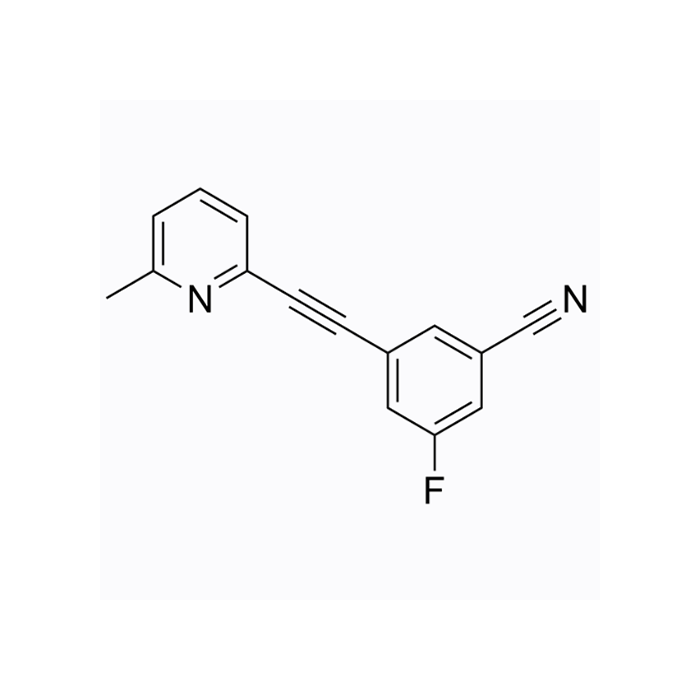
MFZ 10-7 is a highly potent and selective mGluR5 NAM (negative allosteric modulator), with a K i of 0.67 nM for rat mGluR5
In Vitro
MFZ 10-7 has approximately 1150- and 3000-fold lower affinity for MAO-B (monoamine oxidase-B enzyme) and TXA2 (thromboxane A2 receptor), respectively, compared to mGluR5. MCE has not independently confirmed the accuracy of these methods. They are for reference only.
In Vivo
MFZ 10-7 can lower oral sucrose self-administration rate but has no effect on total sucrose intake . MCE has not independently confirmed the accuracy of these methods. They are for reference only.
Form:Solid
IC50& Target:rat mGluR5 0.67 nM (Ki)
Specifications
Especificações e pureza
Moligand™, ≥98%
Mecanismos bioquímicos e fisiológicos
MFZ 10-7 is a highly potent and selective mGluR5 NAM (negative allosteric modulator), with a K i of 0.67 nM for rat mGluR5.
Condições de armazenamento de armazenamento
Store at -20°C
Enviado em
Ice chest + Ice pads
Este produto requer transporte de cadeia fria. Serviços terrestres e outros serviços econômicos não estão disponíveis.
Grau
Moligand™
Tipo de ação
ANTAGONIST
Pureza
≥98%
Nomes e identificadores
Peso molecular
236.24
Documentation
📋 Safety Data Sheet (SDS)
Comprehensive hazard, handling, storage, and regulatory compliance document.
DMSO : 17.86 mg/mL (75.60 mM; ultrasonic and warming and heat to 60°C)
Calculadoras de soluções
Molarity Calculator
Determine the necessary mass, volume, or concentration for preparing a solution.
Dilution Calculator
Determine the dilution needed to prepare a stock solution.
Reconstitution Calculator
Revisões
Avaliações dos Clientes
Application Protocols
No test-validated protocols are provided in the Product Data for MFZ 10-7. The following general procedures are commonly used for small-molecule ligands in discovery assays.
Stock preparation (general)
Equilibrate vial to room temperature in a desiccator to avoid condensation. Weigh the desired mass quickly in a fume hood.
Add dry DMSO to prepare a 10 mM (or higher) stock. Vortex/sonicate briefly until clear. If insoluble, warm gently (≤40°C) and re-sonicate.
Optional: Sterile-filter through 0.2 µm PTFE for cell-based assays.
Aliquoting and storage
Dispense single-use aliquots (e.g., 10–50 µL) into amber, low-bind microtubes. Label with compound name, lot, concentration, and date.
Store at −20°C. Avoid repeated freeze–thaw cycles.
Working solution preparation
For biochemical assays: dilute stock into assay buffer to desired final concentration with 0.1–0.5% DMSO v/v. Mix thoroughly and inspect for precipitation after 10–30 min.
For cell-based assays: limit DMSO to ≤0.1–0.2% v/v if possible. Include vehicle controls and a dilution series (e.g., 10-point half-log) for IC50/EC50 estimation.
QC checks
Confirm purity/identity of the working batch via quick LC–MS/UPLC at first use and after prolonged storage. Document all conditions in your ELN.
Biological Roles
Item-specific
Target, mechanism, and biological role are not provided in the Product Data for MFZ 10-7. No claims of biological activity are made in this listing.
General context (for small-molecule ligands)
Small molecules in screening libraries are commonly evaluated as binders, inhibitors, activators, or modulators of proteins, enzymes, receptors, or pathways in biochemical and cellular assays. Any specific biological role must be determined experimentally or verified from peer-reviewed literature tied to the exact CAS/structure and batch.
Good practices
Confirm identity and purity prior to biological testing (LC–MS/UPLC).
Establish dose–response curves and replicate across independent preparations to ensure robustness.
Evaluate potential aggregation (use detergent controls, dynamic light scattering) to distinguish specific from nonspecific effects.
Assess compound stability under assay conditions (temperature, pH, light) and over time to avoid degradation artifacts.
Note: For this item, do not infer biological function without validated data. Consult the CoA/Spec Sheet or primary literature keyed to CAS 1224431-15-5 if available.
Buffer Applications
This product is not a buffering agent, and no pKa or acid/base properties are provided in the Product Data.
Applicability
Not typically used to prepare buffer systems. If employed in biological assays, it will generally be dosed into pre-made buffers (e.g., PBS, HEPES, Tris) from a DMSO or aqueous stock.
Practical notes (general)
When diluting DMSO stocks into buffer, add stock slowly under vortex to a final DMSO content typically ≤0.1–0.5% v/v to minimize precipitation and assay interference.
If the compound is weakly basic/acidic (unknown here), modest pH adjustments within physiological ranges (pH 6.8–7.6) can aid solubility; verify stability before use.
Green Alternatives
Because MFZ 10-7 is used primarily as a test ligand/compound in discovery workflows, “green” considerations focus on solvent choice and waste minimization rather than substituting the compound itself.
Item-specific
No prescribed solvent system; base your approach on solubility and assay tolerance.
Substitute DMF/NMP with MeCN or ethanol where solubility permits.
For nonaqueous uses, consider 2-MeTHF or CPME instead of toluene/MTBE when compatible with the workflow.
Practical reductions in environmental footprint
Use microplate-based assays and miniaturized volumes (≤10–50 µL per well) to reduce solvent consumption.
Consolidate handling to reduce repeated freeze–thaw of multiple vials; aliquot at first thaw.
Collect DMSO and chlorinated wastes separately; avoid unnecessary evaporation steps.
Balanced tradeoffs (general)
DMSO remains the most reliable solvent for diverse chemotypes; greener replacements may not match its solubilizing power. Validate activity and stability upon any solvent change to avoid confounding assay outcomes.
Pharmaceutical Uses
No pharmacopeial status or excipient role is provided for MFZ 10-7 in the Product Data. This product is supplied strictly for research use only and is not intended for human or veterinary applications.
Item-specific
Regulatory/compendial listings: Not specified for this item; refer to CoA/Spec Sheet.
Formulation role: Not specified for this item; refer to CoA/Spec Sheet.
General guidance for discovery-stage compounds
In preformulation research, small molecules are often handled as DMSO stocks and screened in vitro. If later considered for developability assessments, solubility, stability, and solid-state form (salt, polymorph) must be established de novo; such data are not provided here.
Handling note
Avoid implying any therapeutic claims. For any ADME/DMPK or developability work, generate fresh data on the specific lot and confirm identity/purity via orthogonal methods (e.g., NMR, HRMS).
Physical Properties
Item-specific values are not listed in the Product Data. The following indicates what is and is not available for this catalog entry.
Item-specific (from Product Data)
Appearance: Not specified for this item; refer to CoA/Spec Sheet.
Molecular Weight (exact): Not specified for this item; refer to CoA/Spec Sheet.
Typical physicochemical parameters (status for this item)
Melting point (MP): Not specified for this item; refer to CoA/Spec Sheet.
Boiling point (BP): Not specified for this item; refer to CoA/Spec Sheet.
Density: Not specified for this item; refer to CoA/Spec Sheet.
Refractive index: Not applicable unless liquid; not specified for this item; refer to CoA/Spec Sheet.
Solubility: Not specified for this item; refer to CoA/Spec Sheet. Practical guidance: small-molecule ligands are often soluble in DMSO (10–50 mM stock) and variably soluble in MeOH, EtOH, or aqueous buffer with co-solvent.
pKa/logP/logD: Not specified for this item; refer to CoA/Spec Sheet.
UV–Vis characteristics: Not specified for this item; refer to CoA/Spec Sheet.
Practical screening (general guidance)
Start with analytical-grade DMSO to prepare a 10 mM stock; evaluate clarity by visual inspection and light scattering.
If aqueous use is required, conduct cosolvent screening (DMSO 0.1–1% v/v, MeCN, EtOH) and pH-adjusted buffers (pH 6–8) for compatibility.
Confirm stability by re-checking purity via LC–MS/UPLC after dissolution and following freeze–thaw cycles.
Always rely on the item’s CoA/SDS for authoritative property data.
Quality and Grades
Item-specific (from Product Data)
Grade/Purity: Moligand™
Research Use: For research use only (not for diagnostic or therapeutic use).
What Moligand™ implies (general description)
Moligand-grade offerings are positioned as small-molecule ligands or screening compounds intended for discovery and method-development workflows. While no numerical purity specification is provided here, Moligand items are curated for research applicability (e.g., compatibility with common screening solvents and analytical verification). Exact acceptance criteria (purity, identity testing, residual solvents) are batch-specific — consult the CoA/Spec Sheet.
Interpreting grade vs. application (guidance)
Analytical characterization typically includes LC–MS or HPLC purity; however, for this specific item, numerical data are Not specified for this item; refer to CoA/Spec Sheet.
If low UV background is critical (e.g., chromatographic assays), verify UV cutoff/impurities on the CoA.
For bioassays, confirm salt form, counter-ions, and water content where relevant.
Practical recommendations
Request the current CoA before initiating critical studies; verify identity (e.g., exact mass) and purity against internal acceptance thresholds.
If performing structure–activity relationship (SAR) work, retain aliquots of the received batch for reference QC (UPLC, HRMS, 1H NMR).
Document lot numbers rigorously to ensure traceability across assays and replicates.
Reaction and Applications
This catalog entry is positioned as a research small-molecule ligand rather than a classical synthetic reagent. Therefore, “reaction” use is typically limited to assay preparation rather than chemical transformation.
Item-specific
Manufacturer Applications: Not specified beyond small-molecule library context.
Research applications (general guidance)
Chemical biology and screening: use in primary/secondary assays (biochemical or cell-based) to evaluate binding/phenotypic effects.
Biophysical characterization: DSF/TSA, ITC, SPR, MST to quantify target engagement; requires reliable stock preparation and accurate concentration.
Analytical controls: can serve as a positive/negative control once activity is established by the end-user or literature.
Practical tips
Prepare concentrated DMSO stocks (e.g., 10 mM) using analytical balance and volumetric addition; verify concentration by UV–Vis only if the extinction coefficient is known; otherwise, use mass-based dosing.
Filter (0.2 µm PTFE) if particulate matter is observed; avoid nylon filters for strongly hydrophobic/basic compounds.
Record lot and preparation details in ELN to ensure reproducibility between assay runs.
Not typically applicable
Named organic reactions (e.g., Grignard, cross-coupling) are generally not relevant for routine use of a finished library ligand unless you are derivatizing the scaffold. If derivatization is intended, refer to the Synthetic Utility section.
Reaction Conditions
This product is not primarily intended for use as a reagent in synthetic transformations. No item-specific reaction conditions are provided in the Product Data.
Item-specific
Named reactions/catalysts/solvent systems: Not specified for this item; refer to CoA/Spec Sheet.
General guidance (for assay preparation and handling)
Stock solutions: Prepare 10–50 mM in dry DMSO; verify complete dissolution visually and, if critical, by analytical injection (no precipitate peak or carryover).
Working concentrations: For biochemical/cellular assays, typical final ranges are 0.01–30 µM depending on assay sensitivity and cytotoxicity constraints; these are general literature ranges, not specifications for this item.
Temperature/light: Prepare and store solutions protected from light at ambient temperature during short handling; store long-term aliquots at −20°C.
Compatibility: Avoid high ionic strength or extreme pH unless stability is confirmed for the specific compound.
For any genuine chemical transformation employing this compound as a substrate, determine reactivity empirically after establishing the exact structure.
Safety and Handling
Safety information in the Product Data is incomplete; therefore, handle as a potentially hazardous research chemical and consult the SDS before use.
Item-specific (from Product Data)
GHS Classification: Not specified for this item; refer to SDS.
Signal Word: Not specified for this item; refer to SDS.
H-Statements/Pictograms: Not specified for this item; refer to SDS.
Storage: Store at −20°C.
Shipping: Ice chest + ice pads.
General laboratory precautions (applicable to small-molecule ligands)
Engineering controls: Work in a certified chemical fume hood when weighing/opening vials and during solution prep; avoid aerosol formation.
PPE: Lab coat, safety glasses, and nitrile gloves (double-glove when handling concentrated DMSO stocks). Change gloves frequently.
Hygiene: Avoid skin/eye contact and inhalation; wash hands after handling. Do not pipette by mouth. Keep away from food and drink.
Incompatibilities and stability (general)
Avoid strong oxidizers/reducers and strong acids/bases unless compatibility is known. Protect from light and moisture pending data.
For DMSO/organic solutions, store in inert, tightly capped vials to minimize evaporation and hydrolysis.
First-aid overview (general)
Skin/eye contact: Rinse with water for ≥15 min; remove contaminated clothing; seek medical advice.
Inhalation: Move to fresh air; seek medical attention if symptoms persist.
Ingestion: Rinse mouth; obtain medical attention.
Defer to the SDS for definitive hazard classification, exposure limits, and spill/fire-fighting measures.
Solvent Selection
Given the absence of an item-specific solubility profile, select solvents using a tiered screening approach suitable for small-molecule ligands.
Item-specific
No solvent recommendations are provided in the Product Data; consult CoA/Spec Sheet.
Polarity and miscibility classes (general guidance)
Polar aprotic: DMSO, DMF, NMP, MeCN — highest likelihood of dissolving diverse chemotypes; DMSO is preferred for bioassay stocks.
Protic: MeOH, EtOH, i-PrOH — useful for intermediate solubility and cosolvent systems.
Aqueous: PBS, HEPES, Tris buffers — typically require a 0.1–1% v/v organic cosolvent and/or pH adjustment if ionizable groups exist.
Nonpolar: EtOAc, toluene, CPME, MTBE — mainly for synthetic or analytical sample prep if the compound is hydrophobic.
Practical workflow
Start with DMSO at 10–50 mM; if turbid, sonicate gently and warm to 30–40°C briefly.
For aqueous working solutions: dilute DMSO stock into buffer to final 0.1–0.5% DMSO while vortexing; check for precipitation after 10–30 min.
If precipitation occurs, increase cosolvent to ≤1% DMSO, switch to MeCN co-solvent, or adjust pH within biologically acceptable limits (6.8–7.6).
Comparison (general)
DMSO vs DMF: DMSO is broadly accepted in biological assays; DMF less favored due to cytotoxicity and volatility.
MeOH/EtOH: easier to remove but may disrupt some assays at >1–2% v/v.
MeCN: low viscosity; good for LC injection solvents but less tolerated biologically.
Storage and Reconstitution
Item-specific (from Product Data)
Storage Conditions: Store at −20°C.
Shipped In: Ice chest + ice pads.
Appearance: Not specified for this item; refer to CoA/Spec Sheet.
General storage guidance
Keep container tightly closed in a dry, inert atmosphere. Protect from light and moisture until use.
Upon receipt, allow the sealed container to equilibrate to room temperature before opening to prevent moisture condensation.
For long-term stability, prepare single-use aliquots of stock solutions (e.g., in dry DMSO) and store at −20°C or below in amber vials.
Reconstitution (general recommendations for small molecules)
Preferred solvent: Dry DMSO is typically the first choice for preparing 10–50 mM primary stocks. If DMSO is unsuitable, evaluate MeOH, EtOH, or MeCN.
Aqueous working solutions: Dilute DMSO stocks slowly into buffer with vigorous mixing to final DMSO ≤0.5% v/v (or assay-appropriate level). Inspect for precipitation and use promptly.
Record exact mass, final volume, and resulting concentration; note solvent lot and water content if known.
Stability notes
Solution stability is compound-dependent and not specified for this item; refer to CoA/Spec Sheet. As a precaution, minimize freeze–thaw cycles and discard aliquots showing precipitation, discoloration, or new peaks by LC–MS.
Always defer to the item’s CoA and SDS for authoritative storage limits and reconstitution details.
Structure and Identity
Brief overview: MFZ 10-7 (SKU M650237) is listed within our small-molecule/compound library offerings (Moligand grade). Structural identifiers are not provided in the Product Data.
Item-specific (from Product Data)
SKU: M650237
Product Name: MFZ 10-7
CAS: 1224431-15-5
Grade/Purity: Moligand™
Category Path: 全部 / 可售 / 小分子和化合物库
Research Use: For research use only
InChIKey: Not specified for this item; refer to CoA/Spec Sheet.
SMILES: Not specified for this item; refer to CoA/Spec Sheet.
Molecular Formula: Not specified for this item; refer to CoA/Spec Sheet.
Molecular Weight: Not specified for this item; refer to CoA/Spec Sheet.
Structural features (general guidance)
The specific functional groups, ring systems, and stereochemistry of MFZ 10-7 are not provided in the Product Data. For precise structural interpretation, consult the Certificate of Analysis (CoA), Spec Sheet, or primary literature associated with the CAS number.
2D structure description (general)
Without a provided SMILES/InChI or rendering, a text-based 2D description cannot be given. If you require a 2D depiction for informatics or ELN registration, request the structural file (SDF/Molfile) from our technical support or reference trusted databases using the CAS.
Notes:
Any cheminformatics identifiers (InChI/SMILES) not appearing above should be treated as unknown for this specific catalog item until verified on the CoA/SDS.
Synthetic Utility
As supplied, MFZ 10-7 is positioned as a finished small-molecule ligand rather than a synthetic intermediate. Without a disclosed structure, we cannot specify functional-group reactivity.
Item-specific
Structural handles and protecting-group strategies: Not specified for this item; refer to CoA/Spec Sheet.
General considerations (if derivatization is planned)
If you intend to prepare analogs for SAR, first obtain or elucidate the structure (spectroscopy, database lookup by CAS). Identify modifiable regions (e.g., heteroaryl substituents, amide side chains) and design late-stage diversification routes (e.g., Suzuki–Miyaura on aryl halides, amide coupling on exposed acids/amines).
Establish a robust analytical QC set (UPLC, 1H/13C NMR, HRMS) to confirm integrity after modifications.
If the scaffold contains peroxide-prone motifs (ethers) or base-labile linkages (esters), adapt workup and storage accordingly—these features are unknown for this item and must be verified experimentally.
Target Specificity
Item-specific
Target, pathway, and binding profile: Not specified for this item; refer to CoA/Spec Sheet or primary literature associated with CAS 1224431-15-5.
Guidance
Until target specificity is verified, treat MFZ 10-7 as a non-selective screening compound. Implement orthogonal assays (biochemical vs. biophysical vs. cellular) to confirm on-target activity and rule out assay interference (fluorescence quenching, redox cycling, aggregation).
Perguntas frequentes
What is the purity of this product?
This product is supplied at ≥98% purity (chemical assay). Lot-specific values are stated on the Certificate of Analysis.
What is Moligand??
Moligand? is one of Aladdin Scientific's premium product lines, formulated for high-purity applications across multiple workflows. Compared to standard grades in the same workflow, Moligand? products typically offer tighter specifications, more rigorous QC, and stronger lot-to-lot consistency.
How should this product be stored?
Store at ?20 °C. Freezer storage is required to maintain the specified shelf life.
How is this product shipped?
This product ships in an insulated container with ice pads. Unpack on arrival and transfer it to the storage condition stated above.
What are the CAS number, molecular formula and molecular weight?
The CAS Number is 1224431-15-5, the molecular formula is C15H9FN2, and the molecular weight is 236.24 g/mol.
What documentation is provided?
Available product documentation, including Certificates of Analysis (COA), Safety Data Sheets (SDS), and specification sheets, is shown in the product document area. Document availability and access follow the current site policy.
Need help choosing the grade?
Our grade selection guide covers purity, stabilizer status, and application suitability for all variants in our catalog.
Usamos cookies para garantir o funcionamento adequado do site e, quando permitido, para melhorar a sua experiência. Você pode gerenciar suas preferências a qualquer momento nas Configurações. Saiba mais em nossa Política de Cookies.
Deseja que lhe enviemos uma mensagem quando tivermos descontos disponíveis?
Lembrar-me mais tarde
Obrigado! Por favor, verifique a sua caixa de entrada de e-mail para confirmar.
Products are supplied to verified businesses, institutions, and qualified professionals for research and development use only. Not for use in humans, animals, diagnosis, or therapy.


 G2517425