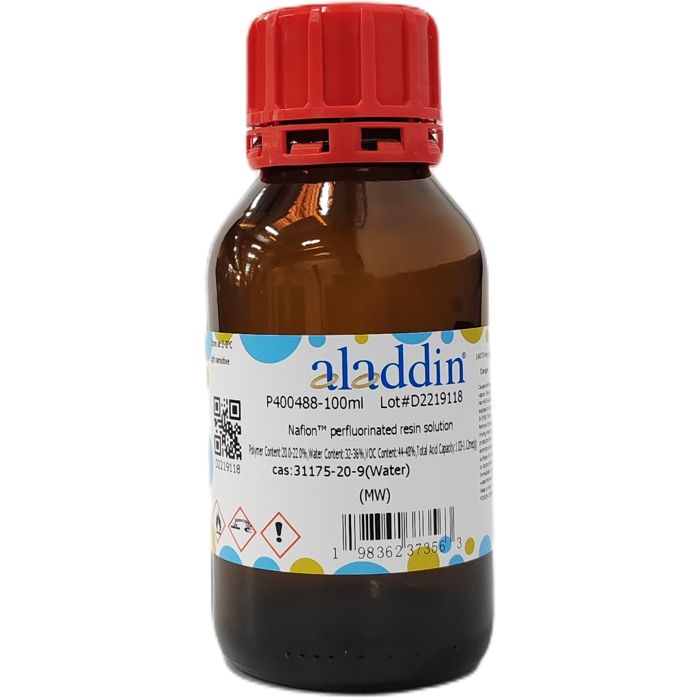
Polymer Content:20.0-22.0%,Water Content:32-36%,VOC Content:44-48%,Total Acid Capacity:1.03-1.12meq/g para fluxos de trabalho cromatográficos e analíticos sensíveis que exigem interferência mínima da linha de base.
🌡
Armazenamento e envio
Store at 2-8°C Envio Wet ice. Consulte o COA específico do lote para obter as especificações exatas.
📋
Documentos de qualidade
SDS, COA, ficha técnica e folha de especificações disponíveis para download. COA específico do lote acessível por meio de pesquisa por número de lote.
📚
Comprovação documental
Citado em 1222 publicações revisadas por pares nas áreas de cromatografia, síntese orgânica e reações de acoplamento cruzado.
Visão geral
Application
Nafion™ polymer dispersions contain the polymer in its chemically stabilized liquid form for easier processing. Typical uses include:
Fabrication of thin films and coating formulations for fuel cell membranes
Determine the necessary mass, volume, or concentration for preparing a solution.
Dilution Calculator
Determine the dilution needed to prepare a stock solution.
Reconstitution Calculator
Revisões
Avaliações dos Clientes
Application Protocols
No item-specific, tested bioassay protocols are provided for this materials reagent. For general use in electrochemical research, consult Reaction Conditions for literature-based guidance on:
Preparing catalyst inks and coating electrodes
Casting and conditioning PFSA films
Using Nafion over-layers for permselective sensor interfaces
For any specialized protocol, validate conditions with small-scale trials and refer to the CoA/SDS for constraints related to solids content and solvent composition.
Biological Roles
This product is a synthetic perfluorinated ionomer without inherent biological function.
No metabolic or enzymatic role: Nafion is not a biochemical metabolite and is not processed by biological pathways.
Biointerface uses (literature/context): Cast Nafion films are sometimes used in biosensors to create permselective barriers that exclude anionic interferents (e.g., ascorbate) while allowing cationic analytes to access electrode surfaces. This is a materials function rather than a biological role.
Biocompatibility: Perfluorinated polymers are generally chemically inert; however, biocompatibility depends on film morphology, residual solvents, and application context. This product is designated for research use only.
No clinical or therapeutic claims are made or implied for this item.
Buffer Applications
Not typically applicable. Nafion resin solution is not a buffering reagent and is not used to set or maintain pH in aqueous systems. For laboratory workflows involving this ionomer, refer instead to Solvent Selection, Reaction & Applications, and Storage & Reconstitution for practical guidance on ink preparation and film casting.
Green Alternatives
PFSA ionomers like Nafion deliver unmatched chemical stability and proton conductivity, but their perfluorinated nature raises environmental persistence and end-of-life concerns. Selection should weigh performance needs against sustainability objectives.
Strengths: Fluorine-free; potential for lower environmental footprint; tunable glass transition/mechanics; compatible with greener solvents (water/ethanol).
Trade-offs: Typically lower oxidative stability in PEMFC/PEWE; may show higher gas crossover or lower durability.
Bio-derived or recyclable ionomers (emerging):
Strengths: Designed for improved end-of-life and reduced toxicity; compatible with aqueous processing.
Trade-offs: Performance and durability still under development.
Process-level greener practices:
Prefer aqueous/alcoholic diluents with low toxicity; minimize use of aprotic polar solvents.
Optimize solids content to reduce drying energy and VOC emissions.
Implement solvent recovery and exhaust scrubbing for coating lines.
Extend component lifetime (membranes/electrodes) through optimized operating conditions to reduce material turnover.
Note: Where application tolerates, hydrocarbon ionomers can be effective green alternatives; for harsh oxidative environments, PFSA may remain necessary.
Pharmaceutical Uses
Not typically applicable as a pharmaceutical excipient. Nafion perfluorinated resin solution is a specialty materials reagent for electrochemical and membrane research.
Formulation context (materials science): Nafion films may be used in analytical devices and research sensors to impart ionic selectivity and chemical resistance.
Regulatory status: No pharmacopeial monograph is associated with Nafion PFSA dispersions. For any use intersecting regulated environments, consult institutional compliance and material suitability.
This product is for research use only.
Physical Properties
Item-specific specifications (this lot):
Concentration (solids), solvent composition, viscosity, and density: Not specified for this item; refer to CoA/Spec Sheet.
General/literature properties for Nafion-type PFSA (polymer or cast films; provided for context only):
Acid strength: pKa of sulfonic acid sites typically < 0 (often cited around −5 to −6; literature) indicating superacidic character compared to mineral acids.
Water uptake and ion-exchange capacity (IEC): Vary with equivalent weight (EW) and hydration; IEC commonly ~0.8–1.1 meq g−1 for mid-EW materials (literature).
Thermal behavior (dry polymer): High thermal stability; significant decomposition generally > 300–350 °C under inert conditions; degradation may release HF and perfluoroisobutylene at elevated temperatures (literature). Glass transition is not well-defined due to semi-crystalline PTFE-like segments.
Solubility/dispersion: As the free acid, Nafion forms stable dispersions/solutions in lower alcohol/water mixtures and certain polar aprotic solvents when processed appropriately (literature). Insoluble in nonpolar hydrocarbons and most chlorinated solvents.
Film properties: Cast films exhibit high proton conductivity when hydrated (10−2–10−1 S·cm−1 at ambient to moderate temperatures, literature), and low gas permeability relative to hydrocarbon ionomers.
LogP/partitioning: Not applicable to high-molecular-weight fluorinated ionomers.
Refractive index, BP/MP of the solution: Not applicable as a polymer dispersion; depends on solvent system (not specified for this item).
Note: Always consult the product CoA for the specific solids percentage, solvent ratios, and viscosity relevant to SKU P400488.
Quality and Grades
Grade/purity: Not specified for this item; refer to CoA/Spec Sheet. For PFSA dispersions, quality is commonly expressed via solids content, equivalent weight (EW), solvent composition, particle/chain size, and ionic form (acid vs. salt).
What “resin solution/dispersion” implies: A stabilized PFSA ionomer phase in a defined solvent blend (often lower alcohols and water, literature) formulated for film casting and as a binder for electrocatalyst inks. Low particulate content and controlled viscosity are important for reproducible coating.
Typical quality attributes (literature/context):
Equivalent weight (EW): Mass of dry polymer per mole of –SO3H groups; lower EW generally gives higher proton conductivity and water uptake, but may affect mechanical robustness.
Solids (wt%): Dictates viscosity and casting/ink formulation; laboratories often dilute to target rheology and ionomer-to-carbon ratios.
Ionic form: Acid (H+) vs. cation-exchanged forms (e.g., Na+, Li+); acid form is typical for proton conduction. Conversion between forms is possible via ion exchange.
Low metallic impurities and low non-volatile residues in the solvent phase are preferred for electrochemical performance; specific impurity limits are product-specific and should be taken from the CoA.
Stabilizers/additives: Not specified for this item; refer to CoA/Spec Sheet. Some commercial dispersions contain proprietary stabilizers to maintain colloidal stability; these can influence drying behavior and conductivity after film formation.
Documentation: For regulated or highly controlled experiments, request the lot-specific CoA/SDS for EW, solids, solvent composition, and ionic form of SKU P400488.
Reaction and Applications
Primary domain: electrochemical materials and membrane science. Nafion resin solutions enable fabrication of proton-conducting films and act as ionomeric binders that couple electronic and ionic pathways in porous electrodes.
Disperse catalyst (Pt/C, IrO2, RuO2, Ni-based) in alcohol/water, add PFSA resin solution to achieve target ionomer-to-carbon (I/C) or ionomer-to-oxide ratios; sonicate to homogenize. The ionomer provides proton conduction and mechanical cohesion.
Effects of ionomer loading: Too low reduces ionic connectivity; too high can occlude pores and hinder gas transport. Optimize empirically for each catalyst/morphology.
Film casting and membranes:
Cast onto glass or inert substrates; controlled drying and thermal annealing/humidity equilibration yield mechanically robust, proton-conducting films for impedance measurements, sensor interfaces, or as model membranes.
Electrode modification:
Thin Nafion over-layers are used to suppress fouling and to impart permselectivity on electrochemical sensors (e.g., screen-printed electrodes), exploiting cation-exchange and hydrophobic barrier properties.
Acid catalysis context (literature):
While solid Nafion-H is a recyclable Brønsted acid catalyst for esterifications, acetalizations, and Friedel–Crafts-type alkylations, the resin solution is primarily a processing form rather than a catalyst per se. Films prepared from the solution can serve as acidic media or supports.
Practical notes:
Degas inks to remove bubbles (vacuum or brief rest) prior to coating.
Control ambient RH/temperature during drying to tune microphase separation and enhance conductivity.
Avoid metal tools that can corrode in contact with acidic dispersions; use PTFE, PFA, or glass.
Reaction Conditions
The following are general, literature-based guidelines for using PFSA resin solutions to prepare films and catalyst inks. They are not product specifications.
Solvent system: Water with lower alcohol (e.g., isopropanol or ethanol). Alcohol:water ratios commonly 1:1 to 9:1 v/v depending on wetting and drying needs.
Ionomer loading: For Pt/C, ionomer-to-carbon (I/C) mass ratios often 0.3–1.0; for oxide catalysts (IrO2/RuO2), ionomer-to-catalyst ratios can be higher (e.g., 0.1–0.5) to ensure ionic pathways; optimize empirically.
Mixing: Probe or bath sonication (minutes-scale) with cooling to avoid overheating; gentle vortexing/roller-mixing to finish. Degas before coating.
Film casting:
Substrates: Glass, silicon, PTFE-lined trays. Filter solutions if needed to remove agglomerates.
Drying: Evaporate at ambient to 60–80 °C; control humidity to mitigate defects. Post-treatments may include hydration cycles or mild thermal annealing (e.g., 80–120 °C, short times) to promote ionic domain formation. Avoid high temperatures that risk decomposition of polymer or solvent.
Electrode coating and curing:
Coat uniformly, then dry in staged steps (e.g., room temperature pre-dry, then elevated temperature hold). Final conditioning in humidified environment can increase proton conductivity.
Storage during use:
Keep containers closed to limit solvent loss; monitor viscosity over time. If evaporation occurs, replenish with the same diluent system used initially to maintain consistency.
Always consult the CoA/SDS for SKU-specific solvent composition, solids content, and any manufacturer-recommended processing windows.
Safety and Handling
Authoritative safety information resides in the product SDS; the following are general considerations for PFSA resin solutions.
GHS classification, signal word, pictograms, H-statements: Not specified for this item; refer to the SDS.
General hazards: Acid-form Nafion dispersions are typically strongly acidic and can be irritating/corrosive to skin and eyes depending on concentration. Avoid inhalation of aerosols/mists and prolonged skin contact. Spills can be slippery.
Thermal decomposition: Heating to high temperatures can generate hazardous fluorinated decomposition products (e.g., HF, perfluoroisobutylene). Avoid processing above recommended temperatures and prevent contact with hot metal surfaces.
Incompatibilities: Strong bases (neutralize acid sites), reactive metals sensitive to acids (e.g., unprotected aluminum, magnesium in presence of moisture), and strong oxidizers for certain solvent systems. Avoid contact with strong nucleophiles that could attack sulfonyl groups under forcing conditions.
PPE: Wear chemical-resistant gloves (e.g., nitrile), lab coat, eye protection (splash goggles). Use in a well-ventilated area or fume hood, especially during sonication or spray-coating to minimize aerosol exposure.
First aid (overview; follow SDS):
Eyes: Rinse cautiously with water for several minutes; remove contact lenses if present and easy; continue rinsing and seek medical attention.
Skin: Wash with soap and water; remove contaminated clothing; seek advice if irritation persists.
Inhalation: Move to fresh air; seek medical attention if symptoms occur.
Ingestion: Rinse mouth; do not induce vomiting; seek medical attention.
Handling tips: Mix gently to re-disperse; avoid vigorous shaking that can entrain air. Prevent drying on hot surfaces to avoid fume generation. Collect waste as halogenated/fluorinated polymer-containing waste per institutional guidance.
Solvent Selection
This item is itself a PFSA resin solution/dispersion; solvent choice is primarily relevant to dilution, ink preparation, and film casting.
Polarity and miscibility (literature):
Compatible diluents: Water and lower aliphatic alcohols (e.g., ethanol, 1-propanol, isopropanol); mixed aqueous–alcohol systems tune evaporation and wetting on supports (carbon, metals, oxides).
Less suitable: Nonpolar hydrocarbons and most aprotic, low-polarity solvents (hexanes, toluene) do not solvate/disperse PFSA.
Conditional: Some polar aprotics (e.g., DMSO, DMF) can interact with sulfonic acid sites but may not be ideal for catalyst inks due to toxicity, residues, and drying behavior.
Practical selection guidelines:
Substrate wetting: Increase alcohol fraction to improve wetting on hydrophobic carbon supports; increase water for hydrophilic oxides.
Evaporation rate: Isopropanol > 1-propanol > ethanol > water (approximate; literature). Blends balance leveling vs. drying speed to prevent coffee-ring effects.
Proton transport post-drying: Final ionomer microstructure depends on solvent history; slower drying and controlled humidity can improve ionic domain connectivity.
Comparison (context):
Ethanol/water: Lower toxicity, fast drying, good general-purpose balance.
Isopropanol/water: Improved wetting on PTFE-treated carbons; slower evaporation aids film uniformity.
Pure water: Highest safety profile but may give poorer dispersion/wetting on hydrophobic substrates.
Do not add strong bases or amines when preparing inks intended for proton-conducting applications, as neutralization reduces conductivity. Always verify compatibility of any co-solvent or additive with the specific dispersion per the CoA/SDS.
Storage and Reconstitution
Storage conditions (item-specific): Store at 2–8 °C. Keep container tightly closed to minimize solvent loss and maintain dispersion stability.
Shipping (item-specific): Shipped on wet ice.
Freezing: Avoid freezing unless the product documentation explicitly allows it; freeze–thaw can destabilize dispersions and alter performance.
Homogenization before use: Upon receipt and before aliquoting, allow the container to equilibrate to room temperature (closed) to prevent condensation, then gently invert/roll to re-disperse. Avoid vigorous shaking that introduces bubbles. If settled phases are observed, longer gentle mixing or brief bath sonication can help re-homogenize.
Reconstitution/dilution: If dilution is required, add compatible diluent slowly with gentle mixing. Use the same solvent family indicated on the CoA (commonly water/alcohol mixtures for PFSA dispersions; confirm for this item). Filter through inert, solvent-compatible membranes (e.g., PTFE, 0.2–0.45 µm) if particulate control is required.
Container/material compatibility: Use fluoropolymer (PTFE/PFA/FEP), glass, or high-grade polypropylene. Avoid reactive metals in contact with acidic dispersions.
In-use stability: Minimize headspace and repeated opening to reduce evaporation and CO2 uptake. Prepare only the volume needed for immediate work; store remaining stock at 2–8 °C.
Waste: Collect residues and rinsates as fluoropolymer-containing waste per institutional and regulatory guidance.
For lot-specific shelf life, solids content, and solvent composition, refer to the CoA/Spec Sheet.
Structure and Identity
Nafion perfluorinated resin solution is a dispersion of a perfluorosulfonic acid (PFSA) ionomer, widely used as a proton-conducting binder and film-forming material.
CAS: 31175-20-9 (PFSA ionomer, general registry for Nafion dispersions)
PubChem CID: 61889 (polymer substance record)
Molecular formula: Not specified for this item; refer to CoA/Spec Sheet.
Molecular weight: Not specified for this item; refer to CoA/Spec Sheet. (Note: PFSA is a polymer; Mn/Mw/EW are distributional, not single values.)
SMILES: Not specified for this item; refer to CoA/Spec Sheet.
InChIKey: Not specified for this item; refer to CoA/Spec Sheet.
Structural features (general, literature):
Backbone: Fully fluorinated, –(CF2–CF2)– (PTFE-like) chains providing exceptional chemical and thermal stability.
Side chains: Perfluoroether pendants terminating in strongly acidic sulfonic acid groups (–SO3H) in the acid form (Nafion-H) or –SO3−M+ in ion-exchanged forms.
Repeat-unit depiction (conceptual): [–CF2–CF2–]m–[–CF2–CF(–O–CF2–CF(CF3)–O–CF2–CF2–SO3H)–]n (literature schematic; exact composition and m:n depend on grade/EW).
Physical form in this product: Resin solution/dispersion (exact solvent system and solids content not specified here).
2D description (verbal): A linear perfluorocarbon backbone bearing perfluoroether side chains that terminate in sulfonic acid groups, giving a comb-like architecture with highly electron-withdrawing, chemically inert fluorinated segments and strongly acidic ionic termini.
Synthetic Utility
While primarily a materials reagent, Nafion’s strongly acidic sulfonic groups and ion-exchange character offer utility in synthesis and separations when employed as films or supported phases prepared from the resin solution.
Solid acid catalysis (literature): Nafion-H in bead/film/powder form catalyzes esterifications, acetalizations, dehydration, and certain electrophilic aromatic substitutions. Advantages include heterogeneous handling, low leaching, and easy recovery. The resin solution can be used to cast acidic films or coat supports to create catalytic surfaces.
Ion-exchange and separations: Cast films or coated frits act as cation-exchange media, enabling proton-cation exchange or selective transport. In electro-organic synthesis, Nafion-coated electrodes can modulate interfacial ion composition and suppress anionic byproducts.
Protective coatings in electrochemistry: Thin Nafion layers on electrodes serve as permselective barriers, improving analyte discrimination (e.g., in amperometric sensing) and stabilizing catalytic nanoparticles.
Support for nanoparticle synthesis: The ionomer matrix can immobilize metal precursors via –SO3− sites, facilitating in situ reduction to yield supported metal nanoparticles with controlled dispersion (literature practice).
Caveats:
The resin solution itself is not a conventional solvent or reagent; it is a processing medium to deposit PFSA. Catalytic activity arises after forming the solid acid phase.
Strong bases/amine additives neutralize acid sites and diminish catalytic/ionic functionality; control ionic form during preparation.
Target Specificity
Not applicable. This product is a polymeric materials reagent (PFSA ionomer), not a biological targeting agent, antibody, or probe. No target, epitope, species reactivity, clone, or isotype information applies.
Perguntas frequentes
How should this product be stored?
Store at 2–8 °C. Refrigerated storage is required to maintain the specified shelf life.
How is this product shipped?
This product ships chilled on wet ice. Unpack on arrival and transfer it to the storage condition stated above.
What are the CAS number, molecular formula and molecular weight?
The CAS Number is 31175-20-9.
What documentation is provided?
Available product documentation, including Certificates of Analysis (COA), Safety Data Sheets (SDS), and specification sheets, is shown in the product document area. Document availability and access follow the current site policy.
Usamos cookies para garantir o funcionamento adequado do site e, quando permitido, para melhorar a sua experiência. Você pode gerenciar suas preferências a qualquer momento nas Configurações. Saiba mais em nossa Política de Cookies.
Deseja que lhe enviemos uma mensagem quando tivermos descontos disponíveis?
Lembrar-me mais tarde
Obrigado! Por favor, verifique a sua caixa de entrada de e-mail para confirmar.
Products are supplied to verified businesses, institutions, and qualified professionals for research and development use only. Not for use in humans, animals, diagnosis, or therapy.

 D2219099