GRADE & PURITYMoligand™?Moligand™ — Aladdin's line of ligands and bioactive small molecules. Use for receptor, pathway, and binding studies needing defined small-molecule tools.10 mM in DMSO
Moligand™, 10 mM in DMSO Moligand™ for sensitive chromatographic and analytical workflows requiring minimal baseline interference.
🌡
Storage & shipping
Store at -80°C Ships Dry ice packs + Cold packs Check lot-specific COA for exact specifications.
📋
Quality documents
SDS, COA, datasheet, and spec sheet available for download. Lot-specific COA accessible via lot number lookup.
📚
Literature proof
Cited in 0 peer-reviewed publications across chromatography, organic synthesis, and cross-coupling reactions.
Visão geral
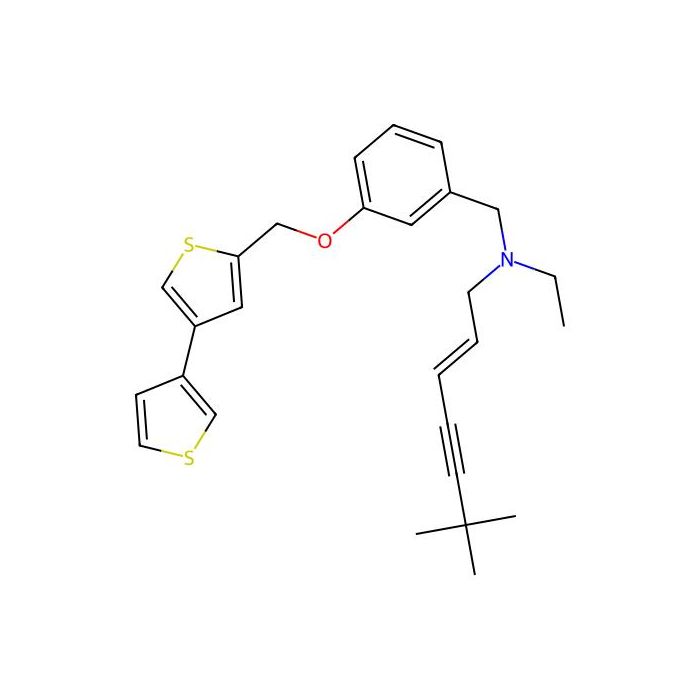
NB-598 is a potent and competitive inhibitor of squalene epoxidase (SE) , and suppresses triglyceride biosynthesis through the farnesol pathway. NB-598 is a click chemistry reagent, it contains an Alkyne group and can undergo copper-catalyzed azide-alkyne cycloaddition (CuAAc) with molecules containing Azide groups.
Specifications
Especificações e pureza
Moligand™, 10 mM in DMSO
Condições de armazenamento de armazenamento
Store at -80°C
Enviado em
Dry ice packs + Cold packs
Este produto requer transporte de cadeia fria. Serviços terrestres e outros serviços econômicos não estão disponíveis.
Determine the necessary mass, volume, or concentration for preparing a solution.
Dilution Calculator
Determine the dilution needed to prepare a stock solution.
Reconstitution Calculator
Revisões
Avaliações dos Clientes
Application Protocols
No vendor-validated protocols are provided for this item. The following are general literature practices for using hydrophobic enzyme inhibitors like NB-598 in cell or biochemical assays. Adjust to your system and consult the item’s SDS and CoA.
Example workflow (cell-based sterol modulation):
Stock solution: Prepare 10–50 mM NB-598 in anhydrous DMSO. Aliquot and store at −80°C.
Working dilution: Prepare intermediate DMSO dilutions (e.g., 1 mM), then dilute into pre-warmed culture medium to achieve final concentrations across a dose–response (e.g., 0.5 nM to 5 µM) while keeping DMSO constant (≤0.1–0.5%).
Treatment: Incubate cells 4–24 h for lipidomic endpoints, or shorter periods (15–120 min) for acute signaling/target engagement assays.
Readouts: Quantify squalene and downstream sterols by LC-MS/GC-MS; assess SREBP target gene expression by qPCR; or apply CETSA/thermal shift for target engagement.
Controls: Vehicle control, an orthogonal SQLE inhibitor as positive control, and cytotoxicity assessment (e.g., resazurin, CellTiter-Glo) to ensure observed effects are not due to loss of viability.
Biochemical assay sketch (SQLE activity):
Reconstitute recombinant SQLE with FAD and necessary cofactors; incubate with squalene substrate in the presence of compound dilutions; measure 2,3-oxidosqualene formation by LC-MS. Include time-course and enzyme titration to confirm linear range.
These examples are illustrative and not validated for this specific lot or item.
Biological Roles
NB-598 is widely cited in the literature as a potent, selective inhibitor of squalene epoxidase (SQLE), an essential FAD-dependent monooxygenase that converts squalene to 2,3-oxidosqualene in the cholesterol/sterol biosynthetic pathway.
Pathway context (literature):
SQLE operates downstream of HMG-CoA reductase in the mevalonate pathway. Inhibition leads to squalene accumulation and depletion of downstream sterols, enabling interrogation of lipid homeostasis, membrane biology, and compensatory regulatory circuits (e.g., SREBP processing and transcriptional responses).
In mammalian systems, SQLE activity influences cholesterol levels and flux into oxysterols and non-sterol isoprenoids; in fungi, the analogous ergosterol pathway is affected.
Research uses (literature):
Chemical biology: acute and reversible suppression of SQLE activity to study temporal regulation of sterol metabolism.
Lipidomics: quantitative measurement of squalene and 2,3-oxidosqualene by LC-MS/GC-MS following compound treatment provides a direct functional readout of SQLE blockade.
Cell physiology: perturbation of membrane sterol composition can reveal impacts on endocytosis, signaling microdomains, and protein trafficking.
Selectivity considerations (literature):
NB-598 has been reported to display high potency for human SQLE with minimal off-target activity in certain profiling panels; however, selectivity should be verified for the specific experimental system and assay conditions.
Note: All statements above summarize general literature knowledge and do not constitute item-specific performance claims. This product is for research use only.
Buffer Applications
NB-598 is not a buffer component and does not form part of classical buffering systems. It is a bioactive small molecule used to modulate enzymatic activity in the sterol biosynthetic pathway.
Practical guidance:
Prepare NB-598 in anhydrous DMSO to make concentrated stocks; then dilute into your assay buffer or culture medium to the desired final concentration while keeping vehicle content consistent across all conditions.
Common assay buffers (HEPES, PBS, Tris) are compatible with low DMSO percentages, but verify protein stability and target activity in the presence of vehicle.
For buffer formulation details (pH ranges, recipes), refer to our dedicated buffer products. Use this section’s advice only to integrate the compound into existing buffered systems for biochemical or cellular assays.
Green Alternatives
Because NB-598 is a target-directed bioactive used at low concentrations, the primary green chemistry leverage is in solvent and workflow choices rather than substitution of the molecule itself.
Greener handling strategies:
Prefer DMSO over DMF/NMP when compatible with your assay, due to toxicological and regulatory profiles. Keep final DMSO ≤0.1–0.5% v/v where possible.
Use aqueous media with solubilization aids (e.g., cyclodextrins) to reduce organic solvent content in working solutions.
Minimize waste by preparing small, single-use aliquots at high concentration to reduce discard volumes from degraded/contaminated stocks.
Employ microscale assay formats (384–1536 well plates) to reduce per-experiment solvent and compound consumption.
Comparison (general considerations):
DMSO vs DMF/NMP: DMSO has a better EHS profile and broader biocompatibility; DMF/NMP can improve solubility in challenging cases but carry greater worker exposure concerns.
Co-solvent systems (EtOH or acetonitrile + buffer) can be used at very low percentages to aid dilution, but confirm compatibility with biological readouts and avoid exceeding cytotoxic thresholds.
Trade-offs:
Some solubilizers (surfactants, cyclodextrins) may alter target engagement or membrane partitioning; benchmark assay performance and interpret data accordingly.
Documentation:
Record vehicle composition meticulously to enable green-chemistry tracking and facilitate replication with reduced-solvent protocols.
Pharmaceutical Uses
This product is supplied strictly for research use only. It is not intended for human or veterinary use, diagnostic procedures, or as an active pharmaceutical ingredient.
Research/manufacturing context (non-clinical):
Reference standard: NB-598 is commonly used in discovery settings as a reference SQLE inhibitor for assay calibration, benchmarking, and method validation (e.g., LC-MS quantitation of pathway intermediates) in preclinical research.
Tool compound in formulation studies: may serve as a model hydrophobic small molecule for evaluating enabling excipients (cyclodextrins, lipid vehicles) and for establishing handling practices for lipophilic inhibitors.
QC/assay controls: can be incorporated into plate controls to define dynamic range and assay sensitivity for SQLE-related readouts in screening campaigns.
Regulatory and quality considerations:
No pharmacopeial monograph is indicated for this item. Any application beyond exploratory research would require independent qualification of identity, purity, residual solvents, and stability consistent with your institutional and regulatory requirements.
Note: No therapeutic, prophylactic, or clinical claims are made or implied for this product.
Physical Properties
Item-specific physicochemical data have not been provided in this listing.
Appearance: Not specified for this item; refer to CoA/Spec Sheet.
Molecular Weight (spec): Not specified for this item; refer to CoA/Spec Sheet.
Molecular Formula (spec): Not specified for this item; refer to CoA/Spec Sheet.
Melting point: Not specified for this item; refer to CoA/Spec Sheet.
Boiling point: Not specified for this item; refer to CoA/Spec Sheet.
Density: Not specified for this item; refer to CoA/Spec Sheet.
Refractive index: Not applicable for a solid; if provided, refer to CoA/Spec Sheet.
Solubility: Not specified for this item; refer to CoA/Spec Sheet.
LogP/logD: Not specified for this item; refer to CoA/Spec Sheet.
pKa: Not specified for this item; refer to CoA/Spec Sheet.
General/literature guidance (context only; not specifications):
NB-598 is commonly handled as a hydrophobic bioactive tool compound. Stock solutions are often prepared in anhydrous DMSO, with working dilutions made into aqueous assay media containing a small percentage of DMSO (e.g., ≤0.1–0.5% v/v), or with solubilizing aids (serum proteins, cyclodextrins, or co-solvents) where appropriate.
For any quantitative property (melting point, solubility limits, pKa), consult primary literature or authoritative databases associated with PubChem CID 6443223, and verify against the item’s CoA for lot-specific values.
Practical note:
Because NB-598 is typically used at low micromolar to nanomolar levels in cellular assays, accurate preparation of concentrated DMSO stocks (e.g., 10–50 mM) with subsequent serial dilutions improves dosing precision while minimizing vehicle content.
Quality and Grades
Grade/Purity for this item: Moligand™.
What Moligand™ typically signifies (general description):
A research screening/library grade emphasizing high identity confidence and suitability for biochemical or cell-based assays. Lots are commonly supported by analytical identity verification (e.g., NMR, MS, or HPLC), but the exact test suite and purity thresholds can vary.
Item-specific quality details:
Exact purity percentage, residual solvent content, water content, inorganic residue/metal limits, or stabilizers: Not specified for this item; refer to CoA/Spec Sheet.
Implications for experimental use:
Moligand™ grade compounds are generally appropriate for target validation, hit finding, and mechanistic biology. For use in sensitive biophysical quantitation (ITC, SPR) or in vivo exploratory work, confirm that the provided grade and purity meet your internal acceptance criteria.
If chromatographic purity is crucial (e.g., for SAR or precise potency benchmarking), request the lot-specific HPLC/UPLC trace. If UV transparency is important, verify UV cutoff/absorbance with the supplier.
Recommended acceptance checks on receipt:
Inspect packaging integrity and verify storage temperature upon delivery (this product ships on dry ice + cold packs and is stored at −80°C).
Review the CoA for identity/purity, then record the lot number and prepare a reference aliquot. Optional: run a quick LC-MS to confirm identity in your lab matrix before committing to screening campaigns.
Reaction and Applications
This product is supplied as a research bioactive tool compound for target/pathway studies, not as a general-purpose synthetic reagent. Consequently, conventional synthetic reaction applications (e.g., as a catalyst, ligand, reagent, or solvent) are not typically applicable.
Relevant applications (research context):
Target/pathway modulation: NB-598 is widely used in the literature as a potent inhibitor of squalene epoxidase (SQLE), enabling temporal control of cholesterol/sterol biosynthesis in cells and model systems.
Phenotypic studies: induction of squalene accumulation with downstream effects on lipid homeostasis, membrane composition, and compensatory gene expression can be profiled by lipidomics and transcriptomics.
Mechanistic biology: used to dissect FAD-dependent monooxygenase function and to separate upstream/downstream steps of the mevalonate pathway.
Assay modalities:
Biochemical enzyme assays (purified SQLE activity readouts), cellular target engagement (e.g., thermal shift, CETSA), and functional cellular assays (sterol content by GC-MS/LC-MS, filipin staining for unesterified sterols) are typical.
Practical tips:
Prepare and store concentrated DMSO stocks, filter if needed (0.22 µm PTFE), and avoid repeated freeze–thaw cycles to maintain consistency across experiments.
Include appropriate vehicle and positive/negative controls (e.g., alternative SQLE modulators) to validate assay windows.
For users seeking reagents for organic synthesis, refer to our catalog sections for catalysts, ligands, and building blocks better suited to that purpose.
Reaction Conditions
Conventional synthetic reaction conditions are not typically applicable because NB-598 is supplied as a finished bioactive small molecule rather than as a reagent. Instead, this section outlines practical handling conditions for biological experiments.
General handling/assay conditions (literature guidance):
Stock preparation: dissolve in anhydrous DMSO to 10–50 mM; sonication or gentle warming may assist dissolution. Filter (0.22 µm PTFE) if particulate is present.
Working concentrations: commonly explored in the low nanomolar to low micromolar range depending on the assay format, cell type, and desired extent of SQLE inhibition. Always include a vehicle-matched control.
Incubation: pre-incubation times from 15 min to several hours are typical for cellular assays evaluating lipid pathway endpoints; longer exposures may be used for steady-state lipidomic changes.
Media/buffer: maintain final DMSO at levels compatible with your system (often ≤0.1–0.5% v/v). Add compound last to minimize precipitation.
Stability considerations:
Protect concentrated stocks from moisture and repeated freeze–thaw; aliquot and store at the recommended −80°C. Thaw on ice and return unused aliquots promptly.
Note: These are general literature practices for hydrophobic bioactive inhibitors and are not product-specific performance guarantees. Optimize conditions empirically for your system.
Safety and Handling
Hazard communication for this catalog entry is not specified. Always consult the product’s SDS for authoritative, up-to-date safety information.
Provided hazard fields:
Signal Word: Not specified for this item; refer to SDS.
H-Statements: Not specified for this item; refer to SDS.
GHS Classification: Not specified for this item; refer to SDS.
GHS Pictograms: Not specified for this item; refer to SDS.
General laboratory safety guidance for research small molecules (context, not a substitute for SDS):
Personal protective equipment: wear lab coat, safety glasses, and appropriate chemically resistant gloves. Handle powders in a fume hood to minimize dust/aerosol formation.
Avoid inhalation, ingestion, skin/eye contact. Wash thoroughly after handling. Do not pipette by mouth.
Storage incompatibilities: keep away from strong oxidizers and strong acids/bases unless compatibility is known. Avoid prolonged exposure to heat and moisture.
Thermal decomposition/combustion can generate irritating/toxic fumes; use appropriate extinguishing media for surrounding fire and follow institutional emergency procedures.
First aid (overview): in case of skin contact, wash with soap and water; for eye exposure, rinse cautiously with water for several minutes; if inhaled, move to fresh air; if swallowed, rinse mouth—seek medical attention in all cases as per SDS.
Special considerations:
Bioactive tool compounds may have unknown toxicological profiles. Use the minimum quantities required, implement closed-handling or containment when possible, and label secondary containers clearly.
Dispose of waste according to local regulations; segregate halogenated/non-halogenated solvent waste if applicable.
Solvent Selection
NB-598 is typically handled as a hydrophobic bioactive small molecule intended for biochemical and cell-based assays.
Practical solvent choices (general guidance):
DMSO: common primary solvent for concentrated stocks due to strong solvating power and assay compatibility at ≤0.1–0.5% v/v in final wells.
DMF or NMP: alternative high-boiling polar aprotics when DMSO is contraindicated; verify cell-line compatibility.
Aqueous media: direct dissolution is often limited; use serial dilution from a DMSO master stock into buffer/medium containing protein or solubilizers (e.g., 0.1–1% polysorbate, cyclodextrins) as appropriate.
Volatile organics (MeOH, EtOH, acetonitrile): may aid co-solubilization in analytical workflows; assess biological compatibility before use in live-cell assays.
Expected to be sparingly soluble in water and freely soluble in strong polar aprotic solvents. Dielectric constants and partitioning parameters should be taken from primary references for quantitative modeling.
When to choose each solvent:
Screening assays: DMSO stocks (e.g., 10–50 mM) with controlled vehicle content across all wells.
Enzymology/biophysics: consider buffer systems with minimal surfactant and use low DMSO to avoid target perturbation; pre-clear solutions by centrifugation/filtration to prevent colloidal aggregation artifacts.
Note: Do not exceed solubility limits—visually inspect for precipitation after dilution, especially at low DMSO percentages and low temperatures.
Storage and Reconstitution
Storage conditions (item-specific):
Store at −80°C.
Shipped on dry ice packs + cold packs to maintain ultra-low temperature during transit.
Reconstitution and handling (general guidance for hydrophobic bioactives):
Solvent: Use anhydrous DMSO to prepare concentrated stock solutions. If alternative solvents are necessary (e.g., DMF, NMP), confirm compatibility with your assay and safety policies.
Aliquoting: Immediately divide freshly prepared stock into small, single-use aliquots in inert, tight-sealing vials or plates to avoid repeated freeze–thaw cycles.
Thawing: Thaw aliquots on ice or at room temperature just before use. Mix thoroughly; if particulates persist, briefly sonicate or warm gently and, if needed, pass through a 0.22 µm PTFE filter.
Light/moisture: Unless otherwise specified on the CoA, protect from moisture and unnecessary light exposure as general best practice for organic small molecules.
Stability notes:
Long-term stability, exact shelf life, and solution stability are Not specified for this item; refer to CoA/Spec Sheet. Verify stability in your matrix by analytical QC (e.g., LC-MS) when experiments extend over days to weeks.
Disposal:
Dispose of solutions and vials in accordance with institutional guidelines for organic solvent and pharmaceutical-like chemical waste.
Research use: For research use only.
Structure and Identity
NB-598 is a well-known research small molecule included in discovery/screening libraries.
Item-specific identifiers provided for this catalog entry:
Molecular Formula: Not specified for this item; refer to CoA/Spec Sheet.
Molecular Weight: Not specified for this item; refer to CoA/Spec Sheet.
SMILES: Not specified for this item; refer to CoA/Spec Sheet.
InChIKey: Not specified for this item; refer to CoA/Spec Sheet.
General/literature description (for context; not item specifications):
NB-598 is reported in the literature as a potent, selective inhibitor of squalene epoxidase (SQLE), a key FAD-dependent enzyme in the cholesterol/ergosterol biosynthetic pathway. It is typically a lipophilic, aromatic small molecule designed to engage the SQLE active site and block the conversion of squalene to 2,3-oxidosqualene.
Structural features discussed in the literature often include multiple aryl substituents and polar/basic functionality enabling target engagement; consult primary references or PubChem CID 6443223 for a definitive structural diagram.
A multi-ring aromatic scaffold bearing electron-withdrawing substituent(s) and a basic/ionizable moiety is commonly depicted; the framework is planar in aromatic regions with substituents extending orthogonally. Exact atom connectivity and stereochemistry should be confirmed from authoritative databases for experimental planning.
Synthetic Utility
NB-598 is not generally used as a reagent, catalyst, or synthetic building block. It is a target-focused small molecule supplied for biological studies.
If synthetic use is contemplated (uncommon):
Derivatization for probe development: researchers may modify known SQLE inhibitors to append tags (e.g., photoaffinity, fluorophores, biotin) via medicinal chemistry strategies. Such work requires knowledge of the precise structure and SAR from the primary literature and is not specific to this catalog item.
Analytical standards: can serve as a reference in chromatographic method development/validation (retention time, response factors) for lipidomics workflows, albeit the compound itself is not a lipid.
For routine organic synthesis, choose reagents and building blocks specifically designed for reactivity (acylation agents, coupling reagents, ligands, catalysts) from our broader catalog.
Summary:
Synthetic utility for NB-598 is limited and secondary to its role as a biochemical tool compound. Researchers aiming to generate analogs or probes should consult the literature for the definitive structure, functional group compatibility, and feasible handles for modification, and source appropriate starting materials accordingly.
Target Specificity
Primary biological target (literature):
Enzyme: Squalene epoxidase (SQLE; EC 1.14.14.17), a FAD-dependent monooxygenase catalyzing the conversion of squalene to 2,3-oxidosqualene in sterol biosynthesis.
Mechanism and selectivity (literature):
Mode of action: NB-598 is described as a potent and selective inhibitor of SQLE, leading to rapid accumulation of squalene and depletion of downstream sterols in treated systems. In vitro potencies in the low-nanomolar range have been reported in multiple assay formats, though numerical values vary with enzyme source and conditions.
Selectivity: Reported to favor SQLE over other lipid-metabolism enzymes, but comprehensive off-target profiling should be consulted for your context. Species differences may affect potency (e.g., human vs. rodent or fungal homologs).
Functional markers of on-target engagement:
Increased cellular squalene levels; reduced 2,3-oxidosqualene and cholesterol/ergosterol downstream (quantified by LC-MS/GC-MS).
Transcriptional feedback via SREBP pathway activation can occur following sterol depletion.
Important notes:
The above reflects general literature and does not constitute an item-specific performance claim. Verify target engagement in your system with appropriate biochemical or genetic controls (e.g., SQLE knockdown/knockout, orthogonal inhibitors).
Perguntas frequentes
What is Moligand??
Moligand? is one of Aladdin Scientific's premium product lines, formulated for high-purity applications across multiple workflows. Compared to standard grades in the same workflow, Moligand? products typically offer tighter specifications, more rigorous QC, and stronger lot-to-lot consistency.
How should this product be stored?
Store at ?80 °C. Ultra-low temperature storage is required to maintain the specified shelf life.
How is this product shipped?
This product ships frozen with dry ice and cold packs. Unpack on arrival and transfer it to the storage condition stated above; handle dry ice with insulated gloves in a ventilated area.
What are the CAS number, molecular formula and molecular weight?
The CAS Number is 131060-14-5, the molecular formula is C27H31NOS2, and the molecular weight is 449.67 g/mol.
What documentation is provided?
Available product documentation, including Certificates of Analysis (COA), Safety Data Sheets (SDS), and specification sheets, is shown in the product document area. Document availability and access follow the current site policy.
Need help choosing the grade?
Our grade selection guide covers purity, stabilizer status, and application suitability for all variants in our catalog.
Usamos cookies para garantir o funcionamento adequado do site e, quando permitido, para melhorar a sua experiência. Você pode gerenciar suas preferências a qualquer momento nas Configurações. Saiba mais em nossa Política de Cookies.
Deseja que lhe enviemos uma mensagem quando tivermos descontos disponíveis?
Lembrar-me mais tarde
Obrigado! Por favor, verifique a sua caixa de entrada de e-mail para confirmar.
Products are supplied to verified businesses, institutions, and qualified professionals for research and development use only. Not for use in humans, animals, diagnosis, or therapy.