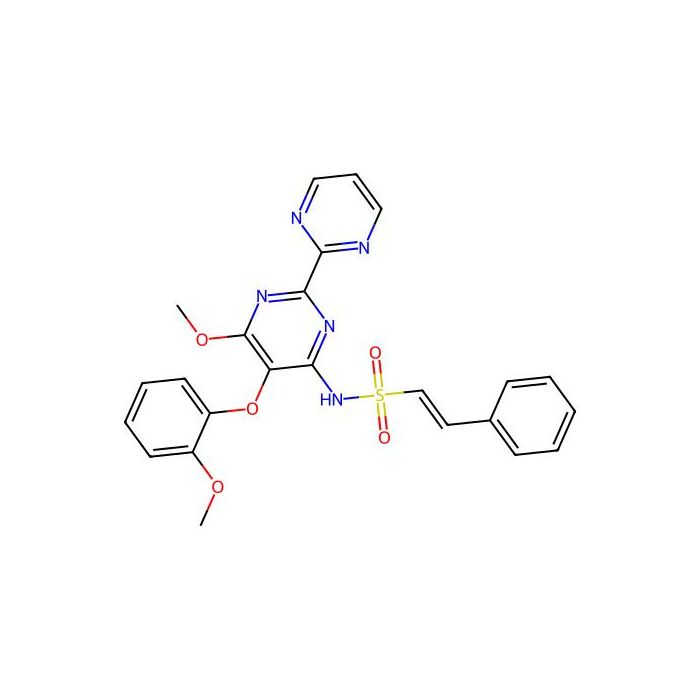
Nebentan (YM598 free base) is a potent, selective and orally active non-peptide endothelin ET A receptor antagonist through the modification of Bosentan . Nebentan inhibits [ 125 I] endothelin-1 binding to cloned human endothelin ETA and ETB receptor, with K i of 0.697 nM and 569 nM, respectively YM598 can ameliorate the progression of cor pulmonale and myocardial infarction in vivo .
In Vitro
Nebentan inhibits the specific binding of [ 125 I] endothelin-1 to endothelin ET A and ET B receptors in a concentration dependent manner, K i values are 0.697 nM and 1.53 nM for human and rat endothelin ETA receptors, respectively. In contrast, YM598 exhibits low affinities for human and rat endothelin ET B receptors, with K i values of 569 nM and 155 nM,respectively. In measurement of intracellular Ca 2+ concentration, Nebentan concentration-dependently inhibits the increase in [Ca 2+ ]i induced by 10 nM endothelin-1 in both CHO cells and A10 cells, the IC 50 values are 26.2 nM for CHO cells and 26.7 nM for A10 cells, respectively. MCE has not independently confirmed the accuracy of these methods. They are for reference only.
In Vivo
Nebentan (oral administration; 0.1-1 mg/kg; 4 weeks) significantly inhibits the progression of pulmonary hypertension and the development of right ventricular hypertrophy. Nebentan (oral administration; 1 mg/kg; 30 weeks) significantly ameliorates the poor survival rate of CHF rats, it markedly reduces the hypertrophy of both ventricles as well as pulmonary congestion. MCE has not independently confirmed the accuracy of these methods. They are for reference only.
Form:Solid
IC50& Target:ET A 0.697 nM (Ki) ET B 569 nM (Ki)
Especificações
Mecanismos bioquímicos e fisiológicos
Nebentan (YM598 free base) is a potent, selective and orally active non-peptide endothelin ET A receptor antagonist through the modification of Bosentan ( HY-A0013 ). Nebentan inhibits [ 125 I] endothelin-1 binding to cloned human endothelin ETA and ETB r
Condições de armazenamento de armazenamento
Store at -20°C
Enviado em
Ice chest + Ice pads
Este produto requer transporte de cadeia fria. Serviços terrestres e outros serviços econômicos não estão disponíveis.
This compound belongs to the class of organic compounds known as bipyrimidines and oligopyrimidines. These are organic compounds containing two or more pyrimidine rings directly linked to each other. Pyrimidine is a 6-membered ring consisting of four carbon atoms and two nitrogen centers at the 1- and 3- ring positions.
External Descriptors
Not available
1. Djoumbou Feunang Y, Eisner R, Knox C, Chepelev L, Hastings J, Owen G, Fahy E, Steinbeck C, Subramanian S, Bolton E, Greiner R, and Wishart DS. ClassyFire: Automated Chemical Classification With A Comprehensive, Computable Taxonomy. Journal of Cheminformatics, 2016, 8:61.
Determine the necessary mass, volume, or concentration for preparing a solution.
Dilution Calculator
Determine the dilution needed to prepare a stock solution.
Reconstitution Calculator
Revisões
Avaliações dos Clientes
Application Protocols
Item-specific tested applications and conditions: Not specified for this item; refer to CoA/Spec Sheet.
Applicability note:
No validated application protocols (e.g., concentrations, assay formats) are provided in the product data. Users should develop assay-specific protocols based on internal SOPs and pilot studies.
General recommendation:
Establish a standard workflow for new library compounds: verify identity/purity (QC), determine solubility window, prepare DMSO stocks (see Storage & Reconstitution), and perform small-scale assay pilot runs with appropriate controls and counterscreens.
Biological Roles
Item-specific biological/target information: Not specified for this item; refer to CoA/Spec Sheet or primary literature associated with CAS 403604-85-3.
General context for small-molecule library members:
Role in discovery: Such compounds are commonly used as probes or candidates in high-throughput screening (HTS), fragment-based discovery (if low MW), or target validation workflows. Their biological roles, if any, are established empirically after screening and orthogonal confirmation.
Assay considerations:
Ensure compound identity and purity to reduce false positives/negatives.
Monitor for pan-assay interference (PAINS) behaviors, aggregation, redox activity, fluorescence, or metal chelation that can confound readouts.
Confirm apparent activity via counterscreens (e.g., detergent supplementation to rule out aggregation, redox quenchers for ROS-mediated artifacts, fluorescence interference scans).
ADME and physicochemical profiling (general):
If structure becomes available, calculate cLogP, pKa, and polar surface area to anticipate permeability and solubility. Perform microsomal stability and plasma protein binding as needed for downstream studies.
Mechanistic follow-up:
Apply dose–response analyses, time-dependence studies, and dilution-to-recovery tests to distinguish covalent, tight-binding, or reversible mechanisms.
No therapeutic or clinical claims are made here. This product is supplied strictly for research use only.
Buffer Applications
Item-specific buffer guidance: Not specified for this item; refer to CoA/Spec Sheet.
Applicability note:
Nebentan is listed as a small-molecule library compound rather than a buffering agent. It is not intended to function as a pH buffer.
General practical guidance (if aqueous work is required):
Solubility testing: Evaluate solubility in common biological buffers (e.g., PBS pH 7.4, HEPES pH 7.4, Tris pH 7.5–8.0) at target assay concentrations. Use DMSO cosolvent (final ≤1% v/v) to aid dissolution when compatible with the assay.
pH effects: If the compound has ionizable groups (unknown here), apparent solubility may vary with pH. Adjust pH cautiously to avoid decomposition; confirm integrity by LC–MS post-adjustment.
Filtration: If particulate persists, 0.2 µm filtration or high-speed centrifugation can clarify solutions prior to use.
For true buffer preparation (HEPES, Tris, phosphate, etc.), please see our dedicated buffering reagents.
Green Alternatives
Item-specific solvent/processing guidance: Not specified for this item; refer to CoA/Spec Sheet.
General green chemistry considerations for handling small-molecule library compounds:
Prefer low-toxicity, biodegradable, and renewable solvents when compatible with solubility and assay constraints.
Suggested hierarchy for dissolution/trituration (when feasible):
Preferred: Water, ethanol, 2-propanol, acetone, ethyl acetate, 2-methyltetrahydrofuran (2-MeTHF) (literature: commonly considered greener than THF), cyclopentyl methyl ether (CPME).
Use with caution: Acetonitrile, methanol (toxic but effective, easily removable), DMSO (high boiling, low volatility; acceptable for assays at low v/v but consider waste burden).
Avoid/minimize: DMF, NMP, DCM, chloroform (hazard and regulatory concerns).
Comparison (general, literature-based):
2-MeTHF vs THF: 2-MeTHF often derived from renewable sources, higher boiling point, reduced peroxide concerns relative to THF; can improve phase separations but has odor and may retain water.
CPME vs MTBE: CPME exhibits lower peroxide formation tendency and broader stability; MTBE is more volatile and smoggier.
Ethanol vs MeOH: Ethanol is less toxic and often acceptable in biochemical systems at low v/v.
Operational tips:
For assay stocks, DMSO remains practical; reduce environmental impact by aliquoting to minimize waste and consolidating compatible waste streams.
Always balance green preferences with data integrity and compound stability.
Pharmaceutical Uses
Item-specific pharmaceutical/formulation status: Not specified for this item; refer to CoA/Spec Sheet.
Applicability note:
This product is sold for research use only. It is not an API, excipient, or GMP-grade material and is not intended for human or veterinary use.
General considerations for formulation research (non-clinical):
If used in pre-formulation studies, establish solubility and stability in pharmaceutically relevant media (simulated gastric/intestinal fluids, biorelevant surfactants) strictly for in vitro assessments.
Evaluate adsorption to plastics and glass; choose low-bind consumables to maintain concentration fidelity.
Avoid extrapolating in vitro findings to clinical contexts. Do not formulate for administration.
Regulatory note:
No pharmacopeial monograph or compendial status is indicated. For any regulated work, source GMP-appropriate materials and follow applicable quality systems.
Physical Properties
Item-specific properties (from Product Data):
Appearance: Not specified for this item; refer to CoA/Spec Sheet.
Molecular Weight: Not specified for this item; refer to CoA/Spec Sheet.
Literature/computed properties (caution):
Without a confirmed structure (SMILES/formula), literature or computed values (e.g., melting point, boiling point, logP, pKa, density, refractive index, UV–Vis features) cannot be reported responsibly for this specific item. Please refer to the lot-specific CoA or perform in-house measurements.
General guidance for unknown/unspecified small molecules (literature-level best practices):
Solubility profiling: Perform tiered tests at small scale (0.5–2 mg) in DMSO, MeOH, EtOH, ACN, DMF, PBS (pH 7.4), and water. Use sonication and gentle warming (≤40 °C) as needed. Record qualitative outcomes (clear, turbid, precipitated) and determine maximum workable stock concentrations.
Hygroscopicity and polymorphism: If TGA or Karl Fischer indicates mass loss or water content variability, store under inert atmosphere with desiccant. Check for polymorph transitions via DSC/XRPD when handling solids intended for biophysical assays.
Stability screening: Conduct forced-degradation microtests in representative solvents (aqueous buffer, DMSO, MeOH) at room temperature, light exposure, and mild base/acid to anticipate storage and assay behavior. Monitor by LC–MS for degradants.
Note: Treat any unverified property as method- and lot-dependent; document all observations in your ELN and reference the specific lot CoA.
Quality and Grades
Item-specific quality information (from Product Data):
Grade/Purity: Not specified for this item; refer to CoA/Spec Sheet.
Interpretation and best practices (general):
When grade/purity is unspecified for a screening library compound, verify suitability for your application by reviewing the CoA for: assay purity (HPLC/UPLC, % area), identity confirmation (NMR, HRMS), residual solvents, water content, and counter-ion/stoichiometry (if salt form).
Typical research grades:
Screening compound grade: Emphasis on identity and organic purity; may not include low-UV or metal specifications typical of chromatographic or semiconductor grades.
Analytical reagent (AR) or >95% purity: Appropriate for most biochemical assays; verify peak homogeneity and impurity profile if SAR or mechanistic work is planned.
Stabilizers: Not specified for this item; refer to CoA/Spec Sheet. If a stabilizer is present, consider its UV absorbance and assay interference potential.
Documentation:
Request batch CoA and, if needed, raw chromatograms/spectra.
If you require higher stringency (e.g., for crystallography or biophysics), perform supplementary QC (qNMR for absolute assay, LC–MS purity orthogonal to HPLC UV, DSC/TGA for thermal behavior).
Acceptance criteria:
Establish fit-for-purpose thresholds (e.g., ≥95% purity by HPLC, single major LC–MS ion, water <1% w/w) appropriate to your workflow; adjust based on assay sensitivity to impurities.
Conclusion: Use the CoA/Spec Sheet to define material suitability; document lot numbers in all reports.
Reaction and Applications
Chemistry reaction applications specific to Nebentan cannot be detailed without structural information.
Item-specific data: Not specified for this item; refer to CoA/Spec Sheet for any guidance on chemical reactivity or stability.
Relevance routing:
This product is categorized as a small molecule/compound library member intended for research screening and discovery workflows rather than as a synthetic reagent or building block. As such, detailed coverage of named reactions or transformation conditions is not typically applicable.
If synthetic use is intended (general considerations):
Verify functional groups by NMR/IR/HRMS before planning any transformations.
Conduct micro-scale reactivity tests to assess sensitivity toward acid/base, oxidation/reduction, and thermal conditions.
Establish anhydrous handling needs (e.g., glovebox/Schlenk) only after confirming moisture sensitivity.
For most users, the more relevant sections are Solvent Selection and Storage & Reconstitution, which address solution preparation and handling in assay contexts.
Reaction Conditions
Item-specific reaction condition guidance: Not specified for this item; refer to CoA/Spec Sheet.
Applicability note:
Without a known structure or functional group profile, providing representative reaction conditions (solvents, temperatures, catalysts, times, yields) would be speculative and is not appropriate.
General guidance (if absolutely necessary to explore reactivity):
Start with benign conditions and orthogonal reaction types on micro-scale (≤5 mg):
Neutral conditions: catalytic hydrogenation (if unsaturation suspected), mild oxidations (TEMPO/bleach for alcohols), or ester hydrolysis at buffered pH.
Acid/base probes: very mild acid (AcOH) or base (NaHCO3) to assess stability before moving to strong reagents.
Analytical follow-up: Track reactions by LC–MS to avoid losing mass balance to unobserved decomposition. Maintain detailed ELN records, including exact stoichiometries and workup notes.
For most users of this library compound, the Solvent Selection and Storage & Reconstitution sections are likely more relevant.
Safety and Handling
Item-specific hazard data (from Product Data):
GHS Classification: Not specified for this item; refer to SDS.
Signal Word: Not specified for this item; refer to SDS.
Hazard Statements (H-codes): Not specified for this item; refer to SDS.
Pictograms: Not specified for this item; refer to SDS.
General laboratory safety guidance (for small-molecule research compounds):
PPE: Wear lab coat, safety glasses, and appropriate chemically resistant gloves (e.g., nitrile). Use additional splash/respiratory protection if handling powders or aerosols.
Engineering controls: Handle powders/solutions in a certified chemical fume hood. Avoid inhalation of dust or vapors and minimize skin contact.
Incompatibilities: Until structure is confirmed, avoid strong oxidizers, strong acids/bases, and reactive metals. Segregate from foodstuffs and pharmaceuticals.
Spill/Exposure response: For small spills, absorb with inert material (vermiculite) and dispose as hazardous waste. On skin contact, wash with soap and water. On eye contact, rinse cautiously with water for several minutes and seek medical attention. If inhaled, move to fresh air and monitor. Always defer to the SDS for authoritative first-aid instructions.
Handling practices: Use micro-spatulas and anti-static precautions to limit aerosolization. For solutions, cap tightly and label with solvent, concentration, date, and operator.
Waste: Collect in halogenated or non-halogenated organic waste streams as appropriate to the solvent system used. Do not discharge to drains.
Transport within facility: Secondary containment and closed containers; protect from temperature excursions and light if stability is unknown.
Always consult the product SDS for definitive hazard classification and emergency measures.
Solvent Selection
Item-specific solvent/solubility data: Not specified for this item; refer to CoA/Spec Sheet.
General guidance for small-molecule library compounds:
Primary solvent for stocks: DMSO is the default for diverse organic compounds due to broad solvency and assay compatibility at ≤1% v/v final concentration.
Solubility screening workflow:
Start with DMSO at 10–50 mg/mL; if insoluble, try DMF or NMP (handle with enhanced PPE), or mixed co-solvents (DMSO:water, DMSO:buffer, DMSO:EtOH).
For more polar molecules, test MeOH, EtOH, ACN, and aqueous buffers (pH 6–8). Adjust pH only if the compound’s acid/base character is known to avoid degradation.
Use sonication and mild warming (≤40 °C) as needed; avoid prolonged heating/light exposure if stability is unknown.
Precipitation control in assays:
Filter 0.2 µm or centrifuge clarified stocks/dilutions to remove particulates.
Keep final DMSO ≤0.5–1% v/v in biochemical assays; validate tolerance for cells/enzymes as needed.
Avoid problem solvents when possible:
Minimize use of chlorinated solvents (DCM, CHCl3) and high-toxicity dipolar aprotics (DMF, NMP) in biological contexts; if used for initial dissolution, back-dilute into DMSO or EtOH and evaporate thoroughly.
Record-keeping:
Document solvent lot, concentration, and observed behavior (clarity, color, precipitation over time). Re-evaluate solubility after freeze–thaw cycles.
Select solvent systems based on your assay tolerance, volatility needs, and downstream processing constraints.
Storage and Reconstitution
Item-specific storage and shipping (from Product Data):
Storage Conditions: Store at −20 °C.
Shipped In: Ice chest + ice pads.
General reconstitution guidance for small-molecule library compounds:
Initial inspection and QC:
Upon receipt, allow the sealed container to equilibrate to room temperature before opening to minimize moisture condensation. Record lot, appearance, and mass. If available, confirm identity/purity (e.g., LC–MS, HPLC, qNMR) before extensive use.
Stock solution preparation:
Primary solvent: DMSO is recommended for broad compatibility. Typical stock concentrations: 10–50 mM (or 10–50 mg/mL if MW is unknown—convert to molarity once MW is confirmed).
Dissolution aids: Gentle sonication and mild warming (≤40 °C). Avoid prolonged heating or strong light if stability is unknown.
Clarification: If undissolved particulates remain, centrifuge or 0.2 µm filter in a compatible material (PTFE/PP). Avoid PVDF/nylon if adsorption is suspected.
Aliquoting and storage:
Dispense single-use aliquots (e.g., 50–200 µL) in amber vials/tubes to minimize freeze–thaw. Store aliquots at −20 °C (as specified). For long-term storage, consider −80 °C if stability permits (verify).
Protect from moisture and air; purge headspace with dry nitrogen/argon if sensitive. Use desiccant in secondary containment for solids.
Thawing and use:
Thaw on ice or at room temperature; mix gently. Avoid repeated freeze–thaw cycles—discard residual aliquots after use.
Aqueous working solutions:
Prepare fresh just before use. Keep DMSO ≤0.5–1% v/v in biochemical assays unless otherwise validated. Monitor for precipitation upon dilution and use within the experiment day.
Note: For any lot-specific stabilizers, salt forms, or concentration limits, refer to the CoA/Spec Sheet.
Structure and Identity
Brief overview: Nebentan is listed as a research small molecule in a compound library. Structural identifiers are largely not provided in the current product data; consult the CoA/Spec Sheet or SDS for definitive identity parameters.
Item-specific (from Product Data):
Product Name: Nebentan (SKU: N646223)
CAS: 403604-85-3
PubChem CID: 9957262
InChIKey: 205040 (as provided)
SMILES: Not specified for this item; refer to CoA/Spec Sheet.
Molecular Formula: Not specified for this item; refer to CoA/Spec Sheet.
Molecular Weight: Not specified for this item; refer to CoA/Spec Sheet.
Structural features (general note):
Functional groups, ring systems, stereochemistry: Not specified for this item; refer to CoA/Spec Sheet.
2D structure (descriptive):
A text description of the 2D structure cannot be provided without a structure diagram or SMILES. Please refer to the product CoA or PubChem record for Nebentan (CID 9957262) for confirmed structural details.
Cross-identification guidance (general):
When working with library compounds, verify lot-specific identity via at least one orthogonal method (e.g., HRMS for exact mass; 1H/13C NMR for connectivity; HPLC/UPLC for purity/retention time). Document the CAS–CID–InChIKey mapping in your ELN to avoid mix-ups in screening collections.
Synthetic Utility
Item-specific synthetic role: Not specified for this item; refer to CoA/Spec Sheet.
Applicability note:
As listed, Nebentan is a small-molecule library compound for screening, not a general-purpose synthetic building block. Without structural information (functional groups, handles), concrete retrosynthetic or forward-synthetic applications cannot be responsibly provided.
General best practices if transformation is contemplated:
Verify structure and purity via 1H/13C NMR, HRMS, and HPLC prior to any reaction planning.
Conduct micro-scale tests to probe sensitivity to acid/base, oxidants/reductants, light, and heat.
If salt form vs free base/acid status is unknown, determine it (qNMR, titration) before stoichiometric reactions.
For scale-up or derivatization, assess reaction compatibility with any potentially labile motifs (e.g., aryl halides, nitro, aldehydes, esters, sulfonamides), once identified.
In most research settings for this item, the primary value lies in biological screening rather than chemical transformation.
Target Specificity
Item-specific target information: Not specified for this item; refer to CoA/Spec Sheet and primary literature for CAS 403604-85-3.
Applicability note:
Target specificity data (e.g., enzyme, receptor, or pathway focus) is not provided. As a compound library entry, Nebentan may be screened across diverse targets to empirically determine activity. No claims of specificity are made.
Perguntas frequentes
How should this product be stored?
Store at ?20 °C. Freezer storage is required to maintain the specified shelf life.
How is this product shipped?
This product ships in an insulated container with ice pads. Unpack on arrival and transfer it to the storage condition stated above.
What are the CAS number, molecular formula and molecular weight?
The CAS Number is 403604-85-3, the molecular formula is C24H21N5O5S, and the molecular weight is 491.52 g/mol. InChIKey LONWRQOYFPYMQD-DTQAZKPQSA-N.
What documentation is provided?
Available product documentation, including Certificates of Analysis (COA), Safety Data Sheets (SDS), and specification sheets, is shown in the product document area. Document availability and access follow the current site policy.
Usamos cookies para garantir o funcionamento adequado do site e, quando permitido, para melhorar a sua experiência. Você pode gerenciar suas preferências a qualquer momento nas Configurações. Saiba mais em nossa Política de Cookies.
Deseja que lhe enviemos uma mensagem quando tivermos descontos disponíveis?
Lembrar-me mais tarde
Obrigado! Por favor, verifique a sua caixa de entrada de e-mail para confirmar.
Products are supplied to verified businesses, institutions, and qualified professionals for research and development use only. Not for use in humans, animals, diagnosis, or therapy.