Determine the necessary mass, volume, or concentration for preparing a solution.
40% Solution in H2O for sensitive chromatographic and analytical workflows requiring minimal baseline interference.
Store at 2-8°C Ships Wet ice Check lot-specific COA for exact specifications.
SDS, COA, datasheet, and spec sheet available for download. Lot-specific COA accessible via lot number lookup.
Cited in 0 peer-reviewed publications across chromatography, organic synthesis, and cross-coupling reactions.
Comprehensive hazard, handling, storage, and regulatory compliance document.
Download SDS →Lot-specific quality data. Enter your lot number to retrieve the exact COA.
Look up COA →Full quality attributes and acceptance criteria for this grade.
View spec sheet →Taxonomy Tree
| Kingdom | Inorganic compounds |
|---|---|
| Superclass | Homogeneous non-metal compounds |
| Classe | Non-metal oxoanionic compounds |
| Subclass | Non-metal nitrates |
| Intermediate Tree Nodes | Not available |
| Direct Parent | Non-metal nitrates |
| Alternative Parents | Inorganic salts Inorganic oxides |
| Molecular Framework | Not available |
| Substituents | Non-metal nitrate - Inorganic oxide - Inorganic salt |
| Descrição | This compound belongs to the class of inorganic compounds known as non-metal nitrates. These are inorganic non-metallic compoundscontaining a nitrate as its largest oxoanion. |
| External Descriptors | Not available |
| Ponto de ebulição (°C) | 120.5 °C |
|---|---|
| Peso molecular | 64.006 g/mol |
| XLogP3 | 0.200 |
| Hydrogen Bond Donor Count | 1 |
| Hydrogen Bond Acceptor Count | 3 |
| Rotatable Bond Count | 0 |
| Exact Mass | 63.9927 Da |
| Monoisotopic Mass | 63.9927 Da |
| Topological Polar Surface Area | 66.100 Ų |
| Heavy Atom Count | 4 |
| Formal Charge | 0 |
| Complexity | 24.800 |
| Isotope Atom Count | 1 |
| Defined Atom Stereocenter Count | 0 |
| Undefined Atom Stereocenter Count | 0 |
| Defined Bond Stereocenter Count | 0 |
| Undefined Bond Stereocenter Count | 0 |
| The total count of all stereochemical bonds | 0 |
| Covalently-Bonded Unit Count | 1 |
No vendor-validated biological assay protocols (e.g., WB, IHC, IF, FC) apply to this chemical reagent. For chemistry and analytical workflows, consider the following general, non-item-specific practices:
Note: Exact operating procedures, concentrations, and safety steps must be adapted from your lab’s SOPs and the product’s SDS/CoA. This reagent is for research use only.
This product is for research use only. The following discusses general biochemical context of nitrate/nitric species and the role of 15N labeling.
Notes:
Nitric acid is not commonly used to prepare classical biological buffers due to its strong oxidizing character and potential to interfere with biomolecules.
Applicable, limited uses (general):
Not typically applicable:
Practical guidance:
Perspective: Nitric acid is effective but presents significant EHS burdens (corrosive, oxidizer, NOx generation). For some tasks, greener choices can reduce risk; for 15N labeling, options are more limited.
Potential alternatives (literature; suitability depends on application):
Comparison snapshot (general):
Conclusion: When isotopic tracing of nitrogen is required, 15N nitric acid or 15N nitrate sources remain the most direct approach; mitigate impact via micro-scale, closed systems, temperature control, and efficient scrubbing of NOx.
No therapeutic claims are made. Isotope-labeled nitric acid is not a typical pharmaceutical excipient. The following notes concern general manufacturing/analytical contexts:
Limitations:
Item-specific values below are only available on the CoA. For aqueous nitric-(15-N) acid solutions, properties depend strongly on concentration.
Literature reference values (neat nitric acid, for context only; solution-dependent in practice):
Practical notes (general):
How to interpret grades for 15N nitric acid solutions (general guidance):
Verification checklist on receipt (best practice):
Applications specific to 15N labeling (general, literature):
Synthesis/analytical (general nitric acid uses; literature):
Practical tips:
Guidance below reflects literature practices for nitric acid; adapt to your substrate and scale. Concentration and 15N enrichment must be taken from the CoA.
Electrophilic aromatic nitration (mixed acid):
• Typical media: HNO3/H2SO4 (varying ratios); temperatures 0–80 °C depending on substrate activation.
• Practical: Pre-cool acids; add substrate slowly; maintain rigorous temperature control. Workup involves quench onto ice and neutralization; expect formation of nitrate salts and possible oxidation byproducts.
• Isotopic note: Using 15N-HNO3 provides uniform 15N incorporation into the nitro group.
Nitrate ester formation:
• Conditions: Alcohol + HNO3 with catalytic H2SO4 or via mixed anhydrides (e.g., N2O5). Low temperatures (−20 to 0 °C) often used to control exotherm and side reactions.
• Caution: Energetic products; assess thermal stability.
Oxidations (substrate dependent):
• Secondary alcohols/aldehydes to acids under controlled conditions; temperatures from ambient to reflux, often diluted to moderate oxidizing strength.
• Metal/inorganic oxidations occur rapidly; NOx evolution likely.
Sample digestion for ICP:
• Aqueous HNO3 (often 2–10 mL) with or without H2O2; microwave programs 140–200 °C depending on matrix.
• Use high-purity acids and closed vessels to minimize contamination and loss of volatiles.
Analytical use (IRMS):
• Prepare standards with gravimetric dilutions using 18 MΩ·cm water; minimize headspace to limit 14N contamination and NOx off-gassing.
Always consult primary literature/SDS and perform small-scale trials before scale-up.
Safety overview (general nitric acid behavior; defer to product SDS for item-specific classification):
This product is a strong aqueous acid/oxidizer rather than a general-purpose organic solvent. As such, “solvent selection” is not typically applicable. However, choosing the correct acidic medium is important for analytics and synthesis.
General properties (literature):
When to choose nitric acid medium:
Brief comparison (literature):
Note: Select concentration and compatible materials (PTFE, PFA, glass for many uses) per your method.
Brief description: Nitric-(15-N) acid solution is an aqueous solution of isotopically labeled nitric acid in which the nitrogen is 15N. This provides a convenient 15N source for tracer studies, isotopic labeling, and MS/NMR workflows.
Structural features (general, literature):
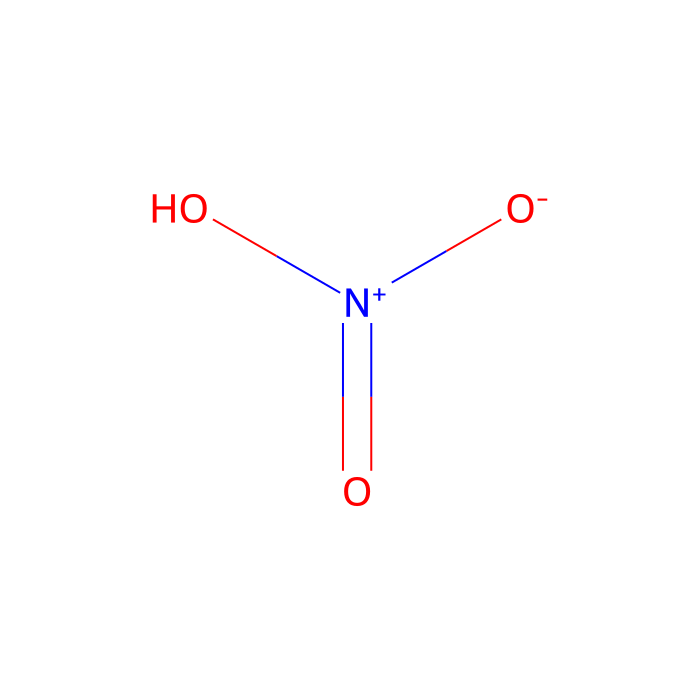
2D structure in words (literature): central 15N atom double-bonded to one O and single-bonded to two O atoms, one of which is protonated in HNO3; in water it largely dissociates to 15NO3– and H3O+.
General reactivity profile (literature):
15N-specific synthetic value:
Retrosynthetic considerations:
Practical notes:
Not applicable. This product is a chemical reagent (isotope-labeled nitric acid solution), not a biological targeting reagent (e.g., antibody/ligand). No antigen/epitope, species reactivity, clone, or isotype information applies.