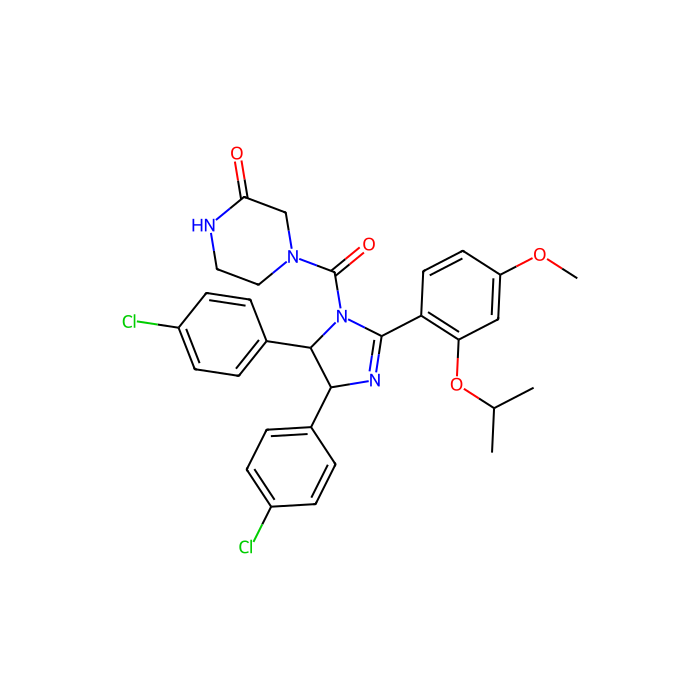
Nutlin-3b - ≥98% , CAS No.675576-97-3

CAS: 675576-97-3 Cat. No.: N127780 Fórmula: C30H30Cl2N4O4 Peso molecular: 581.49
Disponível para encomenda
GRAU & PUREZA ≥98%
Synonyms
(+/-)-4-[4,5-Bis(4-chlorophenyl)-2-(2-isopropoxy-4-methoxy-phenyl)-4,5-dihydro-imidazole-1-carbonyl]-piperazin-2-one | CHEBI:46742 | rel-4-{[(4R,5S)-4,5-bis(4-chlorophenyl)-2-{2-[(propan-2-yl)oxy]-4-methoxyphenyl}-4,5-dihydro-1H-imidazol-1-yl]carbonyl}pip
Storage
Armazenar a -20°C
Shipped In
Arca de gelo + almofadas de gelo
★
Tamanho
USA
Alemanha (EU)*
Preço
Qtd
1mg
N127780-1mg
2 Em stock
—

30,90US$

46,90US$
Gravar 16,00 US$ (34.12%)
5mg
N127780-5mg
2 Em stock
—

113,90US$

170,90US$
Gravar 57,00 US$ (33.35%)
10mg
N127780-10mg
2 Em stock
—

204,90US$

307,90US$
Gravar 103,00 US$ (33.45%)
25mg
N127780-25mg
2 Em stock
—

446,90US$

670,90US$
Gravar 224,00 US$ (33.39%)
50mg
N127780-50mg
2 Em stock
—

803,90US$

1205,90US$
Gravar 402,00 US$ (33.34%)
100mg
N127780-100mg
2 Em stock
—

1365,90US$

2048,90US$
Gravar 683,00 US$ (33.33%)
Enter a quantity for the sizes you want to add.
🧪
Por que este grau

≥98% para fluxos de trabalho cromatográficos e analíticos sensíveis que exigem interferência mínima da linha de base.

🌡

Armazenamento e envio

Armazenar a -20°C Envio Arca de gelo + almofadas de gelo. Consulte o COA específico do lote para obter as especificações exatas.

📋

Documentos de qualidade

SDS, COA, ficha técnica e folha de especificações disponíveis para download. COA específico do lote acessível por meio de pesquisa por número de lote.

📚

Comprovação documental

Citado em 0 publicações revisadas por pares nas áreas de cromatografia, síntese orgânica e reações de acoplamento cruzado.

Visão geral

Nutlin-3b é um antagonista ou inibidor de p53/MDM2 com um valor IC50 de 13,6 μM, 150 vezes menos potente que o (+)-enantiómero de Nutlin-3 em comparação com o (-)-enantiómero oposto Nutlin-3a.

Especificações

Sinónimos
(+/-)-4-[4,5-Bis(4-chlorophenyl)-2-(2-isopropoxy-4-methoxy-phenyl)-4,5-dihydro-imidazole-1-carbonyl]-piperazin-2-one | CHEBI:46742 | rel-4-{[(4R,5S)-4,5-bis(4-chlorophenyl)-2-{2-[(propan-2-yl)oxy]-4-methoxyphenyl}-4,5-dihydro-1H-imidazol-1-yl]carbonyl}pip
Especificações e pureza
≥98%
Mecanismos bioquímicos e fisiológicos
Nutlin-3b é um (+)-enantiómero 150 vezes menos potente de Nutlin-3 como antagonista ou inibidor de p53 MDM2, em comparação com o (-)-enantiómero oposto mais potente Nutlin-3a. É útil como controlo negativo para actividades celulares não relacionadas com o
Condições de armazenamento de armazenamento
Armazenar a -20°C
Enviado em
Arca de gelo + almofadas de gelo
Pureza
≥98%
Nomes e identificadores
Pubchem Sid
Pubchem Sid Url
https://pubchem.ncbi.nlm.nih.gov/substance/488199429
Sorrisos canónicos
CC(C)OC1=C(C=CC(=C1)OC)C2=NC(C(N2C(=O)N3CCNC(=O)C3)C4=CC=C(C=C4)Cl)C5=CC=C(C=C5)Cl
IUPAC Name
4-[(4R,5S)-4,5-bis(4-chlorophenyl)-2-(4-methoxy-2-propan-2-yloxyphenyl)-4,5-dihydroimidazole-1-carbonyl]piperazin-2-one
InChIKey
BDUHCSBCVGXTJM-IZLXSDGUSA-N
INCHI
1S/C30H30Cl2N4O4/c1-18(2)40-25-16-23(39-3)12-13-24(25)29-34-27(19-4-8-21(31)9-5-19)28(20-6-10-22(32)11-7-20)36(29)30(38)35-15-14-33-26(37)17-35/h4-13,16,18,27-28H,14-15,17H2,1-3H3,(H,33,37)/t27-,28+/m1/s1
SMILES isoméricas
CC(C)OC1=C(C=CC(=C1)OC)C2=N[C@@H]([C@@H](N2C(=O)N3CCNC(=O)C3)C4=CC=C(C=C4)Cl)C5=CC=C(C=C5)Cl
Peso molecular
581.49
Reaxy-Rn
11322582
Reaxys-RN_link_address
https://www.reaxys.com/reaxys/secured/hopinto.do?context=S&query=IDE.XRN=11322582&ln=

Documentação

📋 Ficha de dados de segurança (FDS)

Documento abrangente sobre perigos, manuseamento, armazenamento e conformidade regulamentar.

<<<<<<< HEAD Baixar SDS → ======= Baixar SDS → >>>>>>> release248-p3

✅ Certificado de análise (COA)

Dados de qualidade específicos do lote. Introduza o número de lote para obter o COA exato.

Consultar COA →

📊 Ficha técnica

Resumo de referência rápida das especificações e aplicações do produto.

Ver ficha técnica →

🔬 Folha de especificações

Atributos de qualidade completos e critérios de aceitação para este grau.

Ver folha de especificações →

Dados avançados

Taxonomic Classification

Taxonomy Tree

KingdomOrganic compounds
SuperclassPhenylpropanoids and polyketides
ClasseStilbenes
SubclassNot available
Intermediate Tree Nodes Not available
Direct ParentStilbenes
Alternative Parents Alpha amino acids and derivatives  Piperazine carboxamides  Phenoxy compounds  Anisoles  Methoxybenzenes  Alkyl aryl ethers  Chlorobenzenes  Aryl chlorides  Imidazolines  Ureas  Secondary carboxylic acid amides  Lactams  Propargyl-type 1,3-dipolar organic compounds  Carboximidamides  Carboxamidines  Azacyclic compounds  Carbonyl compounds  Hydrocarbon derivatives  Organic oxides  Organochlorides  Organopnictogen compounds  
Molecular FrameworkAromatic heteromonocyclic compounds
Substituents Stilbene - Alpha-amino acid or derivatives - Piperazine-1-carboxamide - Phenoxy compound - Anisole - Phenol ether - Methoxybenzene - Alkyl aryl ether - Halobenzene - Chlorobenzene - Aryl chloride - Aryl halide - Piperazine - Monocyclic benzene moiety - Benzenoid - 1,4-diazinane - 2-imidazoline - Secondary carboxylic acid amide - Carbonic acid derivative - Urea - Carboxamide group - Lactam - Amidine - Azacycle - Carboxylic acid amidine - Organoheterocyclic compound - Carboxylic acid derivative - Organic 1,3-dipolar compound - Propargyl-type 1,3-dipolar organic compound - Ether - Carboximidamide - Organopnictogen compound - Organic nitrogen compound - Organic oxide - Hydrocarbon derivative - Organic oxygen compound - Carbonyl group - Organooxygen compound - Organonitrogen compound - Organochloride - Organohalogen compound - Aromatic heteromonocyclic compound
DescriçãoThis compound belongs to the class of organic compounds known as stilbenes. These are organic compounds containing a 1,2-diphenylethylene moiety. Stilbenes (C6-C2-C6 ) are derived from the common phenylpropene (C6-C3) skeleton building block. The introduction of one or more hydroxyl groups to a phenyl ring lead to stilbenoids.
External Descriptors piperazinone - Nutlin
Estrutura 3D
Modelo de Estrutura Química Interativa


Alvos associados (humanos)
MDM2 Tchem E3 ubiquitin-protein ligase Mdm2 (3 Activities)
Activity TypeActivity Value -log(M)Mechanism of ActionActivity ReferencePublications (PubMed IDs)
TP53 Tchem Cellular tumor antigen p53 (48468 Activities)
Activity TypeRelationActivity valueUnitsAction TypeJournalPubMed IddoiAssay Aladdin ID
MDM2 Tchem p53-binding protein Mdm-2 (4545 Activities)
Activity TypeRelationActivity valueUnitsAction TypeJournalPubMed IddoiAssay Aladdin ID
MCF7 (126967 Activities)
Activity TypeRelationActivity valueUnitsAction TypeJournalPubMed IddoiAssay Aladdin ID
SAOS-2 (672 Activities)
Activity TypeRelationActivity valueUnitsAction TypeJournalPubMed IddoiAssay Aladdin ID
SH-SY5Y (11521 Activities)
Activity TypeRelationActivity valueUnitsAction TypeJournalPubMed IddoiAssay Aladdin ID
T-24 (2342 Activities)
Activity TypeRelationActivity valueUnitsAction TypeJournalPubMed IddoiAssay Aladdin ID
U2OS (164939 Activities)
Activity TypeRelationActivity valueUnitsAction TypeJournalPubMed IddoiAssay Aladdin ID
U-87 MG (3946 Activities)
Activity TypeRelationActivity valueUnitsAction TypeJournalPubMed IddoiAssay Aladdin ID
A549 (127892 Activities)
Activity TypeRelationActivity valueUnitsAction TypeJournalPubMed IddoiAssay Aladdin ID
HCT-116 (91556 Activities)
Activity TypeRelationActivity valueUnitsAction TypeJournalPubMed IddoiAssay Aladdin ID
MDM4 Tchem Protein Mdm4 (729 Activities)
Activity TypeRelationActivity valueUnitsAction TypeJournalPubMed IddoiAssay Aladdin ID
Mecanismos de ação
Certificados(CoA,COO,BSE/TSE e Mapa de Análise)
C of A & Other Certificates(BSE/TSE, COO):
Analytical Chart:

Find and download the COA for your product by matching the lot number on the packaging.

12 results found

Lot NumberCertificate TypeDataItem
A2331843A2331843Certificate of AnalysisAug 03, 2026 N127780
A2331846A2331846Certificate of AnalysisAug 03, 2026 N127780
A2331852A2331852Certificate of AnalysisAug 03, 2026 N127780
A2331853A2331853Certificate of AnalysisAug 03, 2026 N127780
A2331854A2331854Certificate of AnalysisAug 03, 2026 N127780
A2331859A2331859Certificate of AnalysisAug 03, 2026 N127780
A2331861A2331861Certificate of AnalysisAug 03, 2026 N127780
A2331862A2331862Certificate of AnalysisAug 03, 2026 N127780
A2331867A2331867Certificate of AnalysisAug 03, 2026 N127780
A2331868A2331868Certificate of AnalysisAug 03, 2026 N127780
A2331873A2331873Certificate of AnalysisAug 03, 2026 N127780
A2331872A2331872Certificate of AnalysisOct 25, 2022 N127780
Propriedades químicas e físicas
SolubilidadeDMSO 100 mg/mL Water <1 mg/mL Ethanol 100 mg/mL
Peso molecular581.500 g/mol
XLogP35.200
Hydrogen Bond Donor Count1
Hydrogen Bond Acceptor Count5
Rotatable Bond Count6
Exact Mass580.164 Da
Monoisotopic Mass580.164 Da
Topological Polar Surface Area83.500 Ų
Heavy Atom Count40
Formal Charge0
Complexity919.000
Isotope Atom Count0
Defined Atom Stereocenter Count2
Undefined Atom Stereocenter Count0
Defined Bond Stereocenter Count0
Undefined Bond Stereocenter Count0
The total count of all stereochemical bonds0
Covalently-Bonded Unit Count1
Calculadoras de soluções
Revisões

Avaliações dos Clientes

Application Protocols

Not specified for this item; refer to CoA/Spec Sheet.

General guidance for small-molecule tool compounds (literature-based; adapt to your platform):

  • Prepare a sterile 10–50 mM DMSO stock; store in small aliquots at −20 °C.
  • For biochemical binding assays (e.g., FP, TR‑FRET, SPR), include matched vehicle and enantiomeric controls; titrate across a log concentration range.
  • For cell-free enzymatic readouts, maintain final DMSO ≤0.5–1% v/v to minimize solvent effects.
  • Document exact lot, stock concentration, and dilution scheme in your ELN for reproducibility.

Any quantitative recommendations (e.g., IC50 ranges, exposure times) must be established empirically for your system.

Biological Roles

Item-specific biological characterization is not provided in this listing. The following summarizes literature/general knowledge about the Nutlin-3 chemotype for context (no medical or clinical claims; for research use only):

  • The Nutlin-3 scaffold was developed as a high-affinity ligand for the protein–protein interaction interface of MDM2 and p53. The two enantiomers, Nutlin-3a and Nutlin-3b, differ in their three-dimensional presentation of pharmacophores relative to the target surface.
  • Nutlin-3b is the enantiomeric counterpart typically used as a negative or low-affinity control in biochemical assays designed to study p53–MDM2 binding. Its inclusion helps distinguish on-target effects of the active enantiomer from nonspecific or off-pathway readouts.
  • In cellular and cell-free systems, researchers frequently dose Nutlin-3a and Nutlin-3b side-by-side at matched nominal concentrations, using vehicle controls to normalize for cosolvent effects.
  • Because stereochemistry is central to the interaction profile, verification of enantiomeric purity is crucial when attributing observed biological effects to specific target engagement.

Any specific potency values, binding constants, or assay performance metrics are not specified for this item and should be obtained from primary literature or determined empirically under your assay conditions.

Buffer Applications

Nutlin-3b is not a buffering agent. However, practical guidance for incorporating it into buffer-based assays is provided below (general, literature-based):

  • Stock preparation: Dissolve in anhydrous DMSO to prepare a concentrated stock (e.g., 10–50 mM). Store frozen in small aliquots.
  • Dilution into assay buffers: Add the DMSO stock to the target buffer (e.g., HEPES, PBS, Tris) with vigorous mixing to reach the desired final concentration while keeping DMSO at ≤0.5–1% v/v to minimize effects on proteins or cells in vitro.
  • Solubility aids: For particularly low target concentrations or sensitive systems, consider pre-wetting the vessel with a small volume of buffer plus DMSO before addition, or employ cyclodextrins/surfactants if compatible with your assay.
  • Filtration: If sterile or particulate-free solutions are required, filter the final working solution through a 0.22 µm PTFE or PES membrane. Avoid cellulose ester filters with high DMSO content.

Formal buffer recipes, pKa values, and buffering ranges do not apply to this compound.

Green Alternatives

As a solid tool compound, Nutlin-3b itself is not replaced by a “greener reagent,” but greener choices can be made for solvents and handling during preparation and use.

Greener solvent choices for stock preparation (general guidance):

  • Prefer DMSO over DMF or NMP for dissolving small-molecule probes due to lower toxicity and better biodegradability profile relative to amide solvents.
  • Where feasible, use bio-based ethanol for intermediate dilutions or cleaning.
  • Minimize solvent volumes by preparing concentrated stocks and aliquoting to reduce waste.

Comparison of common solvents (general, qualitative):

  • DMSO: Good environmental and safety profile among polar aprotics; excellent solvency for Nutlin chemotypes; miscible with water.
  • Ethanol: Renewable sourcing possible; lower solvency than DMSO; volatile and flammable.
  • DMF/NMP: Strong solvency but higher toxicity concerns; avoid when DMSO suffices.

Operational green practices:

  • Use micro-aliquots to avoid repeated freeze–thaw and disposal of partially degraded solutions.
  • Implement closed, low-headspace vials to reduce solvent losses and emissions.
  • Segregate organic waste streams to facilitate compliant disposal.

Note: These are general sustainability suggestions for handling small-molecule research compounds and do not alter any item-specific storage or shipping instructions.

Pharmaceutical Uses

No pharmacopeial status, excipient role, or GMP manufacturing use is specified for this item. This product is supplied strictly for research use only.

General context (non-clinical, literature-based):

  • Nutlin-3b is commonly used as a reference compound and enantiomeric control in preclinical discovery research and analytical method development (e.g., as a comparator standard to the active enantiomer in LC–MS or chiral HPLC methods).
  • It may serve as a system suitability control for binding assays targeting protein–protein interactions where stereoselectivity is a critical determinant.

Any claims related to therapeutic application, clinical evaluation, or formulation as a drug substance/product are outside the scope of this listing and are not provided.

Physical Properties

Item-specific specifications are not provided for this catalog entry; consult the CoA/Spec Sheet for definitive values. The following are literature/general characteristics of the Nutlin-3 scaffold to aid experimental planning (not product specifications):

  • Physical state/appearance: typically a white to off-white crystalline solid (literature).
  • Molecular weight: ~581.49 g/mol (literature, Nutlin-3 scaffold).
  • Solubility (qualitative, literature):
    • DMSO: readily soluble; commonly prepared as concentrated stock solutions (e.g., 10–50 mM in DMSO for in vitro assays).
    • Ethanol/MeOH: moderate solubility; DMSO generally preferred for highest concentrations.
    • Aqueous buffers: very low intrinsic solubility; requires cosolvent (e.g., 0.1–1% DMSO) or inclusion of surfactant/cyclodextrin for dissolution.
  • logP/logD: reported to be moderately lipophilic for the Nutlin chemotype (literature qualitative assessment); exact value not specified for this item.
  • Melting point, boiling point, density, pKa, refractive index, UV-Vis λmax: Not specified for this item; refer to CoA/Spec Sheet.

Practical notes (general):

  • Warming DMSO to ~37 °C and brief sonication can facilitate dissolution.
  • Filter sterilize DMSO stocks (0.22 µm PTFE) if sterility is required for cell-free assays. Avoid aqueous filtration pre-dissolution, as precipitation is likely without sufficient cosolvent.
Quality and Grades
  • Grade/Purity: Not specified for this item; refer to CoA/Spec Sheet.

Guidance on interpreting typical quality descriptors (general information for small-molecule tool compounds):

  • Research grade: suitable for discovery biology, biochemical assays, and method development; often accompanied by HPLC purity and identity confirmation (NMR/MS). When present, low residual solvent and minimal inorganic residues are preferred for reproducibility.
  • HPLC/assay purity: literature reports for Nutlin chemotypes often specify HPLC area % at a defined wavelength. Note that optical purity (enantiomeric excess) is crucial for Nutlin-3b, as it is the enantiomeric counterpart to Nutlin-3a. If chiral purity is important for your work, confirm by chiral HPLC when available in the CoA.
  • Stabilizers: Not typically required for this class; any stabilizers or formulating agents would be disclosed on the CoA.

What to check on receipt (practical advice):

  • Identity confirmation: verify by LC–MS (expected [M+H]+ around 582, literature), and 1H NMR.
  • Purity: confirm by HPLC/UPLC. For stereospecific studies, request or run chiral HPLC to verify the enantiomeric composition consistent with Nutlin-3b.
  • Water/metal content, residual solvents, UV cutoff: Not specified for this item; refer to CoA/Spec Sheet.
Reaction and Applications

This product is a finished small-molecule tool compound rather than a synthetic reagent. It is not commonly used as a solvent, reagent, or catalyst in preparative organic reactions. Instead, its primary application domain is as a chemical probe in biochemical and chemical biology studies.

Research uses (literature/general; no medical claims):

  • Nutlin-3 scaffold is widely used to interrogate protein–protein interactions involving the p53 pathway. Nutlin-3b is the enantiomeric counterpart of the active Nutlin-3a and is commonly employed as a negative/enantiomeric control to deconvolute on-target from off-target effects in binding and functional assays.
  • Employed in cell-free binding assays (e.g., fluorescence polarization, TR-FRET, SPR, ITC) and in biochemical or cell-based readouts where an inactive control is needed alongside the active enantiomer.

Practical considerations:

  • Prepare concentrated DMSO stock solutions (e.g., 10–50 mM) for accurate dosing and minimal cosolvent in assays.
  • Include matched vehicle controls (DMSO only) and enantiomeric controls (Nutlin-3b vs Nutlin-3a) to benchmark specificity.
  • Confirm identity and (if relevant) enantiopurity by LC–MS and chiral HPLC when rigorous controls are required.

Because Nutlin-3b is not a coupling partner or reagent, sections on reaction scope, catalysts, or stoichiometry are not typically applicable; users seeking reagent-oriented content should consult our building block or catalyst categories.

Reaction Conditions

This product is not employed as a reagent or catalyst; therefore, there are no applicable preparative “reaction conditions” to report for its use in synthesis.

Assay preparation conditions (general, literature-based):

  • Stock solutions: 10–50 mM in anhydrous DMSO; aliquot and store at −20 °C.
  • Working solutions: Dilute into assay buffer to achieve the desired final concentration with 0.1–1% v/v DMSO. Mix thoroughly to avoid local supersaturation and precipitation.
  • Stability: Monitor for precipitation or degradation upon prolonged exposure to aqueous buffers; prepare fresh working solutions when possible.
  • Containers: Use glass vials or solvent-compatible plastics (polypropylene). Avoid polystyrene when using higher concentrations of organic cosolvent.

If your use case involves chemical modification or conjugation of Nutlin-3b, such workflows would be custom and are not standard for this product; consult primary literature and perform feasibility tests.

Safety and Handling

Authoritative safety information resides in the SDS. The following are general laboratory safety considerations for handling small-molecule research chemicals such as Nutlin-3b:

  • GHS classification, signal word, pictograms, and H-statements: Not specified for this item; refer to the SDS.
  • Likely hazards (general): many aromatic amides/heterocycles can cause irritation to skin, eyes, and respiratory tract. Avoid inhalation of dust and contact with skin/eyes.
  • Personal protective equipment (PPE): lab coat, safety glasses, and appropriate chemical-resistant gloves (e.g., nitrile). Handle powders in a fume hood to minimize dust exposure.
  • Handling tips:
    • Minimize aerosolization when weighing; use anti-static tools and weigh boats with covers.
    • Prepare solutions with compatible, dry solvents (e.g., anhydrous DMSO) to prevent hygroscopic clumping.
  • Incompatibilities (general): strong oxidizers and strong acids/bases may cause decomposition. Store away from reactive chemicals and moisture.
  • First-aid overview (general):
    • Inhalation: move to fresh air; seek medical attention if symptoms persist.
    • Skin contact: wash with soap and water; remove contaminated clothing.
    • Eye contact: rinse cautiously with water for several minutes; seek medical advice if irritation continues.
    • Ingestion: rinse mouth; seek medical attention.
  • Waste disposal: collect solutions and solids as organic hazardous waste in accordance with institutional and local regulations.

Always consult the product SDS before use.

Solvent Selection

Nutlin-3b is a moderately lipophilic, neutral organic solid with poor intrinsic aqueous solubility. Solvent choice is driven by target concentration, downstream assay compatibility, and stability considerations.

  • Primary solvent for stocks (literature/common practice):
    • DMSO: High solvating power for aromatic, heterocyclic tool compounds; supports 10–50 mM stocks. Compatible with most biochemical and cell-free assay buffers at ≤0.5–1% v/v final.
  • Secondary solvents:
    • Ethanol or methanol: Useful for intermediate stocks; lower solubility than DMSO; may impact some assays.
    • DMF: Strong solvent alternative; use sparingly due to toxicity and assay interference.
  • Cosolvent strategies for aqueous media:
    • Prepare a DMSO stock and dilute into buffer to a final DMSO content of 0.1–1% v/v to avoid precipitation.
    • Consider cyclodextrin inclusion or nonionic surfactants (e.g., 0.01–0.05% Tween-20) for special applications; assess assay compatibility first.
  • Solvent/material compatibility: Use glass or solvent-rated plastics (e.g., polypropylene). Avoid polystyrene with high-organic content solutions.

Quick comparison (general):

  • DMSO: best solubility, broad assay compatibility.
  • EtOH: moderate solubility, volatile, can perturb membranes/proteins at ≥1%.
  • Aqueous buffer alone: precipitation likely; use only after predissolving in a miscible organic solvent.

Drying/degassing are typically unnecessary for simple dissolution; avoid water uptake in hygroscopic solvents to maintain solution stability.

Storage and Reconstitution
  • Storage conditions (item-specific): Store at −20 °C. Shipped in an ice chest with ice pads.
  • Container: Keep tightly closed in the original light-protective container, if supplied. Use desiccation if available to limit moisture uptake.
  • Stability: Long-term stability data are not specified for this item; refer to CoA/Spec Sheet. As general practice, minimize exposure to ambient humidity and repeated temperature cycling.

Reconstitution and handling (general/literature-based guidance):

  • Solvent for stock: Anhydrous DMSO is recommended for preparing concentrated stocks (e.g., 10–50 mM) due to solubility and assay compatibility.
  • Procedure: Allow vial to equilibrate to room temperature in a desiccator before opening to prevent condensation. Weigh quickly, dissolve in dry DMSO with gentle warming/sonication if needed, and vortex until fully dissolved.
  • Aliquoting: Dispense single-use aliquots into low-bind, solvent-compatible microvials to avoid repeated freeze–thaw.
  • Storage of solutions: Store DMSO stocks at −20 °C (or −80 °C for extended periods). Protect from light. Avoid multiple freeze–thaw cycles; thaw on ice and keep working aliquots refrigerated during use.
  • Aqueous working solutions: Prepare fresh immediately before experiments to reduce risk of precipitation or degradation.

Always consult the product CoA/SDS for any additional, lot-specific instructions.

Structure and Identity

Nutlin-3b is the enantiomer of the Nutlin-3 scaffold, a small-molecule imidazoline-based ligand widely used as an enantiomeric control in protein–protein interaction studies.

  • SKU: N127780
  • Product Name: Nutlin-3b
  • CAS: 675576-97-3 (literature)
  • CID: 16755649 (literature)
  • InChIKey: Not specified for this item; refer to CoA/Spec Sheet.
  • SMILES: Not specified for this item; refer to CoA/Spec Sheet.
  • Molecular Formula: C30H30Cl2N4O4 (literature, for Nutlin-3 scaffold)
  • Molecular Weight: ~581.49 g/mol (literature, for Nutlin-3 scaffold)

Structural features (literature/general description):

  • Core scaffold: a substituted di(aryl) imidazolin-2-one/urea-like framework bearing two 4-chlorophenyl amide motifs connected via a tertiary diamine/imidazoline linker (Nutlin chemotype).
  • Functional groups: two amide (carbamoyl) linkages, dichloroaryl rings, tertiary diamine, and a tertiary alcohol/tert-butyl-like steric element on one amide (as part of a hindered acyl moiety) depending on representation of the scaffold.
  • Stereochemistry: Nutlin-3 exists as two enantiomers; Nutlin-3a (active) and Nutlin-3b (the enantiomeric counterpart used as a control). Nutlin-3b is the opposite absolute configuration to Nutlin-3a at the chiral center(s) of the scaffold.

2D structure in words (literature/general): two para-chloro phenyl rings each attached via an amide to a central, N,N-disubstituted ethylenediamine/imidazoline unit; the amide carbonyls flank the linker, and the aryl rings are positioned anti with respect to the linker, creating a C2-like chiral environment in the non-superimposable enantiomers.

Synthetic Utility

Nutlin-3b is a target molecule (a stereodefined small-molecule probe) rather than a synthetic building block or reagent. As such, it is not typically used to effect chemical transformations. Nonetheless, for synthetic chemists, the following contextual notes may be useful (literature/general):

  • Scaffold features: multiple amide bonds and a tertiary diamine/imidazoline-like core render the molecule polar enough for chromatographic purification, yet sufficiently lipophilic for reversed-phase separations.
  • Stereochemical control: preparation of Nutlin-3 enantiomers often involves enantioselective synthesis or chiral resolution at a late stage. Chiral chromatography is a common method to access Nutlin-3a vs Nutlin-3b for biological testing.
  • Derivatization: medicinal chemistry programs have modified aryl substituents, amide isosteres, and linker topology to probe SAR around the MDM2-binding interface. These derivatives are distinct compounds; Nutlin-3b itself is generally not used as a synthon.

If you require building blocks or reagents to construct Nutlin-like scaffolds, please refer to our catalogs of aryl amines, acid chlorides, and chiral auxiliaries or catalysts. Nutlin-3b, as offered here, is intended for use as a characterized small-molecule standard/control in research assays.

Target Specificity

Not specified for this item; refer to CoA/Spec Sheet.

Note: While literature discusses molecular targets associated with the Nutlin-3 scaffold, this catalog entry does not include item-specific target validation or assay data. Users should consult primary sources and generate in-house data under their experimental conditions.

Deseja que lhe enviemos uma mensagem quando tivermos descontos disponíveis?

Lembrar-me mais tarde

Obrigado! Por favor, verifique a sua caixa de entrada de e-mail para confirmar.

Ops! As notificações estão desativadas.