Recombinant CTRL Antibody - Anticorpo primário, specific to CTRL, Rabbit IgG

Cat. No.: Ab098140
Disponível para encomenda
GRAU & PUREZA Recombinant ? Recombinant — produced via recombinant expression for defined sequence and consistency. Use for reproducible, animal-free proteins of known origin. ExactAb™ ? ExactAb™ — Aladdin's antibody line emphasizing precision and validated quality. Use for reliable, specificity-validated antibody applications. Validated ? Validated grade — performance confirmed in defined applications before release. Use when you want documented assurance the reagent works as stated. See COA
Application
WB
Host species
Coelho
Reactive species
Conselho, Humano, Rato
Isotype
Rabbit IgG
Conjugation
Unconjugated
★
Tamanho
USA
Alemanha (EU)*
Preço
Qtd
10μl
Ab098140-10μl
1 Em stock
—
99,90US$
50μl
Ab098140-50μl
1 Em stock
—
279,90US$
100μl
Ab098140-100μl
Fabricado sob encomenda nos EUA · 2–4 semanas ·
—
419,90US$
1ml
Ab098140-1ml
Fabricado sob encomenda nos EUA · 2–4 semanas ·
—
3399,90US$
Enter a quantity for the sizes you want to add.

Visão geral

Rabbit anti Human CTRL Antibody, Recombinant, could be used for WB and so on.

Especificações

Product Name
Recombinant CTRL Antibody - Anticorpo primário, specific to CTRL, Rabbit IgG
Sinónimos
chymotrypsin like antibody|chymotrypsin like protease antibody|Chymotrypsin-like protease antibody|CTRL antibody|CTRL1 antibody|CTRL|CTRL1
Especificações e pureza
Recombinant, ExactAb™, Validated, See COA
Mecanismos bioquímicos e fisiológicos
This gene encodes a serine-type endopeptidase with chymotrypsin- and elastase-2-like activities. The gene encoding this zymogen is expressed specifically in the pancreas and likely functions as a digestive enzyme.
Espécie hospedeira
Coelho
Especificidade
CTRL
Imunogénio
A synthetic peptide derived from human CTRL (AA 200-264).
Controlo positivo
WB: Mouse pancreas lysates.
Conjugação
Unconjugated
Grau
ExactAb™, Recombinant, Validated
Isótipo
Rabbit IgG
Tipo de corrente de luz
kappa
SDS-PAGE
150 kDa
Método de purificação
Protein A purified
Concentração
See COA
Product Line
Produtos biológicos
Armazenamento e envio
Forma
Liquid
Condições de armazenamento de armazenamento
Store at -20°C,Avoid repeated freezing and thawing
Enviado em
Ice chest + Ice pads
Estabilidade e armazenamento
Store at 4℃ short term (1-2 weeks). Store at -20℃ long term (24 months). Upon receipt, it is recommended to aliquot. Avoid freeze/thaw cycle.
Imagens

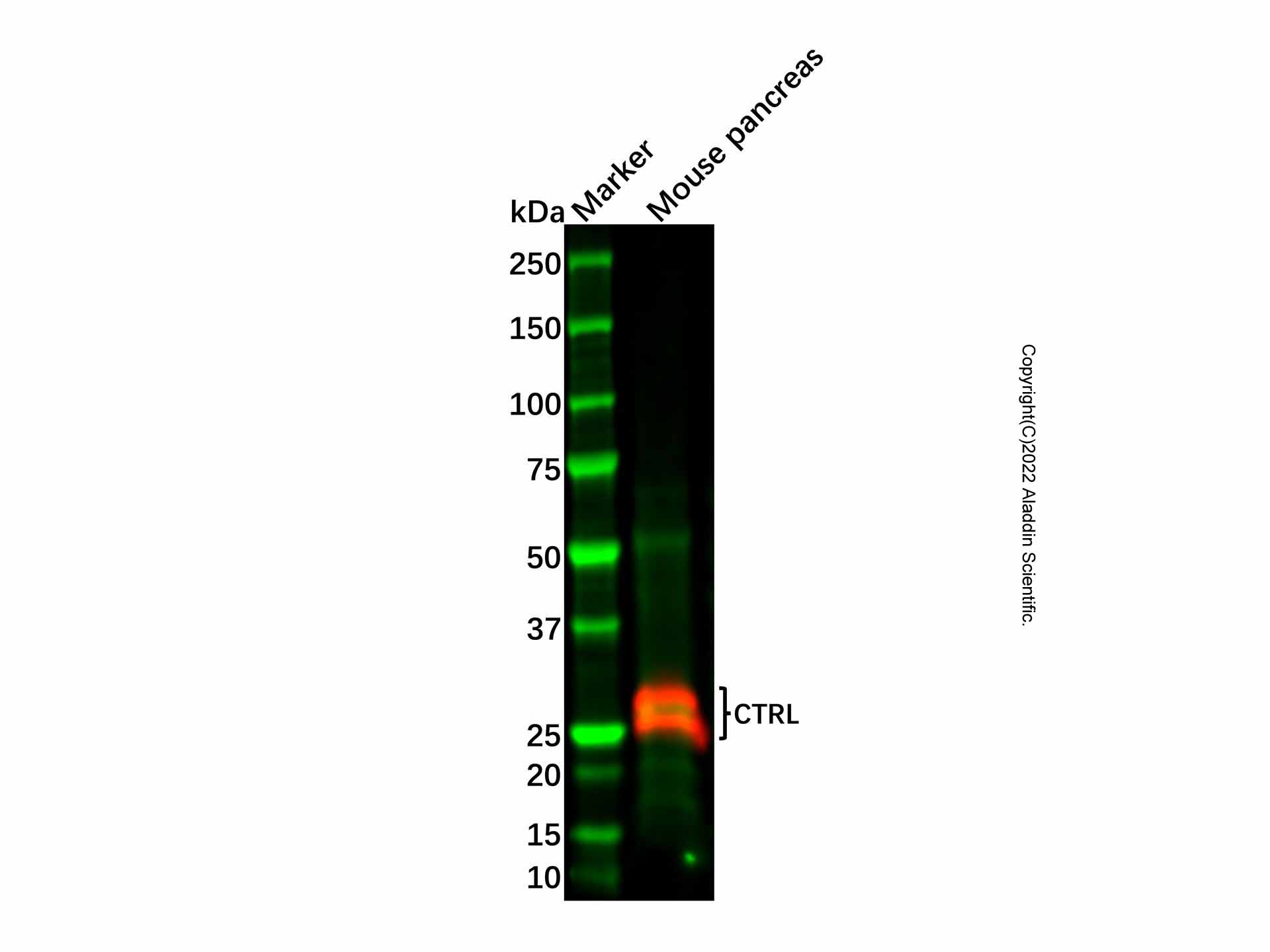
Recombinant CTRL Antibody (Ab098140) - Western Blot
All lanes: Recombinant CTRL Antibody (Ab098140) at 1/1000 dilution
Samples: Lysates at 20 µg per lane
Secondary: Goat Anti-Rabbit IgG H&L (HRP) (Ab170144) at 1/20000 dilution
Predicted band size: 28 kDa
Observed band size: 26, 28 kDa
Exposure time: 80.0 s

Aplicação
Aplicação
Dilution info
WB

1/1000 - 1/2000

Dados avançados

Alvos associados (humanos)
CTRL Tchem Chymotrypsin-like protease CTRL-1 (0 Activities)
Activity TypeActivity Value -log(M)Mechanism of ActionActivity ReferencePublications (PubMed IDs)
Mecanismos de ação
Certificados(CoA,COO,BSE/TSE e Mapa de Análise)
C of A & Other Certificates(BSE/TSE, COO):
Analytical Chart:

Find and download the COA for your product by matching the lot number on the packaging.

2 results found

Lot NumberCertificate TypeDataItem
ZJ24F1113757ZJ24F1113757Certificate of AnalysisAug 10, 2026 Ab098140
ZJ24F1113758ZJ24F1113758Certificate of AnalysisAug 10, 2026 Ab098140
Calculadoras de soluções
Revisões

Avaliações dos Clientes

Application Protocols

Tested applications, recommended dilutions, and positive controls specific to SKU Ab098140 are Not specified for this item; refer to CoA/Spec Sheet.

Per the Non-Negotiable Rules, only product-data-verified protocols can be listed here. Please consult the product CoA/Spec Sheet for:

  • Validated applications (e.g., WB, IHC, IF, ELISA, FC), if any
  • Recommended working concentrations or dilutions
  • Suggested positive/negative control samples and blocking conditions
  • Secondary antibody compatibility and detection systems

If the CoA is unavailable, contact Aladdin Scientific technical support with the SKU (Ab098140) for assistance.

Biological Roles

The precise antigen/target specificity for this recombinant CTRL antibody is Not specified for this item; refer to CoA/Spec Sheet.

General function of control antibodies (literature):

  • Isotype/CTRL antibodies serve as negative controls to quantify nonspecific binding due to Fc-receptor interactions, sticky epitopes, or matrix effects in assays such as flow cytometry, immunofluorescence, immunohistochemistry, and ELISA.
  • They are matched to the primary antibody’s isotype and host to control for background introduced by secondary antibodies and detection systems.
  • In Fc-receptor–rich systems (e.g., myeloid cells), control antibodies establish the baseline fluorescence or staining that results from Fc interactions, enabling accurate gating and thresholding.
  • In quantitative ELISA or IP, control antibodies can assess nonspecific capture and provide a matrix-matched reference.

Biochemical considerations (general):

  • Affinity, off-rate, and glycosylation patterns influence background binding and matrix interactions. Recombinant production typically enhances lot-to-lot reproducibility of these properties, although exact values for this product are Not specified.
  • Control antibodies should be titrated to match the mass/concentration used for the test antibody to ensure valid comparisons.

For target identity, isotype, and cross-reactivity details specific to this SKU, consult the CoA/Spec Sheet.

Buffer Applications

Antibody performance depends strongly on buffer composition, pH, ionic strength, and additives. The following are general, literature-based guidelines and not item-specific specifications.

Common buffer systems (general):

  • PBS (phosphate-buffered saline): pH 7.2–7.6; typical 1× composition ~137 mM NaCl, 2.7 mM KCl, 10 mM phosphate. Widely used for dilutions and washes.
  • TBS (Tris-buffered saline): pH 7.4–8.0; typical 1× composition ~25–50 mM Tris, 150 mM NaCl. Preferred when phosphate interferes (e.g., alkaline phosphatase assays).
  • Blocking buffers: 1–5% BSA, 3–5% non-fat dry milk, or casein blockers. Select based on assay and epitope (avoid milk/casein for phospho-epitopes).
  • Detergents: 0.05–0.1% Tween-20 for WB/IHC washes; 0.1–0.5% mild detergents for permeabilization (e.g., saponin for intracellular flow, Triton X-100 for IF where compatible).
  • Additives: 0.5–2% BSA or 5–10% serum can reduce nonspecific binding; Mg2+/Ca2+ may be needed for certain interactions (avoid EDTA if metal-dependent binding is required).

Practical tips (general):

  • Match the isotype control antibody concentration to that of the test antibody for valid background assessment.
  • Filter buffers (0.22 µm) for sterile or low-background applications.
  • Avoid sodium azide with HRP-based detection (it inhibits peroxidase). Presence of azide in this product is Not specified.

For the exact recommended diluent and pH for SKU Ab098140, refer to the CoA/Spec Sheet.

Green Alternatives

Environmental considerations for antibody workflows revolve around buffer composition, preservatives, and waste minimization rather than solvent replacement.

Greener practice suggestions (general; not item-specific):

  • Reduce hazardous preservatives: Where biosafety permits, use low-toxicity preservatives (e.g., ProClin-type isothiazolinones at minimal effective levels) instead of high azide concentrations. Presence/absence of azide in this SKU is Not specified.
  • Minimize single-use plastics: Employ reusable, low-retention tips and tubes where appropriate. Use glass vials for long-term aliquots to reduce adsorption and plastic waste.
  • Energy-efficient storage: Consolidate aliquots to reduce freezer door-open time. Validate stability at −20°C (as specified for this product) to avoid unnecessary −80°C storage.
  • Aqueous-only workflows: Prefer aqueous buffers and enzyme-compatible detergents over organic cosolvents. Many antibody assays function in purely aqueous systems at neutral pH.
  • Waste management: Segregate azide-containing and dye-conjugate waste per institutional EHS guidance to prevent heavy-metal azide formation and minimize environmental release of fluorophores.

Comparison (general):

  • Traditional: Sodium azide-preserved PBS; frequent dry ice shipments.
  • Greener alternatives: Minimal-preservative or preservative-free buffers prepared fresh; optimized cold-chain with reusable ice packs (this item ships with ice pads per Product Data). Trade-offs include shorter open-vial stability and need for aseptic technique.
Pharmaceutical Uses

This product is designated For research use only and is not intended for diagnostic or therapeutic applications.

General formulation/manufacturing context for antibodies (literature; not specific to this SKU):

  • Reference standards and controls: Recombinant antibodies may be used as process controls or analytical standards in bioprocess development (e.g., method qualification for ELISA, HPLC-SEC system suitability) under non-clinical, pre-GMP conditions.
  • Excipient compatibility studies: Screening of buffer systems (histidine, citrate, acetate, phosphate) with stabilizers (sugars, polysorbates) to inform formulations for therapeutic candidates. This product is not approved for such therapeutic use but may serve as a research surrogate.
  • Device and surface recovery studies: Evaluating adsorption to filters, tubings, and containers to optimize low-loss handling.

No pharmacopeial status, excipient role, or clinical use is claimed for this item. For any regulated application, source documentation (sequence, glycosylation, host cell line, viral safety) would be required; these details are Not specified for this item and must be confirmed directly from the CoA/Spec Sheet if applicable to your research.

Physical Properties

Item-specific physicochemical parameters have not been provided for this antibody preparation.

  • Appearance: Not specified for this item; refer to CoA/Spec Sheet.
  • Concentration/formulation: Not specified for this item; refer to CoA/Spec Sheet.
  • pH, buffer, and stabilizers (e.g., PBS/TBS, glycerol, BSA, azide): Not specified for this item; refer to CoA/Spec Sheet.
  • Extinction coefficient (ε) and A280 conversion: Not specified for this item; refer to CoA/Spec Sheet.

General protein/literature notes (not item-specific):

  • Typical IgG is a globular protein, highly water-soluble in physiological buffers (e.g., PBS, TBS) across pH ~6.5–8.0.
  • Approximate isoelectric points vary by sequence and isotype (literature: pI often ~6–9 for IgG subclasses).
  • Proteins denature at elevated temperature, extremes of pH, or in chaotropes (e.g., urea, guanidinium) and are sensitive to repeated freeze–thaw cycles.
  • Typical storage formulations include neutral buffer with optional 10–50% glycerol as cryoprotectant and carrier protein to minimize adsorption (when compatible with downstream use). These are general practices; do not assume for this item.

For all quantitative specifications (concentration, buffer composition, preservatives, extinction coefficient), consult the product’s CoA/Spec Sheet.

Quality and Grades

Item-specific quality designations per Product Data:

  • Grade/Purity: Recombinant, ExactAb™, Validated

What these mean (general definitions; not additional specifications):

  • Recombinant: The antibody is produced from defined DNA sequence(s) in a controlled expression system. Benefits typically include lot-to-lot genetic identity, consistent CDR sequences, and reduced variability compared to hybridoma ascites or polyclonal sources.
  • ExactAb™: A vendor-specific branding that typically denotes sequence-defined, precision-engineered recombinant antibody materials designed for high reproducibility. Exact feature set is proprietary; consult the CoA/Spec Sheet for item-level attributes (isotype, clonality, sequence, epitope mapping, etc.).
  • Validated: Indicates that performance has been confirmed by the manufacturer in one or more applications or sample types. This product’s specific validated applications and sample matrices are Not specified for this item; refer to CoA/Spec Sheet.

Additional quality considerations (general):

  • Lot-to-lot consistency is a key advantage of recombinant production. Sequence identity and expression host can influence glycosylation and Fc behavior.
  • Purity metrics for antibodies commonly include SEC-HPLC monomer % and SDS-PAGE purity; UV/Vis A260/280 for nucleic acid contamination; endotoxin levels when relevant for cell assays. Exact numeric specifications are Not specified for this item; refer to CoA/Spec Sheet.
  • If low background in immunoassays is critical, verify preservative content and cross-reactivity profile in the CoA before use.
Reaction and Applications

This section primarily addresses chemical reaction usage, which is not directly applicable to antibody reagents.

  • Applicability: Antibodies are macromolecular affinity reagents used for detection, capture, or modulation of biomolecules, not as reagents in small-molecule synthetic reactions.
  • For use-cases relevant to this product (immunoassays such as WB, IHC, IF, ELISA, FC), please see “Application Protocols.” However, specific tested applications for this SKU are Not specified for this item; refer to CoA/Spec Sheet.

General notes (literature, for context only):

  • Antibodies may be chemically conjugated (via lysine, cysteine, carbohydrate, or site-specific methods) to enzymes, fluorophores, or solids for detection and capture. Conjugation status for this item is Not specified.
  • Controlled coupling chemistries (e.g., NHS-ester to lysines, maleimide to thiols) require careful buffer selection (avoid primary amines for NHS, avoid excess thiols for maleimide). These are general practices and not specific to this SKU.
Reaction Conditions

In the context of antibodies, “reaction conditions” translate to incubation and binding conditions in immunoassays. No item-specific, validated conditions are provided for SKU Ab098140.

General literature guidance (not item-specific):

  • Western blot (primary incubation): 0.2–2 µg/mL in PBST or TBST with 1–5% BSA or milk; 1 h at RT or overnight at 4°C with gentle agitation.
  • Immunofluorescence/IHC: 0.5–10 µg/mL depending on epitope abundance; blocking with serum/BSA; incubation 1 h at RT or overnight at 4°C. Antigen retrieval for FFPE sections as assay-appropriate (citrate pH 6 or Tris-EDTA pH 9).
  • Flow cytometry: 0.05–5 µg/test (∼10^5–10^6 cells); staining 20–30 min at 4°C in protein-containing buffer; include Fc block where relevant.
  • ELISA (capture/detect): 0.1–2 µg/mL coating in carbonate buffer pH 9.6; detection antibody titrated to linear range; thorough washing with PBST.

Environmental parameters:

  • Temperature: 4°C reduces off-target binding; RT accelerates kinetics.
  • Ionic strength and detergents: Adjust to tune stringency. Avoid detergent for live-cell staining.

These ranges are typical starting points only. For conditions validated for this ExactAb™ product, consult the CoA/Spec Sheet before experimental planning.

Safety and Handling

Safety information specific to this SKU has not been provided.

  • GHS classification, signal word, pictograms, H-statements: Not specified for this item; refer to SDS.
  • Research use note: For research use only (per Product Data). Not for human or veterinary diagnostic or therapeutic use.

General laboratory guidance for antibody reagents (literature/best practice):

  • PPE: Wear lab coat, gloves, and safety glasses. Avoid inhalation/ingestion and contact with skin/eyes.
  • Handling: Keep sterile when needed for cell-based assays. Work on ice or at 2–8°C during setup to minimize degradation.
  • Incompatibilities: Avoid strong oxidizers, extreme pH, and proteases. Sodium azide (if present) is incompatible with lead/copper plumbing and can form explosive metal azides; dispose of azide-containing waste accordingly. Presence/absence of azide in this product is not specified.
  • Biological safety: Recombinant antibodies are non-infectious proteins but treat all biological materials as potentially biohazardous until SDS/CoA confirms details.
  • First aid (overview): In case of contact, rinse affected area with water. If inhaled or ingested, seek medical attention as needed. Always consult the SDS for authoritative instructions.

Always defer to the product-specific SDS and institutional EHS policies for risk assessment and disposal.

Solvent Selection

For antibodies, “solvent” choice corresponds to assay and storage buffers rather than organic solvents.

General buffer selection (literature; not item-specific):

  • Working buffers: PBS (pH 7.2–7.6) or TBS (pH 7.4–8.0) are standard for dilutions and washes. Low Tween-20 (0.05–0.1%) may reduce nonspecific binding in immunoassays.
  • Blocking reagents: BSA, non-fat milk, casein, or commercial blockers selected to match assay (e.g., milk is unsuitable with anti-phospho epitopes due to casein kinases).
  • Sample compatibility: For flow cytometry and IF, isotonic buffers with protein (0.5–2% BSA) help minimize cell loss and nonspecific adsorption.
  • Storage buffers: Neutral pH, isotonic salts; optional glycerol for frozen storage and carrier protein to reduce adsorption (only if compatible with your assay). Composition for this item is Not specified; consult CoA.

When to choose PBS vs TBS (general):

  • PBS: Common default; phosphate can interact with certain metal-dependent epitopes/enzymes.
  • TBS: Preferred when phosphate interferes (e.g., alkaline phosphatase detection).

Compatibility notes:

  • Avoid azide when using HRP-conjugated antibodies in peroxidase-based detection? Azide inhibits HRP. Conversely, azide is acceptable for storage when no enzymatic detection is involved. Presence of azide in this product is Not specified.
  • Detergents can disrupt weak protein–protein interactions; titrate carefully for IP/Co-IP.
Storage and Reconstitution

Item-specific storage directives (from Product Data):

  • Storage conditions: Store at −20°C. Avoid repeated freezing and thawing.
  • Shipping: Ice chest + ice pads (cold-packed shipment)

Best practices (general guidance; not item-specific specifications):

  • Upon receipt: Inspect for any signs of thawing/leakage. Centrifuge briefly to collect contents. Keep on ice during handling.
  • Aliquoting: To prevent freeze–thaw cycles, divide into single-use aliquots in low-protein-binding tubes. Maintain sterility if required for cell-based assays.
  • Cryoprotection: If compatible with downstream application, glycerol (e.g., 30–50% v/v) can allow storage at −20°C without freezing. Do not assume presence or suitability for this item; verify via CoA.
  • Reconstitution (if lyophilized): Hydrate gently with sterile, neutral buffer (e.g., PBS or manufacturer-recommended buffer) to the desired concentration. Avoid vigorous vortexing; mix by gentle pipetting. Lyophilization status for this item is Not specified.
  • Short-term storage: For frequent use, keep aliquots at 2–8°C for up to a few days as stability allows; monitor for turbidity or precipitation.
  • Light and contamination: Protect fluorescent conjugates from light. Use clean tips and aseptic technique to avoid microbial growth. Conjugation status for this SKU is Not specified.

Always defer to the product’s CoA/Spec Sheet for exact buffer composition, preservatives, and any additional, item-specific stability data.

Structure and Identity

Brief description: Recombinant CTRL Antibody supplied as a research-use reagent. Item-specific structural identifiers (small-molecule style) are not applicable to proteins.

  • Product name/SKU: Recombinant CTRL Antibody (SKU: Ab098140)
  • Category: Antibody reagent (recombinant), ExactAb™, validated (per Product Data)
  • Molecular formula: Not applicable to proteins; item-specific value not provided (Not specified for this item; refer to CoA/Spec Sheet.)
  • Molecular weight: Not specified for this item; refer to CoA/Spec Sheet.
    • Typical IgG MW (literature): ~150 kDa (∼50 kDa heavy chains + ∼25 kDa light chains, disulfide-linked)
  • SMILES / InChI / InChIKey: Not applicable for macromolecular proteins
  • Structural features (general, literature):
    • Antibodies are Y-shaped glycoproteins composed of two identical heavy (H) chains and two identical light (L) chains with intra-/inter-chain disulfide bonds.
    • Domains: variable (V) regions that bind antigen; constant (C) regions that define isotype and effector functions.
    • Post-translational features may include N-linked glycosylation on Fc (IgG) and potential C-terminal lysine variants (item-specific status not provided).
  • Isotype/host/clonality/antigen: Not specified for this item; refer to CoA/Spec Sheet.
  • 2D description in words (general): Two Fab arms (each containing VH-VL antigen-binding domains) connected via a flexible hinge to the Fc stem (CH2–CH3 domains).
Synthetic Utility

Not typically applicable. Antibodies are biological macromolecules used for recognition and binding rather than for chemical synthesis or as building blocks in small-molecule chemistry.

General chemistry context (literature):

  • Conjugation chemistry: Antibodies can be derivatized via NHS-esters (lysines), maleimides (cysteines), click chemistry (azide–alkyne), or glycan engineering for site-specific payload attachment. Conjugation status and suitability for this SKU are Not specified.
  • Solid support immobilization: Covalent coupling to activated resins (e.g., CNBr-activated Sepharose, epoxy/aldehyde-functionalized beads) for affinity capture. Buffer composition (amine-free for NHS) and pH control are critical.
  • Crosslinkers: Homobifunctional (e.g., DSS) or heterobifunctional (e.g., SMCC) reagents can stabilize complexes for immunoprecipitation/mass spectrometry. These are general techniques, not validations for this item.

For practical usage aligned with this product, see Buffer Applications and Storage & Reconstitution.

Target Specificity

Target/antigen information for this SKU is not provided.

  • Antigen/epitope: Not specified for this item; refer to CoA/Spec Sheet.
  • Species reactivity/cross-reactivity: Not specified for this item; refer to CoA/Spec Sheet.
  • Isotype/clone/host: Not specified for this item; refer to CoA/Spec Sheet.

General note: “CTRL” commonly denotes a control or isotype control antibody used to establish background staining/binding. Confirm the exact isotype and species matching to your experimental primary antibody in the product documentation to ensure appropriate control selection.

Precisa de ajuda para escolher o grau?

O nosso guia de seleção de graus abrange pureza, estado do estabilizador e adequação à aplicação para todas as variantes do nosso catálogo.

Ver o guia de graus Recombinant → Ver o guia de graus Validated → Ver o guia de graus ExactAb™ →

Produtos Relacionados

Goat Anti-Rabbit IgG H&L Antibody - Anticorpo secundário, for ELISA,LF,GICA various applications, from Rabbit, generated in Goat
Goat Anti-Rabbit IgG H&L (AF594) - Anticorpo secundário, IgG
Goat Anti-Rabbit IgG H&L (Biotin) - Anticorpo secundário, IgG
Goat Anti-Rabbit IgG H&L (AF488) - Anticorpo secundário, IgG
Goat Anti-Rabbit IgG H&L (AF405) - Anticorpo secundário, IgG
Donkey Anti-Rabbit IgG H&L (AF647) - Anticorpo secundário, specific to , IgG
Donkey Anti-Rabbit IgG H&L (Biotin) - Anticorpo secundário, IgG
Goat Anti-Rabbit IgG H&L (HRP) - Anticorpo secundário
Goat Anti-Rabbit IgG H&L Antibody - Anticorpo secundário, Goat IgG
Goat Anti-Rabbit IgG H&L (Biotin) - Anticorpo secundário
Goat Anti-Rabbit IgG H&L (Cy5) - Anticorpo secundário
Goat Anti-Rabbit IgG H&L (FITC) - Anticorpo secundário
Goat Anti-Rabbit IgG H&L (TRITC) - Anticorpo secundário
Goat Anti-Rabbit IgG H&L (Biotin) - Anticorpo secundário, Goat IgG
Goat Anti-Rabbit IgG H&L (HRP) - Anticorpo secundário, Goat IgG
Goat Anti-Rabbit IgG H&L (Cy5) - Anticorpo secundário, Goat IgG
Goat Anti-Rabbit IgG H&L (TRITC) - Anticorpo secundário, Goat IgG
Goat Anti-Rabbit IgG H&L (FITC) - Anticorpo secundário, Goat IgG
Goat Anti-Rabbit IgG H&L (PE) - Anticorpo secundário, Goat IgG
Goat Anti-Rabbit IgG H&L (APC) - Anticorpo secundário, Goat IgG
Goat Anti-Rabbit IgG H&L (AF647) - Anticorpo secundário, Goat IgG
Goat Anti-Rabbit IgG H&L (AF405) - Anticorpo secundário, Goat IgG
Goat Anti-Rabbit IgG H&L (AF555) - Anticorpo secundário, Goat IgG
Goat Anti-Rabbit IgG H&L (AF546) - Anticorpo secundário, specific to Rabbit IgG
Goat Anti-Rabbit IgG H&L (AF700) - Anticorpo secundário, specific to Rabbit IgG
Goat Anti-Rabbit IgG H&L (AF488) - Anticorpo secundário
Goat Anti-Rabbit IgG H&L (AF647) (Ready to use) - Anticorpo secundário, specific to Rabbit IgG

Deseja que lhe enviemos uma mensagem quando tivermos descontos disponíveis?

Lembrar-me mais tarde

Obrigado! Por favor, verifique a sua caixa de entrada de e-mail para confirmar.

Ops! As notificações estão desativadas.