GRADE & PURITYAnimal Free?Animal-free — produced without animal-derived components to reduce contamination risk. Use in biomanufacturing and culture avoiding animal-origin material.Carrier Free?Carrier-free — supplied without added carrier protein/stabilizer. Use when carriers (e.g. BSA) would interfere with conjugation or sensitive assays.Bioactive?Bioactive grade — verified to retain biological activity in functional assays. Use when the molecule must be functionally active, not just pure.ActiBioPure™?ActiBioPure™ — Aladdin's premier line for bioactive and recombinant products. Use when both high purity and preserved biological activity are required.Azide Free?Azide-free — without sodium azide preservative. Use in conjugations, cell work, or assays where azide is toxic or inhibitory.His Tag?His tag grade — recombinant protein bearing a His tag for affinity purification/detection. Use to purify, immobilize, or detect the tagged protein.≥95%(SDS-PAGE)
Accession #
P09326-1
Protein Tag
C-His
Expression system
HEK293
Endotoxin Concentration
<1.0 EU/μg
Bioactivity
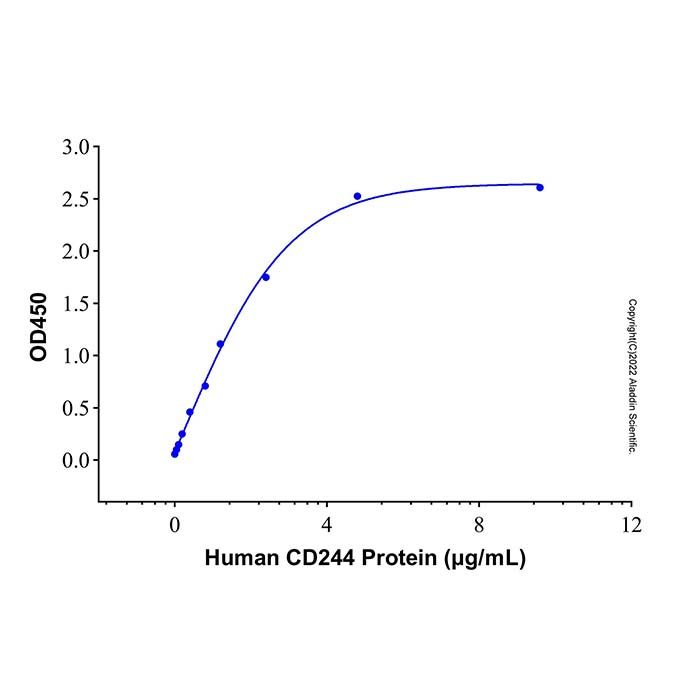
Measured by its ability to bind recombinant human CD244. Immobilized recombinant human CD48 at 5 μg/mL (100 μL/well) can bind recombinant human CD244 with a linear range of 0.2-1 μg/mL.
Measured by its ability to bind recombinant human CD244. Immobilized recombinant human CD48 at 5 μg/mL (100 μL/well) can bind recombinant human CD244 with a linear range of 0.2-1 μg/mL.
Reconstitute in sterile water to a concentration of 0.1-0.5 mg/ml.
Condições de armazenamento de armazenamento
Store at -20°C,Avoid repeated freezing and thawing
Enviado em
Ice chest + Ice pads
Estabilidade e armazenamento
Store at -20~-80℃ for more than 1 year. Upon receipt, it is recommended to aliquot. Avoid freeze/thaw cycle.
Imagens
Recombinant Human CD48 Protein (rp144040) - Protein Bioactivity Immobilized Recombinant Human CD48 Protein (rp144040) at 5.0 μg/mL can bind recombinant human CD244 with a linear range of 0.2 -1.0 μg/mL.
Recombinant Human CD48 Protein (rp144040) - SDS-PAGE 3 μg/lane of Recombinant Human CD46 Protein was resolved with SDS-PAGE under reducing (R) and non-reducing (N) conditions and visualized by Coomassie® Blue staining, showing the band at 37.0 - 46.0 kDa.
Documentation
📋 Safety Data Sheet (SDS)
Comprehensive hazard, handling, storage, and regulatory compliance document.
Determine the necessary mass, volume, or concentration for preparing a solution.
Dilution Calculator
Determine the dilution needed to prepare a stock solution.
Reconstitution Calculator
Revisões
Avaliações dos Clientes
Application Protocols
Validated application types, recommended working concentrations, and positive controls are Not specified for this item; refer to CoA/Spec Sheet.
General usage examples (literature/best practice, not item-specific):
BLI/SPR ligand capture:
Equilibrate instrument buffer (e.g., HBS-P). Load His-tagged CD48 onto Ni-NTA sensors at low density to minimize mass transport. Inject analyte (2B4 ectodomain) in a dilution series; fit 1:1 or heterogeneous models as appropriate.
Plate-based binding ELISA:
Coat Ni-NTA or anti-His plates to capture CD48; block with protein-free buffer; add serial dilutions of 2B4-Fc; detect with anti-Fc HRP.
Cell-based co-stimulation:
Immobilize CD48 on plates; seed NK/T cells expressing 2B4; include isotype and excess soluble CD48 as competition controls; measure IFN-γ or reporter signal.
These are illustrative only; optimize concentrations, incubation times, and buffers for your system. Always consult the product’s CoA for any item-specific instructions when available.
Biological Roles
CD48 (SLAMF2) is an immune cell surface receptor of the signaling lymphocyte activation molecule (SLAM) family.
General biology (literature; not item-specific):
Expression: Broadly on hematopoietic cells, including B cells, T cells, NK cells, monocytes, and dendritic cells.
Topology: GPI-anchored with two extracellular Ig-like domains; lacks a cytoplasmic tail and signals via interactions with adaptor-bearing partners.
Ligand interactions: High-affinity ligand is 2B4 (CD244), a receptor on NK and T cells; weaker species-dependent binding to CD2 has been described.
Function: Modulates adhesion, immune synapse formation, and co-stimulatory signals influencing NK-cell cytotoxicity and T-cell activation, with context-dependent activating or inhibitory outcomes via 2B4-associated signaling adaptors.
Immunobiology implications: CD48–2B4 axis is widely used to interrogate NK cell education, exhaustion, and target recognition processes; it also provides a handle to study SLAM-family cross-talk.
Utility of the recombinant ectodomain:
Serves as a defined ligand for 2B4 in reductionist assays.
Enables species specificity testing of antibodies and engineered receptors without cellular confounders.
No medical or clinical claims are made here; this information is provided solely to contextualize research use of recombinant CD48.
Buffer Applications
CD48 is not a buffering agent. However, buffer choice is crucial for maintaining its structure and activity.
General buffer guidance (not item-specific):
pH range: Near-neutral pH (7.0–7.5) is commonly used for soluble CD48 ectodomains in binding assays.
Ionic strength: 100–300 mM total ionic strength (e.g., PBS or HEPES-buffered saline) often balances stability and reduces non-specific interactions.
Additives: For carrier-free proteins, trace non-ionic detergents (e.g., 0.001–0.01% Tween-20) can reduce surface adsorption if compatible with your assay. For BLI/SPR, include 0.005–0.05% surfactant and 0.1% inert protein only if it does not interfere with binding analyses.
Metal affinity contexts: For His-tag capture, maintain 200–500 mM NaCl and avoid chelators like EDTA during immobilization; reintroduce chelators only after capture if necessary for assay.
Item-specific buffer composition, pH, and excipients: Not specified for this item; refer to CoA/Spec Sheet.
Green Alternatives
Green chemistry considerations for recombinant proteins focus on buffer systems and cold-chain efficiency rather than solvent replacement:
Prefer aqueous buffers with minimal environmental impact:
Use PBS or HEPES over buffers requiring hazardous components. Avoid azide when not required—this item is Azide Free (item-specific).
Reduce single-use plastics: Employ low-bind, reusable glassware where compatible with protein stability and sterility; balance against adsorption risks.
Energy efficiency: Consolidate thawing/aliquoting steps to minimize freezer door-open time; store working aliquots at 2–8°C for short periods to reduce freeze–thaw events (general guidance; verify stability empirically).
Illustrative comparison (general):
Tris buffer vs. HEPES: HEPES offers better pH stability near neutral with lower temperature coefficients, potentially reducing pH-adjustment waste; both are relatively benign compared to buffers requiring organic co-solvents.
Detergents: Favor biodegradable, low-toxicity surfactants at minimal effective concentrations; confirm they do not disrupt CD48 activity.
Disposal: Proteinaceous waste can often be deactivated by heat or biodegradable enzymes, then disposed per institutional biosafety protocols—consult SDS and local regulations.
Pharmaceutical Uses
This product is for research use only and is not intended for human or veterinary use.
Formulation/manufacturing context (general, not item-specific):
Recombinant ectodomains such as CD48 may serve as analytical reagents in biopharmaceutical discovery and development, e.g.,
Reference ligands in binding assays for candidate biologics targeting 2B4–CD48 interactions.
Calibration standards for ligand-binding assays (LBA) and potency assays.
Affinity capture or column ligands in process development models (His-tag may be leveraged for orientation-controlled immobilization).
No pharmacopeial monograph, dosage form, or excipient status is specified for this item. Any clinical or GMP use would require separate qualification; such use is outside the scope of this research-grade product.
Physical Properties
Appearance/State: Not specified for this item; refer to CoA/Spec Sheet.
Molecular weight: Not specified for this item; refer to CoA/Spec Sheet. (Note: native human CD48 is ~45 kDa including glycan; soluble ectodomains vary by construct; literature information only.)
Isoelectric point (pI): Literature values for human CD48 ectodomain are typically acidic to neutral depending on glycosylation; not item-specific.
Extinction coefficient: Not specified for this item; refer to CoA/Spec Sheet. (Sequence- and glycosylation-dependent.)
Solubility: Recombinant soluble CD48 ectodomains are generally soluble in physiological buffers (e.g., PBS) at ≥0.1 mg/mL (literature guidance). Actual solubility varies with formulation; not item-specific.
Stability: Storage at −20°C is specified for this item; avoid repeated freeze–thaw cycles.
Buffer composition, pH, excipients: Not specified for this item; refer to CoA/Spec Sheet.
Practical notes (general literature, not item-specific):
Recombinant His-tagged ectodomains of CD48 are commonly formulated in neutral buffered saline with low protein-binding detergents or carrier proteins removed for “Carrier Free” offerings; adsorption losses can be mitigated by using low-bind plastics.
If concentration by ultrafiltration is required, select MWCO ~10 kDa or as appropriate for the construct, pre-rinse membranes, and keep temperatures at 2–8°C to preserve activity.
Quality and Grades
This item carries multiple grade/attribute designations that inform suitability for sensitive research applications:
Animal Free (item-specific): Manufactured without animal-derived components, minimizing adventitious agents and enabling workflows sensitive to animal-origin materials (e.g., certain cell-based or GMP-adjacent discovery steps). Not a GMP designation.
Carrier Free (item-specific): No carrier proteins (e.g., BSA) added. Benefits: defined composition, minimized interference in binding/biophysical assays, and compatibility with downstream conjugation. Tradeoff: greater tendency for surface adsorption—use low-bind plastics and include inert protein or detergent only if compatible with your assay.
Bioactive (item-specific claim): Produced/formulated to preserve biological activity of the recombinant CD48 ectodomain. Always verify activity in your assay context.
ActiBioPure™ (item-specific branding): Indicates a high-purity, functionally validated preparation from Aladdin Scientific. For exact specifications (purity metrics, endotoxin levels), refer to CoA/Spec Sheet.
Azide Free (item-specific): No sodium azide preservative. Advantages: compatible with azide-sensitive enzymes/cells. Implication: increased microbial risk—maintain sterility and cold-chain.
His Tag (item-specific): Affinity tag facilitates purification and detection. Note potential effects on oligomerization or binding depending on tag position; consult CoA for construct details.
Item-specific numerical specs (e.g., purity %, endotoxin EU/µg, host cell protein/DNA): Not specified for this item; refer to CoA/Spec Sheet.
Reaction and Applications
As a recombinant immune receptor ectodomain, CD48 is primarily applied in biochemical and cell-based binding systems rather than classical synthetic reactions.
Representative research applications (general literature, not item-specific):
Ligand-binding assays: Quantify CD48 interaction with human 2B4 (CD244) using ELISA, BLI/SPR, or AlphaScreen formats to determine kinetics and affinity.
Cell activation/co-stimulation models: Present soluble CD48 or CD48-coated surfaces to NK or T cells to study 2B4 signaling pathways (with appropriate crosslinking or Fc-mediated clustering if required by the design; His-tagged proteins can be captured via Ni-NTA surfaces).
Competitive inhibition studies: Use recombinant CD48 to probe blocking antibodies or small molecules targeting the 2B4–CD48 axis.
Immunology workflows: Calibrate flow cytometry reagents, validate anti-CD48 antibody specificity using ligand competition, or generate standard curves.
Structural/biophysical studies: Map epitope engagement or domain mutations by comparing binding to wild-type CD48.
Practical tips:
Maintain low non-specific binding by using low-bind plastics and minimizing surface exposure times.
For plate-based assays, pre-block surfaces and consider orientation-controlled immobilization (e.g., His-tag capture) to preserve the native binding interface.
Validate activity lot-by-lot in your assay context; “Bioactive” designation indicates functional production but assay conditions vary.
Reaction Conditions
Classical chemical reaction conditions are not relevant to this recombinant protein. For bioassays involving CD48–2B4 interactions, consider the following general conditions (literature, not item-specific):
ELISA/BLI/SPR binding:
Buffer: PBS or HEPES-buffered saline, pH 7.2–7.5, 0.005–0.05% non-ionic surfactant.
Temperature: 20–25°C for kinetics; 2–8°C for storage and preparation.
Immobilization: Capture His-tagged CD48 on Ni-NTA surfaces; avoid chelators and high imidazole during capture.
Cell-based co-stimulation assays:
Presentation: Plate-bound CD48 (via anti-His or Ni-NTA coating) or soluble CD48 with crosslinking Ab where needed.
Readouts: Cytokine secretion, cytotoxicity, or reporter activity; optimize dose-response empirically.
Inhibition/competition studies:
Titrate recombinant CD48 against fixed 2B4 density to determine IC50/KB; include non-specific protein controls.
These conditions are general guidance. Item-specific concentration, activity units, and lot acceptance criteria are not provided; refer to CoA/Spec Sheet and validate in your system.
Safety and Handling
Research use only; not for human or veterinary use.
GHS classification, signal word, pictograms, and H-statements: Not specified for this item; refer to SDS for authoritative information.
Storage conditions (item-specific): Store at −20°C. Avoid repeated freezing and thawing.
Shipping (item-specific): Shipped in ice chest with ice pads to maintain cold chain.
General laboratory precautions (best practice, not item-specific):
Use appropriate PPE: lab coat, gloves, and eye protection.
Handle using aseptic technique to prevent microbial contamination; recombinant proteins are susceptible to proteolysis—work on ice when feasible.
Avoid vigorous vortexing or foaming to limit denaturation; mix by gentle inversion.
Incompatibilities: Avoid strong oxidizers and proteases; avoid elevated temperatures and extreme pH unless validated for the construct.
First-aid overview (general):
Skin/eye contact: Rinse with water. Remove contaminated clothing. Seek medical attention if irritation persists.
Inhalation/ingestion: Move to fresh air and seek medical advice if symptoms occur.
Waste disposal:
Dispose of protein solutions and consumables according to institutional biosafety procedures for non-hazardous biological materials unless SDS indicates otherwise.
Solvent Selection
Classically, recombinant proteins are not used with organic solvents. CD48 should be handled in aqueous buffers compatible with its fold and activity.
Applicability: Organic solvent selection is not typically relevant. Focus instead on buffer selection, ionic strength, and additives that stabilize the protein.
Aqueous environment (general guidance):
Buffers: PBS or HEPES-buffered saline at near-neutral pH are commonly used for soluble ectodomains (literature).
Additives: In “Carrier Free” formats, include low levels of non-ionic detergent (e.g., 0.001–0.01% Tween-20) or inert protein only if compatible with your assay to reduce adsorption (general best practice, not item-specific).
Avoid: High concentrations of denaturants, extremes of pH, or >10–20% organic cosolvent unless validated for the construct.
For chromatography or biophysical measurements, select buffers with low UV absorbance where needed (e.g., HEPES vs. Tris at 214–230 nm), but confirm compatibility with CD48 activity.
Storage and Reconstitution
Storage (item-specific): Store at −20°C. Avoid repeated freezing and thawing.
Shipping (item-specific): Ice chest with ice pads.
Appearance, formulation, concentration: Not specified for this item; refer to CoA/Spec Sheet.
General guidance (not item-specific):
Upon receipt: Centrifuge briefly to collect contents. If lyophilized, allow vial to equilibrate to room temperature in a desiccator before opening.
Reconstitution: Use sterile, neutral pH buffer (e.g., PBS or HEPES-buffered saline). Start with small volume to achieve desired concentration. Mix gently—do not vortex.
Aliquoting: Prepare single-use aliquots in low-bind tubes to prevent freeze–thaw; typical aliquots 10–50 µL depending on usage.
Short-term storage: 2–8°C for hours to a few days as stability permits; add sterile additives (e.g., 0.001–0.01% non-ionic surfactant) only if compatible with downstream assays.
Long-term storage: −20°C to −80°C per CoA; avoid frost-free freezers and minimize temperature cycling.
Thawing: Thaw on ice; mix by gentle inversion. Discard any solution showing turbidity/precipitation unless expected for the formulation.
For definitive instructions (buffer composition, pH, protein concentration, stability data, and acceptable storage durations), refer to the lot-specific CoA/Spec Sheet.
Structure and Identity
Recombinant human CD48 is a cell-surface immunoglobulin superfamily protein produced in a recombinant expression system and supplied with a C‑terminal His tag for affinity purification and detection.
CAS, CID, InChIKey, SMILES: Not specified for this item; refer to CoA/Spec Sheet.
Molecular formula and molecular weight: Not specified for this item; refer to CoA/Spec Sheet.
Structural features (general literature, not item-specific):
CD48 (SLAMF2) is a glycosylphosphatidylinositol (GPI)-anchored member of the SLAM family with two extracellular Ig-like domains (one V-set, one C2-set).
Native human CD48 is typically a ~45 kDa glycoprotein; the unglycosylated extracellular domain is ~24–30 kDa (literature ranges; glycosylation-dependent).
Primary ligand: 2B4 (CD244); weaker interactions reported with CD2 (species-dependent).
2D/Domain description (general literature):
N-terminus: signal peptide followed by V-type Ig domain responsible for ligand engagement.
C-terminus: C2-type Ig domain; native protein ends with a GPI-anchor signal sequence (recombinant constructs often omit the GPI signal and include an affinity tag, such as His, to yield a soluble ectodomain).
Synthetic Utility
Not typically applicable. Recombinant CD48 is a biological macromolecule used for biochemical and cell-based studies, not as a building block or reagent in chemical synthesis.
If coupling or conjugation is desired (general literature, not item-specific):
His tag can enable site-directed immobilization on Ni-NTA resins, IMAC chips, or chelator-functionalized surfaces.
Amine- or thiol-directed chemistries (e.g., NHS ester, maleimide) may be applied if the formulation and construct support them; verify that modifications do not impair 2B4 binding.
Keep reactions at near-neutral pH and low temperatures to preserve activity; remove excess reagents by desalting or SEC.
Item-specific reactive group counts, sequence, and buffer composition: Not specified for this item; refer to CoA/Spec Sheet.
Target Specificity
Item-specific target-binding validation data (e.g., confirmed binding to human 2B4/CD244, species cross-reactivity, KD/EC50, assay platforms) are Not specified for this item; refer to CoA/Spec Sheet.
General literature context (not item-specific):
Primary ligand: human 2B4 (CD244). Cross-species interactions can differ; verify species pairing empirically.
Antibody interactions: Anti-CD48 antibodies may compete with 2B4 binding depending on epitope.
No claims of specificity, affinity, or cross-reactivity are made for this particular lot/product without the accompanying CoA.
Perguntas frequentes
What is the purity of this product, and how is it determined?
This product is supplied at ≥95% purity, determined by SDS-PAGE. Lot-specific values are stated on the Certificate of Analysis.
What does Animal Free mean?
Animal Free indicates that the material has been processed and tested for specialty industrial processing. Specifications focus on the impurities that affect performance in that application — for example, metal content for electronics, particle size for batteries, refractive index for optics, or moisture content for moisture-sensitive processes.
What does Carrier Free mean?
Carrier Free indicates that the material has been processed and tested for specialty industrial processing. Specifications focus on the impurities that affect performance in that application — for example, metal content for electronics, particle size for batteries, refractive index for optics, or moisture content for moisture-sensitive processes.
How should this product be stored?
Store at ?20 °C. Avoid repeated freeze–thaw cycles. Aliquot into single-use volumes before freezing.
How is this product shipped?
This product ships in an insulated container with ice pads. Unpack on arrival and transfer it to the storage condition stated above.
What documentation is provided?
Available product documentation, including Certificates of Analysis (COA), Safety Data Sheets (SDS), and specification sheets, is shown in the product document area. Document availability and access follow the current site policy.
Need help choosing the grade?
Our grade selection guide covers purity, stabilizer status, and application suitability for all variants in our catalog.
Usamos cookies para garantir o funcionamento adequado do site e, quando permitido, para melhorar a sua experiência. Você pode gerenciar suas preferências a qualquer momento nas Configurações. Saiba mais em nossa Política de Cookies.
Deseja que lhe enviemos uma mensagem quando tivermos descontos disponíveis?
Lembrar-me mais tarde
Obrigado! Por favor, verifique a sua caixa de entrada de e-mail para confirmar.
Products are supplied to verified businesses, institutions, and qualified professionals for research and development use only. Not for use in humans, animals, diagnosis, or therapy.

 ZJ24F0404955