GRADE & PURITYRecombinant?Recombinant — produced via recombinant expression for defined sequence and consistency. Use for reproducible, animal-free proteins of known origin.ExactAb™?ExactAb™ — Aladdin's antibody line emphasizing precision and validated quality. Use for reliable, specificity-validated antibody applications.Validated?Validated grade — performance confirmed in defined applications before release. Use when you want documented assurance the reagent works as stated.0.3 mg/mL
ExactAb™, Validated, Recombinant, 0.3 mg/mL ExactAb™,Recombinant,Validated for sensitive chromatographic and analytical workflows requiring minimal baseline interference.
🌡
Storage & shipping
Store at -20°C,Avoid repeated freezing and thawing Ships Ice chest + Ice pads Check lot-specific COA for exact specifications.
📋
Quality documents
SDS, COA, datasheet, and spec sheet available for download. Lot-specific COA accessible via lot number lookup.
📚
Literature proof
Cited in 0 peer-reviewed publications across chromatography, organic synthesis, and cross-coupling reactions.
Visão geral
Rabbit anti Human Tissue Factor Antibody, Recombinant, could be used for WB, IHC and so on. Application: WB: 1/500-1/1000 IHC: 1/50-1/100 Protein Function Initiates blood coagulation by forming a complex with circulating factor VII or VIIa. The [TF:VIIa] complex activates factors IX or × by specific limited protolysis. TF plays a role in normal hemostasis by initiating the cell-surface assembly and propagation of the coagulation protease cascade.
Specifications
Product Name
Recombinant Tissue Factor Antibody - Anticorpo primário, specific to F3, Rabbit IgG
A synthetic peptide derived from human Tissue Factor (AA 39-52)
Controlo positivo
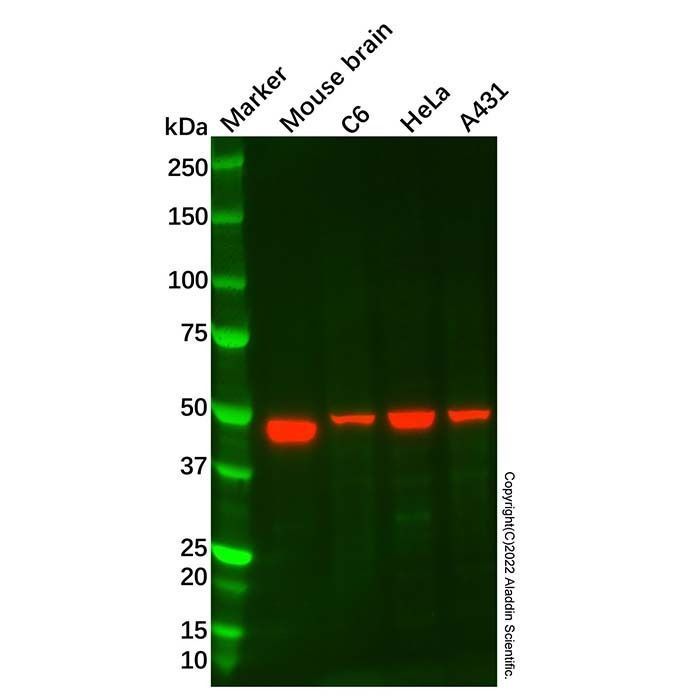
WB: Mouse brain, HeLa, A431, NIH/3T3 and C6 lysates. IHC: Human lung cancer tissue.
Conjugação
Unconjugated
Grau
ExactAb™, Recombinant, Validated
Isótipo
Rabbit IgG
SDS-PAGE
150 kDa
Método de purificação
Antigen affinity purified
Concentração
0.3 mg/mL
Product Line
Produtos biológicos
Armazenamento e envio
Forma
Liquid
Condições de armazenamento de armazenamento
Store at -20°C,Avoid repeated freezing and thawing
Enviado em
Ice chest + Ice pads
Estabilidade e armazenamento
Store at 4°C short term (1-2 weeks). Store at -20°C long term (24 months). Upon receipt, it is recommended to aliquot. Avoid freeze/thaw cycle.
Imagens
Recombinant Tissue Factor Antibody (Ab131401) - Western Blot All lanes: Recombinant Tissue Factor Antibody (Ab131401) at 1/1000 dilution Samples: Lysates at 20 µg per lane Secondary: Goat Anti-Rabbit IgG H&L (HRP) (Ab170144) at 1/20000 dilution
Predicted band size: 33 kDa Observed band size: 45 kDa Exposure time: 113.4 s
Recombinant Tissue Factor Antibody (Ab131401) - Western Blot All lanes: Recombinant Tissue Factor Antibody (Ab131401) at 1/1000 dilution Samples: Lysates at 20 µg per lane Secondary: Goat Anti-Rabbit IgG H&L (HRP) (Ab170144) at 1/20000 dilution
Predicted band size: 33 kDa Observed band size: 45 kDa Exposure time: 300.0 s
Recombinant Tissue Factor Antibody (Ab131401) - IHC Immunohistochemistry analysis of paraffin-embedded Human lung cancer using Recombinant Tissue Factor Antibody (Ab131401). High-pressure and temperature Sodium Citrate pH 6.0 was used for antigen retrieval.
Aplicação
Aplicação
Dilution info
WB
1/500-1/1000
IHC
1/50 - 1/100
Documentation
📋 Safety Data Sheet (SDS)
Comprehensive hazard, handling, storage, and regulatory compliance document.
Determine the necessary mass, volume, or concentration for preparing a solution.
Dilution Calculator
Determine the dilution needed to prepare a stock solution.
Reconstitution Calculator
Revisões
Avaliações dos Clientes
Application Protocols
Item-specific facts (from Product Data)
Manufacturer Applications: Not specified for this item; refer to CoA/Spec Sheet.
General starting-point protocols (to be optimized; literature)
Western blot: Start at 1:500–1:2000 primary dilution; incubate 1 h at room temp or overnight at 4°C. Use appropriate membrane blocking (5% BSA or milk) based on epitope sensitivity.
IHC/IF: Begin with 1–10 µg/mL or 1:100–1:500 dilution. Optimize antigen retrieval (citrate pH 6 or Tris-EDTA pH 9) and fixation method.
Flow cytometry: 0.1–1 µg per 10^6 cells as a starting range. Include Fc-block if using immune cells and appropriate viability dye.
ELISA: 0.1–1 µg/mL for capture or detection, depending on format; perform checkerboard titration.
Controls and validation (general)
Include isotype controls, secondary-only controls, and TF-positive/negative biological controls. Confirm linear dynamic range and limit of detection.
Note
The above are general literature ranges and not specifications for this item. Use the CoA/Spec Sheet for any manufacturer-validated conditions.
Biological Roles
General biology of the target (literature)
Tissue Factor (TF; gene F3, also known as CD142) is a transmembrane glycoprotein that functions as the primary initiator of the extrinsic coagulation pathway. TF binds Factor VII/VIIa, forming the TF–FVIIa complex that activates Factors IX and X, promoting thrombin generation and fibrin formation.
Expression: Predominantly found in subendothelial cells such as smooth muscle cells and fibroblasts; exposure upon vascular injury triggers coagulation. TF expression can be inducible in various cell types under inflammatory or stress conditions.
Structure: TF comprises an extracellular domain that binds FVII/FVIIa, a single-pass transmembrane helix, and a short cytoplasmic tail implicated in signaling.
Research significance: TF is widely studied in hemostasis, thrombosis, inflammation-associated coagulation, and cell signaling contexts. Antibodies to TF are used to map expression patterns, quantify surface levels, and interrogate TF–FVIIa signaling.
Item-specific note
This antibody is described as a “Recombinant Tissue Factor Antibody.” Specific epitope, isotype, affinity, species cross-reactivity, and validated applications for this item are not specified; refer to the CoA/Spec Sheet for definitive details.
Compliance
For research use only. No medical or clinical diagnostic claims are made or implied.
Buffer Applications
Applicability
This product is an antibody reagent, not a buffering agent. Therefore, buffer formulation as a primary application is not applicable.
Practical guidance for use (general)
Working buffers: PBS or TBS at pH ~7.2–7.6 are commonly used for antibody dilution. Include blocking proteins (e.g., BSA) and mild detergents as your assay requires; exact compatibility for this item is not specified.
Storage buffer: Composition for this item is not specified; consult the CoA/Spec Sheet. Avoid repeated freeze–thaw by aliquoting into low-binding tubes.
pH sensitivity: Extreme pH can denature antibodies or alter binding; maintain near-neutral conditions unless performing controlled elution steps.
Note
For validated buffers and any required additives specific to this antibody, refer to the CoA/Spec Sheet.
Green Alternatives
Context
Antibody use typically involves aqueous buffers and minimal volumes of hazardous solvents. “Green” considerations focus on buffer composition, blocking agents, detection chemistries, and waste minimization.
Greener practice suggestions (general)
Aqueous-only workflows: Favor PBS/TBS with biodegradable detergents at minimal effective concentrations. Avoid chlorinated solvents and minimize methanol or acetone use for fixation unless required by the protocol.
Blocking and detergents: Use plant-derived or certified sustainable blocking agents when compatible. Select low-toxicity detergents and optimize to reduce volumes.
Detection chemistry: Prefer non-heavy-metal fluorophores or enzyme substrates with lower hazard classifications; evaluate chemiluminescent reagents with improved EHS profiles.
Waste reduction: Optimize antibody titers to reduce reagent consumption; employ mini-blot and micro-IHC formats; regenerate affinity matrices when possible.
Cold-chain efficiency: Consolidate shipments and use reusable cold packs where allowable to reduce packaging footprint.
Item-specific note
No special formulation details are provided for this item; assess preservative and buffer components from the CoA/SDS and adapt greener alternatives where compatible with performance.
Pharmaceutical Uses
Applicability
This product is supplied for research use only. It is not intended for human or veterinary use, clinical diagnostics, or as an active pharmaceutical ingredient.
General context (literature/practice)
In pharmaceutical R&D, research-grade antibodies can be employed as analytical reagents in assays such as ELISA, Western blot, flow cytometry, or immunocapture during process and product characterization. They may support biomarker quantitation and mechanistic studies in preclinical research.
Reagent considerations: For GMP or regulated uses, purpose-built reagents with full qualification, traceability, and change control are required. Specifications such as isotype, sequence, endotoxin, bioburden, and stability must be established; these are not specified here.
Item-specific note
No pharmacopeial status, excipient role, or GMP suitability is provided for this item. For any regulated application, request documentation and assess suitability under your quality system.
Physical Properties
Item-specific facts (from Product Data)
Appearance: Not specified for this item; refer to CoA/Spec Sheet.
Concentration, buffer, excipients, pH: Not specified for this item; refer to CoA/Spec Sheet.
General properties for antibodies (literature)
Approximate size: IgG antibodies migrate near ~150 kDa by non-reducing SDS-PAGE; heavy chain ~50 kDa and light chain ~25 kDa by reducing SDS-PAGE. Actual values depend on isotype and glycosylation.
Solubility: Readily soluble in aqueous buffers (e.g., PBS, TBS) at neutral pH; precipitation can occur with extreme pH, high salt, or denaturants.
Isoelectric point (pI): Often in the 6–9 range for IgGs, clone-dependent.
Stability: Antibodies are sensitive to repeated freeze–thaw; stability is enhanced by aliquoting and storage at recommended temperatures.
Optical properties: Protein solutions typically show A280 for quantification (ε depends on sequence); UV–Vis profile will vary with formulation and concentration.
Notes
Do not treat general literature values as specifications for this item. Where exact values are required for method validation or comparability, consult the product CoA/Spec Sheet.
Quality and Grades
Item-specific facts (from Product Data)
Grade/Purity: Recombinant, ExactAb™, Validated.
Interpretation and implications (general)
Recombinant: Produced via controlled expression systems (e.g., mammalian or other hosts) for enhanced lot-to-lot consistency versus hybridoma-derived or polyclonal antibodies. Benefits include defined sequence and streamlined scalability. Exact host system for this item is not specified.
ExactAb™: Branded designation indicating a defined, sequence-controlled recombinant antibody offering enhanced reproducibility. It typically implies stringent release testing; refer to the CoA for the precise performance metrics tied to this item.
Validated: Indicates the antibody has undergone application-oriented testing. The specific tested applications, species reactivity, and positive controls for this item are not specified; consult the CoA/Spec Sheet for exact validation scope and results.
What to check on receipt
Review CoA for: isotype, concentration, buffer/preservatives, QC assays (purity by SDS-PAGE/SEC, endotoxin if relevant, binding specificity/affinity), and validated applications with recommended dilutions. Any such specifics are not provided here.
Keep documentation for method qualification/transfer and to ensure reproducibility across lots.
Reaction and Applications
Item-specific facts (from Product Data)
Labeled “Recombinant Tissue Factor Antibody”; validated, but specific tested applications are not provided. Use is for research only.
General research applications for Tissue Factor antibodies (literature)
Immunodetection: Western blotting (WB) to detect TF expression in lysates; immunohistochemistry (IHC/IHC‑P/IHC‑F) for tissue localization; immunofluorescence (IF) for cellular localization; ELISA for quantitative measurement; flow cytometry (FC) for surface TF on cells. Exact suitability and dilutions for this item are not specified.
Immunocapture: Pull-down/IP to enrich TF and co-complexes; validate epitope accessibility and denaturation sensitivity before use.
Assay development: Reference controls, standard curves, and spike-recovery experiments for quantitative workflows. Include appropriate negative and isotype controls.
Practical tips (general)
Antigen retrieval: For IHC, test citrate vs EDTA retrieval conditions; TF epitope exposure can be fixation-dependent.
Controls: Use TF-positive cell lines/tissues and TF-knockdown/knockout as negative controls where feasible.
Titration: Perform checkerboard titrations to determine optimal antibody concentration and incubation time; avoid high backgrounds by optimizing blocking and washing.
Detection: Choose secondary antibodies compatible with the primary’s isotype and species; if this is a recombinant monoclonal, isotype must be confirmed from the CoA.
Note
Application-specific recommendations for this item (dilutions, species reactivity, incubation times) are not specified; consult the CoA/Spec Sheet.
Reaction Conditions
Not typically applicable
Classical reaction condition scouting (solvent, temperature, catalysts) does not apply to antibody products.
Assay condition guidance (general)
Temperature: Perform binding/incubations at 4–25°C depending on assay type; avoid elevated temperatures that can denature antibodies.
Incubation: Primary antibody incubations range from 1–2 h at room temperature to overnight at 4°C; actual optimal conditions must be empirically determined.
Buffers: PBS or TBS with optimized blocking agents and detergents (e.g., 0.05–0.1% Tween-20 for WB/ELISA) are common. For flow cytometry, use protein-containing staining buffers to minimize non-specific binding.
Washes: Thorough but gentle washing reduces background while preserving antigen integrity.
Item-specific note
Validated application conditions (dilutions, times, retrieval, species) for this antibody are not specified; refer to the CoA/Spec Sheet and optimize for your system.
Safety and Handling
Item-specific facts (from Product Data)
GHS classification, signal word, pictograms, H-statements: Not specified for this item; refer to SDS.
Storage conditions: Store at -20°C. Avoid repeated freezing and thawing.
Shipping: Ice chest + ice pads (cold chain).
General guidance for antibodies and protein reagents (literature/practice)
Hazard profile: Most purified antibodies in aqueous buffers are not classified as hazardous; however, always consult the SDS. Preservatives (e.g., sodium azide) may be present in some formulations; composition for this item is not specified.
PPE: Laboratory coat, nitrile gloves, and safety eyewear. Avoid ingestion, inhalation of aerosols, and contact with skin/eyes.
Handling: Keep on ice during use. Mix gently—avoid vigorous vortexing and foaming which can denature proteins. Use low-retention tips and protein-compatible plastics.
Incompatibilities: Avoid strong oxidants, extreme pH, and proteases. Metal chelators, detergents, or carrier proteins may affect downstream assays depending on the formulation; composition for this item is not specified.
First aid (overview): Skin/eye contact—rinse with water. Ingestion—rinse mouth. Inhalation—move to fresh air. Seek medical attention if symptoms persist. SDS provides authoritative guidance.
Waste: Dispose of proteinaceous materials and any biologicals according to institutional biosafety procedures and local regulations.
Freeze–thaw: Minimize cycles by preparing single-use aliquots upon first thaw.
Solvent Selection
Applicability
This is an aqueous protein reagent; organic solvent selection is generally not applicable. Focus instead on compatible biological buffers and additives.
Practical guidance (general)
Compatible buffers (literature): Phosphate-buffered saline (PBS, pH ~7.2–7.4) or Tris-buffered saline (TBS) are commonly used for dilution and storage. Additives such as carrier proteins or mild detergents can impact assays; composition for this item is not specified.
Avoid: Strong organic solvents, extreme pH, chaotropes, and high shear, which can denature antibodies or disrupt binding.
Filtration: Use low protein-binding membranes (e.g., PVDF with appropriate pore size) if sterile filtration is required.
Note
For this specific item’s formulation and compatible diluents, details are not specified; refer to the CoA/Spec Sheet and validate buffer conditions in your assay system.
Storage and Reconstitution
Item-specific facts (from Product Data)
Storage: Store at -20°C. Avoid repeated freezing and thawing.
Shipping: Ice chest + ice pads.
Appearance, buffer, concentration, preservative: Not specified for this item; refer to CoA/Spec Sheet.
General recommendations (literature/practice)
Upon receipt: Verify integrity of cold chain. Centrifuge briefly to collect contents. Inspect for turbidity or precipitate.
Aliquoting: Prepare single-use aliquots in low-binding tubes to minimize freeze–thaw cycles. Record aliquot concentration and date.
Thawing/handling: Thaw on ice. Mix gently by pipetting; avoid vigorous vortexing or frothing.
Working solutions: Dilute with sterile, protein-compatible buffer (e.g., PBS/TBS with carrier protein if appropriate for the assay). Filter sterilize only if necessary using low protein-binding membranes.
Short-term storage: Keep on ice during use; store at 2–8°C for short periods if compatible with formulation. For long-term stability, adhere to the specified -20°C storage.
Reconstitution: If supplied lyophilized (not specified), reconstitute with sterile water or buffer per CoA instructions; allow gentle rocking to dissolve completely.
Note
Because formulation and concentration are not specified for this item, always consult the CoA/Spec Sheet for definitive guidance on reconstitution volumes, recommended diluents, and stability after opening.
Molecular formula: Not specified for this item; refer to CoA/Spec Sheet.
Molecular weight: Not specified for this item; refer to CoA/Spec Sheet.
SMILES / InChIKey / CAS / CID: Not applicable to proteins; not specified for this item; refer to CoA/Spec Sheet.
General description (literature)
Molecular class: Immunoglobulin (antibody) protein reagent, recombinant production.
Typical architecture: Y‑shaped heterotetramer (2 heavy + 2 light chains) with variable regions that bind antigen and constant regions that mediate Fc functions. If IgG, an apparent MW is typically ~150 kDa; actual size depends on isotype and glycosylation.
Target: Tissue Factor (TF), a cell-surface glycoprotein also known as coagulation factor III (F3/CD142). The antibody’s variable region is designed to recognize an epitope on TF; exact epitope/isotype are not specified for this item.
2D/functional depiction in words (literature)
Two antigen-binding fragments (Fabs) at the arms with complementarity-determining regions (CDRs) that engage Tissue Factor epitopes; one Fc stem that may be used for secondary antibody recognition or conjugation depending on isotype. Exact primary sequence and post-translational modifications are not specified for this item.
Synthetic Utility
Not typically applicable
As an antibody reagent, this product is not used as a synthetic building block or reagent in classical organic synthesis.
Where conceptually relevant (general)
Conjugation chemistry: Antibodies can be conjugated to enzymes, fluorophores, biotin, or linkers using chemistries such as NHS-ester labeling (lysines), maleimide-thiol coupling (reduced cysteines), click chemistry (azide–alkyne), or site-specific methods (e.g., enzymatic tags). For this item, no conjugation state or recommendations are specified.
Immobilization: Passive adsorption or covalent coupling (e.g., EDC/NHS to carboxylated matrices or Protein A/G capture) for immunoaffinity applications.
Item-specific note
Any sequence, isotype, or formulation details required to plan site-specific modifications are not specified; consult the CoA/Spec Sheet before developing conjugation workflows.
Target Specificity
Item-specific facts (from Product Data)
Antigen name: Tissue Factor
Clone, isotype, host species, conjugate, epitope: Not specified for this item; refer to CoA/Spec Sheet.
Species reactivity and cross-reactivity: Not specified for this item; refer to CoA/Spec Sheet.
Applications validated by manufacturer: Not specified for this item; refer to CoA/Spec Sheet.
Notes
Only target name is inferred from the product name. For precise specificity (epitope, affinity, off-target assessment), consult the CoA/Spec Sheet and SDS.
Perguntas frequentes
What does ExactAb? mean?
ExactAb? indicates the product has been validated for use in rigorous antibody validation workflows. Validation may include positive/negative control samples, signal-to-noise testing, and protocol-specific QC. Lot-specific test data is published on the Certificate of Analysis where available.
What does Recombinant mean?
Recombinant is a defined analytical purity tier suitable for workflows requiring a specific validated property. It specifies a minimum assay percentage, controlled limits on common impurities (water, heavy metals, residue on ignition), and lot-to-lot consistency. Recombinant is one of several purity tiers — choose based on the sensitivity and regulatory requirements of your method.
How should this product be stored?
Store at ?20 °C. Avoid repeated freeze–thaw cycles. Aliquot into single-use volumes before freezing.
How is this product shipped?
This product ships in an insulated container with ice pads. Unpack on arrival and transfer it to the storage condition stated above.
What documentation is provided?
Available product documentation, including Certificates of Analysis (COA), Safety Data Sheets (SDS), and specification sheets, is shown in the product document area. Document availability and access follow the current site policy.
Which species reactivity has this antibody been validated against?
Validated reactivity is listed on the PDP and on each lot's datasheet. We validate against the most commonly tested species for the target (Recombinant Tissue Factor Antibody); cross-reactivity in untested species may exist but is not guaranteed. Contact technical support for specific species inquiries.
Need help choosing the grade?
Our grade selection guide covers purity, stabilizer status, and application suitability for all variants in our catalog.
Usamos cookies para garantir o funcionamento adequado do site e, quando permitido, para melhorar a sua experiência. Você pode gerenciar suas preferências a qualquer momento nas Configurações. Saiba mais em nossa Política de Cookies.
Deseja que lhe enviemos uma mensagem quando tivermos descontos disponíveis?
Lembrar-me mais tarde
Obrigado! Por favor, verifique a sua caixa de entrada de e-mail para confirmar.
Products are supplied to verified businesses, institutions, and qualified professionals for research and development use only. Not for use in humans, animals, diagnosis, or therapy.

 ZJ24F0606502