GRADE & PURITYRecombinant?Recombinant — produced via recombinant expression for defined sequence and consistency. Use for reproducible, animal-free proteins of known origin.ExactAb™?ExactAb™ — Aladdin's antibody line emphasizing precision and validated quality. Use for reliable, specificity-validated antibody applications.Validated?Validated grade — performance confirmed in defined applications before release. Use when you want documented assurance the reagent works as stated.See COA
Recombinant, ExactAb™, Validated, See COA ExactAb™,Recombinant,Validated for sensitive chromatographic and analytical workflows requiring minimal baseline interference.
🌡
Storage & shipping
Store at -20°C,Avoid repeated freezing and thawing Ships Ice chest + Ice pads Check lot-specific COA for exact specifications.
📋
Quality documents
SDS, COA, datasheet, and spec sheet available for download. Lot-specific COA accessible via lot number lookup.
📚
Literature proof
Cited in 0 peer-reviewed publications across chromatography, organic synthesis, and cross-coupling reactions.
Visão geral
Rabbit anti Human UQCRFS1/RISP Antibody, Recombinant, could be used for WB and so on. Application: WB: 1/1000-1/2000 Protein Function: Component of the ubiquinol-cytochrome c reductase complex (complex III or cytochrome b-c1 complex), which is a respiratory chain that generates an electrochemical potential coupled to ATP synthesis. The transit peptide of the Rieske protein seems to form part of the bc1 complex and is considered to be the subunit 11/IX of that complex.
Specifications
Product Name
Recombinant UQCRFS1/RISP Antibody - Anticorpo primário, specific to UQCRFS1, Rabbit IgG
Sinónimos
Complex III subunit 5 | Cytochrome b6f complex iron sulfur subunit, chloroplastic | petC | PGR1 | Plastohydroquinone:plastocyanin oxidoreductase iron sulfur protein | Proton gradient regulation protein 1 | Rieske iron sulfur protein | RIP1 | RIS1 | RISP |
Especificações e pureza
Recombinant, ExactAb™, Validated, See COA
Espécie hospedeira
Coelho
Especificidade
UQCRFS1
Imunogénio
A synthetic peptide derived from human UQCRFS1 (AA 220-274)
Store at -20°C,Avoid repeated freezing and thawing
Enviado em
Ice chest + Ice pads
Estabilidade e armazenamento
Store at 4°C short term (1-2 weeks). Store at -20°C long term (24 months). Upon receipt, it is recommended to aliquot. Avoid freeze/thaw cycle.
Imagens
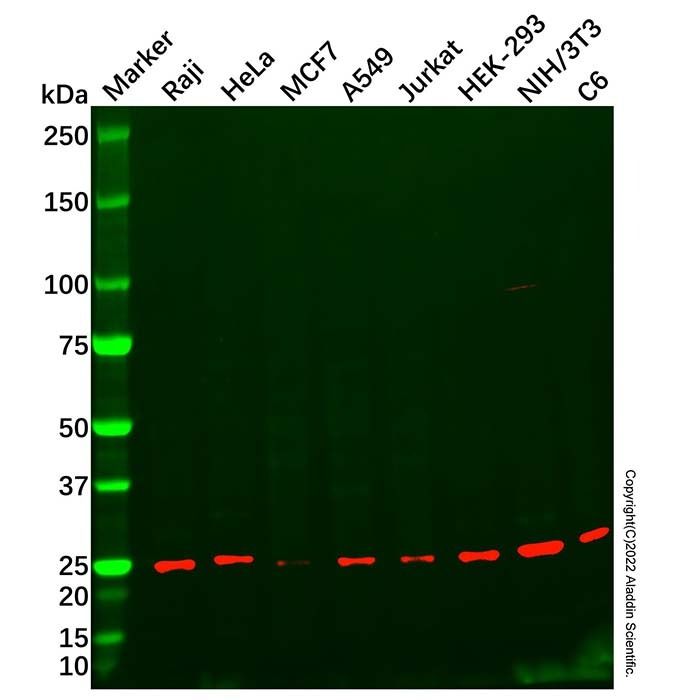
Recombinant UQCRFS1/RISP Antibody (Ab133588) - Western Blot All lanes: Recombinant UQCRFS1/RISP Antibody (Ab133588) at 1/1000 dilution Samples: Lysates at 20 µg per lane Secondary: Goat Anti-Rabbit IgG H&L (HRP) (Ab176443) at 1/20000 dilution
Predicted band size: 30 kDa Observed band size: 25 kDa Exposure time: 2.8 s
Aplicação
Aplicação
Dilution info
WB
1/1000 - 1/2000
Documentation
📋 Safety Data Sheet (SDS)
Comprehensive hazard, handling, storage, and regulatory compliance document.
Determine the necessary mass, volume, or concentration for preparing a solution.
Dilution Calculator
Determine the dilution needed to prepare a stock solution.
Reconstitution Calculator
Revisões
Avaliações dos Clientes
Application Protocols
Item-specific protocols and recommended dilutions: Not specified for this item; refer to CoA/Spec Sheet.
Notes
Because validated applications and working dilutions are not provided for Ab133588, users should follow institutional best practices for antibody titration and control selection, and consult the product CoA when available.
Biological Roles
General background on the antigen UQCRFS1/RISP (literature; not product-specific)
Function: UQCRFS1 encodes the Rieske iron–sulfur protein of the mitochondrial cytochrome bc1 complex (Complex III). It harbors a [2Fe–2S] cluster and mediates electron transfer from ubiquinol to cytochrome c1 within the Q-cycle.
Cellular localization: Inner mitochondrial membrane as a peripheral subunit of Complex III; the catalytic domain undergoes conformational movement between Qo and cytochrome c1 sites.
Biological significance: Essential for oxidative phosphorylation, proton motive force generation, and ATP production. Defects affect mitochondrial respiration and can alter reactive oxygen species production.
Protein processing: Synthesized in the cytosol with an N-terminal targeting sequence; imported into mitochondria and assembled into Complex III with coordinated biogenesis of other subunits and cofactors.
Implications for experimental design (general)
Expression context: Highest in mitochondria-rich tissues/cell types. Sample preparation that preserves mitochondrial integrity (e.g., gentle isolation buffers) can improve signal.
Controls: Parallel probing of other OXPHOS markers (e.g., NDUFA9 for Complex I, COX IV for Complex IV, ATP5A for ATP synthase) aids interpretation of respiratory chain composition and assembly states.
Buffer Applications
Not typically applicable. This product is an antibody reagent and is not used as a buffering agent. For experimental use with antibodies, see Solvent Selection for general guidance on compatible buffers (PBS/TBS, blocking agents, detergents).
Green Alternatives
Limited applicability. This product is a biologic reagent rather than a process solvent or bulk chemical.
General sustainability considerations for antibody use (literature/general)
Shipping and cold-chain: Consolidate orders to reduce packaging and cold-chain emissions. This item ships on ice pads; minimize transit time and avoid dry ice when -20°C is sufficient.
Buffer choices: Use phosphate- or Tris-based buffers prepared from concentrated stocks to reduce plastic waste; avoid azide when possible for easier wastewater treatment (only if bioburden control allows).
Reusability: Aliquot upon first thaw to minimize waste from activity loss due to freeze–thaw cycles.
Lab plastics: Prefer refillable reservoirs and recyclable tip boxes; validate low-retention, reusable vessels where appropriate to reduce adsorption losses and waste.
Pharmaceutical Uses
Not applicable to this research reagent. This antibody is labeled For research use only and is not intended for diagnostic or therapeutic applications.
General context (literature/general)
In pharmaceutical development laboratories, research-grade antibodies may be used as analytical reagents in assays (e.g., Western blot, ELISA) to characterize cell lines, pathway engagement, or mitochondrial content in preclinical studies. Such use is distinct from GMP-grade or clinical diagnostics materials.
Physical Properties
Item-specific facts (from Product Data)
Appearance: Not specified for this item; refer to CoA/Spec Sheet.
Concentration, buffer composition, stabilizers (e.g., glycerol, BSA, azide): Not specified for this item; refer to CoA/Spec Sheet.
Molecular formula/weight: Not specified for this item; refer to CoA/Spec Sheet.
General/literature values for antibodies (for context only; not product-specific)
Isoelectric point (pI): commonly ~6–9 depending on isotype/sequence.
Solubility: High aqueous solubility in physiological buffers (PBS, TBS); sensitive to extreme pH, high ionic strength, and denaturants.
Stability enhancers: Polyols (e.g., 10–50% glycerol), carrier proteins (0.1–1% BSA), and preservatives (0.02–0.05% sodium azide) are often used to improve shelf life; exact presence/amounts are not specified for this item.
Freeze–thaw sensitivity: Repeated cycles can induce aggregation/functional loss; the Product Data specifically advises avoiding repeated freezing and thawing.
Quality and Grades
Item-specific facts (from Product Data)
Grade/Purity: Recombinant, ExactAb™, Validated.
Clarifications of terms (general)
Recombinant antibody: Produced by engineered expression systems (e.g., mammalian or other hosts) from defined sequences, providing lot-to-lot consistency versus hybridoma-derived monoclonals or polyclonals.
ExactAb™: A manufacturer line-name indicating sequence-defined, recombinant production and stringent QC; consult the certificate of analysis for the specific QC tests performed for Ab133588.
Validated: Indicates the product has undergone functional verification. Since specific applications/assays and acceptance criteria are not listed for this item, refer to the CoA/Spec Sheet for details (e.g., tested species, assay formats, dilution ranges).
What this means for your experiments
Lot-to-lot consistency: Recombinant production typically reduces variability in affinity/avidity and background.
Documentation: For Ab133588, application-specific performance metrics (e.g., WB banding pattern, IHC staining quality, titers) are Not specified for this item; refer to CoA/Spec Sheet.
Additives/formulation: Not specified for this item; check CoA if you need azide-free/BSA-free formulations or low endotoxin.
Reaction and Applications
Item-specific facts (from Product Data)
Product purpose: Recombinant antibody against UQCRFS1/RISP; research use only.
Manufacturer Applications: Not specified for this item; refer to CoA/Spec Sheet.
General application landscape for anti-UQCRFS1 antibodies (literature/general)
Western blot (WB): Detection of UQCRFS1 in mitochondrial fractions or whole-cell lysates to assess Complex III content or assembly status. Typical SDS-PAGE under reducing conditions; employ chemiluminescent or fluorescent detection.
Immunocytochemistry/Immunofluorescence (ICC/IF): Mitochondrial localization studies; co-stain with mitochondrial markers (e.g., TOMM20) and use appropriate fixation (paraformaldehyde) and permeabilization (saponin/Triton X-100) strategies.
Immunohistochemistry (IHC): Tissue-level distribution in energy-demanding tissues; antigen retrieval conditions vary—optimize empirically.
Immunocapture/Co-IP: Probe assembly of Complex III and supercomplexes; perform digitonin-based gentle solubilization to preserve native interactions.
Flow cytometry: Less common, but possible for intracellular targets following fixation/permeabilization.
Practical tips (general)
Load equal protein and include mitochondrial enrichment if target abundance is low.
Validate species cross-reactivity with positive controls known to express UQCRFS1; include negative controls (siRNA/CRISPR knockdown where feasible).
Optimize primary antibody dilution, incubation duration, and blocking buffer empirically. Since validated applications are not specified for this item, perform pilot titrations.
Reaction Conditions
Not applicable. Antibodies are not used as reagents in classical organic reactions with defined temperatures, catalysts, or yields. For assay conditions relevant to immunoapplications, refer to Reaction & Applications and to the CoA/Spec Sheet for any item-specific recommendations (not provided for this item).
Safety and Handling
Item-specific facts (from Product Data)
Storage: Store at -20°C. Avoid repeated freezing and thawing. Shipped in an ice chest with ice pads.
GHS classification, signal word, H-statements, pictograms: Not specified for this item; refer to SDS.
General guidance for protein antibodies (defer to SDS for authoritative instructions)
Expected hazards: Most research antibodies are considered non-hazardous proteins but may contain preservatives (e.g., sodium azide) in some formulations. Since the presence of preservatives is not specified for this item, consult the CoA/SDS.
PPE: Laboratory coat, nitrile gloves, and safety glasses. Handle using aseptic technique to prevent contamination.
Incompatibilities: Avoid strong oxidants and extreme pH; avoid freeze–thaw cycling which can cause aggregation and loss of activity.
First aid (general): If skin/eye contact occurs, rinse with water. If inhaled (aerosols), move to fresh air. If ingested, rinse mouth. Seek medical attention if adverse symptoms persist. Follow institutional biosafety policies.
Spill response: Absorb with inert material, clean with aqueous detergent, and dispose according to local regulations for biological materials.
Waste: Dispose in compliance with institutional and regional regulations for proteinaceous laboratory waste and any preservatives that may be present.
Solvent Selection
Not typically applicable. As a protein biologic, this antibody is supplied in an aqueous buffer (exact composition not specified for this item). For experimental use, choose biologically compatible buffers rather than organic solvents.
General guidance (literature/general)
Common working buffers: PBS or TBS at pH 7.2–7.6. Include 0.05–0.1% Tween-20 for washing steps in immunoassays to reduce nonspecific binding.
Stabilizers: 10–50% glycerol can enable storage at -20°C without freezing; carrier proteins (e.g., 0.1–1% BSA) can minimize adsorption. Presence/levels are not specified for this item.
Avoid: High percentages of organic solvents (e.g., >10% methanol or acetonitrile) and extreme pH, which can denature antibodies.
Storage and Reconstitution
Item-specific facts (from Product Data)
Storage conditions: Store at -20°C. Avoid repeated freezing and thawing.
Shipping: Shipped in an ice chest with ice pads.
Reconstitution instructions: Not specified for this item; refer to CoA/Spec Sheet.
General guidance (literature/general)
Upon receipt: If the product is liquid, briefly centrifuge to collect contents, aliquot into single-use volumes, and store at -20°C or below as directed. If lyophilized (not specified for this item), reconstitute with sterile buffer (e.g., PBS) to a convenient stock concentration and allow gentle mixing without vortexing.
Freeze–thaw: Minimize cycles; consider adding 10–50% glycerol to enable storage at -20°C without freezing (only if compatible with your assays).
Working stocks: Prepare assay-ready dilutions fresh in appropriate blocking/dilution buffer. Avoid prolonged exposure to room temperature and light.
Long-term storage: For extended storage beyond several months, -80°C is commonly used for antibodies if compatible with formulation; verify against CoA/Spec Sheet for this item.
Molecular formula: Not specified for this item; refer to CoA/Spec Sheet.
Molecular weight: Not specified for this item; refer to CoA/Spec Sheet.
CAS, CID, InChIKey, SMILES: Not applicable to protein biologics; not provided for this item.
General/literature notes
Antibodies are protein macromolecules composed of immunoglobulin domains. Typical full-length IgG contains two heavy and two light chains with disulfide linkages and N-linked glycosylation (literature).
Typical IgG apparent molecular weight is ~150 kDa by SDS-PAGE under non-reducing conditions; ~50 kDa (heavy) and ~25 kDa (light) under reducing conditions (literature). Actual values vary by isotype/format.
Target antigen: UQCRFS1, also known as RISP (Rieske iron–sulfur protein), a subunit of mitochondrial complex III (bc1 complex). The antibody recognizes epitopes within UQCRFS1; exact epitope/clone/isotype not specified for this item.
2D/structural description (general for antibodies)
Modular immunoglobulin fold with variable domains (antigen-binding) and constant regions (effector). Antigen recognition is mediated by CDR loops in the variable regions (literature).
Synthetic Utility
Not applicable. As a recombinant antibody, this product is not a small-molecule building block and is not employed in chemical synthesis or named reactions. For practical use cases, see Reaction & Applications and Biological Roles.
Target Specificity
Item-specific facts (from Product Data)
Antigen/Target: UQCRFS1/RISP (Rieske iron–sulfur protein of mitochondrial Complex III)
Clone, isotype, host, epitope, and species reactivity: Not specified for this item; refer to CoA/Spec Sheet.
Notes
Without clone/isotype and validated species data, end-users should perform preliminary experiments to confirm reactivity in their specific species/tissues and application formats.
Perguntas frequentes
What does ExactAb? mean?
ExactAb? indicates the product has been validated for use in rigorous antibody validation workflows. Validation may include positive/negative control samples, signal-to-noise testing, and protocol-specific QC. Lot-specific test data is published on the Certificate of Analysis where available.
What does Recombinant mean?
Recombinant is a defined analytical purity tier suitable for workflows requiring a specific validated property. It specifies a minimum assay percentage, controlled limits on common impurities (water, heavy metals, residue on ignition), and lot-to-lot consistency. Recombinant is one of several purity tiers — choose based on the sensitivity and regulatory requirements of your method.
How should this product be stored?
Store at ?20 °C. Avoid repeated freeze–thaw cycles. Aliquot into single-use volumes before freezing.
How is this product shipped?
This product ships in an insulated container with ice pads. Unpack on arrival and transfer it to the storage condition stated above.
What documentation is provided?
Available product documentation, including Certificates of Analysis (COA), Safety Data Sheets (SDS), and specification sheets, is shown in the product document area. Document availability and access follow the current site policy.
Which species reactivity has this antibody been validated against?
Validated reactivity is listed on the PDP and on each lot's datasheet. We validate against the most commonly tested species for the target (Recombinant UQCRFS1/RISP Antibody); cross-reactivity in untested species may exist but is not guaranteed. Contact technical support for specific species inquiries.
Need help choosing the grade?
Our grade selection guide covers purity, stabilizer status, and application suitability for all variants in our catalog.
Usamos cookies para garantir o funcionamento adequado do site e, quando permitido, para melhorar a sua experiência. Você pode gerenciar suas preferências a qualquer momento nas Configurações. Saiba mais em nossa Política de Cookies.
Deseja que lhe enviemos uma mensagem quando tivermos descontos disponíveis?
Lembrar-me mais tarde
Obrigado! Por favor, verifique a sua caixa de entrada de e-mail para confirmar.
Products are supplied to verified businesses, institutions, and qualified professionals for research and development use only. Not for use in humans, animals, diagnosis, or therapy.

 ZJ24F1012450