This compound belongs to the class of organic compounds known as 1,2-diols. These are polyols containing an alcohol group at two adjacent positions.
External Descriptors
butane-1,2-diol
1. Djoumbou Feunang Y, Eisner R, Knox C, Chepelev L, Hastings J, Owen G, Fahy E, Steinbeck C, Subramanian S, Bolton E, Greiner R, and Wishart DS. ClassyFire: Automated Chemical Classification With A Comprehensive, Computable Taxonomy. Journal of Cheminformatics, 2016, 8:61.
Determine the necessary mass, volume, or concentration for preparing a solution.
Dilution Calculator
Determine the dilution needed to prepare a stock solution.
Reconstitution Calculator
Revisões
Avaliações dos Clientes
Application Protocols
No assay or application protocols are provided for this item.
General guidance
For synthetic transformations, follow literature procedures appropriate to vicinal diols and confirm conditions by small-scale trials.
For biocatalytic resolutions or acylations, consult enzyme vendor recommendations for solvent, water activity, and temperature control.
For validated, product-specific protocols (e.g., analytical methods, chiral HPLC conditions, drying procedures), refer to the item’s CoA/Spec Sheet or contact Technical Support.
Biological Roles
This product is provided strictly for research use. The following notes summarize general biochemical context for vicinal diols and 1,2-butanediol-type compounds.
General/literature context
Metabolism: Aliphatic 1,2-diols can be substrates for microbial alcohol dehydrogenases and oxidases, undergoing stepwise oxidation to hydroxyketones or diketones; metabolic pathways are organism-dependent.
Enzymatic selectivity: Lipases and esterases often display high regio- and enantioselectivity toward secondary vs primary alcohol acylation in 1,2-diols, enabling kinetic resolution or desymmetrization strategies.
Interactions: Strong hydrogen bonding and hydrophilicity influence partitioning between aqueous and organic phases and can affect enzyme activity in nonaqueous media.
Not provided for clinical/diagnostic use; no claims are made regarding physiological effects or therapeutic relevance. For any biological experimentation, confirm compatibility with your system and consult the SDS for safe handling.
Buffer Applications
(S)-1,2-Butanediol is not a buffering agent and is not typically used to set or maintain pH in biochemical systems. If present, it would act as a polar organic cosolvent or cryo-/stabilizing additive in materials or enzyme media rather than as a buffer component.
For pH control, select established buffer systems (e.g., phosphate, HEPES, Tris) appropriate to your target pH and ionic strength. Refer to our Buffer and Biochemicals categories for suitable buffering reagents.
Green Alternatives
Context: (S)-1,2-Butanediol is commonly used as a chiral reagent/building block rather than a commodity solvent. Green chemistry considerations thus focus on sourcing, protection group economy, and safer reagents.
Greener choices and strategies (literature/general)
Bio-based sourcing: 1,2-butanediol can be prepared via catalytic hydrogenation or biocatalytic routes from renewable feedstocks; inquire about origin if lifecycle impact matters for your program.
Protection minimization: Prefer chemoselective transformations that avoid unnecessary protection/deprotection of the diol (atom economy, reduced waste).
Carbonate couplings: Use CDI (carbonyldiimidazole) instead of phosgene-derived reagents for carbonate formation.
Oxidants: Favor catalytic TEMPO/O2 or Swern over heavy-metal oxidants; avoid stoichiometric Pb(IV) or Cr(VI) where possible.
Solvent selection: For workups and reactions, consider 2-MeTHF or CPME (from renewable sources) in place of chlorinated solvents when polarity requirements allow.
Illustrative comparison (general)
Periodate cleavage vs oxidative C–C scission with H2O2/Fe catalysts: Catalytic systems reduce inorganic salt waste but may require optimization.
Lipase-catalyzed acylation in green media (2-MeTHF, supercritical CO2, or solvent-free) can lower VOC burden versus traditional polar aprotics.
Tradeoffs
High polarity/viscosity of diols can increase energy for mixing and separation. Alternative, lower-viscosity cosolvents may reduce energy use but can alter selectivity.
Pharmaceutical Uses
No item-specific pharmacopeial status or excipient grade is provided for this product.
Item-specific
Grade/Compliance: Not specified for this item; refer to CoA/Spec Sheet.
General context (non-clinical, literature)
Some low-molecular-weight diols are used industrially as humectants, solvents, or plasticizer precursors in formulation development. However, 1,2-butanediol is less common than propylene glycol or glycerol in regulated pharmaceutical applications.
If considering use in pre-formulation or materials research, verify:
Residual solvent and impurity profiles (meets ICH Q3C/Q3A expectations if relevant to your workflow).
Optical purity and stability under processing conditions (thermal history, pH exposure).
Extractables/leachables compatibility with contact materials due to the compound’s polarity and hydrogen-bonding capacity.
Note: This product is supplied for research use only and is not intended for human or animal administration.
Physical Properties
Item-specific specifications
Appearance: Not specified for this item; refer to CoA/Spec Sheet.
Grade/Purity: Not specified for this item; refer to CoA/Spec Sheet.
Literature values (for general reference; not item specifications)
State at RT: typically a colorless, hygroscopic liquid (literature for 1,2-butanediol enantiomers).
Boiling point: ~193–195 °C at 1 atm (literature).
Melting point: well below 0 °C; remains liquid at ambient conditions (literature).
Density: ~0.90–0.92 g/mL at 20 °C (literature ranges).
Refractive index: nD20 ~1.436–1.440 (literature).
Solubility: miscible with water, alcohols, and many polar organic solvents; limited solubility in nonpolar hydrocarbons (literature).
LogP (octanol/water): low/negative, consistent with polar diols (literature qualitative).
pKa (O–H): ~15–16 (very weak acid; literature for aliphatic alcohols).
Practical notes
Strong hydrogen bonding and high polarity lead to high boiling point and significant viscosity relative to mono-alcohols of similar mass.
Water content can appreciably affect viscosity and reactivity; for moisture-sensitive transformations, dry over molecular sieves (3 Å) prior to use.
Quality and Grades
Item-specific quality information
Grade/Purity: Not specified for this item; refer to CoA/Spec Sheet.
Stabilizers/Inhibitors: Not specified for this item; refer to CoA/Spec Sheet.
Interpreting common grades (general guidance)
Chemical grade (technical): Suitable for routine synthesis where trace UV-active or ionic impurities are not critical.
Reagent/AR grade: Tighter control of common impurities; appropriate for analytical procedures and sensitive transformations.
Chiral purity: For an enantiopure listing such as (S)-1,2-butanediol, two distinct measures matter: chemical purity (area %) and enantiomeric excess (ee or er). Verify both on the CoA.
Water content: Diols are hygroscopic; Karl Fischer moisture content can influence stoichiometry and reactivity in moisture-sensitive reactions. Check the CoA and dry as needed.
UV cutoffs/metal content: If using in photochemical or catalysis workflows, consult the Spec Sheet for UV background and trace metals.
Practical notes
If optical rotation is provided on the CoA, confirm cell pathlength, temperature, wavelength (commonly 589 nm), and solvent to compare with literature values.
For exact assay method (GC, HPLC, chiral GC/HPLC) and impurity profile, refer to the item’s CoA.
Reaction and Applications
(S)-1,2-Butanediol serves as a versatile chiral vicinal diol in synthesis. The secondary alcohol at C2 and primary alcohol at C1 allow differential functionalization and protection strategies.
Protection/derivatization: Formation of cyclic acetals/ketals and dioxolanes with carbonyls; conversion to boronate esters or silyl ethers for orthogonal protection; carbonate formation (e.g., with triphosgene or carbonyldiimidazole) for diol coupling.
Selective activation: Monotosylation/mesylation of the primary OH (TsCl or MsCl, base) enabling intramolecular cyclization or nucleophilic substitution; secondary OH can be inverted under Mitsunobu conditions for access to (R)-derivatives of downstream products.
Oxidation/cleavage: Periodate or lead tetraacetate cleavage of vicinal diols to carbonyl fragments (useful in degradative studies); selective oxidation of the secondary OH to a ketone under TEMPO- or Dess–Martin-type conditions (with protection of the primary OH as needed).
Chiral building block: Source of the (S)-configured center in constructing β-substituted alcohols, 1,2-aminoalcohols (via sulfonate displacement/azidation-reduction), or cyclic ethers via intramolecular substitutions.
Biocatalysis: Substrate for lipase-catalyzed regio-/enantioselective acylation providing differentially protected derivatives with retention of stereochemical integrity.
Practical tips
Drying: Use 3 Å molecular sieves to reduce water content before moisture-sensitive couplings.
Control of selectivity: Exploit differing reactivity of primary vs secondary OH to achieve regioselectivity; employ protecting groups for orthogonal sequences.
Optical purity: Verify ee/er after transformations that may induce epimerization or SN1-type conditions.
Reaction Conditions
General literature guidance for common transformations of 1,2-diols; adjust to your substrate and scale. These are not item-specific specifications.
Selective monotosylation (primary OH): TsCl (1.05–1.2 equiv), pyridine or Et3N (2–3 equiv), 0–25 °C, 2–6 h. Monitor by TLC/GC. Work up by aqueous quench and extract; typical isolated yields 70–90% (literature).
Mitsunobu inversion at secondary OH: DEAD or DIAD (1.2–1.5 equiv), PPh3 (1.2–1.5 equiv), carboxylic acid nucleophile (1.5–2 equiv), THF or toluene, 0 °C to RT, 2–16 h; inversion at C2 expected (literature). Exercise care with energetic reagents.
Carbonate formation (di- or monocyclic): CDI (1.1–2.2 equiv), DMF/MeCN, RT to 50 °C, 2–12 h; or triphosgene (0.5–1.0 equiv) with base at 0–25 °C (literature).
Oxidation to hydroxyketone: Dess–Martin periodinane (1.3 equiv), CH2Cl2, 0 °C to RT, 1–3 h; protect primary OH if selectivity is required (literature yields often 70–85%).
Periodate cleavage: NaIO4 (1.2–1.5 equiv), MeOH/H2O or acetone/H2O, 0–25 °C, 0.5–3 h; affords carbonyl fragments; control exotherm and quench oxidant (literature).
Enzymatic acylation (regio-/enantioselective): Vinyl acetate or isopropenyl acetate (2–5 equiv), lipase (e.g., CAL-B, immobilized), 25–50 °C, solvent such as 2-MeTHF, MTBE, or neat; monitor ee/er by chiral HPLC (literature).
Tips
Dry the diol and solvents for moisture-sensitive couplings.
Verify ee before and after steps that may epimerize; use chiral HPLC/GC or optical rotation as appropriate.
Safety and Handling
Authoritative safety information must be taken from the product SDS. The following summarizes general practices for vicinal diols like 1,2-butanediol.
Item-specific hazard data
Signal word: Not specified for this item; refer to SDS.
H-statements / GHS classification / Pictograms: Not specified for this item; refer to SDS.
General safety guidance (literature/general)
Hazards: Aliphatic diols are generally of low volatility yet can cause eye and skin irritation. Avoid inhalation of mists/aerosols. Combustible at elevated temperatures.
PPE: Lab coat, safety glasses or face shield, and nitrile gloves. Use splash protection when handling larger volumes.
Engineering controls: Handle in a well-ventilated area; use a fume hood for heating, charging, or when generating vapors/aerosols.
Incompatibilities: Strong oxidizers (risk of exothermic oxidation); strong dehydrating agents; acid-catalyzed dehydration can produce ethers/olefins; reactive with acid chlorides/anhydrides (intended synthetic transformations).
First aid (overview):
Eyes: Rinse cautiously with water for several minutes; remove contact lenses if present and easy to do; seek medical attention if irritation persists.
Skin: Wash with soap and water; remove contaminated clothing.
Ingestion: Rinse mouth; do not induce vomiting; seek medical advice.
Inhalation: Move to fresh air; monitor for respiratory irritation.
Fire response: Use water fog, alcohol-resistant foam, dry chemical, or CO2. Cool containers with water spray.
Peroxide formation: Not typically a peroxide-forming class (unlike ethers).
Solvent Selection
(S)-1,2-Butanediol is primarily a chiral building block and reactant rather than a routine reaction solvent; however, its polarity and hydrogen-bonding capacity influence its handling.
General solvent characteristics (literature/general)
Polarity: Polar protic; high hydrogen-bond donor/acceptor capacity.
Dielectric behavior: Higher than monoalcohols of similar MW; supports dissolution of salts to a limited extent.
Miscibility: Miscible with water and most polar organics (alcohols, acetone, DMF, DMSO); limited with apolar hydrocarbons.
When to use or avoid
Use cases: As a reaction medium for biocatalytic or solvolytic processes where a chiral diol is a participant; as a viscous cosolvent/humectant in materials research.
Avoid as primary solvent when: Low viscosity, rapid mass transfer, or low-boiling conditions are critical; choose lower-boiling alcohols (MeOH, EtOH) or dipolar aprotics (MeCN, DMF) instead.
Comparison (general)
Relative to ethylene glycol/propylene glycol: Lower viscosity, higher volatility; more hydrophobic due to the ethyl substituent.
Relative to 2-MeTHF/EtOAc: Much more polar and higher-boiling; unsuitable as a drop-in replacement for typical organic extractions.
Storage and Reconstitution
Item-specific storage
Recommended storage condition: Room temperature (as provided in Product Data).
Shipping: Normal.
General handling for diols (literature/general)
Container: Store tightly closed in an inert container to minimize moisture uptake and oxidative discoloration. Amber glass is preferred when long-term storage at elevated light exposure is possible.
Atmosphere: Not air-sensitive; for long-term storage, blanket headspace with dry nitrogen to limit water uptake.
Stability: Typically stable at ambient conditions. Avoid prolonged exposure to strong acids/bases or elevated temperatures that can promote dehydration or oxidation.
Reconstitution
Not applicable; supplied neat. If solidification occurs at low temperature, gently warm to ambient and mix thoroughly before use.
Before critical applications
If water content or optical purity is critical, verify by Karl Fischer titration and chiral HPLC/GC or optical rotation, respectively.
Structure and Identity
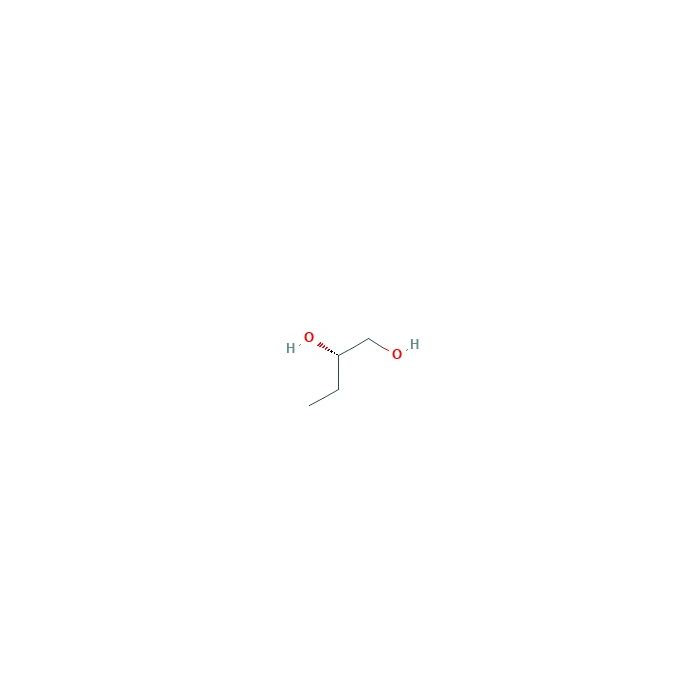
Overview: (S)-1,2-Butanediol is a chiral vicinal diol with one stereogenic center at C2; it is the (S)-enantiomer of 1,2-butanediol.
Item-specific (from Product Data)
CAS: 73522-17-5
InChIKey: 28895 (as provided)
Storage: Room temperature
Shipping: Normal
Literature/computed identifiers and descriptors (for reference; not item specifications)
Common name: (S)-butane-1,2-diol; (S)-1,2-butanediol
Functional groups: two primary/secondary alcohols (vicinal diol), capable of intra-/intermolecular hydrogen bonding.
Stereochemistry: one chiral center at C2 with S configuration.
2D description: a four-carbon chain; carbon-1 bears a primary hydroxyl (–CH2OH), carbon-2 bears a secondary hydroxyl (–CHOH–) with S configuration; carbons 3–4 terminate in –CH2–CH3.
Notes
Enantiopure materials should be handled to avoid racemization during strongly acidic/basic or high-temperature processes.
Synthetic Utility
Key reactivity features of (S)-1,2-butanediol (literature/general)
Bifunctional handle: Differentiable primary and secondary hydroxyls enable stepwise derivatization (e.g., selective sulfonation, acylation, or silylation).
Chiral center transfer: The (S) configuration at C2 can be embedded into downstream targets (e.g., β-substituted alcohols, 1,2-aminoalcohols) via substitution on activated derivatives with retention/inversion control.
Cyclic derivatives: Intramolecular cyclization after monotosylation can access tetrahydrofuran derivatives; carbonate or cyclic sulfate formation opens to nucleophilic ring-opening chemistry.
Redox and cleavage: Selective oxidation (Dess–Martin, TEMPO) of the secondary OH to ketones; vicinal diol cleavage (periodate) to carbonyl fragments for chain-shortening or analytical purposes.
Protecting group chemistry: Temporary masking of one OH (e.g., TBS, TBDPS) while transforming the other provides orthogonality in multistep synthesis.
Practical utility
Regioselectivity: Kinetic control and steric bias favor reactions at the primary OH; catalysts (enzymatic or organocatalytic) enhance selectivity at the secondary center.
Stereochemical integrity: Avoid strongly acidic, solvolytic, or SN1-promoting conditions that risk racemization at C2; Mitsunobu can invert configuration predictably when desired.
Target Specificity
Not applicable. This product is a small-molecule chiral diol and is not an antibody, ligand-binding probe, or targeted biological reagent. No target specificity data are provided for this item.
Perguntas frequentes
What is the purity of this product, and how is it determined?
This product is supplied at ≥98% purity, determined by gas chromatography (GC). Lot-specific values are stated on the Certificate of Analysis.
How should this product be stored?
Store at room temperature.
How is this product shipped?
This product ships under standard ambient conditions. No temperature-controlled packaging is required.
What are the CAS number, molecular formula and molecular weight?
The CAS Number is 73522-17-5, the molecular formula is C4H10O2, and the molecular weight is 90.12 g/mol. InChIKey BMRWNKZVCUKKSR-BYPYZUCNSA-N.
What documentation is provided?
Available product documentation, including Certificates of Analysis (COA), Safety Data Sheets (SDS), and specification sheets, is shown in the product document area. Document availability and access follow the current site policy.
Usamos cookies para garantir o funcionamento adequado do site e, quando permitido, para melhorar a sua experiência. Você pode gerenciar suas preferências a qualquer momento nas Configurações. Saiba mais em nossa Política de Cookies.
Deseja que lhe enviemos uma mensagem quando tivermos descontos disponíveis?
Lembrar-me mais tarde
Obrigado! Por favor, verifique a sua caixa de entrada de e-mail para confirmar.
Products are supplied to verified businesses, institutions, and qualified professionals for research and development use only. Not for use in humans, animals, diagnosis, or therapy.

 I1728074