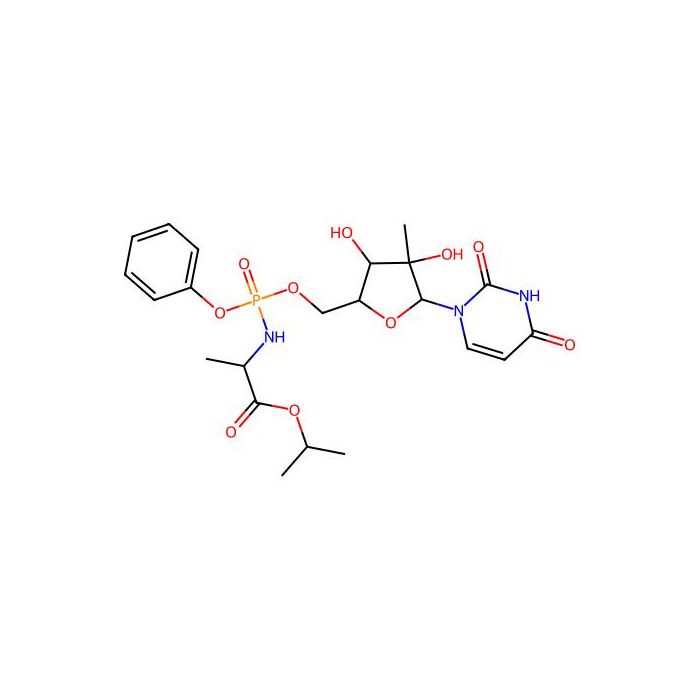
Sofosbuvir impurity M, an diastereoisomer of Sofosbuvir, is the impurity of Sofosbuvir. Sofosbuvir (PSI-7977) is an inhibitor of HCV RNA replication, demonstrates potent anti-hepatitis C virus activity.
Form:Solid
IC50& Target:HCV
Especificações
Especificações e pureza
≥99%
Mecanismos bioquímicos e fisiológicos
Sofosbuvir impurity M, an diastereoisomer of Sofosbuvir, is the impurity of Sofosbuvir. Sofosbuvir (PSI-7977) is an inhibitor of HCV RNA replication, demonstrates potent anti-hepatitis C virus activity.
Condições de armazenamento de armazenamento
Store at -20°C
Enviado em
Ice chest + Ice pads
Este produto requer transporte de cadeia fria. Serviços terrestres e outros serviços econômicos não estão disponíveis.
Determine the necessary mass, volume, or concentration for preparing a solution.
Dilution Calculator
Determine the dilution needed to prepare a stock solution.
Reconstitution Calculator
Revisões
Avaliações dos Clientes
Application Protocols
No vendor-tested biological assay protocols are provided for this product. For analytical quality-control applications, the following generalized protocol outline can be adapted (non-item-specific):
Stock solution: Accurately weigh an appropriate amount into an amber vial. Dissolve in HPLC-grade acetonitrile or DMSO to prepare a primary stock. Filter if necessary.
Working standards: Dilute the stock with initial mobile phase or diluent (organic/aqueous mixture) to calibration levels spanning expected impurity ranges (e.g., 0.02–1.0% relative to API concentration). Validate linearity and precision.
LC method: Reversed-phase C18 is common for nucleoside analogs. Optimize gradient, column temperature, and additive (e.g., 5–20 mM ammonium formate/acetate) for peak shape and MS compatibility.
System suitability: Use impurity M to verify retention time, resolution from API, and signal-to-noise at the reporting threshold.
Stability: Store standards at −20 °C when not in immediate use. Limit freeze–thaw cycles by aliquoting.
Adjust details per your validated SOPs, regulatory framework, and the specific information on the CoA/SDS.
Biological Roles
This product is supplied as a research-use impurity standard and is not intended for biological assays or clinical use.
No item-specific biological function, receptor interaction, or metabolic role is provided in the Product Data.
As a named sofosbuvir-related impurity, it may be encountered in the context of pharmaceutical development and stability studies of sofosbuvir, but this does not imply any intrinsic biological activity or suitability for biological testing.
If a biological investigation is planned, obtain the complete structural information and safety data from the CoA/SDS and perform an independent risk assessment. However, the primary and appropriate use of this material is analytical (method development, system suitability, impurity profiling).
Buffer Applications
Not typically applicable. Sofosbuvir impurity M is not a buffering agent, and there is no Product Data supporting buffer preparation or use in electrophoresis/cell culture.
Analytical context (general):
If incorporated into LC methods, it may be dissolved in mobile phase-compatible buffers (e.g., ammonium formate/acetate) at low concentrations for standard solutions. Validate stability at the chosen pH and ionic strength.
Avoid assuming aqueous stability; confirm by short-term recovery studies and replicate injections.
Green Alternatives
Green chemistry considerations here focus on analytical solvent choices and handling, since the product is an impurity reference standard rather than a process solvent or bulk reagent.
Greener solvent strategy (general guidance):
Preferred LC mobile phases: Water with bio-based or lower-toxicity organics (e.g., ethanol) when chromatographic performance allows. Acetonitrile offers performance but has higher environmental footprint than ethanol; methanol is a compromise.
Sample preparation: Aim for minimal volumes and higher-concentration stocks to reduce solvent usage. Employ microvolumetric dispensing and low-dead-volume vials.
Waste reduction: Use shorter columns with optimized particle size to cut run times/solvent consumption. Implement multiplexed gradients or columns switching for efficiency.
Small comparison (general):
Acetonitrile vs methanol: ACN gives lower backpressure and often sharper peaks; MeOH is less hazardous but can change selectivity—revalidate method.
DMSO vs PEG-400 as stock vehicle: DMSO is widely used and MS-compatible at low %; PEG-400 is greener but less MS-friendly and may broaden peaks.
Operational practices:
Consolidate runs, use autosampler temperature control to improve stability and avoid repeat injections.
Segregate halogenated vs non-halogenated waste; consider on-site solvent recycling if validated for your lab.
Pharmaceutical Uses
No excipient or therapeutic use is indicated. For research use only.
Appropriate pharmaceutical development context (general):
Reference standard: Employed in method development, validation, and routine QC testing to monitor and quantify related substances in sofosbuvir drug substance/product per ICH guidelines (e.g., Q3A/B, Q2).
Stability program support: Used to verify the specificity of stability-indicating methods across stress conditions. Assists in establishing purge factors and setting impurity acceptance criteria.
Process development: Helps correlate impurity formation with synthetic route parameters and intermediates, enabling targeted process controls.
Note: Do not use in human or veterinary applications. This product does not have pharmacopeial monograph status indicated in the Product Data; if compendial alignment is required, consult applicable pharmacopeias and internal standards procedures.
Physical Properties
Item-specific physicochemical specifications are not supplied in the Product Data and should be verified on the CoA.
Appearance: Not specified for this item; refer to CoA/Spec Sheet.
Melting point: Not specified for this item; refer to CoA/Spec Sheet.
Boiling point: Not applicable/unknown for this item in the absence of structural and phase information.
Density: Not specified for this item; refer to CoA/Spec Sheet.
Refractive index: Not applicable unless supplied as a liquid; not specified for this item.
Solubility: Not specified for this item; refer to CoA/Spec Sheet.
LogP/logD, pKa: Not specified for this item.
General guidance (literature/practice, not item-specific):
Many sofosbuvir-related impurities and nucleoside analogs are more readily prepared as analytical stocks in polar aprotic solvents (e.g., acetonitrile, DMSO) for LC–UV/LC–MS workflows. Confirm solubility and stability empirically.
Photolabile or hydrolysis-prone phosphoramidates may require protection from light and moisture; verify for this specific impurity on the CoA/SDS.
Note: Treat any computed or literature values from related compounds as approximate and not item specifications for this exact impurity M.
Quality and Grades
Grade/purity is not specified in the Product Data for this item. For impurity reference standards, the following considerations are typical:
Characterization: High-quality impurity standards are commonly accompanied by a CoA with identity confirmation (e.g., 1H/13C NMR, HRMS, and purity by HPLC/UPLC). Request these data for Sofosbuvir impurity M.
Purity basis: Purity may be reported by area % (HPLC/UPLC) and/or weight % after correcting for residual solvents or water. The exact reporting convention should be verified on the CoA.
Stabilizers: Not specified for this item; refer to CoA/Spec Sheet. If present, stabilizers or counter-ions will be listed explicitly.
Intended use: Supplied for research use only, suitable for analytical method development, system suitability, spike/recovery studies, and related-substance profiling.
What the grade implies (general guidance):
Analytical reference/impurity grade emphasizes identity and assay traceability over functional performance. Low-level inorganic/organic residues are typically minimized but are not guaranteed unless stated.
Item-specific note:
Because the specification sheet is not provided here, do not assume moisture content, residual solvents, water, or salt form. Confirm these details before quantitative use (e.g., gravimetric preparation of calibration standards).
Reaction and Applications
As a named related substance, Sofosbuvir impurity M is primarily used as an analytical reference material rather than a synthetic reagent.
Method development/validation: Establish identity/retention windows, mass transitions (MRM), and UV spectra for specificity and system suitability in LC–UV/LC–MS assays monitoring sofosbuvir and its impurities.
Calibration and quantitation: Prepare calibration curves and spike/recovery samples for impurity profiling in drug-substance and drug-product matrices.
Forced-degradation studies: Support stress testing (acid/base hydrolysis, oxidation, thermal, photolysis) to map degradant pathways and to prove indicating capability of stability-indicating methods.
Isomer/epimer resolution: Aid in developing chiral or selectivity-enhanced separations if impurity M is an isomeric variant.
Practical notes:
Verify solution stability under method conditions (autosampler at 4–10 °C, light exposure). Track potential on-column degradation by bracketed standards.
Use matched diluents between standards and samples to avoid solvent-strength mismatches and peak distortion.
Maintain traceability by documenting lot numbers, exact masses, preparation dates, and storage conditions; reassess periodically against fresh standards.
Synthetic context (general):
Reference impurities help elucidate synthetic route selectivity and side-reaction profiles for nucleoside phosphoramidate prodrugs, guiding process optimization and impurity control strategies.
Reaction Conditions
Not typically applicable as a reagent. There are no item-specific reaction conditions in the Product Data.
General analytical handling conditions:
Stock preparation: Often prepared at 0.5–2.0 mg/mL in DMSO or acetonitrile for LC–MS/LC–UV use; adjust per detector sensitivity and solubility. This is general guidance and not a specification for this item.
Autosampler stability: Many organic impurities are stable for 24–72 h at 4–10 °C; verify experimentally for impurity M.
Light/moisture sensitivity: If the impurity is phosphoramidate-like, protect from moisture and light; confirm using CoA/SDS.
If the material is used in stress testing:
Typical stress screens (general): 0.1–1 M HCl (acid), 0.1–1 M NaOH (base), 0.1–3% H2O2 (oxidation), heat (50–80 °C), and photolysis per ICH Q1B. Use low concentrations and short exposures for reference materials to prevent complete degradation.
Always document lot, exact mass, solvent, concentration, and storage conditions for traceability.
Safety and Handling
Hazard classification details were not provided in the Product Data. Always consult the Safety Data Sheet (SDS) for authoritative, up-to-date information.
Signal word: Not specified for this item; refer to SDS.
GHS classification and pictograms: Not specified for this item; refer to SDS.
H-statements: Not specified for this item; refer to SDS.
General laboratory precautions (good practice):
Handle in a chemical fume hood. Avoid inhalation of dust/vapors and contact with skin or eyes.
PPE: lab coat, safety glasses, and suitable chemical-resistant gloves (e.g., nitrile). Consider double-gloving for extended handling.
Avoid moisture and prolonged exposure to air if the impurity contains hydrolysis-susceptible functionality (common in phosphoramidate-like scaffolds). Keep containers tightly closed.
Incompatibilities: Strong oxidizers/reductants and strong acids/bases may promote degradation; verify specifics on the SDS.
First aid overview: In case of skin contact, wash with soap and water; eye contact, rinse cautiously with water for several minutes and seek medical attention; ingestion/inhalation, seek medical advice and follow institutional protocols.
Waste: Dispose of as organic laboratory chemical waste in accordance with local regulations.
Special risks (general for analytical reference standards):
Reference standards can be present in small quantities and high purity; minimize contamination and cross-exposure in analytical labs. Use clean tools and dedicated weigh boats/vials.
Solvent Selection
No item-specific solubility data are provided. For sofosbuvir-related impurities used as analytical standards, the following solvent strategy is commonly effective (general guidance, not item-specific specifications):
Primary solvents for stock solutions: DMSO or acetonitrile (HPLC grade) are typical for LC–MS/LC–UV workflows due to strong solvating power and compatibility with mobile phases.
Secondary solvents/co-solvents: Methanol or ethanol can be used as diluents; water can be added last to create mixed-organic working solutions if the analyte tolerates aqueous media. Verify stability.
Aqueous buffers: Use only if the impurity is stable in water at the chosen pH; avoid alkaline conditions if phosphoramidate-like linkages are suspected.
Practical tips:
Prepare a small test dissolution (e.g., 1 mg in 1 mL) in several solvents to identify the most suitable vehicle for stock preparation.
Filter through 0.2 µm PTFE for particulate removal if needed; avoid nylon if adsorption is observed.
For long-term standards, store concentrated stocks at −20 °C in amber vials; minimize freeze–thaw by aliquoting.
Comparison (general):
DMSO: maximal solubilization, but higher viscosity; often needs further dilution before injection.
Acetonitrile: excellent for LC, low viscosity, volatile; may give improved peak shape in reversed-phase methods.
Storage and Reconstitution
Storage and shipping (item-specific from Product Data):
Storage conditions: Store at −20 °C.
Shipped in: Ice chest + ice pads.
General best practices for impurity standards (not item-specific specifications):
Container: Keep tightly sealed in an inert, dry atmosphere. Use amber glass to protect from light if chromophoric or photolabile.
Moisture/light: Minimize exposure during weighing and solution prep. Allow vial to equilibrate to room temperature before opening to prevent condensation.
Aliquoting: Prepare single-use aliquots of solid or concentrated stock solutions to avoid repeated freeze–thaw cycles.
Reconstitution guidance:
If supplied as a solid: Dissolve initially in a minimal volume of dry DMSO or acetonitrile to create a concentrated primary stock. Sonication may assist dissolution. Record exact mass and final volume for traceable concentration.
If supplied as a solution: Verify solvent, concentration, and any stabilizers on the CoA; store under the same −20 °C conditions unless otherwise stated.
Stability checks: Periodically reassess by LC (purity/assay) after storage. Discard solutions showing significant degradation, precipitation, or color change.
Note: For all item-specific details (appearance, purity, exact solvent compatibility, stability), refer to the CoA/Spec Sheet and SDS.
Structure and Identity
Sofosbuvir impurity M is a named related substance associated with the nucleotide prodrug sofosbuvir. It is typically used as a reference standard for analytical method development and quality control.
SKU: S649152
CAS: 2095551-10-1
PubChem CID: 130337055
InChIKey (as provided): 393212
SMILES: Not specified for this item; refer to CoA/Spec Sheet.
Molecular formula: Not specified for this item; refer to CoA/Spec Sheet.
Molecular weight: Not specified for this item; refer to CoA/Spec Sheet.
Structural features:
Item-specific functional groups, stereochemistry, and ring systems are not provided in the Product Data. As a named sofosbuvir-related impurity, it is generally expected to be structurally related to a nucleoside phosphoramidate scaffold; however, exact structural details for “impurity M” should be confirmed from the Certificate of Analysis (CoA) or original reference.
2D description (general):
Without a SMILES or structure, a definitive 2D description cannot be provided for this specific impurity. Request structural documentation from the CoA for precise depiction and spectral assignments (1H/13C NMR, HRMS).
Synthetic Utility
Without an item-specific structure, Sofosbuvir impurity M is not positioned as a building block or reagent. Its primary synthetic relevance is indirect:
Route elucidation: Presence and levels of impurity M can indicate specific side reactions or incomplete conversions within sofosbuvir manufacturing routes (e.g., nucleoside coupling, phosphoramidation, or protecting-group manipulations), guiding synthetic optimization.
Mechanistic insights: Tracking impurity profiles under varied conditions (solvent, base, temperature, protecting groups) can reveal mechanistic pathways for degradation or rearrangements in nucleoside prodrug chemistry.
Reference correlations: When a defined structure is available from the CoA/literature, NMR and MS fingerprints of impurity M enable unambiguous assignment of unknown peaks in in-process controls.
Because no structural formula is provided here, do not assume reactivity, protecting-group compatibility, or functional-group transformations. Treat the material strictly as a reference standard unless conformational identity and functionality are documented.
Target Specificity
Not applicable. This product is not a biological targeting agent (e.g., antibody, ligand standard), and no specificity data (antigen, epitope, species reactivity, clone, isotype) are provided or relevant.
Perguntas frequentes
What is the purity of this product?
This product is supplied at ≥99% purity (chemical assay). Lot-specific values are stated on the Certificate of Analysis.
How should this product be stored?
Store at ?20 °C. Freezer storage is required to maintain the specified shelf life.
How is this product shipped?
This product ships in an insulated container with ice pads. Unpack on arrival and transfer it to the storage condition stated above.
What are the CAS number, molecular formula and molecular weight?
The CAS Number is 2095551-10-1, the molecular formula is C22H30N3O10P, and the molecular weight is 527.46 g/mol. InChIKey WAKQLZVLNOKKHE-YMGVOGLASA-N.
What documentation is provided?
Available product documentation, including Certificates of Analysis (COA), Safety Data Sheets (SDS), and specification sheets, is shown in the product document area. Document availability and access follow the current site policy.
Usamos cookies para garantir o funcionamento adequado do site e, quando permitido, para melhorar a sua experiência. Você pode gerenciar suas preferências a qualquer momento nas Configurações. Saiba mais em nossa Política de Cookies.
Deseja que lhe enviemos uma mensagem quando tivermos descontos disponíveis?
Lembrar-me mais tarde
Obrigado! Por favor, verifique a sua caixa de entrada de e-mail para confirmar.
Products are supplied to verified businesses, institutions, and qualified professionals for research and development use only. Not for use in humans, animals, diagnosis, or therapy.