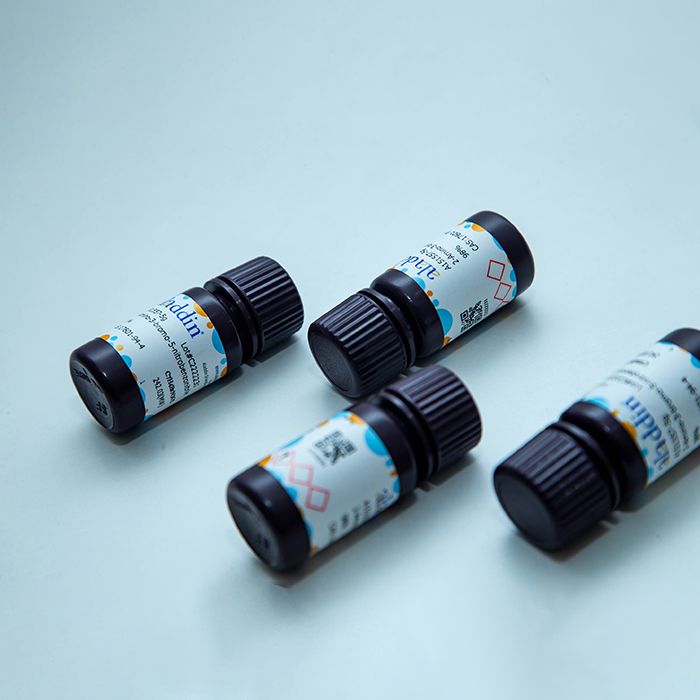
SPC5001 is a locked nucleic acid (LNA)-modifed antisense oligonucleotide (ASO) complementary to human PCSK9 (proprotein convertase subtilisin/kexin type 9) mRNA . SPC5001 can be used for the research of hypercholesterolemia. SPC5001 sequence: 5′-TGmCTACAA
Appearance:Solid
In Vitro:SPC5001 (0.16-40 µM; 72 h) induces the downregulation of PCSK9 mRNA targets but cytotoxicity is not observed at any concentration in 2D human renal proximal tubule epithelial cells (HRPTEC) cultures. SPC5001 (5 µM; 48 h or 20 d) downregulates PCSK9 m
Biological Activity:SPC5001 is a locked nucleic acid (LNA)-modifed antisense oligonucleotide (ASO) complementary to human PCSK9 (proprotein convertase subtilisin/kexin type 9) mRNA . SPC5001 can be used for the research of hypercholesterolemia. SPC5001 sequence: 5′-TGmCTACAA
Especificações
Especificações e pureza
≥90%
Condições de armazenamento de armazenamento
Store at -20°C,Desiccated
Enviado em
Ice chest + Ice pads
Este produto requer transporte de cadeia fria. Serviços terrestres e outros serviços econômicos não estão disponíveis.
Pureza
≥90%
Nomes e identificadores
Sorrisos canónicos
[SPC5001]
Peso molecular
4689.85
Dados avançados
Certificados(CoA,COO,BSE/TSE e Mapa de Análise)
C of A & Other Certificates(BSE/TSE, COO):
Analytical Chart:
Propriedades químicas e físicas
Solubilidade
H2O : ≥ 100 mg/mL (21.32 mM)
Calculadoras de soluções
Molarity Calculator
Determine the necessary mass, volume, or concentration for preparing a solution.
Dilution Calculator
Determine the dilution needed to prepare a stock solution.
Reconstitution Calculator
Revisões
Avaliações dos Clientes
Application Protocols
Item-specific tested applications and dilutions: Not specified for this item; refer to CoA/Spec Sheet.
General laboratory protocols for small-molecule screening compounds (guidance; not specific to SPC5001):
Stock preparation:
Warm vial to room temperature in a desiccator before opening. Weigh quickly to minimize moisture uptake.
Prepare DMSO stock at 10–50 mM. If insoluble, try DMF or co-solvent blends; gently heat (≤40 °C) and sonicate as needed.
Sterile-filter through 0.22 µm PTFE for cell-based assays if compatible; avoid adsorption by validating recovery.
Working solutions:
Dilute into assay buffer or media to achieve final DMSO ≤0.5–1% v/v for cells and ≤2% for many biochemical assays (as tolerated by the target system).
Include vehicle controls, concentration-response (8–12 points, half-log spacing), and replicates (n ≥ 3).
Interference controls:
Assess aggregation (0.01–0.1% non-ionic detergent), fluorescence/absorbance overlap with assay readouts, and redox activity.
Stability checks:
LC–MS immediate and time-course (0, 2, 24 h) in assay matrix at room temperature; repeat at 4 °C if needed.
Documentation:
Record exact lot, mass, solvent, and concentrations; retain aliquots frozen for repeat testing.
Adjust these steps based on the actual structure and solubility once available.
Biological Roles
Item-specific biological information:
Target/Pathway/Mode of action: Not specified for this item; refer to CoA/Spec Sheet or associated screening data.
Context (general, not specific to SPC5001):
As a member of a small-molecule/compound library, SPC5001 would typically be used to probe biological systems for modulatory effects, but no endogenous biological role can be inferred without structure or prior annotations.
Potential use cases include: tool-compound exploration in biochemical assays, phenotypic screening in cells or organisms, and fragment-to-lead or scaffold-hopping efforts once identity is known.
Consider liabilities common to screening compounds: aggregation-based inhibition, redox cycling, covalent reactivity, fluorescence/absorbance interference, and metal chelation. Mitigate with counter-screens (detergent addition, redox assays, orthogonal readouts).
Practical recommendations:
Maintain rigorous controls for DMSO concentration, pH, and ionic strength in biological assays.
Verify chemical stability in the specific assay matrix (buffer composition, cofactors, metals) by LC–MS time-course prior to interpreting bioactivity.
If a salt form is provided (not specified here), account for counterions when calculating molar concentrations.
No clinical or therapeutic claims are made; this product is designated for research use only.
Buffer Applications
This product is a small-molecule/compound library entry with unknown acid/base characteristics. It is not typically used as a buffering agent.
Buffer roles: Not applicable without a defined pKa profile and functional groups.
Practical note: When preparing assay solutions, use established biological buffers (e.g., phosphate, HEPES, Tris) appropriate to your target system and keep co-solvent levels (e.g., DMSO) consistent across controls and treatments.
For any pH-dependent solubility optimization of SPC5001, consult the CoA/Spec Sheet for ionization data (if available) and perform small-scale pH-solubility screens.
Green Alternatives
Because the identity and solubility profile of SPC5001 are not disclosed, greener choices relate mainly to solvent and process options used during handling, assay preparation, and any follow-up chemistry.
General greener solvent substitutions (literature/guidance):
Replace DMF/NMP with: Cyrene (dihydrolevoglucosenone), propylene carbonate, or dimethyl isosorbide for certain couplings or as co-solvents. Note: Compatibility depends on the reaction class and base; reactivity can differ markedly.
Replace dichloromethane/toluene with: 2-MeTHF, CPME, or EtOAc where applicable. These often provide lower VOC impact and improved safety profiles. Trade-offs include peroxide formation (ethers) and different solvation parameters.
For stock solutions: Prefer ethanol or aqueous buffers with minimal DMSO where solubility permits. However, DMSO remains the most universal solubilizer for screening compounds; maintain ≤0.5–1% in assays to reduce cytotoxicity.
Small comparison (general):
DMSO vs Ethanol: DMSO offers broader solubility; ethanol is greener but may not dissolve highly lipophilic or strongly hydrogen-bonding scaffolds.
DMF vs Cyrene: Similar polarity; Cyrene can be effective in amidations but may require base/catalyst adjustments.
Operational green practices:
Use micro-scale solubility screens to minimize solvent use.
Store at −20 °C desiccated to extend shelf-life and reduce waste due to degradation.
Employ closed-ventilated systems and solvent recycling where feasible.
Confirm any substitution experimentally, as performance is structure- and reaction-dependent.
Pharmaceutical Uses
No pharmacopeial status, excipient role, or formulation use is specified for this item; refer to CoA/Spec Sheet. The product is designated For research use only.
General context (not specific to SPC5001):
Screening compounds may, after extensive optimization and safety evaluation, inform lead discovery. However, library members are not intended or qualified for clinical use or as excipients.
If formulation-like studies are performed in research, typical solvents/vehicles include DMSO, ethanol, PEG400, and aqueous buffers with surfactants. Any such work remains strictly preclinical/laboratory in scope.
Recommendation:
Do not use in humans or for therapeutic purposes. For any pre-formulation research (e.g., solubility profiling), rely on the item’s CoA and conduct independent analytical verification (identity, purity, residual solvents, water content) prior to studies.
Physical Properties
Item-specific values (from Product Data):
Appearance: Not specified for this item; refer to CoA/Spec Sheet.
Melting Point (MP): Not specified for this item; refer to CoA/Spec Sheet.
Boiling Point (BP): Not specified for this item; refer to CoA/Spec Sheet.
Density: Not specified for this item; refer to CoA/Spec Sheet.
Refractive Index: Not specified for this item; refer to CoA/Spec Sheet.
Solubility: Not specified for this item; refer to CoA/Spec Sheet.
LogP/logD, pKa: Not specified for this item; refer to CoA/Spec Sheet.
General/literature guidance for small-molecule library members (not specific to SPC5001):
Physical state: Most screening compounds are supplied as dry solids (free base/acid or salt) or as films in microplates/vials to maximize stability. Oils are less common but possible for low-melting substances.
Solubility: DMSO is the standard primary solvent (often 10–50 mM stock). Secondary solvents include DMF, ethanol, or aqueous buffers with co-solvent. Actual solubility can vary by >1000-fold across chemotypes.
Ionization: Compounds bearing amines, carboxylic acids, or heteroaryl nitrogens may exhibit pKa values roughly 3–11 (literature), impacting aqueous solubility and permeability.
Hygroscopicity/polymorphism: Certain salts and hydrogen-bond-rich scaffolds may absorb moisture or display polymorphic behavior; verify by TGA/DSC when critical.
Practical note:
Because no physicochemical data are specified for SPC5001, determine solubility and stability empirically on receipt (small-scale solubility screens; LC–MS stability checks) and rely on the CoA for definitive values.
Quality and Grades
Item-specific grade/purity from Product Data:
Grade/Purity: Not specified for this item; refer to CoA/Spec Sheet.
Context and expectations for small-molecule/compound library items (general):
Typical specifications: Screening compounds are commonly provided at ≥90–95% purity by HPLC/LC–MS unless otherwise indicated. When intended for biochemical assays or medicinal chemistry, additional controls (residual solvents, counterion content, water, salts) may be reported. Because no value is provided here, do not assume a purity threshold—verify on the CoA.
Analytical characterization: Identity confirmation often includes LC–MS (m/z and retention), 1H NMR, sometimes 13C NMR and HRMS. If chirality is present, enantiomeric purity may be unspecified unless stated; confirm via chiral HPLC if stereochemistry matters.
Grade definitions (general):
Research grade: Suitable for discovery research; may not meet pharmacopeial standards.
Screening/Library grade: Prioritizes identity and purity conducive to HTS; low UV background and minimal interfering impurities are typical goals.
HPLC/LC–MS suitability: Low UV cutoff of the diluent solvent matters more than the compound; not applicable to the solid.
Stabilizers: None stated for this item; if sensitive motifs (e.g., aldehydes) are present, stabilizers may be included—check CoA.
Recommendation:
For critical decisions (SAR, IC50, crystallography), re-validate purity/identity in-house and consult the item’s CoA/Spec Sheet for definitive grade information.
Reaction and Applications
Item-specific application notes from Product Data:
Manufacturer Applications: Not specified for this item.
General research applications for a small-molecule library member (non-specific to SPC5001):
Discovery screening: Use in biochemical, biophysical, or cell-based assays to identify preliminary hits. Typical readouts include enzymatic activity, binding (thermal shift, SPR), or phenotypic responses. Maintain consistent DMSO controls.
Orthogonal confirmation: Validate activity with independent assays (e.g., enzymatic vs biophysical) to mitigate assay interference.
Hit triage: Assess solubility, aggregation (detergent sensitivity, DLS), redox activity, fluorescence interference, and PAINS alerts once the structure is known.
Follow-up chemistry: If a structure is provided, analog synthesis and SAR exploration can be undertaken. Pay attention to latent functional handles (halides, boronates, nitriles, acids/amines) that facilitate diversification.
Analytical support: LC–MS monitoring of stability in assay buffer and in DMSO stock at room temperature vs −20 °C; evaluate for hydrolysis or oxidation.
Notes on synthetic reactions (contingent on structure; not specific to SPC5001):
If aryl halides/boronates are present: cross-couplings (Suzuki, Buchwald–Hartwig).
If carbonyls or amines are present: amide couplings (EDC/HATU), reductive amination.
If heteroaromatics present: N-oxidation, Minisci, or late-stage C–H functionalization.
Because no structure or reactivity is disclosed, treat this product primarily as a screening entity pending CoA details.
Reaction Conditions
Item-specific reaction conditions are not available because the structure and functional groups of SPC5001 have not been provided. Refer to the CoA/Spec Sheet and any associated literature before attempting transformations.
General guidance (not specific to SPC5001):
Cross-coupling (if aryl halide/boronate handles exist): Pd-catalyzed Suzuki–Miyaura in 2-MeTHF/H2O or dioxane/H2O, base K3PO4/Cs2CO3, 40–90 °C, 1–16 h.
Amide coupling (if acid/amine present): HATU/DIPEA in DMF or greener alternatives (propylene carbonate, EtOAc under Schotten–Baumann), 0–25 °C, 1–4 h.
Reductive amination (if carbonyl/amine present): NaBH3CN or BH3·THF with AcOH/TEA buffer in MeOH/MeCN, 0–25 °C.
N-alkylation (if amine present): Alkyl halide, K2CO3 in acetonitrile/acetone; monitor for over-alkylation and E2.
Heteroaromatic functionalization: Minisci with persulfate or photoredox catalysts in aqueous alcohols; 20–40 °C under visible light.
Process control:
Use inert atmosphere for air-sensitive couplings.
Confirm stability of SPC5001 to base/acid/oxidants before selecting conditions.
Validate product identity and purity after modification by LC–MS and NMR.
These are literature-style conditions and must be adapted to the actual structure of SPC5001 once disclosed.
Safety and Handling
Item-specific safety data from Product Data:
GHS Classification: Not specified for this item; refer to SDS.
Signal Word: Not specified for this item; refer to SDS.
H-Statements: Not specified for this item; refer to SDS.
Pictograms: Not specified for this item; refer to SDS.
Research Use: For research use only.
Storage: Store at −20°C, desiccated. Shipped in ice chest with ice pads.
General laboratory handling guidance (not specific to SPC5001; follow SDS when available):
PPE: Wear lab coat, safety glasses, and appropriate chemically resistant gloves (e.g., nitrile). Work in a fume hood to avoid inhalation of dust or solvent vapors when preparing solutions.
Avoid: Ingestion, inhalation of powders, skin/eye contact. For unknown toxicity profiles, apply conservative handling.
First aid (overview): Eye/skin contact—rinse with water for ≥15 min and remove contaminated clothing; inhalation—move to fresh air; ingestion—rinse mouth. Seek medical attention in all cases; bring SDS.
Incompatibilities: Without a structure, assume general incompatibilities—strong oxidizers/reductants, strong acids/bases for labile scaffolds, and reactive acylating/alkylating agents during storage. Avoid prolonged exposure to moisture, heat, and light.
Waste: Collect in organic waste suitable for DMSO/DMF/MeOH solutions unless aqueous only; label clearly with solvent and compound ID.
Analytical verification: Upon opening, consider quick identity/purity checks (LC–MS, HPLC, NMR) before biological use.
Always defer to and follow the product-specific SDS and institutional EHS policies.
Solvent Selection
Item-specific solvent information:
Solubility data for SPC5001: Not specified for this item; refer to CoA/Spec Sheet.
General selection strategy for dissolving small-molecule screening compounds (literature/guidance):
Primary solvent: DMSO is the standard due to broad solubilization power and biological compatibility at low final percentages (typically ≤0.5–1% v/v in assays).
Secondary solvents/co-solvents: DMF (strong solvating power; cell-toxic at higher levels), ethanol or isopropanol (more benign; lower solubilizing power), and water adjusted with pH and co-solvent for ionizable compounds.
Sequential approach:
Attempt DMSO (e.g., 10–50 mM stock). If insoluble, gently warm (≤40 °C) and vortex/sonicate.
If still insoluble, explore DMF or add co-solvent to DMSO (e.g., 10–30% ethanol) and/or adjust salt form.
For acids/bases, prepare salt forms (e.g., HCl salt for amines) to improve aqueous solubility.
Photolability/oxidation: If structure suggests sensitivity (unknown here), minimize light/air exposure; use amber vials and inert gas.
Comparison (general):
DMSO: Highest success rate; hygroscopic; can carry impurities.
Ethanol: Greener; limited for highly lipophilic scaffolds.
DMF: Strong solvency; more toxic; harder to remove.
PEG400/propylene glycol: Useful for in vivo formulation studies (not applicable here; research use only) and for viscous stock solutions in special cases.
Because SPC5001’s structure is undisclosed, run a small solubility screen before scaling.
Storage and Reconstitution
Item-specific conditions from Product Data:
Storage: Store at −20 °C, desiccated.
Shipping: Ice chest + ice pads.
Appearance: Not specified for this item; refer to CoA/Spec Sheet.
Best practices (general; not specific to SPC5001):
On receipt: Allow the sealed container to equilibrate to room temperature inside a desiccator before opening to prevent condensation on hygroscopic material.
Desiccation: Maintain with fresh desiccant (silica gel or molecular sieves). Minimize headspace humidity; consider argon/nitrogen backfill for air-sensitive compounds.
Light/air sensitivity: If unknown, store in amber vials and limit oxygen exposure. Use septum caps to enable inert handling if frequent access is expected.
Aliquoting: Prepare single-use aliquots of solid or concentrated stock solutions (e.g., 10–50 mM in DMSO) to avoid repeated freeze–thaw cycles. Label with compound ID, lot, concentration, solvent, and date.
Freeze–thaw: Avoid repeated cycles; thaw on ice or at room temperature as appropriate. For DMSO stocks, prevent water ingress (DMSO is hygroscopic) and re-freeze promptly after use.
Stability verification: Periodically check by LC–MS/HPLC for degradation (hydrolysis/oxidation) during long-term storage.
Reconstitution guidance:
Solvent choice depends on structure; start with dry DMSO, then consider DMF, ethanol, or buffer with co-solvent. If salt formation improves solubility, prepare the corresponding salt under anhydrous conditions.
For definitive instructions (including any stabilizers or reconstitution solvents specific to this lot), consult the CoA/Spec Sheet.
Structure and Identity
Item-specific identifiers from Product Data:
SKU: S659397
Product Name: SPC5001
CAS: S659397 (catalog placeholder)
Molecular Formula: Not specified for this item; refer to CoA/Spec Sheet.
Molecular Weight: Not specified for this item; refer to CoA/Spec Sheet.
SMILES: Not specified for this item; refer to CoA/Spec Sheet.
InChIKey: Not specified for this item; refer to CoA/Spec Sheet.
Interpretive notes (general):
This product is listed under a small-molecule/compound library category. In such libraries, SPC codes typically denote discrete organic entities intended for screening or as reference building blocks. Without a disclosed structure, functional group content, heteroatom composition, ring systems, and stereochemistry cannot be confirmed for this specific item.
2D structure description (general guidance): For small organic screening compounds, common motifs include aromatic/heteroaromatic rings (e.g., phenyl, pyridyl), linkers (ethers, amides, ureas), and polar handles (nitriles, sulfonamides, tertiary amines) to balance solubility and permeability. However, none of these can be assumed for SPC5001 without its CoA/Spec Sheet.
Actionable recommendation:
Consult the item’s Certificate of Analysis or Specification Sheet for definitive structure (SMILES/InChI), exact elemental formula, and stereochemical information before planning analytical, synthetic, or biological work.
Synthetic Utility
Item-specific synthetic features cannot be described because no structure, functional groups, or stereochemistry are provided in the Product Data. Refer to the CoA/Spec Sheet for structural information before planning any transformations.
General considerations for library compounds in synthetic/medicinal chemistry (not specific to SPC5001):
Scaffold assessment: Once a structure is available, identify synthetic handles (e.g., aryl halides/boronates for cross-coupling, carbonyls for reductive amination/amide formation, olefins for hydrofunctionalization) to enable SAR.
Protecting-group strategy: If multiple nucleophiles are present (amines, alcohols), plan orthogonal protections (Boc/CBz, TBS/TBDPS) to enable selective elaborations.
Late-stage functionalization: C–H activation, photoredox-mediated Minisci, or radical halogenation can diversify heteroaromatics and benzylic positions while preserving the core.
Stereochemistry: If chiral centers exist, control via asymmetric catalysis or chiral pool starting materials; verify enantiopurity by chiral HPLC.
Analytical QC: Use LC–MS, 1H/13C NMR, and purity profiling after each step; monitor for isomerization/tautomerism in heteroaromatics.
If SPC5001 serves as a hit, resynthesis from disclosed routes (once available) with analog generation is the typical next step for SAR and property optimization.
Target Specificity
Item-specific target data:
Antigen/Target: Not specified for this item.
Epitope/Binding site: Not specified for this item.
Species reactivity/Selectivity: Not specified for this item.
Clone/Isotype: Not applicable (small molecule, not an antibody).
Interpretation:
As a small-molecule library member with undisclosed identity, no target specificity can be stated. Any binding or activity claims require supporting assay data tied to the confirmed structure.
Recommendation:
Upon obtaining screening results, confirm target engagement using orthogonal biophysical methods (e.g., DSF, ITC, SPR, CETSA) and structure-activity relationships.
Usamos cookies para garantir o funcionamento adequado do site e, quando permitido, para melhorar a sua experiência. Você pode gerenciar suas preferências a qualquer momento nas Configurações. Saiba mais em nossa Política de Cookies.
Deseja que lhe enviemos uma mensagem quando tivermos descontos disponíveis?
Lembrar-me mais tarde
Obrigado! Por favor, verifique a sua caixa de entrada de e-mail para confirmar.
Products are supplied to verified businesses, institutions, and qualified professionals for research and development use only. Not for use in humans, animals, diagnosis, or therapy.