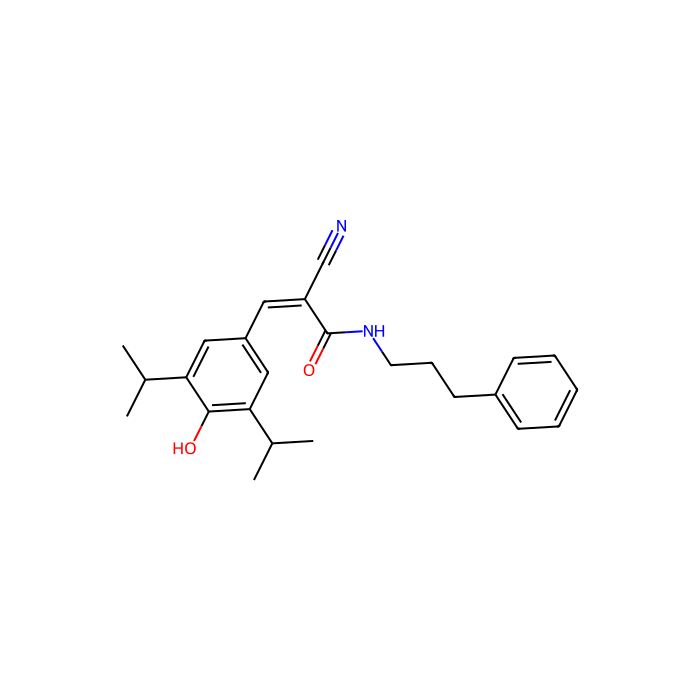
SU1498 - ≥98%(HPLC) , CAS No.168835-82-3

CAS: 168835-82-3 Cat. No.: S167823 Fórmula: C25H30N2O2 Peso molecular: 390.52 Número CE: 809-155-6 PubChem CID: 5941539
Disponível para encomenda
GRADE & PURITY ≥98%(HPLC)
Synonyms
BCP25508 | BDBM50375659 | SCHEMBL1371456 | CHEBI:92611 | JANPYFTYAGTSIN-FYJGNVAPSA-N | CCG-100667 | (2E)-2-cyano-3-[4-hydroxy-3,5-di(propan-2-yl)phenyl]-N-(3-phenylpropyl)prop-2-enamide | BRD-K34995470-001-03-1 | EC-000.2538 | U0103 | BiomolKI2_000069 | D
Storage
Armazenar a -20°C
Shipped In
Arca de gelo + almofadas de gelo
★
Size
USA
Alemanha (EU)*
Price
Qty
5mg
S167823-5mg
3 Em stock
—

52,90US$

79,90US$
Gravar 27,00 US$ (33.79%)
10mg
S167823-10mg
3 Em stock
—

94,90US$

142,90US$
Gravar 48,00 US$ (33.59%)
25mg
S167823-25mg
3 Em stock
—

206,90US$

310,90US$
Gravar 104,00 US$ (33.45%)
50mg
S167823-50mg
3 Em stock
—

349,90US$

524,90US$
Gravar 175,00 US$ (33.34%)
100mg
S167823-100mg
2 Em stock
—

592,90US$

889,90US$
Gravar 297,00 US$ (33.37%)
250mg
S167823-250mg
2 Em stock
—

1297,90US$

1946,90US$
Gravar 649,00 US$ (33.34%)
Enter a quantity for the sizes you want to add.
🧪
Why this grade

≥98%(HPLC) for sensitive chromatographic and analytical workflows requiring minimal baseline interference.

🌡

Storage & shipping

Armazenar a -20°C Ships Arca de gelo + almofadas de gelo Check lot-specific COA for exact specifications.

📋

Quality documents

SDS, COA, datasheet, and spec sheet available for download. Lot-specific COA accessible via lot number lookup.

📚

Literature proof

Cited in 6 peer-reviewed publications across chromatography, organic synthesis, and cross-coupling reactions.

Specifications

Sinónimos
BCP25508 | BDBM50375659 | SCHEMBL1371456 | CHEBI:92611 | JANPYFTYAGTSIN-FYJGNVAPSA-N | CCG-100667 | (2E)-2-cyano-3-[4-hydroxy-3,5-di(propan-2-yl)phenyl]-N-(3-phenylpropyl)prop-2-enamide | BRD-K34995470-001-03-1 | EC-000.2538 | U0103 | BiomolKI2_000069 | D
Especificações e pureza
≥98%(HPLC)
Mecanismos bioquímicos e fisiológicos
O SU1498 é um inibidor potente e seletivo da quinase do recetor VEGFR2, Flk-1, com um valor IC50 de 700 nM. O SU1498 é um inibidor muito fraco da quinase PDGFR, da quinase EGFR e da quinase HER-2, com valores de IC50 > 50 μM. O SU1498 foi utilizado para e
Condições de armazenamento de armazenamento
Armazenar a -20°C
Enviado em
Arca de gelo + almofadas de gelo
Nota
Instável; preparar soluções frescas e utilizar imediatamente. Precisa de mais conselhos sobre solubilidade, utilização e manuseamento? Para mais informações, visite a nossa página de perguntas frequentes (FAQ).
Pureza
≥98%(HPLC)
Nomes e identificadores
Pubchem Sid
Pubchem Sid Url
https://pubchem.ncbi.nlm.nih.gov/substance/504763981
Sorrisos canónicos
CC(C)C1=CC(=CC(=C1O)C(C)C)C=C(C#N)C(=O)NCCCC2=CC=CC=C2
IUPAC Name
(E)-2-cyano-3-[4-hydroxy-3,5-di(propan-2-yl)phenyl]-N-(3-phenylpropyl)prop-2-enamide
InChIKey
JANPYFTYAGTSIN-FYJGNVAPSA-N
INCHI
1S/C25H30N2O2/c1-17(2)22-14-20(15-23(18(3)4)24(22)28)13-21(16-26)25(29)27-12-8-11-19-9-6-5-7-10-19/h5-7,9-10,13-15,17-18,28H,8,11-12H2,1-4H3,(H,27,29)/b21-13+
SMILES isoméricas
CC(C)C1=CC(=CC(=C1O)C(C)C)/C=C(\C#N)/C(=O)NCCCC2=CC=CC=C2
PubChem CID
5941539
Peso molecular
390.52

Documentation

📋 Safety Data Sheet (SDS)

Comprehensive hazard, handling, storage, and regulatory compliance document.

Download SDS →

✅ Certificate of Analysis (COA)

Lot-specific quality data. Enter your lot number to retrieve the exact COA.

Look up COA →

📊 Datasheet

Quick-reference summary of product specifications and applications.

View datasheet →

🔬 Specification Sheet

Full quality attributes and acceptance criteria for this grade.

View spec sheet →

Advanced Data

Taxonomic Classification

Taxonomy Tree

KingdomOrganic compounds
SuperclassPhenylpropanoids and polyketides
ClasseCinnamic acids and derivatives
SubclassHydroxycinnamic acids and derivatives
Intermediate Tree Nodes Not available
Direct ParentCoumaric acids and derivatives
Alternative Parents Cinnamic acid amides  Phenylpropanes  Cumenes  Phenols  Secondary carboxylic acid amides  Nitriles  Organopnictogen compounds  Organic oxides  Hydrocarbon derivatives  Carbonyl compounds  
Molecular FrameworkAromatic homomonocyclic compounds
Substituents Cinnamic acid amide - Coumaric acid or derivatives - Cumene - Phenylpropane - Phenol - Monocyclic benzene moiety - Benzenoid - Carboxamide group - Secondary carboxylic acid amide - Nitrile - Carbonitrile - Carboxylic acid derivative - Hydrocarbon derivative - Organic oxide - Organooxygen compound - Organonitrogen compound - Organopnictogen compound - Organic oxygen compound - Organic nitrogen compound - Carbonyl group - Aromatic homomonocyclic compound
DescriçãoThis compound belongs to the class of organic compounds known as coumaric acids and derivatives. These are aromatic compounds containing Aromatic compounds containing a cinnamic acid moiety (or a derivative thereof) hydroxylated at the C2 (ortho-), C3 (meta-), or C4 (para-) carbon atom of the benzene ring.
External Descriptors monocarboxylic acid amide - phenols - nitrile - enamide
Estrutura 3D
Modelo de Estrutura Química Interativa


Alvos associados (humanos)
DAPK3 Tchem Death-associated protein kinase 3 (2108 Activities)
Activity TypeRelationActivity valueUnitsAction TypeJournalPubMed IddoiAssay Aladdin ID
MAPK11 Tchem MAP kinase p38 beta (2785 Activities)
Activity TypeRelationActivity valueUnitsAction TypeJournalPubMed IddoiAssay Aladdin ID
GSK3B Tclin Glycogen synthase kinase-3 beta (11785 Activities)
Activity TypeRelationActivity valueUnitsAction TypeJournalPubMed IddoiAssay Aladdin ID
MAP2K6 Tchem Dual specificity mitogen-activated protein kinase kinase 6 (1284 Activities)
Activity TypeRelationActivity valueUnitsAction TypeJournalPubMed IddoiAssay Aladdin ID
CSNK1G1 Tchem Casein kinase I gamma 1 (2496 Activities)
Activity TypeRelationActivity valueUnitsAction TypeJournalPubMed IddoiAssay Aladdin ID
CAMK2B Tchem CaM kinase II beta (1626 Activities)
Activity TypeRelationActivity valueUnitsAction TypeJournalPubMed IddoiAssay Aladdin ID
CDK6 Tclin Cyclin-dependent kinase 6 (1724 Activities)
Activity TypeRelationActivity valueUnitsAction TypeJournalPubMed IddoiAssay Aladdin ID
CHEK2 Tchem Serine/threonine-protein kinase Chk2 (4015 Activities)
Activity TypeRelationActivity valueUnitsAction TypeJournalPubMed IddoiAssay Aladdin ID
PDPK1 Tchem 3-phosphoinositide dependent protein kinase-1 (3758 Activities)
Activity TypeRelationActivity valueUnitsAction TypeJournalPubMed IddoiAssay Aladdin ID
PRKAA2 Tchem AMP-activated protein kinase, alpha-2 subunit (1328 Activities)
Activity TypeRelationActivity valueUnitsAction TypeJournalPubMed IddoiAssay Aladdin ID
PIM1 Tchem Serine/threonine-protein kinase PIM1 (9629 Activities)
Activity TypeRelationActivity valueUnitsAction TypeJournalPubMed IddoiAssay Aladdin ID
PLK1 Tchem Serine/threonine-protein kinase PLK1 (28605 Activities)
Activity TypeRelationActivity valueUnitsAction TypeJournalPubMed IddoiAssay Aladdin ID
JAK1 Tclin Tyrosine-protein kinase JAK1 (8569 Activities)
Activity TypeRelationActivity valueUnitsAction TypeJournalPubMed IddoiAssay Aladdin ID
CAMK4 Tbio CaM kinase IV (2116 Activities)
Activity TypeRelationActivity valueUnitsAction TypeJournalPubMed IddoiAssay Aladdin ID
KDR Tclin Vascular endothelial growth factor receptor 2 (20924 Activities)
Activity TypeRelationActivity valueUnitsAction TypeJournalPubMed IddoiAssay Aladdin ID
MAP2K2 Tclin Dual specificity mitogen-activated protein kinase kinase 2 (1262 Activities)
Activity TypeRelationActivity valueUnitsAction TypeJournalPubMed IddoiAssay Aladdin ID
CAMK2D Tchem CaM kinase II delta (2813 Activities)
Activity TypeRelationActivity valueUnitsAction TypeJournalPubMed IddoiAssay Aladdin ID
CSNK1G2 Tchem Casein kinase I gamma 2 (2539 Activities)
Activity TypeRelationActivity valueUnitsAction TypeJournalPubMed IddoiAssay Aladdin ID
MAPK3 Tchem MAP kinase ERK1 (4725 Activities)
Activity TypeRelationActivity valueUnitsAction TypeJournalPubMed IddoiAssay Aladdin ID
CDK2 Tchem Cyclin-dependent kinase 2 (9050 Activities)
Activity TypeRelationActivity valueUnitsAction TypeJournalPubMed IddoiAssay Aladdin ID
PRKACA Tchem cAMP-dependent protein kinase alpha-catalytic subunit (3475 Activities)
Activity TypeRelationActivity valueUnitsAction TypeJournalPubMed IddoiAssay Aladdin ID
CAMK2A Tchem CaM kinase II alpha (1938 Activities)
Activity TypeRelationActivity valueUnitsAction TypeJournalPubMed IddoiAssay Aladdin ID
RPS6KA3 Tchem Ribosomal protein S6 kinase alpha 3 (4284 Activities)
Activity TypeRelationActivity valueUnitsAction TypeJournalPubMed IddoiAssay Aladdin ID
PLK4 Tchem Serine/threonine-protein kinase PLK4 (1882 Activities)
Activity TypeRelationActivity valueUnitsAction TypeJournalPubMed IddoiAssay Aladdin ID
STK16 Tchem Serine/threonine-protein kinase 16 (910 Activities)
Activity TypeRelationActivity valueUnitsAction TypeJournalPubMed IddoiAssay Aladdin ID
STK10 Tchem Serine/threonine-protein kinase 10 (2119 Activities)
Activity TypeRelationActivity valueUnitsAction TypeJournalPubMed IddoiAssay Aladdin ID
CLK1 Tchem Dual specificty protein kinase CLK1 (2189 Activities)
Activity TypeRelationActivity valueUnitsAction TypeJournalPubMed IddoiAssay Aladdin ID
CLK2 Tchem Dual specificity protein kinase CLK2 (3942 Activities)
Activity TypeRelationActivity valueUnitsAction TypeJournalPubMed IddoiAssay Aladdin ID
CLK3 Tchem Dual specificity protein kinase CLK3 (2711 Activities)
Activity TypeRelationActivity valueUnitsAction TypeJournalPubMed IddoiAssay Aladdin ID
NEK2 Tchem Serine/threonine-protein kinase NEK2 (3514 Activities)
Activity TypeRelationActivity valueUnitsAction TypeJournalPubMed IddoiAssay Aladdin ID
CDK16 Tchem Serine/threonine-protein kinase PCTAIRE-1 (829 Activities)
Activity TypeRelationActivity valueUnitsAction TypeJournalPubMed IddoiAssay Aladdin ID
STK4 Tchem Serine/threonine-protein kinase MST1 (2643 Activities)
Activity TypeRelationActivity valueUnitsAction TypeJournalPubMed IddoiAssay Aladdin ID
CAMK1D Tchem CaM kinase I delta (2141 Activities)
Activity TypeRelationActivity valueUnitsAction TypeJournalPubMed IddoiAssay Aladdin ID
CAMK1G Tchem CaM kinase I gamma (570 Activities)
Activity TypeRelationActivity valueUnitsAction TypeJournalPubMed IddoiAssay Aladdin ID
CAMKK2 Tchem CaM-kinase kinase beta (1281 Activities)
Activity TypeRelationActivity valueUnitsAction TypeJournalPubMed IddoiAssay Aladdin ID
MAP3K5 Tchem Mitogen-activated protein kinase kinase kinase 5 (1965 Activities)
Activity TypeRelationActivity valueUnitsAction TypeJournalPubMed IddoiAssay Aladdin ID
SLK Tchem Serine/threonine-protein kinase 2 (1640 Activities)
Activity TypeRelationActivity valueUnitsAction TypeJournalPubMed IddoiAssay Aladdin ID
NEK6 Tchem Serine/threonine-protein kinase NEK6 (1986 Activities)
Activity TypeRelationActivity valueUnitsAction TypeJournalPubMed IddoiAssay Aladdin ID
PAK6 Tchem Serine/threonine-protein kinase PAK6 (1915 Activities)
Activity TypeRelationActivity valueUnitsAction TypeJournalPubMed IddoiAssay Aladdin ID
PIM2 Tchem Serine/threonine-protein kinase PIM2 (5873 Activities)
Activity TypeRelationActivity valueUnitsAction TypeJournalPubMed IddoiAssay Aladdin ID
PAK5 Tchem Serine/threonine-protein kinase PAK7 (1760 Activities)
Activity TypeRelationActivity valueUnitsAction TypeJournalPubMed IddoiAssay Aladdin ID
STK17A Tchem Serine/threonine-protein kinase 17A (1791 Activities)
Activity TypeRelationActivity valueUnitsAction TypeJournalPubMed IddoiAssay Aladdin ID
TNIK Tchem TRAF2- and NCK-interacting kinase (1174 Activities)
Activity TypeRelationActivity valueUnitsAction TypeJournalPubMed IddoiAssay Aladdin ID
PAK4 Tchem Serine/threonine-protein kinase PAK 4 (3212 Activities)
Activity TypeRelationActivity valueUnitsAction TypeJournalPubMed IddoiAssay Aladdin ID
PBK Tchem PDZ-binding kinase (995 Activities)
Activity TypeRelationActivity valueUnitsAction TypeJournalPubMed IddoiAssay Aladdin ID
PIM3 Tchem Serine/threonine-protein kinase PIM3 (4133 Activities)
Activity TypeRelationActivity valueUnitsAction TypeJournalPubMed IddoiAssay Aladdin ID
DMPK Tchem Myotonin-protein kinase (927 Activities)
Activity TypeRelationActivity valueUnitsAction TypeJournalPubMed IddoiAssay Aladdin ID
CSNK1G3 Tchem Casein kinase I isoform gamma-3 (2408 Activities)
Activity TypeRelationActivity valueUnitsAction TypeJournalPubMed IddoiAssay Aladdin ID
MAPK6 Tchem Mitogen-activated protein kinase 6 (562 Activities)
Activity TypeRelationActivity valueUnitsAction TypeJournalPubMed IddoiAssay Aladdin ID
STK25 Tchem Serine/threonine-protein kinase 25 (577 Activities)
Activity TypeRelationActivity valueUnitsAction TypeJournalPubMed IddoiAssay Aladdin ID
Alvos associados (não humanos)
Camk2g CaM kinase II gamma (1 Activities)
Activity TypeRelationActivity valueUnitsAction TypeJournalPubMed IddoiAssay Aladdin ID
Mapt Microtubule-associated protein tau (6 Activities)
Activity TypeRelationActivity valueUnitsAction TypeJournalPubMed IddoiAssay Aladdin ID
Impa1 Inositol monophosphatase 1 (16203 Activities)
Activity TypeRelationActivity valueUnitsAction TypeJournalPubMed IddoiAssay Aladdin ID
Mecanismos de ação
Certificados(CoA,COO,BSE/TSE e Mapa de Análise)
C of A & Other Certificates(BSE/TSE, COO):
Analytical Chart:

Find and download the COA for your product by matching the lot number on the packaging.

7 results found

Lot NumberCertificate TypeDataItem
K2524061Certificate of AnalysisDec 09, 2025 S167823
F2204710Certificate of AnalysisMar 04, 2025 S167823
F2204713Certificate of AnalysisMar 04, 2025 S167823
F2204876Certificate of AnalysisMar 04, 2025 S167823
F2204882Certificate of AnalysisMar 04, 2025 S167823
F2204883Certificate of AnalysisMar 04, 2025 S167823
F2204884Certificate of AnalysisMar 04, 2025 S167823
Propriedades químicas e físicas
SensibilidadeHeat Sensitive
Ponto de fusão (°C)126 °C
Peso molecular390.500 g/mol
XLogP35.800
Hydrogen Bond Donor Count2
Hydrogen Bond Acceptor Count3
Rotatable Bond Count8
Exact Mass390.231 Da
Monoisotopic Mass390.231 Da
Topological Polar Surface Area73.100 Ų
Heavy Atom Count29
Formal Charge0
Complexity577.000
Isotope Atom Count0
Defined Atom Stereocenter Count0
Undefined Atom Stereocenter Count0
Defined Bond Stereocenter Count1
Undefined Bond Stereocenter Count0
The total count of all stereochemical bonds1
Covalently-Bonded Unit Count1
FAQs e artigos
Citations of This Product
Calculadoras de soluções
Revisões

Avaliações dos Clientes

Application Protocols
  • Item-specific validated applications and recommended conditions: Not specified for this item; no manufacturer protocols are provided in the listing.

  • General guidance (literature-derived best practices)

    • Cell-based assays: Prepare 10–50 mM DMSO stock; dilute into culture media to desired final concentration ensuring DMSO ≤0.1–0.5% v/v. Pre-incubate cells 30 minutes before VEGF stimulation; harvest for phospho-VEGFR2/p-ERK analysis.
    • Biochemical kinase assays: Use serial dilutions to generate IC50 curves with ATP concentrations near Km for VEGFR2; include controls for assay interference.
    • Imaging/functional assays: For endothelial tube formation or migration assays, include matched vehicle controls and replicate wells; monitor precipitation in extracellular matrices.
  • Documentation

    • Record lot number, stock concentration, vehicle percentage, and exposure times for reproducibility.
Biological Roles
  • Mechanistic role (literature)

    • SU1498 is widely cited as an ATP-competitive inhibitor used to probe vascular endothelial growth factor receptor 2 (VEGFR2/KDR/Flk-1) signaling. Inhibition of VEGFR2 modulates downstream pathways including PLCγ–ERK/MAPK and PI3K–AKT in endothelial and other VEGF-responsive cells.
  • Research utilities

    • Tool for dissecting angiogenic signaling, endothelial cell proliferation/migration assays, tube formation assays, and VEGF-induced phosphorylation events.
    • Applied in chemical biology for pathway validation, target engagement studies, and as a comparator in panels of kinase inhibitors.
  • Selectivity considerations (literature/general)

    • As with many kinase inhibitors, off-target interactions can occur at higher concentrations. Employ orthogonal tools (genetic knockdown/knockout or structurally unrelated inhibitors) and concentration–response analyses to confirm on-target effects.
  • Systems context

    • Effects may vary by cell type, receptor expression level, and culture conditions (serum factors, matrix). Establish context-specific potency and exposure–response relationships.
  • Important caveats

    • No medical, diagnostic, or therapeutic claims are made. Use strictly for in vitro/in vivo laboratory research consistent with your institution’s approvals.
    • Verify compound identity and purity for critical studies; impurities can confound bioactivity readouts.
Buffer Applications

SU1498 is a hydrophobic bioactive small molecule, not a buffering agent. It does not define or maintain pH. For experiments, it is typically introduced into pre-made biological buffers or cell culture media via a co-solvent (e.g., DMSO). If precipitation occurs on dilution, increase pre-dilution in DMSO, add serum-containing media, or gently warm and mix to ensure complete solubilization.

Green Alternatives

Although SU1498 itself is a bioactive probe rather than a solvent or reagent with direct greener substitutes, you can improve the environmental footprint of experiments that use it.

  • Solvent and diluent choices

    • Prefer minimal DMSO percentages consistent with assay performance. Evaluate ethanol or aqueous carrier with cyclodextrins/serum proteins where compatible to reduce DMSO load (literature, case-dependent).
    • Use small-volume, single-use aliquots to minimize waste from degraded material.
  • Process and waste minimization

    • Scale assays appropriately (96-/384-well) to reduce compound consumption and solvent waste.
    • Consolidate analytical checks (e.g., LC–MS identity/purity) to a single run per lot.
  • Packaging and materials

    • Choose glass vials for stock solutions to reduce adsorption and enable full recovery, decreasing re-makes and waste.
  • Comparative perspective (general)

    • There is no direct “green alternative” to SU1498’s biological activity; alternative VEGFR2 tool compounds (e.g., different chemotypes) may offer improved aqueous solubility or stability, but trade-offs include potency, selectivity profiles, and IP considerations. Select based on data quality rather than presumed greenness.
  • Documentation

    • Record solvent volumes and disposal paths to support green chemistry metrics (E-factor) even in small-scale biological experiments.
Pharmaceutical Uses
  • Role and regulatory status

    • This product is provided strictly for research use only. It is not an active pharmaceutical ingredient, excipient, or a USP/EP compendial material as sold here.
  • Formulation context in research (general)

    • In preclinical research, SU1498 is sometimes formulated in DMSO-based vehicles for in vitro assays, or in co-solvent/surfactant systems for exploratory in vivo studies (literature). Such uses are outside the scope of this catalog listing and require institutional approvals and appropriate formulation development.
  • Manufacturing/quality notes

    • For any translational work, fully qualify identity, purity, residual solvents, and stability with validated methods; establish impurity fate and light/moisture sensitivity. None of these parameters are specified for this catalog item—refer to the item’s CoA/Spec Sheet for available data.
Physical Properties
  • Item-specific specifications

    • Appearance: Not specified for this item; refer to CoA/Spec Sheet.
    • Grade/Purity: Not specified for this item; refer to CoA/Spec Sheet.
  • Thermal and basic properties (item-specific)

    • Melting point, boiling point, density, refractive index: Not specified for this item; refer to CoA/Spec Sheet.
  • Solubility and logP (literature/general guidance)

    • SU1498 is commonly handled as concentrated DMSO stock solutions for biological assays, indicating good solubility in polar aprotic organics (e.g., DMSO, DMF) and limited aqueous solubility without co-solvent (literature, qualitative).
    • Aqueous solubility is typically enhanced by co-solvents (DMSO, ethanol) and/or serum proteins in cell culture media (literature, qualitative).
  • Ionization/pKa (literature)

    • Specific pKa values are not consistently reported across sources. Treat as a neutral-to-weakly basic, hydrophobic small molecule for planning purposes; verify experimentally for your lot/system.
  • Practical notes

    • For solution prep and filtration, use low-binding plastics or glass and 0.22 µm PTFE filters when preparing DMSO-based stocks. Determine exact solubility empirically for your application.
Quality and Grades
  • Item-specific quality information

    • Grade/Purity: Not specified for this item; refer to CoA/Spec Sheet.
  • Interpreting typical grades (general guidance)

    • Research/bioactive small-molecule grade typically emphasizes identity (NMR/LC–MS), purity by HPLC/UPLC area percent, and residual solvent/metals profiles suitable for in vitro research. It is not intended for human or veterinary use.
    • If labeled as “≥98% (HPLC)” in a CoA, this refers to chromatographic area purity under the specified method. Minor differences in methods (column, gradient, detection wavelength) can shift reported values; compare like-for-like.
  • What to look for on the CoA (best practices)

    • Identity confirmation: 1H NMR, LC–MS (m/z), and retention time; sometimes HRMS/elemental analysis.
    • Purity determination: HPLC chromatogram with method details and wavelength(s). If UV-active, dual-wavelength reporting (e.g., 220/254 nm) improves confidence.
    • Residual solvents and water: GC and KF, respectively, if provided.
  • Lot-to-lot considerations

    • For cell-based assays, small changes in impurity profile can affect potency/selectivity. When changing lots, re-run a quick potency curve or control experiment to verify continuity.
  • Research use only

    • As stated: For research use only. Not for diagnostic, clinical, or therapeutic use.
Reaction and Applications
  • Synthetic reaction use

    • SU1498 is not typically used as a synthetic reagent, catalyst, or building block. It is employed as a bioactive reference compound.
  • Research applications (literature)

    • Widely used as a tool compound to interrogate VEGF/VEGFR2 (KDR/Flk-1) signaling in cell and biochemical assays, including studies of endothelial cell function, angiogenesis pathways, and downstream phosphorylation cascades.
    • Applied in pathway mapping, chemical biology, and target validation experiments where selective inhibition of VEGFR2 kinase activity is desired.
    • Utilized alongside orthogonal inhibitors/siRNA to deconvolute on-target versus off-target effects in signaling networks.
  • Practical tips

    • Titrate concentrations to establish complete and partial target inhibition windows; incorporate vehicle controls and cytotoxicity readouts (e.g., CellTiter, resazurin) to separate cytostatic/toxic effects from pathway inhibition.
    • Consider timing of treatment relative to ligand stimulation (e.g., pre-incubate prior to VEGF addition in cell assays) to capture acute signaling events.
    • Use parallel phospho-specific readouts (e.g., p-VEGFR2, p-ERK, p-AKT Western blots or ELISAs) to confirm pathway engagement.
  • Data quality considerations

    • Verify compound integrity by LC–MS before critical experiments. Light and repeated freeze–thaw can degrade some kinase inhibitors; use single-use aliquots.
Reaction Conditions

Not typically applicable. SU1498 is not used as a reagent in chemical transformations, so there are no standard “reaction conditions” to report.

For biological assays (literature/general guidance):

  • Stock preparation: Dissolve in anhydrous DMSO; common stock concentrations 10–50 mM. Filter through 0.22 µm PTFE if particulates are present.
  • Working concentration ranges: Assay-dependent; establish concentration–response curves and include vehicle controls. Many kinase pathway studies explore low-nanomolar to micromolar ranges to map potency and selectivity (literature, varies by system).
  • Incubation: Pre-incubate 15–60 minutes before ligand stimulation for acute signaling readouts; optimize empirically.
  • Readouts: Phospho-protein Westerns/ELISAs, reporter assays, or functional phenotypes (migration, tube formation) with parallel cytotoxicity controls.
Safety and Handling
  • Regulatory and hazard statements (item-specific)

    • GHS Classification: Not specified for this item; refer to SDS.
    • Signal Word: Not specified for this item; refer to SDS.
    • H-Statements: Not specified for this item; refer to SDS.
    • Pictograms: Not specified for this item; refer to SDS.
  • General laboratory precautions (best practice; defer to SDS as authoritative)

    • Handle in a chemical fume hood with appropriate PPE: lab coat, safety glasses, and disposable nitrile gloves. Avoid inhalation of dust/aerosols and skin/eye contact.
    • Avoid contact with oxidizers, strong acids/bases until compatibility is assessed.
    • Prevent environmental release; collect waste in properly labeled organic hazardous waste containers.
  • First-aid overview (general)

    • Skin/eye contact: Rinse with water for ≥15 minutes; remove contaminated clothing; seek medical attention if irritation persists.
    • Inhalation: Move to fresh air; seek medical advice if symptoms occur.
    • Ingestion: Rinse mouth; do not induce vomiting; seek medical attention.
  • Special risks and handling tips (general for bioactive small molecules)

    • Potent bioactivity at low concentrations is reported for SU1498 in cell-based systems (literature). Minimize exposure and avoid accidental contact with skin. Prepare aliquots to limit repeated freeze–thaw and bench handling.
    • Always consult and follow the product-specific SDS for definitive hazard, spill, and firefighting measures.
Solvent Selection
  • Polarity and miscibility (general for SU1498-type bioactives)

    • Practical handling indicates good solubility in polar aprotic solvents (DMSO, DMF) and lower solubility in water without co-solvent (literature, qualitative).
    • Ethanol or isopropanol may dissolve modest amounts; mixtures with aqueous buffers require DMSO or other co-solvents to prevent precipitation.
  • Recommended preparation strategies (literature/general practice)

    • Prepare concentrated stock solutions in anhydrous DMSO (e.g., 10–50 mM) and store as small aliquots at −20°C, protected from light and moisture to reduce degradation and adsorption losses.
    • For working solutions in cell culture, final DMSO concentrations are commonly kept ≤0.1–0.5% v/v to minimize solvent effects; verify tolerability for your cells.
  • Choosing between solvents

    • DMSO: Highest solvating power; preferred for primary stocks; compatible with most in vitro assays at low percentages.
    • DMF: Alternative for some analytical workflows; less favored in biology due to cytotoxicity and handling concerns.
    • Ethanol: Useful for short-term working dilutions; lower solubility ceiling than DMSO for many kinase inhibitors.
  • Compatibility notes

    • Adsorption to plastics can occur for hydrophobic molecules. Use polypropylene or glass vials; pre-wet with solvent to minimize losses. Confirm clarity after dilution into media; warm gently and vortex to fully dissolve.
  • Non-applicable aspects

    • As SU1498 is a bioactive small molecule, traditional “chromatography-grade solvent” discussions are less relevant than ensuring biocompatible co-solvent selection and stock stability.
Storage and Reconstitution
  • Item-specific storage and shipping

    • Storage Conditions: Store at −20°C (as provided in Product Data). Protect from light and moisture.
    • Shipped In: Ice chest + ice pads (as provided in Product Data).
  • Reconstitution (general guidance)

    • Solvent: Use anhydrous DMSO to prepare a concentrated stock solution. If needed, DMF or ethanol can be evaluated as secondary options.
    • Concentration: Common research practice is 10–50 mM stocks for ease of dilution (literature). Adjust to your assay’s working range and solubility.
    • Technique: Allow vial to equilibrate to room temperature in a desiccator before opening to avoid condensation. Weigh quickly, cap promptly, and dissolve with gentle vortexing/sonication. Filter through 0.22 µm PTFE if particulates remain.
    • Aliquoting: Dispense into single-use, amber microvials to avoid repeated freeze–thaw. Minimize headspace; purge with inert gas if prolonged storage is anticipated.
  • Stability considerations (general)

    • Store frozen (−20°C) and protected from light. Avoid multiple freeze–thaw cycles. Inspect solutions periodically for discoloration or precipitation and verify integrity by LC–MS/HPLC prior to critical experiments.
  • Research use note

    • For research use only. Not for human or veterinary use.
Structure and Identity

Brief overview: SU1498 is a small-molecule research tool widely cited as a VEGFR2 (KDR/Flk-1) tyrosine kinase pathway inhibitor (literature). This listing provides identity metadata but does not specify a detailed structure.

  • Item-specific identifiers (from Product Data)

    • SKU: S167823
    • Product Name: SU1498
    • CAS: 168835-82-3
    • PubChem CID: 5941539
    • InChIKey: 155280 (as provided)
    • SMILES: Not specified for this item; refer to CoA/Spec Sheet.
    • Molecular Formula: Not specified for this item; refer to CoA/Spec Sheet.
    • Molecular Weight: Not specified for this item; refer to CoA/Spec Sheet.
  • Structural features (literature/general knowledge)

    • SU1498 is described in the literature as a small-molecule ATP-competitive inhibitor used to interrogate VEGF/VEGFR2 signaling in cells. Specific ring systems and functional groups vary by source; consult primary structural references or the CoA for definitive chemical structure.
    • Typical depiction in 2D: an aromatic, polyheteroatom scaffold consistent with kinase-directed chemotypes (literature, qualitative). Verify exact structure with a certified reference (CoA/SDS) prior to analytical work.
  • Notes

    • When setting up analytical methods (NMR, LC–MS), obtain the exact structural representation (SMILES/InChI) from the product CoA or a reliable database, then confirm by spectroscopic analysis of the received lot.
Synthetic Utility

SU1498 is a finished bioactive small molecule, not a general synthetic intermediate or reagent. It is not commonly employed as a building block or catalyst in organic synthesis. For synthetic route development or derivatization studies, consult primary literature on SU1498 analogs and structure–activity relationships; such work typically begins from earlier-stage intermediates rather than the final inhibitor.

Target Specificity
  • Item-specific target data: Not specified for this item; refer to CoA/Spec Sheet and primary literature.

  • General literature note

    • SU1498 is commonly referenced as a tool compound targeting VEGFR2 (KDR/Flk-1) kinase activity in biochemical and cellular assays. Confirm target engagement in your system using orthogonal methods (e.g., phospho-VEGFR2 reduction, CETSA/DRAC, or nanoBRET target engagement assays).
  • Caution

    • Do not assume exclusivity. Profile concentration–response and consider a kinase panel if selectivity is critical for interpretation.

Shall we send you a message when we have discounts available?

Remind me later

Thank you! Please check your email inbox to confirm.

Oops! Notifications are disabled.