GRAU & PUREZAMoligand™?Moligand™ — Aladdin's line of ligands and bioactive small molecules. Use for receptor, pathway, and binding studies needing defined small-molecule tools.10 mM in DMSO
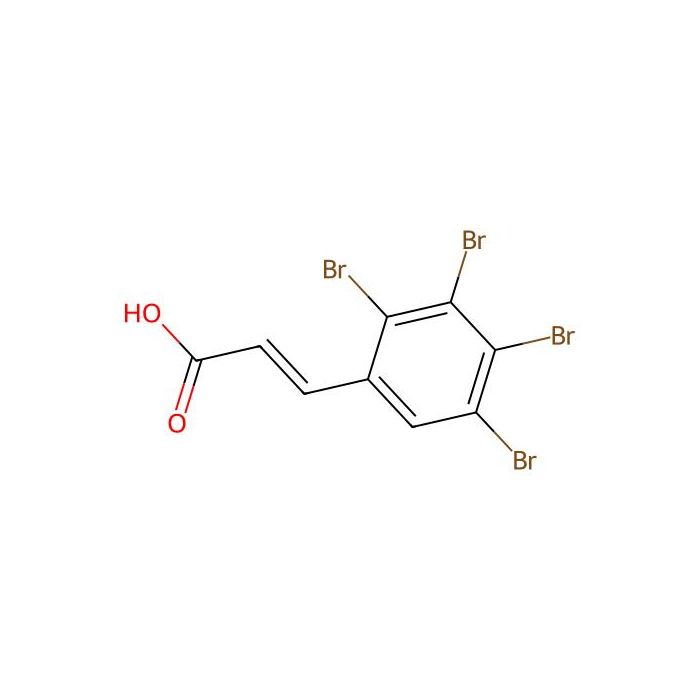
TBCA is a highly selective CK2 ( casein kinase II) inhibitor with an IC 50 of 110 nM and a K i of 77 nM. TBCA shows selectivity for CK2 over CK1 , DYRK1A and a panel of 27 other kinases .
Especificações
Especificações e pureza
Moligand™, 10 mM in DMSO
Condições de armazenamento de armazenamento
Argon charged,Store at -80°C
Enviado em
Dry ice packs + Cold packs
Este produto requer transporte de cadeia fria. Serviços terrestres e outros serviços econômicos não estão disponíveis.
Grau
Moligand™
Nomes e identificadores
SMILES isoméricas
C1=C(C(=C(C(=C1Br)Br)Br)Br)/C=C/C(=O)O
WGK Alemanha
3
PubChem CID
16760346
Peso molecular
463.74
Dados avançados
Certificados(CoA,COO,BSE/TSE e Mapa de Análise)
C of A & Other Certificates(BSE/TSE, COO):
Analytical Chart:
Segurança e perigos (GHS)
Sinal
Warning
Declarações de perigo
H315:Causes skin irritation
H319:Causes serious eye irritation
H335:May cause respiratory irritation
WGK Alemanha
3
RIDADR
NONHforallmodesoftransport
Calculadoras de soluções
Molarity Calculator
Determine the necessary mass, volume, or concentration for preparing a solution.
Dilution Calculator
Determine the dilution needed to prepare a stock solution.
Reconstitution Calculator
Revisões
Avaliações dos Clientes
Application Protocols
No validated application protocols are provided for this item. The following generic protocols are common for small-molecule library samples; adapt only after confirming solubility and stability.
General screening workflow (non-item-specific):
Stock preparation: Dissolve in anhydrous DMSO to a convenient concentration (e.g., 10–50 mM). Filter through 0.2 µm PTFE if compatible. Record exact concentration by weight or LC/UV.
Aliquoting: Dispense into low-bind vials or plate wells (e.g., 10–50 µL per aliquot) to avoid repeated freeze–thaw. Store at −80 °C under inert gas per item guidance.
Assay dilution: Titrate into assay buffer to reach final DMSO ≤0.1–1.0% v/v, as permitted by the assay. Mix thoroughly to avoid precipitation.
Controls: Include vehicle control (DMSO), positive and negative controls, and, where appropriate, detergent to mitigate aggregation artifacts.
Stability check: Post-assay, analyze residual solution by LC–MS to assess degradation.
Note: Any protocol specifics (WB, IHC, IF, FC, etc.) are not applicable to this small-molecule listing unless explicitly provided. Refer to the project’s SOPs and the compound’s CoA for any item-specific instructions.
Biological Roles
No structure or mechanism-of-action data were provided for this item; therefore, specific biological functions cannot be assigned.
General considerations for small-molecule library members (non-item-specific):
May act as putative ligands or modulators in biochemical assays, phenotypic screens, or target deconvolution studies, depending on the scaffold and substituent pattern.
Potential interactions include noncovalent binding to protein active/allosteric sites, nucleic acid intercalation or groove binding, or modulation of lipid/membrane interfaces—these are scaffold dependent and must be experimentally determined.
ADME-relevant properties (permeability, stability, solubility) are unknown for this item; obtain or measure cLogP, pKa, and solubility before in vitro assays that rely on exposure.
Important:
This product is labeled “For research use only.” It is not intended for food, cosmetic, household, diagnostic, or therapeutic applications. Any biological role must be established by the user through appropriate experimentation and controls.
Buffer Applications
This listing is a small-molecule library compound, not a buffering reagent. Without structure or pKa data, buffer preparation guidance is not applicable.
For assay work, prepare standard biological buffers (e.g., PBS, HEPES, Tris) according to their established recipes and then spike the compound from a concentrated organic stock (commonly DMSO) to the desired final concentration while maintaining low organic cosolvent.
If the compound bears ionizable groups (unknown here), buffer pH can markedly affect solubility and activity; determine pKa values experimentally or from the CoA before optimizing assay pH.
Green Alternatives
Greenness considerations mainly pertain to solvent and process choices because the compound structure is not disclosed here.
Stock solution media: Prefer bio-based or lower-toxicity solvents where scientifically feasible. For example, replace DMF/NMP with Cyrene, propylene carbonate, PEG-400, or EtOH/IPA blends for handling and sample prep when compatible with downstream assays. Validate solubility and target compatibility.
Assay dilution buffers: Reduce DMSO carryover to ≤0.1–0.5% v/v during biochemical assays to limit environmental and biological impacts.
Workup and waste minimization: Use microscale screening formats (96/384-well) to reduce solvent use; apply sealed plates to limit VOC emissions.
Green substitutions must not compromise compound integrity. For reactive or air/moisture-sensitive entities (storage under argon, −80°C), ensure alternative solvents do not introduce degradation pathways (e.g., transesterification in alcohols, base-catalyzed hydrolysis). Always perform a small-scale compatibility screen with LC–MS monitoring.
Pharmaceutical Uses
No excipient or pharmacopeial status is provided for this item.
This product is supplied for research use only and is not manufactured to cGMP for human use. Do not use in clinical, diagnostic, or therapeutic applications.
If the compound is evaluated in pre-formulation research, standard discovery-stage practices apply: assess stability in common vehicles (e.g., PEG-400/water, Captisol, lipid-based systems) and measure solubility/partitioning. All such evaluations are user-driven and outside the scope of this catalog entry.
There are no item-specific references to compendial monographs (USP/EP/JP) or to roles as a pharmaceutical excipient.
Conclusion: Treat as a non-GMP research chemical with undetermined pharmaceutical utility pending structure disclosure and quality documentation.
Physical Properties
Only item-verified specifications should be used for laboratory planning. In the absence of a provided structure and certificate data, do not infer values.
Item-specific properties:
Appearance: Not specified for this item; refer to CoA/Spec Sheet.
Molecular Weight: Not specified for this item; refer to CoA/Spec Sheet.
Molecular Formula: Not specified for this item; refer to CoA/Spec Sheet.
Melting/Freezing Point: Not specified for this item; refer to CoA/Spec Sheet.
Boiling Point: Not specified for this item; refer to CoA/Spec Sheet.
Density: Not specified for this item; refer to CoA/Spec Sheet.
Refractive Index: Not specified for this item; refer to CoA/Spec Sheet.
Solubility Profile: Not specified for this item; refer to CoA/Spec Sheet.
logP / pKa: Not specified for this item; refer to CoA/Spec Sheet.
UV-Vis Characteristics / LC-UV cutoff: Not specified for this item; refer to CoA/Spec Sheet.
General laboratory guidance (non-item-specific):
Small-molecule library members are commonly supplied as solids or films intended for dissolution in high-boiling polar aprotic solvents (e.g., DMSO) or alcohols prior to assay use. Verify solubility and stability experimentally on receipt.
For quantitative handling (gravimetric or volumetric), confirm hygroscopicity and polymorph data in the CoA, as these affect weighing accuracy and solubility kinetics.
If UV detection is planned, obtain the compound’s extinction coefficients or check for interfering chromophores in the CoA or SDS.
Quality and Grades
This item is supplied as Moligand™ grade, suitable for discovery chemistry and ligand screening workflows.
Moligand™ (Aladdin) – intended use: Research-grade small-molecule or ligand candidates suitable for biochemical, cell-free target-binding, or primary screening assays.
Typical quality attributes (general description; not item-specific):
Identity confirmation by orthogonal methods (e.g., LC–MS, NMR) in the release documentation.
Purity appropriate for screening and SAR exploration. Specific purity thresholds, residual solvent limits, or elemental analyses must be verified on the item’s CoA.
Packaged to limit moisture/oxygen exposure when stability dictates.
What is specific to this item:
Supplied under inert atmosphere instructions: “Argon charged, Store at −80°C,” indicating sensitivity to air, moisture, and/or thermal degradation.
Shipped on dry ice + cold packs to maintain ultra-low temperature chain of custody.
Important notes:
Do not assume analytical specs (e.g., water content, residual metals, UV cutoff) without the CoA. If you require method-specific purity (e.g., HPLC-grade for analytics or endotoxin limits for biochemical assays), request the current batch CoA/Spec Sheet before committing to protocols.
For medchem decisions (SAR/QC), consider running an incoming check: LC–MS purity, 1H NMR, and, if needed, chiral HPLC if stereodefined.
Reaction and Applications
No item-specific reactivity or application notes were provided. Without a confirmed structure, only general use-cases applicable to library compounds can be outlined.
General research applications (non-item-specific):
Ligand screening and target validation: Suitable for biochemical binding assays, thermal shift assays (DSF), or biophysical methods (SPR, MST), contingent on solubility and stability.
Cell-free assay development: Enzyme inhibition/activation studies or fragment-to-lead workflows when integrated into screening cascades at controlled DMSO percentages.
Analytical reference: Can serve as an internal or external reference once structure and purity are confirmed.
If used in synthesis:
In the absence of structural information, do not assign nucleophile/electrophile roles or specific reaction families. Obtain the SMILES/InChI from the CoA and consult reaction literature for the exact scaffold.
Practical tips:
Start with micro-scale solubility screens (DMSO, DMF, MeOH, ACN, EtOH) and check stability by LC–MS after 24–48 h at ambient and refrigerated conditions.
For biochemical assays, minimize freeze–thaw of DMSO stocks by preparing single-use aliquots and storing at −80°C under inert gas (as per item storage guidance).
Reaction Conditions
No reaction conditions can be recommended without knowing the functional groups present. The following are generic practices if exploratory transformations are attempted after obtaining the confirmed structure.
General guidance (non-item-specific):
Atmosphere: Given the storage under argon at −80°C, assume air/moisture sensitivity; conduct manipulations in a glovebox or using Schlenk techniques.
Solvents: Select anhydrous solvents matched to the transformation (e.g., toluene, THF, 2-MeTHF, DCM, MeCN, DMF). Validate compound stability in the chosen solvent by time-course LC–MS.
Temperature: Start at ambient; escalate cautiously. For thermally sensitive compounds, maintain ≤40 °C unless stability is documented.
Catalysts/Bases/Acids: Choose based on known functionality (after CoA review). Avoid strong nucleophiles/electrophiles until compatibility is established.
Monitoring: LC–MS and TLC; quench small aliquots to profile decomposition vs. conversion. Include oxygen/moisture indicators if handling in inert conditions.
Expected yields or times cannot be stated without literature precedent for the exact scaffold. Consult primary literature once the definitive identity is known (CAS and CID can help locate references).
Safety and Handling
Authoritative safety information is provided by the product SDS. The following summarizes handling practices when specific hazard codes are not yet confirmed.
Item-specific safety data:
Signal Word: Not specified for this item; refer to SDS.
GHS Hazard Statements / Classification / Pictograms: Not specified for this item; refer to SDS.
General laboratory precautions (non-item-specific):
PPE: Laboratory coat, safety glasses or chemical splash goggles, and appropriate chemical-resistant gloves. Consider double-gloving when handling unknown-toxicity small molecules.
Engineering controls: Handle in a certified chemical fume hood to avoid inhalation exposure. Use ventilated balance enclosure for powders.
Avoid: Ingestion, inhalation of dust/aerosols, and skin/eye contact. Prevent environmental release; collect waste according to institutional procedures.
First aid (overview): In case of exposure, flush affected area with water for ≥15 minutes; remove contaminated clothing; seek medical attention. If inhaled, move to fresh air; if ingested, rinse mouth—do not induce vomiting unless directed by medical personnel. Refer to SDS for specific measures.
Thermal/chemical stability: Unknown; avoid strong oxidizers/reducers and extreme pH until compatibility is confirmed.
Special risk controls: For compounds of unknown peroxide tendency or light sensitivity, store under inert gas as instructed and minimize light/air exposure.
Waste handling:
Dispose as organic laboratory chemical waste. Segregate halogenated from non-halogenated waste streams when composition is known; otherwise, follow your EHS guidance for unknowns.
Solvent Selection
Item-specific solubility has not been provided; therefore, choose solvents incrementally, starting with broadly solvating media commonly used for discovery compounds.
General guidance for small-molecule library members (non-item-specific):
Primary stock solvent: DMSO (high-boiling, polar aprotic) is typically preferred for preparing assay stocks (e.g., 10–50 mM), due to wide solubility compatibility and biochemical assay compatibility at low percent levels. Confirm actual solubility and stability.
Alternative solvents:
DMF or NMP for challenging polar/heteroaromatic scaffolds (check assay compatibility and toxicity).
Ethanol or isopropanol for moderately polar, protic-compatible compounds; can facilitate rapid drying post-dosing.
Acetonitrile or methanol for LC/MS sample preparation.
Aqueous systems: If water solubility is uncertain, co-solvent approaches (e.g., DMSO 0.1–1% v/v in buffer) or inclusion of solubilizers (cyclodextrins, surfactants) can be evaluated after verifying no compound degradation.
Small comparison (general):
DMSO: maximal solvation power; may freeze near room temperature and can oxidize sensitive motifs over time.
DMF: good solvency but more hygroscopic; consider toxicological handling.
EtOH/MeOH: rapid evaporation; can precipitate hydrophobic analytes post-dilution.
Always filter stocks (0.2 µm PTFE) if compatible, and verify concentration by UV or LC where possible. Defer to the CoA for any compound-specific solvent restrictions.
Storage and Reconstitution
Follow the item-specific storage instructions precisely to preserve integrity.
Item-specific instructions:
Storage Conditions: Argon charged, Store at −80 °C.
Shipped In: Dry ice packs + Cold packs.
Additional guidance (general best practices; not item-specific specifications):
Receiving: Keep the package cold; transfer immediately to a −80 °C freezer. Allow vials to equilibrate to room temperature in a desiccator or inert atmosphere before opening to avoid condensation.
Reconstitution: If the CoA indicates DMSO compatibility, prepare concentrated DMSO stock solutions (commonly 10–50 mM) under inert atmosphere using anhydrous solvent. If aqueous use is intended, test small-scale co-solvent strategies (e.g., 0.5% DMSO in buffer) while monitoring for precipitation.
Aliquoting: Prepare single-use aliquots to minimize freeze–thaw. Use low-binding vials or plates; backfill headspace with argon or nitrogen before re-freezing.
Stability: Absent explicit stability data, avoid repeated temperature cycling and light exposure. Track storage history and date of first thaw.
Documentation: Consult and retain the lot-specific CoA/Spec Sheet and SDS for definitive handling, solubility, and stability instructions.
If any discrepancy exists between this page and the CoA/SDS, defer to the CoA/SDS.
Structure and Identity
Concise identity information for reference and inventory control. Due to limited item-specific data provided, structural descriptors are listed as available.
Product Name: TBCA (abbreviation as provided)
SKU: T1494341
CAS: 934358-00-6
PubChem CID (literature identifier): 16760346
Grade: Moligand™
Category: Small-molecule and compound library (小分子和化合物库)
Item-specific structural descriptors:
Molecular Formula: Not specified for this item; refer to CoA/Spec Sheet.
Molecular Weight: Not specified for this item; refer to CoA/Spec Sheet.
SMILES: Not specified for this item; refer to CoA/Spec Sheet.
InChIKey: Not specified for this item; refer to CoA/Spec Sheet.
General structural notes (context):
"TBCA" is an acronym used in the literature for multiple distinct chemotypes. Without the authoritative structure (SMILES/InChI) from the CoA or SDS, detailed functional-group and ring-system description cannot be confirmed for this catalog entry.
2D structure (descriptive):
Not specified for this item; refer to CoA/Spec Sheet for definitive connectivity and stereochemistry (if any).
Synthetic Utility
Synthetic applications depend on functional groups and connectivity, which are not provided for this item. As such, no scaffold-specific transformations can be recommended.
General notes (non-item-specific) for library compounds in synthesis:
If the compound is a building block, confirm presence of reactive handles (e.g., halides, boronates, acids, amines) by obtaining the SMILES/InChI from the CoA, then select appropriate coupling or condensation methodologies (Suzuki–Miyaura, Buchwald–Hartwig, amide coupling, etc.).
For sensitive motifs (suggested by inert-gas, −80°C storage), handle under dry, oxygen-free conditions and avoid prolonged exposure to heat, light, or bases/acids that could trigger decomposition.
Consider protecting-group strategies only after structural verification. Track conversions by LC–MS and validate product identity with NMR.
Until definitive structure is confirmed, treat this material primarily as a screening sample rather than a preparative reagent.
Target Specificity
No target, epitope, or binding specificity information is provided for this item.
Item-specific details such as protein target, pathway, Ki/IC50, or selectivity panels are not specified; refer to the CoA/Spec Sheet or associated screening data if available.
For internal projects, establish specificity using biochemical assays (e.g., enzyme kinetics, dose–response curves), orthogonal biophysical methods (SPR/MST/ITC), and counterscreens to rule out assay interference (e.g., PAINS filters, redox activity, aggregation by DLS).
Conclusion: Target specificity is not specified for this item.
Precisa de ajuda para escolher o grau?
O nosso guia de seleção de graus abrange pureza, estado do estabilizador e adequação à aplicação para todas as variantes do nosso catálogo.
Usamos cookies para garantir o funcionamento adequado do site e, quando permitido, para melhorar a sua experiência. Você pode gerenciar suas preferências a qualquer momento nas Configurações. Saiba mais em nossa Política de Cookies.
Deseja que lhe enviemos uma mensagem quando tivermos descontos disponíveis?
Lembrar-me mais tarde
Obrigado! Por favor, verifique a sua caixa de entrada de e-mail para confirmar.
Products are supplied to verified businesses, institutions, and qualified professionals for research and development use only. Not for use in humans, animals, diagnosis, or therapy.