
Determine the necessary mass, volume, or concentration for preparing a solution.
| Activity Type | Activity Value -log(M) | Mechanism of Action | Activity Reference | Publications (PubMed IDs) |
|---|
Armazenar a -20°C. Armazenar em condições de dessecação. O produto pode ser armazenado até 12 meses.
Taxonomy Tree
| Kingdom | Organic compounds |
|---|---|
| Superclass | Organoheterocyclic compounds |
| Classe | Naphthopyrans |
| Subclass | Not available |
| Intermediate Tree Nodes | Not available |
| Direct Parent | Naphthopyrans |
| Alternative Parents | Naphthalenes Phenoxy compounds Methoxybenzenes Anisoles Pyranones and derivatives Cyclohexenones Alkyl aryl ethers Vinylogous esters Tertiary alcohols Heteroaromatic compounds Lactones Cyclic alcohols and derivatives Oxacyclic compounds Organic oxides Hydrocarbon derivatives |
| Molecular Framework | Aromatic heteropolycyclic compounds |
| Substituents | Naphthopyran - Naphthalene - Anisole - Phenoxy compound - Phenol ether - Methoxybenzene - Cyclohexenone - Alkyl aryl ether - Pyranone - Monocyclic benzene moiety - Pyran - Benzenoid - Vinylogous ester - Cyclic alcohol - Heteroaromatic compound - Tertiary alcohol - Lactone - Ketone - Ether - Oxacycle - Alcohol - Organooxygen compound - Organic oxygen compound - Carbonyl group - Organic oxide - Hydrocarbon derivative - Aromatic heteropolycyclic compound |
| Descrição | This compound belongs to the class of organic compounds known as naphthopyrans. These are compounds containing a pyran ring fused to a naphthalene moiety. Furan is a 6 membered-ring non-aromatic ring with five carbon and one oxygen atoms. Naphthalene is a polycyclic aromatic hydrocarbon made up of two fused benzene rings. |
| External Descriptors | Not available |
| Activity Type | Activity Value -log(M) | Mechanism of Action | Activity Reference | Publications (PubMed IDs) |
|---|
| Activity Type | Relation | Activity value | Units | Action Type | Journal | PubMed Id | doi | Assay Aladdin ID |
|---|
| Activity Type | Relation | Activity value | Units | Action Type | Journal | PubMed Id | doi | Assay Aladdin ID |
|---|
| Peso molecular | 526.6 |
|---|---|
| XLogP3 | 2.800 |
| Hydrogen Bond Donor Count | 2 |
| Hydrogen Bond Acceptor Count | 9 |
| Rotatable Bond Count | 4 |
| Exact Mass | 526.22 Da |
| Monoisotopic Mass | 526.22 Da |
| Topological Polar Surface Area | 121.000 Ų |
| Heavy Atom Count | 38 |
| Formal Charge | 0 |
| Complexity | 1120.000 |
| Isotope Atom Count | 0 |
| Defined Atom Stereocenter Count | 4 |
| Undefined Atom Stereocenter Count | 0 |
| Defined Bond Stereocenter Count | 0 |
| Undefined Bond Stereocenter Count | 0 |
| The total count of all stereochemical bonds | 0 |
| Covalently-Bonded Unit Count | 1 |
H330:Fatal if inhaled
H301+H311:Toxic if swallowed or in contact with skin
P260:Do not breathe dust/fume/gas/mist/vapors/spray.
P264:Wash hands [and …] thoroughly after handling.
P270:Do not eat, drink or smoke when using this product.
P271:Use only outdoors or in a well-ventilated area.
P280:Wear protective gloves/protective clothing/eye protection/face protection.
P284:[In case of inadequate ventilation] Wear respiratory protection.
No vendor-validated application protocols are provided in the Product Data. The following are general, non-item-specific examples to assist with planning; adjust to your system and verify experimentally.
Example A: Preparation of a research stock solution
Example B: LC–MS calibration curve (matrix-matched)
Example C: Enzymatic assay dosing
Biological context (literature, non-item-specific):
Caveats:
Note: This product is intended strictly for research use in controlled laboratory settings.
Territrem B is not a buffering agent and is not typically used to prepare or maintain pH in biochemical systems.
Practical note:
As a specialized natural product standard, Territrem B itself does not have a “green alternative” in the sense of interchangeable reagents. However, greener choices can be made in the handling and analytical workflow.
Greener workflow considerations (general):
Illustrative comparison (general, literature):
Always confirm that greener substitutions maintain recovery, peak shape, and analyte stability.
No pharmaceutical or excipient uses are specified for this item. Territrem B is offered solely for research applications.
Context and boundaries:
Formulation notes for research settings (general):
Reminder: Research use only. No clinical, diagnostic, or veterinary applications are implied or permitted.
Item-specific physico-chemical specifications are not provided in the Product Data.
Item-specific values:
General expectations (literature, non-item-specific):
Note: For quantitative use (e.g., standard curve preparation, LC–MS calibration), determine solubility and extinction coefficients empirically in the chosen solvent system and consult the item’s CoA for any available lot-specific properties.
Item-specific grade/purity is not provided in the Product Data. For exact purity, stabilizers, residual solvents, and analytical acceptance criteria, refer to the CoA/Spec Sheet.
What the listing specifies for this item:
Guidance on grades and implications (general):
Recommended quality verification upon receipt (best practices):
This product is primarily used as a bioactive reference standard and research probe rather than as a synthetic reagent.
Research and analytical applications (literature, general):
Practical tips:
Note: Because item-specific reactivity and functional group details are not provided here, this product is not recommended as a general synthetic reagent without consulting the primary literature and verifying compatibility.
There are no item-specific reaction conditions provided, and Territrem B is not commonly used as a general-purpose reagent. The following guidance addresses handling and analytical preparations rather than synthetic transformations.
General preparation conditions (research use):
Stability checks:
Note: Any chemical transformations or derivatizations should be developed de novo with small-scale trials and real-time analytical monitoring, given the potential lability of polyoxygenated scaffolds.
GHS and hazard statements are not specified in the Product Data for this item. Always consult the SDS for authoritative hazard classification.
General safety guidance (for tremorgenic/mycotoxin-class natural products; literature, non-item-specific):
Note: This product is for research use only. Follow institutional biosafety and chemical hygiene plans; dispose of residues as hazardous waste.
This item is a complex, relatively nonvolatile organic small molecule rather than a solvent. Selection of a solvent pertains to dissolving Territrem B for assay, stock preparation, or analytical workflows.
General solvent guidance (literature, non-item-specific):
Comparison (general):
Always confirm solubility and stability empirically in your chosen solvent system.
Item-specific conditions (from Product Data):
Best practices for storage:
Reconstitution guidance (general):
Disposal: Dispose of unused material and solutions as hazardous organic waste in accordance with institutional and local regulations.
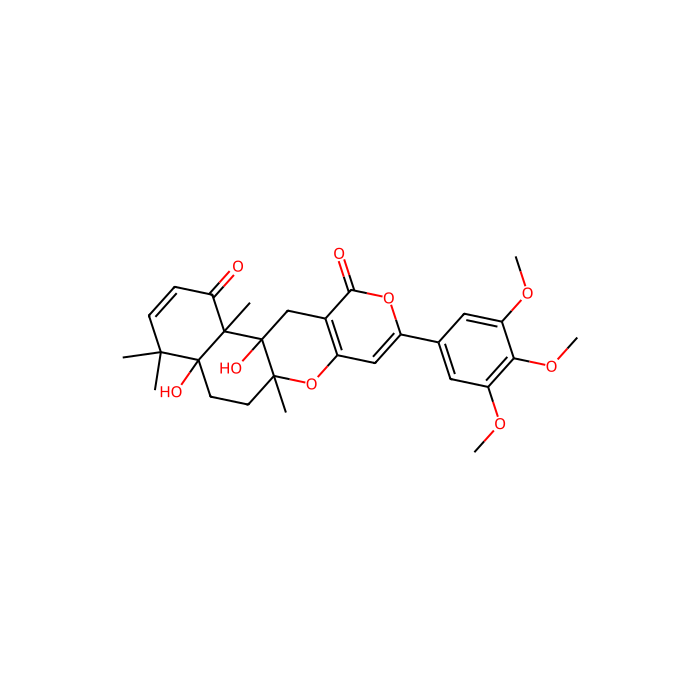
Territrem B is a complex fungal secondary metabolite offered for research use as part of a small-molecule/compound library.
Item-specific identifiers (from Product Data):
General structural notes (literature, non-item-specific):
2D structure description (general family, literature):
Territrem B is not typically employed as a reagent or building block; rather, it serves as a complex natural product target/reference. Nevertheless, several synthetic and analytical considerations can be relevant in research:
General synthetic context (literature):
Analytical chemistry utility:
Cautions:
Conclusion: Treat Territrem B primarily as a reference/target molecule; employ derivatizations sparingly and with rigorous analytical confirmation.
No target specificity, antigen information, clone/isotype, or species reactivity is provided in the Product Data for this item. This product is a small-molecule natural product standard and not an antibody or biological reagent with defined immunochemical specificity.
If used as a biochemical probe, target engagement, potency, and selectivity must be established experimentally under your assay conditions, using appropriate controls and orthogonal confirmation methods.