for sensitive chromatographic and analytical workflows requiring minimal baseline interference.
🌡
Storage & shipping
Protected from light,Room temperature Ships Normal Check lot-specific COA for exact specifications.
📋
Quality documents
SDS, COA, datasheet, and spec sheet available for download. Lot-specific COA accessible via lot number lookup.
📚
Literature proof
Cited in 156 peer-reviewed publications across chromatography, organic synthesis, and cross-coupling reactions.
Visão geral
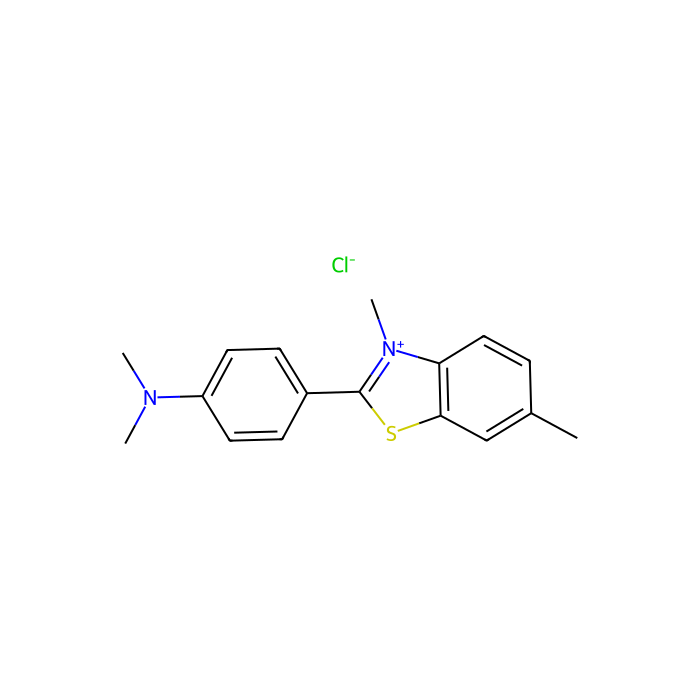
Thioflavin T is a benzothiazole dye that increases in fluorescence upon binding to amyloid.Thioflavin T has been used in histology and for protein characterization. Usually used to identify the presence of amyloid fibrils in samples.
Specifications
Sinónimos
Setoflavine T | Basic yellow 1
Mecanismos bioquímicos e fisiológicos
Fluorescent cell-permeable amyloid binding benzothiazole salt. Dye used to visualise stacked β sheets in vitro and in vivo . Binding induces a shift in excitation maximum (385 nm to 450 nm) and emission maximum (445 nm to 482 nm). Highly soluble in water.
Condições de armazenamento de armazenamento
Protected from light,Room temperature
Enviado em
Normal
Nota
Wherever possible, you should prepare and use solutions on the same day. However, if you need to make up stock solutions in advance, we recommend that you store the solution as aliquots in tightly sealed vials at -20°C. Generally, these will be useable for up to one month. Before use, and prior to opening the vial we recommend that you allow your product to equilibrate to room temperature for at least 1 hour. Refer to SDS for further information Need more advice on solubility, usage and handling? Please visit our frequently asked questions (FAQ) page for more details.
This compound belongs to the class of organic compounds known as benzothiazoles. These are organic compounds containing a benzene fused to a thiazole ring (a five-membered ring with four carbon atoms, one nitrogen atom and one sulfur atom).
External Descriptors
organic chloride salt
1. Djoumbou Feunang Y, Eisner R, Knox C, Chepelev L, Hastings J, Owen G, Fahy E, Steinbeck C, Subramanian S, Bolton E, Greiner R, and Wishart DS. ClassyFire: Automated Chemical Classification With A Comprehensive, Computable Taxonomy. Journal of Cheminformatics, 2016, 8:61.
Prepare ThT stock (e.g., 1–2 mM in water). Protect from light.
Dispense protein solution into black 96-well plate; add ThT to 10–20 µM final. Include dye-only and protein-only controls.
Seal plate to prevent evaporation. Optional: intermittent shaking at 37°C.
Read fluorescence every 2–10 min (Ex 440–450 nm / Em 480–490 nm). Fit sigmoidal curves to extract lag time and growth rate.
B. Endpoint fibril detection (cuvette)
Mix sample with ThT to 10 µM final in Tris or glycine buffer (pH 8–8.5).
Incubate 5–10 min at room temperature, protected from light.
Record spectrum (Ex 440–450 nm; scan Em 460–600 nm). Subtract buffer + ThT blank.
C. Research staining of fixed samples
Prepare 10–50 µM ThT in pH 8–9 buffer.
Incubate sample 5–15 min; rinse thoroughly. Image with blue excitation and green emission filters.
Quality controls
Include a known fibril standard to verify dye performance.
Validate that potential test compounds do not intrinsically fluoresce at detection wavelengths (or correct via controls).
All uses are for research only; not for diagnostic or clinical procedures.
Biological Roles
Thioflavin T does not have a native biological role; it is a synthetic cationic dye used to interrogate biological macromolecules.
Biochemical interactions (literature/general):
Amyloid binding: Preferentially associates with cross-β-sheet grooves of amyloid fibrils and protofibrils. Binding restricts dye torsional motion, increasing fluorescence quantum yield (“molecular rotor” behavior).
Specificity profile: Strong response with ordered β-sheet aggregates; weak with natively folded monomers/oligomers lacking extended grooves. Binding affinity and stoichiometry vary across proteins and fibril polymorphs.
Environmental sensitivity: Fluorescence is modulated by microviscosity and polarity; in viscous or confined environments, emission can rise even without canonical amyloid, necessitating appropriate controls.
Kinetic reporting: Signal trajectories reflect nucleation and elongation processes; however, ThT reports structure formation, not necessarily toxicity or biological function.
Assay considerations:
pH and ionic strength tune dye–fibril interactions; mildly alkaline conditions often maximize contrast.
Compounds with intrinsic fluorescence in the 450–550 nm window or absorbance near 440–450 nm may interfere via inner-filter or FRET-like effects.
All uses are for research/lab purposes only; ThT is not intended for in vivo administration.
Buffer Applications
ThT-based assays are conducted in simple aqueous buffers optimized for dye stability and amyloid-binding contrast. While ThT is not a buffering agent, buffer selection is critical for performance.
Common buffer systems (literature/practice):
Glycine–NaOH, pH 8.5: Popular for plate-reader assays; provides robust fluorescence enhancement with many amyloid targets.
Tris-HCl, pH 7.4–8.0: Widely used for protein compatibility; low intrinsic fluorescence.
PBS, pH 7.4–7.6: Physiological ionic strength; convenient for biological relevance, though phosphate can modestly influence aggregation kinetics.
HEPES, pH 7.4–8.2: Good buffering capacity with low background signal in many systems.
Practical tips:
Filter buffers (0.22 µm) and degas to reduce scattering and bubble-related artifacts.
Avoid azides and strong oxidizers; sodium azide can quench fluorescence and complicate photophysics.
Maintain constant ionic strength and pH across replicates to ensure reproducible kinetics.
Working ThT concentration: commonly 5–20 µM in final assay (literature); optimize per target protein.
Recipe hint (example, literature):
50 mM glycine–NaOH, pH 8.5; add ThT to 10 µM from a 1–2 mM aqueous stock; mix gently; protect from light.
Always validate buffer composition for your specific protein to avoid unintended effects on aggregation pathways.
Green Alternatives
While Thioflavin T is a specialized amyloid probe and not easily substituted on a like-for-like basis, greener practices can minimize environmental impact.
Greener practice options (literature/practice):
Aqueous-only workflows: Prepare and use ThT stocks in water to avoid organic solvents (DMSO/EtOH) unless necessary for solubility.
Miniaturization: Use low-volume microplates and microcuvettes to reduce dye consumption and waste.
Waste segregation: Collect dye-containing solutions as hazardous waste; avoid discharge to drain due to dye persistence.
Alternative probes: For some applications, alternatives such as luminescent conjugated oligothiophenes (LCOs) or ProteoStat can be used at lower concentrations or offer different photostability; trade-offs include cost, availability, and spectral differences.
Energy reduction: Room-temperature assays (as feasible) reduce incubation energy; adopt sealed plates to limit evaporation rather than active humidification.
Comparison snapshot (general):
ThT (water-based assay) vs. ThT (DMSO stock): Water-only handling lowers VOCs and hazard classification but may limit maximum stock concentration.
ThT vs. Congo Red: Congo Red offers absorbance-based readouts but may require higher dye loadings and presents its own safety/waste concerns.
Choose buffer systems and plate materials that minimize background fluorescence, allowing lower ThT usage without sacrificing sensitivity.
Pharmaceutical Uses
Thioflavin T is a research dye and is not used as an active pharmaceutical ingredient. It also is not a common pharmaceutical excipient.
Process analytics (biotech R&D): Employed as a fluorescence probe to monitor protein aggregation in development laboratories (e.g., biologics formulation stress testing). Not for manufacturing release testing unless method-validated internally.
Histology in research: Fluorescent staining of amyloid structures on fixed tissues or model aggregates in nonclinical settings.
Regulatory note:
No pharmacopeial monograph is generally associated with Thioflavin T for medicinal use. Any use in regulated environments would require internal method validation and impurity control appropriate to the specific context.
Summary: Use is limited to research and analytical development; not intended for human or veterinary therapeutic or diagnostic applications.
Physical Properties
Item-specific specifications:
Appearance: Not specified for this item; refer to CoA/Spec Sheet.
Molecular Weight: Not specified for this item; refer to CoA/Spec Sheet.
Molecular Formula: Not specified for this item; refer to CoA/Spec Sheet.
Other specs (mp, bp, density, purity, stabilizers, UV cutoff): Not specified for this item; refer to CoA/Spec Sheet.
General/literature information (for context only; not item specifications):
Physical state: typically supplied as an orange to yellow crystalline powder (dye salt).
Solubility: readily soluble in water; also soluble in polar organics (e.g., ethanol, methanol, DMSO). Aqueous stock solutions are commonly prepared at 1–5 mM (literature practice).
Photophysics (in amyloid-bound state, literature): excitation ~440–450 nm; emission ~480–490 nm. In free solution, fluorescence is weak and blue-shifts with microenvironment viscosity/polarity.
Thermal behavior: dyes of this class may char/decompose on strong heating rather than exhibit a sharp boiling point (qualitative literature note).
Practical notes (general):
Filter aqueous solutions (0.22 µm) to remove particulates that increase background.
Light sensitivity: store and handle solutions protected from light to minimize photobleaching and photooxidation.
pH sensitivity: fluorescence response in assays is commonly optimized in mildly alkaline buffers (e.g., pH 8–8.5, literature).
Quality and Grades
Item-specific grade/purity is not provided for this listing; Not specified for this item; refer to CoA/Spec Sheet.
How to interpret grades for Thioflavin T (general guidance):
Dyes grade vs. research grade: A “research grade” ThT typically emphasizes low inorganic residue and consistent dye counterion content (commonly chloride). A “dye content” percentage may be stated for some suppliers; higher dye content can reduce lot-to-lot variability in quantum yield.
HPLC/fluorescence suitability: For fluorescence assays, low background impurities and minimal fluorescent contaminants are important to achieve high signal-to-noise. Some lots are qualified by excitation/emission spectra and relative fluorescence in standard amyloid-binding tests.
Stabilizers: ThT is usually provided without stabilizers; if present, stabilizers can impact spectral properties. Always check the CoA for any additives.
Counterion content: commonly chloride; confirm if halide or other anion is present and its %.
Residual solvents/ash: informative for sensitive analytical work.
Spectral QC: Absorbance max in free solution and fluorescence enhancement factor upon binding to a standard fibril prep (literature-type QC some labs perform).
If your application demands stringent photophysical consistency (kinetic amyloid assays), consider validating each lot against an internal ThT reference curve.
Reaction and Applications
This product is primarily a fluorescent probe rather than a synthetic reagent. Its principal applications are in biophysical/biochemical assays for protein aggregation.
Key applications (literature/general):
Amyloid fibril detection and quantification: ThT exhibits a strong fluorescence enhancement upon binding to cross-β-sheet structures of amyloid fibrils and protofibrils. Widely used for Aβ, α-synuclein, tau, prion protein, and many other amyloidogenic systems.
Kinetic aggregation assays: Real-time monitoring of fibrillization with plate readers (Ex ~440–450 nm; Em ~480–490 nm) to extract lag time, growth rate, and endpoint metrics; supports global fitting to nucleation–polymerization models.
Fibril seeding/fragmentation studies: Tracks shifts in kinetics upon seeding, agitation, or small-molecule modulation.
Histological staining (solution-based): Fluorescent staining of amyloid-rich material in vitro on fixed samples (research use only).
Material science: Probing β-sheet-rich peptide hydrogels and silk fibroin assembly.
Practical considerations:
Working concentrations: Typically 5–20 µM in assays; optimize to balance signal and inner-filter effects (literature ranges).
Interferences: Certain small molecules, detergents, and buffer components can quench or enhance signal; include dye-only and sample-only controls.
Calibration: Use a reference fibril prep and constant optical path to normalize plate-to-plate variation.
Photophysics: Avoid bubbles and edge effects in plates; use black-walled, clear-bottom plates to reduce crosstalk and background.
Note: The above are literature/practice guidelines; validate conditions for your system.
Reaction Conditions
As an analytical dye rather than a reactant, Thioflavin T is used under measurement conditions rather than synthetic reaction conditions. The following summarizes typical assay conditions from the literature (not item specifications):
Plate-reader kinetic assays:
Buffer: 20–50 mM glycine–NaOH (pH 8.0–8.5), Tris-HCl (pH 7.4–8.0), HEPES (pH 7.4–8.2), or PBS.
ThT concentration: 5–20 µM final; higher levels can cause inner-filter effects and perturb aggregation.
Temperature: Commonly 25–37°C; for accelerated kinetics, 37–42°C may be used depending on protein stability.
Excitation/Emission: Ex ~440–450 nm, Em ~480–490 nm; bandwidths 5–10 nm. Use black 96–384 well plates with clear bottoms.
Agitation: Intermittent orbital shaking (e.g., 200–600 rpm) can promote nucleation for certain proteins; maintain consistency across replicates.
Controls: Dye-only blank, protein-only background, and known fibril positive control to verify instrument performance.
Endpoint staining (fixed samples):
Working solution: 10–50 µM ThT in buffer, pH ~8–9; incubate 5–15 min; rinse thoroughly with buffer; image using appropriate filter set.
Data quality tips:
Avoid bubbles; briefly centrifuge plates prior to reading.
Keep pathlength consistent; in cuvettes, maintain absorbance at excitation <0.1 to minimize inner-filter effects.
Note: Optimize conditions per protein system; results are sensitive to buffer, ionic strength, and temperature.
Safety and Handling
Authoritative safety information for this specific item (GHS, pictograms, H-statements) is not provided here; consult the product SDS.
Item-specific handling directives:
Storage: Protected from light, Room temperature (per product data).
Shipping: Normal (per product data).
General laboratory safety guidance for cationic dyes (literature/practice; not product-specific):
Likely hazards: May cause skin/eye irritation and staining; avoid ingestion and inhalation of dust. Some cationic dyes can be harmful if swallowed or upon prolonged exposure—exercise caution.
PPE: Lab coat, nitrile gloves, safety glasses; use dust control measures when weighing (weighing paper, local exhaust/hood).
Incompatibilities: Strong oxidizers may degrade dye; strong bases/acids can alter spectral properties; avoid reactive bleaches.
Light sensitivity: Minimize light exposure to prevent photodegradation; wrap vials in foil during use.
First aid (overview): If on skin/eyes, rinse with water for several minutes; remove contaminated clothing. If inhaled, move to fresh air. If swallowed, rinse mouth; seek medical attention. Always follow institutional EHS procedures.
Spill/cleanup: Avoid dust generation; gently collect solids; for solutions, absorb with inert material. Decontaminate surfaces with aqueous detergent.
Waste: Collect dye-containing solutions as hazardous organic/aqueous waste per local regulations (dyes can be persistent).
Defer to the SDS for authoritative GHS classification and emergency measures.
Solvent Selection
As a cationic dye salt, Thioflavin T dissolves readily in water and polar organics. Solvent choice should prioritize spectral stability, sample compatibility, and low background fluorescence.
General/literature guidance:
Primary solvent: ultrapure water (resistivity ≥18 MΩ·cm) for routine stocks (e.g., 1–5 mM). Filter-sterilize to remove particulates.
Co-solvents: DMSO or ethanol can be used for concentrated stocks when water solubility limits are reached. Keep final organic content low (<1–2% v/v) in assays to avoid affecting aggregation kinetics (literature practice).
Buffer compatibility: Commonly used in PBS, Tris, or glycine–NaOH buffers. Mildly alkaline pH (≈8–8.5) often maximizes amyloid-bound fluorescence and minimizes background.
Avoid: Strongly acidic media (can alter protonation state), high surfactant levels, or strongly oxidizing environments that may quench or degrade the dye.
Comparison (literature/practice):
Water vs. DMSO stocks: Water minimizes interference in aggregation assays; DMSO enables higher-concentration master stocks but must be diluted thoroughly.
Tris vs. PBS: Tris can offer low background in some systems; PBS provides physiological ionic strength but may modestly influence aggregation kinetics—validate for your protein target.
Practical tips:
Prepare single-use aliquots to avoid repeated freeze–thaw/photobleaching.
Match solvent/buffer between standards and samples to ensure comparable fluorescence baselines.
Storage and Reconstitution
Item-specific storage and shipping:
Storage Conditions: Protected from light, Room temperature (per product data).
Shipped In: Normal (per product data).
General guidance (literature/practice; not item specifications):
Solid: Keep tightly closed in an amber container or wrapped in foil. Store desiccated to minimize moisture uptake and caking.
Aqueous stock solutions: Commonly prepared at 1–5 mM. Store in amber vials at 2–8°C for short term (days to weeks) or aliquot and freeze (−20°C) for longer term. Avoid repeated freeze–thaw; thaw aliquots on ice and use promptly.
Solvent stocks (DMSO/EtOH): Stable when protected from light; dilute into buffer immediately before use. Keep final organic content low in biological assays.
Filtration: Filter (0.22 µm) after preparation to reduce particulates that increase background fluorescence.
Photostability: Minimize exposure to ambient light; perform assay setup under low light and cover plates/vials with foil.
Reconstitution example (literature):
Add water to achieve 1 mM stock; vortex gently until dissolved; filter through 0.22 µm PVDF; dispense into single-use amber aliquots; store protected from light.
Always refer to the product’s CoA/Spec Sheet and SDS for definitive instructions for this specific lot.
Structure and Identity
Thioflavin T (ThT) is a classic cationic benzothiazolium dye widely used as an amyloid-binding fluorescent probe.
SKU: T168914
Product Name: Thioflavin T
CAS: 2390-54-7
PubChem CID: 16953
InChIKey (item-specific): 155004
SMILES (item-specific): Not specified for this item; refer to CoA/Spec Sheet.
Molecular Formula (item-specific): Not specified for this item; refer to CoA/Spec Sheet.
Molecular Weight (item-specific): Not specified for this item; refer to CoA/Spec Sheet.
Structural features (general/literature description):
Aromatic heterocycle: benzothiazole core fused to a benzene ring (thiazolium-type cation in the common chloride salt).
Cationic dye: quaternary center on the benzothiazolium nitrogen; typically paired with chloride as counterion.
Electron-donating dimethylamino-substituted phenyl moiety conjugated to the benzothiazolium through an ethylenic (C=C) linker.
Conjugated push–pull system leading to strong environment-sensitive fluorescence.
2D depiction (verbal): Two aromatic rings connected via a vinyl bridge; one ring is a benzothiazolium (positively charged), the other bears a dimethylamino substituent para to the bridge; a chloride anion balances charge (for the chloride salt).
Synonyms (literature): Basic Yellow 1; ThT; Thioflavin T chloride; 3,6-dimethylamino-10-methylacridinium analog (historical dye family; not the same compound).
Synthetic Utility
Thioflavin T is not typically employed as a synthetic building block or reagent. Its value lies in its photophysical response upon binding to ordered β-sheet structures.
Nevertheless, for synthetic/analytical chemists (general/literature):
Probe for self-assembly: Useful in studying peptide/polymer self-assembly and supramolecular materials; allows rapid screening of formulation variables affecting β-sheet content.
Assay development: Serves as a reporter in high-throughput screening for aggregation modulators (small molecules, peptides, excipients). Synthetic chemists can leverage ThT assays to guide SAR where aggregation modulation is a target.
Dye derivatives: Structural analogs (e.g., Thioflavin S mixtures or modified benzothiazolium rotors) are synthesized for altered spectral properties or binding modes, but ThT itself is generally an endpoint probe rather than a precursor.
Analytical compatibility:
Pairs well with orthogonal methods (TEM/AFM, CD, FTIR) to confirm β-sheet formation and morphology.
LC or CE can monitor small-molecule binders while ThT tracks aggregate formation, providing a combined kinetic/quantification picture.
If chemical modification of the probe is desired (e.g., bioconjugation), consider starting from benzothiazole intermediates rather than from ThT chloride itself.
Target Specificity
Not applicable to this product. Thioflavin T is a small-molecule dye, not an antibody or affinity reagent with a defined antigen/epitope or species reactivity profile.
Relevant guidance:
For binding context, see Biological Roles and Reaction & Applications for a description of its preferential fluorescence enhancement with cross-β-sheet amyloid structures.
Usamos cookies para garantir o funcionamento adequado do site e, quando permitido, para melhorar a sua experiência. Você pode gerenciar suas preferências a qualquer momento nas Configurações. Saiba mais em nossa Política de Cookies.
Deseja que lhe enviemos uma mensagem quando tivermos descontos disponíveis?
Lembrar-me mais tarde
Obrigado! Por favor, verifique a sua caixa de entrada de e-mail para confirmar.
Products are supplied to verified businesses, institutions, and qualified professionals for research and development use only. Not for use in humans, animals, diagnosis, or therapy.

 H2624402