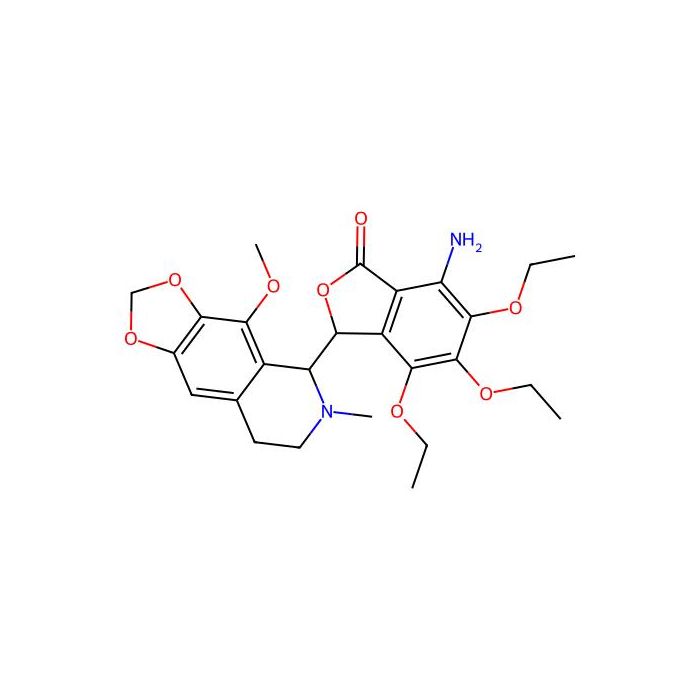
This compound belongs to the class of organic compounds known as phthalide isoquinolines. These are organic compounds with a structure characterized by an isoquinoline moiety linked to phthalide.
External Descriptors
Not available
1. Djoumbou Feunang Y, Eisner R, Knox C, Chepelev L, Hastings J, Owen G, Fahy E, Steinbeck C, Subramanian S, Bolton E, Greiner R, and Wishart DS. ClassyFire: Automated Chemical Classification With A Comprehensive, Computable Taxonomy. Journal of Cheminformatics, 2016, 8:61.
Determine the necessary mass, volume, or concentration for preparing a solution.
Dilution Calculator
Determine the dilution needed to prepare a stock solution.
Reconstitution Calculator
Revisões
Avaliações dos Clientes
Application Protocols
Item-specific (Product Data)
Manufacturer application notes: Not provided for this item.
Example research-use workflows (general; adapt to your system)
Enzyme inhibition assay (biochemical)
Prepare a 10–20 mM DMSO stock; serially dilute to generate 10–12 concentrations.
Incubate Tritoqualine with recombinant HDC and PLP cofactor for 10–15 min at 25–37 °C.
Initiate with L-histidine substrate; quench at defined times and quantify histamine by LC–MS/MS or fluorescence after derivatization.
Fit IC50 using non-linear regression; report assay conditions (substrate/cofactor concentrations, time, temperature, buffer).
Cellular modulation assay
Treat cells with a concentration range while maintaining constant vehicle (e.g., 0.1% DMSO).
After incubation, measure extracellular/intracellular histamine or downstream markers. Include cytotoxicity counterscreens.
Analytical reference standard use
Prepare calibration curves (at least 6–8 levels) in matched matrix; bracket samples with QCs.
Verify stability in autosampler conditions and after freeze–thaw.
Controls and QC
Vehicle-only, no-enzyme, and heat-inactivated controls.
Orthogonal readouts to confirm mechanism (e.g., direct histamine quantitation and enzyme activity readout).
Biological Roles
Item-specific (Product Data)
Research use note: For research use only.
Literature/General
Reported function: Tritoqualine has been described in the literature as a modulator of histamine biosynthesis, commonly referenced as an inhibitor of histidine decarboxylase (HDC), the PLP-dependent enzyme that converts L-histidine to histamine. It is used as a tool compound to probe histamine pathways in biochemical and cellular models.
Experimental contexts: Employed in studies of mast-cell biology, inflammatory signaling, and enzymology to evaluate changes in intracellular/extracellular histamine levels and downstream readouts (e.g., Ca2+ flux, gene expression). No clinical/therapeutic claims are made here.
Selectivity considerations: Specificity versus other PLP-dependent decarboxylases and potential off-target interactions should be established under your assay conditions via orthogonal assays and counterscreens.
Practical notes for biology workflows
Establish a concentration–response with at least 8–12 points to determine IC50 under defined substrate and cofactor concentrations.
Include time-course experiments to distinguish reversible functional modulation from time-dependent effects.
Validate pathway modulation using independent readouts (e.g., direct histamine quantitation by LC–MS/MS alongside functional assays).
Buffer Applications
Applicability
Tritoqualine is not a buffering agent and is not typically used to prepare buffer systems.
Practical guidance
When used in biochemical assays, prepare Tritoqualine stock solutions (commonly in DMSO) and dilute into an appropriate assay buffer (e.g., phosphate, HEPES, or Tris) validated for your enzyme/cell system.
Confirm that the vehicle concentration and any solubilizing aids (e.g., cyclodextrins, low levels of nonionic surfactant) do not alter buffer pH, ionic strength, or assay performance.
Monitor potential precipitation upon dilution into aqueous buffers; filter or adjust co-solvent as needed.
Green Alternatives
Context
As a bioactive small molecule, the principal environmental impacts arise from solvent choice and scale of use rather than from substituting the active itself.
Greener handling strategies (general)
Prefer aqueous buffers with minimal DMSO where feasible; cap DMSO to ≤0.1–0.5% v/v in biological assays.
For chromatography, consider water–acetonitrile systems over water–methanol when appropriate; ACN offers lower viscosity and often reduced backpressure, enabling lower solvent use. Recycle solvents when infrastructure permits.
Use micro-scale assays (96/384-well formats) to minimize solvent and compound consumption.
Comparison of common solvents (general)
DMSO: High solvency; challenging waste stream; minimize volumes and segregate waste.
Ethanol: Preferable from a green perspective; acceptable in many bioassays at low percentages.
2-Propanol: Useful for cleaning; higher VOC burden than ethanol.
Water/buffer: Greenest carrier when solubility permits; consider cyclodextrins or surfactants (e.g., 0.01–0.05% polysorbate) to enhance apparent solubility—verify no assay interference.
Operational best practices
Implement closed-well handling and plate seals to limit VOC emissions.
Utilize analytical methods with shorter runtimes and lower flow rates (UHPLC) to cut solvent usage.
Consolidate waste streams and employ approved solvent reclamation.
Pharmaceutical Uses
Item-specific (Product Data)
Compendial status and excipient roles: Not specified for this item; refer to CoA/Spec Sheet.
Research/formulation context (non-clinical)
Tritoqualine may be employed as a reference standard or analytical control material in method development (e.g., HPLC/LC–MS quantitation) related to histamine-pathway research compounds.
Preformulation studies can characterize solubility, stability (pH/light/oxidation), and solid-state properties to support in vitro dosing or in vivo exploratory studies in research settings.
No medical, therapeutic, or clinical claims are made; this product is for research use only.
Practical notes for analytical use
Prepare calibration standards in matched matrix (e.g., surrogate matrix with the same organic content as samples) to avoid adsorption or recovery biases.
Assess carryover and matrix effects in LC–MS; use stable-isotope internal standards when available.
Physical Properties
Item-specific (Product Data)
Appearance: Not specified for this item; refer to CoA/Spec Sheet.
Grade/Purity: Not specified for this item; refer to CoA/Spec Sheet.
Molecular weight, molecular formula: Not specified for this item; refer to CoA/Spec Sheet.
Literature/General (for planning only; verify against the CoA for your lot)
Exact MP, BP, density, refractive index, logP/logD, pKa, and aqueous solubility are not provided here. Consult primary databases (e.g., PubChem CID 72145) or experimental determinations.
Practical handling note: Small-molecule bioactives of this class are frequently soluble in DMSO at 10–50 mM for stock solutions, with subsequent dilution into assay buffers. Always confirm actual solubility and stability empirically for your lot.
Experimental recommendations
Conduct a preliminary solubility screen (water, PBS, MeOH, EtOH, acetonitrile, DMSO) at room temperature, then at 37 °C if needed.
Assess stability by LC–UV or LC–MS over 24–72 h in intended media (buffer, culture medium, serum) to detect hydrolysis/oxidation.
Record pH-dependent solubility and any precipitation upon dilution from DMSO to aqueous media.
Quality and Grades
Item-specific (Product Data)
Grade/purity: Not specified for this item; refer to CoA/Spec Sheet.
Stabilizers, residual solvents, UV cutoff, metal limits: Not specified for this item; refer to CoA/Spec Sheet.
Interpreting grades (general guidance)
Research-grade small molecules are typically suitable for discovery biology, screening, and method development; they may not meet compendial (USP/EP) requirements for drug-substance use.
If HPLC/LC–MS analytical use is intended, confirm UV absorbance background, residual solvents, and assay purity with the CoA. Request a detailed impurity profile when necessary.
Recommended quality checks on receipt
Identity: Verify by LC–MS or HRMS using a certified reference where possible.
Purity: Check by HPLC/UPLC with at least two orthogonal methods (e.g., UV at two wavelengths and MS TIC). Record system suitability.
Water content: Determine by Karl Fischer if moisture sensitivity or formulation concentration is critical.
Solid-state form: If polymorphism is relevant, characterize by PXRD/DSC/TGA.
Lot-to-lot control
Retain a reference chromatogram and spectra for future comparison.
For bioassays, re-establish dose–response curves when changing lots to detect potency shifts attributable to minor impurities.
Reaction and Applications
Item-specific (Product Data)
Manufacturer applications: Not provided for this item.
Applicability to synthetic chemistry
Tritoqualine is primarily used as a bioactive research chemical rather than as a general-purpose synthetic reagent. It is not typically employed as a catalyst, ligand, or coupling partner in standard organic reactions.
Research applications (literature/general)
Employed as a tool compound in histamine-pathway biology to modulate enzymatic activity and histamine levels in vitro. Useful in pharmacology, receptor biology, and enzyme-kinetic studies when appropriate controls are used.
Practical notes
Ensure accurate dosing through gravimetric preparation of concentrated stocks and validated dilution schemes.
For biochemical assays, pre-incubate with target enzyme or cells to allow equilibrium binding/functional effects; time-dependence should be established empirically.
Track compound stability in the presence of cofactors (e.g., PLP-dependent enzymes) and metals; quench/controls may be needed to distinguish compound decomposition from target modulation.
Documentation
Record batch number, solvent, final assay concentration, and incubation times. Include vehicle controls and, if available, a mechanistically orthogonal comparator compound.
Reaction Conditions
Applicability
As supplied, Tritoqualine is intended as a research bioactive, not as a reactant. No item-specific reaction conditions are provided.
General conditions for handling in assays
Stock solution preparation: Frequently 10–50 mM in DMSO (literature/general). Verify actual solubility for this item/lot.
Working concentrations: Determine empirically by constructing dose–response curves; ensure vehicle control is matched.
Incubation: Pre-equilibrate with target enzyme/cells; typical times range from 10–60 minutes for acute assays, longer for expression-level changes. Validate time dependence.
LC–MS quantitation: Reversed-phase C18, water (0.1% formic acid) / acetonitrile gradient; monitor for expected molecular ion; confirm with fragmentation pattern.
Stability checks: Incubate at assay temperature in intended media and analyze at multiple timepoints to derive apparent half-life under assay conditions.
Note
Do not construe the above as specifications. Optimize and validate conditions for your specific system.
Safety and Handling
Item-specific (Product Data)
GHS classification, signal word, hazard statements, pictograms: Not specified for this item; refer to SDS.
Storage: Room temperature (Product Data). Protect from excessive heat and direct sunlight.
General laboratory precautions (always defer to SDS)
PPE: Lab coat, safety glasses, appropriate chemically resistant gloves. Handle powders/solids in a fume hood to minimize inhalation of dust.
Avoid: Contact with skin/eyes; inhalation of dust/aerosols; ingestion. Wash thoroughly after handling.
Incompatibilities: Until specific data are available, segregate from strong oxidizers and strong acids/bases. Use amber containers if compound is light-sensitive (check stability notes from your CoA/SDS).
First-aid overview (general)
Inhalation: Move to fresh air. Seek medical attention if symptoms occur.
Skin/eye contact: Rinse with water for 15 minutes. Remove contaminated clothing. Obtain medical advice if irritation persists.
Ingestion: Rinse mouth. Do not induce vomiting unless directed by medical personnel. Seek medical attention.
Waste & spill response
Small spills: Absorb with inert material, collect in suitable container for hazardous waste. Avoid creating dust.
Disposal: Treat as organic laboratory chemical waste in accordance with institutional and local regulations.
Note: Obtain and review the SDS for this specific product/lot before use; SDS supersedes general guidance.
Solvent Selection
Item-specific (Product Data)
Specific solubility data: Not specified for this item; refer to CoA/Spec Sheet.
Practical selection strategy (general for small-molecule bioactives)
Primary stock solvent: DMSO is typically preferred due to broad solvency and assay compatibility at ≤0.1–0.5% v/v final.
Alternative organic solvents: Methanol, ethanol, or acetonitrile for analytical prep and HPLC sample dissolution; verify UV transparency if using UV detection.
Aqueous media: Solubility in water/PBS is compound-dependent; use co-solvent strategies (DMSO seed ≤5% v/v) or cyclodextrin complexation if needed.
Ethanol: Biologically tolerated up to ~0.5–1% v/v in many cell assays; lower solvency than DMSO.
Acetonitrile: Excellent for analytical work; limited use in live-cell assays.
Tips
Filter 0.2 μm prior to chromatography or bioassay addition to remove particulates.
Assess adsorption losses on plastics; use low-bind tubes/plates for hydrophobic compounds.
Document the exact solvent lot and water content when reproducibility is critical.
Storage and Reconstitution
Item-specific (Product Data)
Storage conditions: Room temperature.
Shipped in: Not specified for this item; refer to CoA/Spec Sheet.
Appearance and reconstitution solvent: Not specified for this item; refer to CoA/Spec Sheet.
General guidance
On receipt: Store tightly closed in a dry, well-ventilated place. If hygroscopic or light-sensitive per CoA/SDS, protect with desiccant and amber containment.
Stock solutions: Prepare concentrated stocks in DMSO or another verified solvent. Aliquot and store at −20 °C or −80 °C for long-term stability to minimize freeze–thaw; assess stability empirically by LC–MS/UPLC.
Working solutions: Prepare fresh on the day of use; avoid prolonged exposure to light/air if instability is suspected.
Freeze–thaw: Minimize cycles; use single-use aliquots. Document the number of cycles and discard if degradation is observed.
Compatibility: Verify compatibility with plastics or use glass vials for long-term stock storage to reduce adsorption.
Documentation
Record lot number, preparation date, solvent, concentration, and storage conditions in your ELN.
Refer to the CoA/Spec Sheet and SDS for item-specific limits and stability information; those documents supersede general guidance.
Structure and Identity
Item-specific (Product Data)
SKU: T694402
Product name: Tritoqualine
CAS: 14504-73-5
Storage conditions: Room temperature
Other identifiers (InChIKey, SMILES, MF, MW): Not specified for this item; refer to CoA/Spec Sheet.
Literature/General
Common name: Tritoqualine (also known in literature as a small-molecule histamine-pathway modulator)
Structural class: Reported as a heteroaromatic small molecule (literature). Exact constitutional diagram, functional groups, and stereochemistry should be verified from an authoritative structural database before use in structure-based work.
Recommended practice: If using in computational or analytical workflows, obtain a verified structure record (SMILES/InChI) from a primary database (CAS Registry, PubChem CID 72145, etc.) and include versioning in your ELN to ensure traceability.
Descriptive 2D features (general guidance)
Heteroaromatic pharmacophore; potential for hydrogen-bonding and π–π interactions (literature, general for this class). Confirm actual donor/acceptor counts and ring systems from a verified structure file before QSAR or docking.
Synthetic Utility
Applicability
Tritoqualine is a finalized small-molecule entity and is not commonly used as a reagent, catalyst, or building block in routine synthetic chemistry.
General guidance (if undertaking synthesis of analogs/derivatives)
Without item-specific structural details in this listing, route design should be based on a verified structure from primary databases (e.g., CAS Registry, PubChem). Identify key heteroaromatic coupling/disconnection sites and functional handles suitable for diversification (literature).
Typical enabling transformations for heteroaromatic drug-like scaffolds include: electrophilic aromatic substitution, nucleophilic aromatic substitution on activated rings, cross-couplings (Suzuki–Miyaura, Buchwald–Hartwig), and late-stage functionalizations (C–H activation). Method selection depends on the confirmed scaffold and substitution pattern.
Analytical control
Employ orthogonal methods (HPLC-UV, LC–MS, NMR) to ensure identity and purity of any derivatives.
For SAR work, retain detailed records of tautomers/protonation states if the scaffold supports multiple forms.
Target Specificity
Item-specific (Product Data)
No antibody/biologic target data are provided for this item.
Literature/General (small-molecule context)
Reported primary pathway: Histamine biosynthesis modulation, commonly via inhibition of histidine decarboxylase (HDC) activity in biochemical systems.
Selectivity considerations: Determine off-target activity against other PLP-dependent decarboxylases (e.g., DOPA decarboxylase) using counterscreens. Evaluate potential interactions with histamine receptors or transporters if relevant to the study design.
Mechanistic controls: Include positive controls (a known HDC inhibitor) and negative controls (inactive analogs/vehicle) to attribute observed effects to on-target action.
Matrix effects: In cellular models, uptake, efflux, and protein binding can influence apparent potency; measure intracellular concentrations when feasible.
We use cookies to ensure the website functions properly and, where permitted, to improve your experience. You can manage your preferences at any time in Settings. Learn more in our Cookie Policy.
Shall we send you a message when we have discounts available?
Remind me later
Thank you! Please check your email inbox to confirm.
Products are supplied to verified businesses, institutions, and qualified professionals for research and development use only. Not for use in humans, animals, diagnosis, or therapy.