GRAU & PUREZAMoligand™?Moligand™ — Aladdin's line of ligands and bioactive small molecules. Use for receptor, pathway, and binding studies needing defined small-molecule tools.10 mM in DMSO
Moligand™, 10 mM in DMSO Moligand™ para fluxos de trabalho cromatográficos e analíticos sensíveis que exigem interferência mínima da linha de base.
🌡
Armazenamento e envio
Store at -80°C Envio Dry ice packs + Cold packs. Consulte o COA específico do lote para obter as especificações exatas.
📋
Documentos de qualidade
SDS, COA, ficha técnica e folha de especificações disponíveis para download. COA específico do lote acessível por meio de pesquisa por número de lote.
📚
Comprovação documental
Citado em 0 publicações revisadas por pares nas áreas de cromatografia, síntese orgânica e reações de acoplamento cruzado.
Visão geral
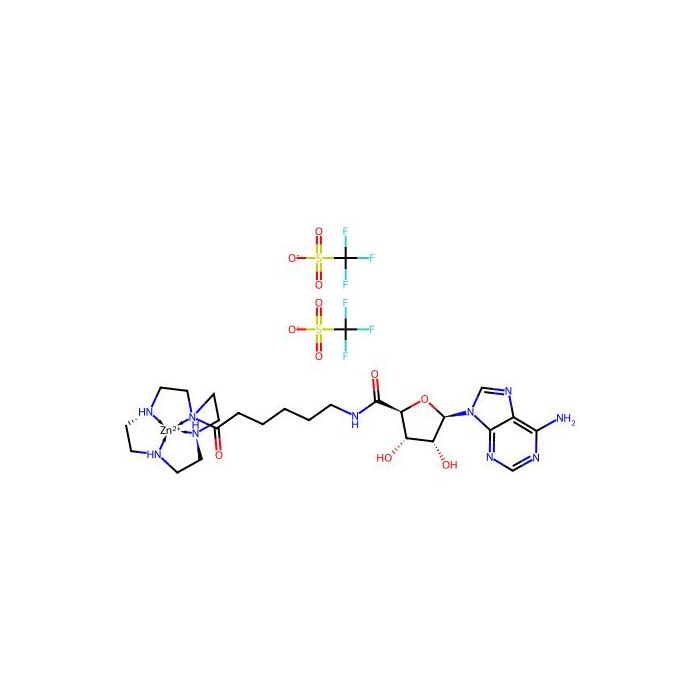
UBA5-IN-1 (compound 8.5) is a selective UBA5 inhibitor with an IC 50 value of 4.0 μM. UBA5-IN-1 inhibits cell proliferation of Sk-Luci6 cancer cells with high expression levels of UBA5.
Especificações
Especificações e pureza
Moligand™, 10 mM in DMSO
Condições de armazenamento de armazenamento
Store at -80°C
Enviado em
Dry ice packs + Cold packs
Este produto requer transporte de cadeia fria. Serviços terrestres e outros serviços econômicos não estão disponíveis.
Grau
Moligand™
Nomes e identificadores
Peso molecular
912.16
Documentação
📋 Ficha de dados de segurança (FDS)
Documento abrangente sobre perigos, manuseamento, armazenamento e conformidade regulamentar.
Determine the necessary mass, volume, or concentration for preparing a solution.
Dilution Calculator
Determine the dilution needed to prepare a stock solution.
Reconstitution Calculator
Revisões
Avaliações dos Clientes
Application Protocols
No item-specific, validated protocols are provided for this product. The following are general starting points for small-molecule ligand evaluation; adjust to your system.
Biochemical enzyme assay (general)
Prepare a 10–50 mM DMSO stock; make a 10-point 3-fold dilution series in assay buffer with constant DMSO across wells.
Typical buffer: 25–50 mM HEPES pH 7.5–8.0, 100–150 mM NaCl, 1–2 mM DTT, 5–10 mM MgCl2, 0.01% Tween-20.
Components: Recombinant UBA5, UFM1, ATP; monitor adenylation/thioester formation via gel-shift, fluorescence polarization, or coupled luminescent readouts.
Seed cells to reach 70–80% confluence at treatment. Treat with a serial dilution (e.g., 0.03–30 μM) maintaining ≤0.1–0.5% DMSO final.
Endpoints: UFM1-conjugate levels by immunoblot, ER stress markers, or reporter assays. Include vehicle and orthogonal controls.
Controls and QC
Include positive/negative controls appropriate to the assay, test for assay interference (fluorescence quenching, aggregation), and verify compound identity/purity before critical experiments.
Note: Optimize concentrations and times empirically; consult the CoA/Spec Sheet for any item-specific handling notes.
Biological Roles
Context (literature/general)
UBA5 is an E1 activating enzyme specific for UFM1, initiating the UFMylation cascade (UBA5 → UFC1 [E2] → UFL1 [E3], with accessory factors). UFMylation modifies substrate proteins via isopeptide linkage to UFM1, regulating ER homeostasis, ribosome-associated quality control, secretory pathways, and stress responses.
Mechanistic outline: UBA5 adenylates UFM1 and forms a thioester intermediate with its catalytic cysteine in an ATP-dependent manner, subsequently transferring UFM1 to the E2 enzyme UFC1.
Biological impact: Perturbation of UFMylation influences proteostasis, unfolded protein response, and cell differentiation programs. Genetic studies implicate the pathway in development and organ function; however, molecular outcomes are highly context dependent.
Relevance of small-molecule ligands
Chemical probes that modulate UBA5 can be used to interrogate rate-limiting steps of UFMylation, enabling target validation, pathway mapping, and establishing chemical–genetic relationships alongside CRISPR/siRNA.
Assay modalities: Enzyme kinetics with recombinant UBA5/UFM1/ATP, thioester formation assays, AlphaScreen/FP binding readouts, and cell-based reporters for UFMylation flux are common approaches.
Important note
No potency, selectivity, or mode-of-action data are specified for this particular item in the listing. Users should consult the CoA/Spec Sheet and perform in-house validation to define active concentrations and specificity profiles under their experimental conditions.
Buffer Applications
Not typically applicable. UBA5-IN-1 is a bioactive small molecule rather than a buffering agent. It does not serve as a pH buffer component or buffering system.
Practical guidance (general)
When using in biochemical assays, prepare DMSO stocks and dilute into assay buffers such as HEPES, Tris, or phosphate-based buffers appropriate for UBA5/UFM1 enzymology. Maintain a constant final DMSO percentage across controls.
Include bovine serum albumin (BSA) or mild detergents where nonspecific adsorption is a concern; verify no assay interference.
For specific buffer recipes and pH ranges, refer to your enzymology protocol; this product does not define buffer conditions.
Green Alternatives
Because UBA5-IN-1 is a bioactive screening ligand rather than a process solvent or commodity reagent, the concept of greener drop-in replacements is not typically applicable.
General sustainability considerations (literature/general)
Solvent choice for handling: Prefer lower-toxicity, high-boiling, and recoverable solvents when feasible. For stock solutions, DMSO is widely accepted; if alternative co-solvents are needed, evaluate ethanol or water/solubilizer systems with attention to assay compatibility.
Waste minimization: Use microplate-based assays and miniaturized volumes to reduce chemical consumption and hazardous waste.
Supply chain: Consolidate shipments with other cold-chain items to reduce packaging and transport footprint.
Illustrative comparison for stock preparation (general)
DMSO vs DMF: DMSO typically offers better biocompatibility at low percentages in biological assays compared with DMF; choose DMSO when possible.
Ethanol: Greener but lower solubility breadth; can be viable for some ligands at modest concentrations.
Note: No direct “green alternative molecule” exists for a specific bioactive research compound without altering biological activity.
Pharmaceutical Uses
This product is designated for research use only and is not intended for human or veterinary use, clinical diagnostics, or GMP manufacturing.
General formulation context (literature/general)
Early discovery ligands may be formulated as DMSO stocks for in vitro assays or dissolved in appropriate vehicles for in vivo research in preclinical settings; however, no formulation guidance is provided or implied for this specific item.
No compendial status (e.g., USP/Ph. Eur.) is claimed. No excipient role is indicated.
Conclusion
No pharmaceutical or excipient uses are specified or supported for UBA5-IN-1 in this listing.
Physical Properties
Item-specific properties
Appearance: Not specified for this item; refer to CoA/Spec Sheet.
Molecular weight: Not specified for this item; refer to CoA/Spec Sheet.
Molecular formula: Not specified for this item; refer to CoA/Spec Sheet.
Melting point: Not specified for this item; refer to CoA/Spec Sheet.
Boiling point: Not specified for this item; refer to CoA/Spec Sheet.
Density: Not specified for this item; refer to CoA/Spec Sheet.
Solubility: Not specified for this item; refer to CoA/Spec Sheet.
LogP, pKa, refractive index: Not specified for this item; refer to CoA/Spec Sheet.
General expectations for small-molecule screening ligands (literature/general)
Solubility profile: Many screening ligands are supplied as solids or films and are reconstituted in anhydrous DMSO at 10–50 mM to produce a stable master stock. Aqueous solubility varies widely and often benefits from co-solvent (DMSO) or surfactant in assay buffers.
Stability: Typical small molecules are stable for months at −80°C as dry solids and as aliquoted DMSO stocks when protected from moisture, oxygen, and light. Freeze-thaw cycles should be minimized.
Hygroscopicity: Some heteroatom-rich ligands may be mildly hygroscopic; handle quickly under dry conditions if noted on the CoA.
Note: For definitive, item-specific physical constants and any stabilizers or form information, please consult the CoA/Spec Sheet for SKU U1497458.
Quality and Grades
Item-specific
Grade/Purity: Moligand™.
Research use: For research use only.
What Moligand™ typically implies (general description)
Moligand™ denotes inclusion in a curated small-molecule/ligand discovery collection intended for biochemical or cellular screening and target validation research. Such collections commonly emphasize identity verification and impurity control compatible with early-stage SAR, rather than application-specific grades like HPLC-grade solvents or GMP materials. Exact release tests for this item (e.g., purity %, residual solvents, water content) are not specified here and should be confirmed on the CoA.
Analytical characterization (general guidance)
Recommended confirmatory checks prior to screening campaigns include LC–MS for identity/purity, 1H NMR for structural confirmation, and assessment of solubility/stability in assay-relevant media.
What is NOT covered
This product is not designated for clinical, diagnostic, or GMP manufacturing use. No pharmacopoeial grade is claimed.
Documentation
For this SKU (U1497458), refer to CoA/Spec Sheet for item-specific test methods, acceptance criteria, and any stabilizers or salt/form information.
Reaction and Applications
This product is supplied as a bioactive small-molecule research ligand rather than a synthetic reagent. As such, it is not typically used to drive organic transformations (e.g., condensations, cross-couplings, reductions). If you intend to derivatize or conjugate the compound, consult the CoA/Spec Sheet for functional group information and ensure compatibility with your chemistry.
Biochemical screening: Evaluation against the UBA5/UFM1 conjugation pathway enzymes in vitro.
Cell biology: Phenotypic assays to interrogate UFMylation-dependent signaling and proteostasis, subject to confirmed cell permeability and cytotoxicity profiling.
Chemoproteomics (if suitable handles are present): Target engagement or pull-down studies after structural validation and, if needed, installation of tags via analog synthesis.
Practical tips (general)
Prepare concentrated DMSO stocks, aliquot, and avoid repeated freeze–thaw cycles.
Confirm identity and purity (LC–MS, NMR) before critical experiments.
Establish dose–response curves and monitor off-target liabilities using orthogonal assays.
For canonical synthetic reaction conditions and examples, refer to the Synthetic Utility and Reaction Conditions tabs only if you possess the structural details from the CoA; otherwise these sections are not typically applicable.
Reaction Conditions
Not typically applicable. This product is not intended as a reagent or catalyst for synthetic reactions.
Assay conditions (general, literature-based for UBA5 pathway)
Biochemical assays: Recombinant UBA5, UFM1, ATP/Mg2+, and appropriate buffer (e.g., 25–50 mM HEPES, pH 7.5–8.0; 100–150 mM NaCl) are commonly used to measure adenylation/thioester formation. Reducing agent (e.g., 1–2 mM DTT) can preserve active-site cysteines. Temperature commonly 25–37°C; reaction time 15–60 min depending on signal window.
Cellular assays: Titrate compound across a broad range (e.g., 8–12-point dilution series) with matched DMSO controls; monitor UFMylation readouts by immunoblotting for UFM1 conjugates or reporter assays.
Note: No item-specific potency, selectivity, or solubility data are provided in this listing; users must optimize conditions empirically.
Safety and Handling
Authoritative safety information is provided on the SDS. Hazard pictograms, GHS classification, and H-statements are not specified in this listing and must be verified on the product SDS.
Item-specific
GHS classification: Not specified for this item; refer to SDS.
Signal word / H-statements / pictograms: Not specified for this item; refer to SDS.
General laboratory safety (good practice)
PPE: Wear lab coat, safety glasses, and appropriate chemical-resistant gloves. Use in a chemical fume hood to avoid inhalation of dust/aerosols.
Avoid: Skin/eye contact, ingestion, and inhalation of powders. Prevent moisture ingress when handling powders or DMSO stocks.
Incompatibilities: Until specifics are known, avoid strong oxidizers and bases/acids in concentrated form; keep away from ignition sources if formulated in organic solvent.
First aid (overview, non-exhaustive):
Skin/eye contact: Rinse with plenty of water for at least 15 minutes; remove contaminated clothing; seek medical attention if irritation persists.
Inhalation: Move to fresh air; seek medical attention if symptoms occur.
Ingestion: Rinse mouth; do not induce vomiting; seek medical attention.
Waste disposal: Collect residues and contaminated disposables as organic hazardous waste; follow institutional and local regulations.
Note: Always defer to the product-specific SDS for definitive hazards, handling, and spill/accident procedures.
Solvent Selection
Item-specific solvent data are not provided. For small-molecule screening ligands such as UBA5-IN-1, DMSO is typically the primary solvent for stock preparation due to its broad solubilizing power and biological assay compatibility at low v/v percentages.
General guidance (literature/general)
Primary solvent: Anhydrous DMSO for 10–50 mM master stocks. Filter-sterilize if sterile work is required.
Secondary solvents: DMF, ethanol, or acetonitrile can be used for certain assay formats; verify compatibility with cells/enzymes and instrumentation.
Aqueous use: Dilute DMSO stocks into buffered systems (e.g., PBS, HEPES, assay buffer) to final DMSO ≤0.1–0.5% v/v for cell-based assays, or ≤2% for many biochemical assays, unless your protocol demonstrates tolerance.
Light and moisture: Protect from light if the structure includes photosensitive motifs (general precaution). Use dry solvents to avoid hydrolysis of labile chemotypes.
Quick comparison (general)
DMSO: Highest solubility breadth; biologically compatible at low %; high boiling point.
Ethanol: Lower solubility breadth; volatile; often acceptable up to ~0.1–0.5% v/v in cells.
Acetonitrile: Useful for HPLC and some enzyme assays; limited cell compatibility.
Always perform a small-scale solubility/stability check under your exact assay conditions.
Storage and Reconstitution
Item-specific conditions (from Product Data)
Storage: Store at −80°C.
Shipping: Dry ice packs + cold packs.
General handling guidance for small-molecule ligands
Upon receipt: Allow the shipping container to equilibrate to room temperature before opening to prevent condensation. Immediately return unopened vials to −80°C until use.
Reconstitution: If supplied as a solid or film, dissolve in anhydrous DMSO to prepare a 10–50 mM master stock. Vortex gently and, if needed, briefly sonicate. If sterile application is required, filter through a 0.22 μm PTFE filter.
Aliquoting: Dispense into single-use aliquots (e.g., 10–50 μL) in low-bind tubes to avoid repeated freeze–thaw and adsorption losses.
Storage of stocks: Keep DMSO stocks at −80°C, protected from light and moisture. Avoid more than 2–3 freeze–thaw cycles. Record preparation date and concentration on each aliquot.
Working solutions: Prepare fresh by diluting into assay buffer or culture media, maintaining a constant DMSO percentage. Discard leftover diluted solutions after use; do not refreeze.
Specifications not provided for this item
Exact solubility limits, stabilizers, salt form, and appearance are not specified; refer to the CoA/Spec Sheet for definitive details.
Structure and Identity
Overview: UBA5-IN-1 is cataloged as a small-molecule ligand in the Moligand series, associated with the UBA5/UFM1 pathway based on name designation. Item-specific structural identifiers are not provided in the current listing.
Item-specific (from Product Data)
CAS: 1831169-11-9
Product name: UBA5-IN-1 (Moligand series)
Molecular formula: Not specified for this item; refer to CoA/Spec Sheet.
Molecular weight: Not specified for this item; refer to CoA/Spec Sheet.
SMILES: Not specified for this item; refer to CoA/Spec Sheet.
InChIKey: Not specified for this item; refer to CoA/Spec Sheet.
General chemical context (literature/general)
Compound type: Small-molecule bioactive ligand candidate; likely non-volatile organic molecule designed for target engagement with UBA5 (E1 enzyme for UFM1).
Expected functional features (general, not item-specific): H-bond donors/acceptors and hydrophobic motifs are common in E1 enzyme ligands to access ATP/adenylation or protein–protein interaction sites; final structures vary by series.
2D structure description
Not available for this specific item. Without a supplied SMILES or structural diagram, ring systems, stereochemistry, and functional groups cannot be detailed. Please consult the CoA/Spec Sheet or SDS for definitive identifiers.
Synthetic Utility
Not typically applicable. UBA5-IN-1 is provided as a bioactive small-molecule ligand for target/pathway interrogation rather than as a building block or reagent for synthetic transformations.
If derivatization is planned (general guidance)
Confirm structural details from the CoA/Spec Sheet before attempting analog synthesis or probe derivatization (e.g., linker installation for biotin/fluorophore tagging).
Maintain pharmacophore integrity by avoiding modification of putative binding motifs until SAR is established.
For purity and identity confirmation of derivatives, employ orthogonal methods (LC–MS, HRMS, NMR, HPLC) and assess stability in DMSO and assay buffers.
Without item-specific structural information (SMILES/InChI, functional groups), further chemical reactivity guidance cannot be provided.
Target Specificity
Item-specific target data are not provided in the listing.
General context (based on name designation; literature/general)
UBA5 is the E1 activating enzyme in the UFM1 conjugation pathway. Compounds termed “UBA5-IN-#” in literature or collections often denote ligands intended to modulate UBA5 function, but actual specificity and potency require empirical validation.
Selectivity: Counterscreens against related E1 enzymes (e.g., UBA1, UBA3/NAE), E2 enzyme UFC1, and unrelated ATPases to assess off-target liabilities.
Cellular on-target effects: Knockdown/knockout rescue, or use of orthogonal chemical probes, to link phenotypes to UBA5 modulation.
Conclusion
Without a CoA/Spec Sheet providing potency and selectivity data, no item-specific target specificity claims can be made.
Perguntas frequentes
What is Moligand??
Moligand? is one of Aladdin Scientific's premium product lines, formulated for high-purity applications across multiple workflows. Compared to standard grades in the same workflow, Moligand? products typically offer tighter specifications, more rigorous QC, and stronger lot-to-lot consistency.
How should this product be stored?
Store at ?80 °C. Ultra-low temperature storage is required to maintain the specified shelf life.
How is this product shipped?
This product ships frozen with dry ice and cold packs. Unpack on arrival and transfer it to the storage condition stated above; handle dry ice with insulated gloves in a ventilated area.
What are the CAS number, molecular formula and molecular weight?
The CAS Number is 1831169-11-9, the molecular formula is C26H40F6N10O11S2Zn, and the molecular weight is 912.16 g/mol.
What documentation is provided?
Available product documentation, including Certificates of Analysis (COA), Safety Data Sheets (SDS), and specification sheets, is shown in the product document area. Document availability and access follow the current site policy.
Precisa de ajuda para escolher o grau?
O nosso guia de seleção de graus abrange pureza, estado do estabilizador e adequação à aplicação para todas as variantes do nosso catálogo.
Usamos cookies para garantir o funcionamento adequado do site e, quando permitido, para melhorar a sua experiência. Você pode gerenciar suas preferências a qualquer momento nas Configurações. Saiba mais em nossa Política de Cookies.
Deseja que lhe enviemos uma mensagem quando tivermos descontos disponíveis?
Lembrar-me mais tarde
Obrigado! Por favor, verifique a sua caixa de entrada de e-mail para confirmar.
Products are supplied to verified businesses, institutions, and qualified professionals for research and development use only. Not for use in humans, animals, diagnosis, or therapy.