GRAU & PUREZAMoligand™?Moligand™ — Aladdin's line of ligands and bioactive small molecules. Use for receptor, pathway, and binding studies needing defined small-molecule tools.≥98%(HPLC)
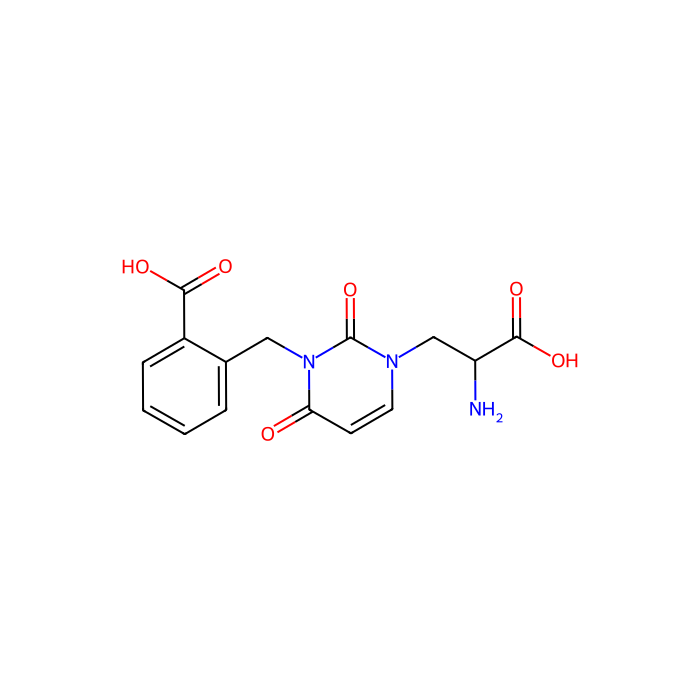
This compound belongs to the class of organic compounds known as l-alpha-amino acids. These are alpha amino acids which have the L-configuration of the alpha-carbon atom.
External Descriptors
Not available
1. Djoumbou Feunang Y, Eisner R, Knox C, Chepelev L, Hastings J, Owen G, Fahy E, Steinbeck C, Subramanian S, Bolton E, Greiner R, and Wishart DS. ClassyFire: Automated Chemical Classification With A Comprehensive, Computable Taxonomy. Journal of Cheminformatics, 2016, 8:61.
Solvent:1eq. NaOH, Max Conc. mg/mL: 8.33, Max Conc. mM: 25; Solvent:DMSO, Max Conc. mg/mL: 6.67, Max Conc. mM: 20 with gentle warming
Peso molecular
333.300 g/mol
XLogP3
-3.200
Hydrogen Bond Donor Count
3
Hydrogen Bond Acceptor Count
7
Rotatable Bond Count
6
Exact Mass
333.096 Da
Monoisotopic Mass
333.096 Da
Topological Polar Surface Area
141.000 Ų
Heavy Atom Count
24
Formal Charge
0
Complexity
576.000
Isotope Atom Count
0
Defined Atom Stereocenter Count
1
Undefined Atom Stereocenter Count
0
Defined Bond Stereocenter Count
0
Undefined Bond Stereocenter Count
0
The total count of all stereochemical bonds
0
Covalently-Bonded Unit Count
1
Calculadoras de soluções
Molarity Calculator
Determine the necessary mass, volume, or concentration for preparing a solution.
Dilution Calculator
Determine the dilution needed to prepare a stock solution.
Reconstitution Calculator
Revisões
Avaliações dos Clientes
Application Protocols
No manufacturer-validated protocols are provided in the Product Data for UBP 302.
General protocol templates (for guidance only):
Stock preparation: Dissolve compound in DMSO to 10–50 mM. Aliquot into amber vials, flush with inert gas if stability is a concern, and store desiccated.
Biochemical assay: Prepare serial dilutions in assay buffer with constant DMSO (e.g., 0.2% v/v). Include vehicle controls and a reference ligand.
Cell-based assay: Titrate compound across a relevant range (e.g., 8–12-point curve). Validate cell health and vehicle tolerance; measure response after appropriate incubation.
Electrophysiology: Use fresh working solutions in perfusion buffer; verify solubility and absence of precipitate; pre-filter.
Important: These are general guidelines. Optimize for your assay format, and consult your institutional SOPs. This product is for research use only.
Biological Roles
Scope: Biological context provided here is general literature background for small-molecule ligands akin to UBP 302 and is not an item specification.
General/literature context:
UBP-class ligands are widely used to interrogate ionotropic glutamate receptors, especially the kainate (GluK) receptor family in neurochemical research.
Such ligands support studies on synaptic transmission, receptor pharmacology, and downstream signaling by modulating ligand-gated ion channels.
They enable evaluation of subtype selectivity, desensitization kinetics, and receptor reserve in recombinant systems and native tissues.
Experimental considerations:
Potency and selectivity are assay- and system-dependent; validate in your biological context with appropriate controls.
Receptor modulation can have indirect effects on cellular excitability; interpret phenotypes with orthogonal readouts (e.g., electrophysiology vs. calcium imaging).
Note: No clinical or diagnostic use is intended. For specific numerical potency/selectivity values, consult primary literature and confirm with your system. Item-specific biological activity data are not provided and should be generated under your assay conditions.
Buffer Applications
Relevance: UBP 302 is not a buffering agent. This section provides general guidance for buffers commonly used to deliver small-molecule ligands in assays.
General guidance:
Use HEPES-buffered saline (HBS) or PBS adjusted to physiological pH (7.2–7.4) for cell-based or receptor assays. Maintain consistent ionic strength and pH across control and treated samples.
When diluting DMSO stocks, add compound last to pre-warmed buffer with vigorous mixing to avoid local supersaturation.
Include carrier proteins (e.g., 0.1% BSA) only if compatible with the assay and ligand recovery; proteins can sequester ligands and alter free concentration.
Filter buffers (0.22 µm) and degas if using in electrophysiology or optical readouts sensitive to bubbles.
Note: No item-specific buffer recipes or pKa data are provided for UBP 302; formulate buffers according to your assay requirements and verify compound stability therein.
Green Alternatives
Context: UBP 302 is a screening ligand; green chemistry considerations mainly concern solvent choice and waste minimization in assay workflows.
Greener handling strategies (general):
Prefer aqueous buffers with minimal DMSO (≤0.1–0.5% v/v) compatible with assay biology.
Use microscale formats (384/1536-well plates) to reduce solvent use and waste volume.
Consider on-demand stock preparation to limit the need for stabilizers and reduce expired chemical waste.
Solvent comparison (general guidance):
DMSO: High solvency; biocompatible at low %; non-volatile. Waste stream manageable but requires segregation.
Ethanol: Renewable feedstock; more volatile; biological tolerance varies; may perturb membranes/receptors.
Water-only systems: Greenest option if compound solubility permits; verify stability and potency.
Tradeoffs:
Reducing DMSO can improve green metrics but risks precipitation or adsorption; confirm by turbidity checks and LC-MS recovery.
Note: No item-specific stabilizers or hazardous additives are specified; consult the SDS for any additional environmental considerations.
Pharmaceutical Uses
This product is supplied for research use only and is not intended for human or veterinary use.
Formulation-relevant notes (general):
In pre-formulation research, small-molecule ligands of this class are often handled as DMSO concentrates due to limited aqueous solubility. For dose–response studies, maintain a constant vehicle fraction.
For in vitro work, avoid excipients that could interfere with target receptors (e.g., high ethanol, surfactants) unless necessary for solubility and proven compatible.
Pharmacopeial/compendial status:
No pharmacopeial monograph is indicated for UBP 302 in the provided data.
Manufacturing/CMC relevance:
Not applicable; no GMP or clinical-use specifications are claimed for this item. If translational studies are contemplated, independent material characterization (identity, purity, water content, counter-ions, residual solvents) must be established separately and is outside the scope of this Moligand™ grade.
Physical Properties
Item-specific physical data:
Appearance: Not specified for this item; refer to CoA/Spec Sheet.
Molecular weight: Not specified for this item; refer to CoA/Spec Sheet.
Molecular formula: Not specified for this item; refer to CoA/Spec Sheet.
Melting point (MP): Not specified for this item; refer to CoA/Spec Sheet.
Boiling point (BP): Not applicable/undetermined for nonvolatile solids; not specified for this item.
Density: Not specified for this item; refer to CoA/Spec Sheet.
Refractive index: Not applicable for solids; not specified for this item.
Solubility: Not specified for this item; refer to CoA/Spec Sheet.
General guidance (literature/typical practice; not item specification):
Small-molecule receptor ligands like UBP 302 are commonly prepared as DMSO stock solutions (e.g., 10–50 mM) and further diluted into aqueous assay buffers containing 0.1–1% DMSO.
If water solubility is limited, co-solvent systems (e.g., DMSO/water or DMSO/physiological buffer) are often used; mild heating (≤40 °C) and sonication can aid dissolution. Filter sterilization (0.22 µm PTFE) can clarify solutions.
pKa/logP values and partitioning behavior should be confirmed from literature or calculated anew before assay design to anticipate adsorption to plastics and recovery from serial dilutions.
Note: Definitive specifications for this item’s lot should be taken from the CoA/Spec Sheet.
Quality and Grades
Item-specific grade:
Moligand™: Internal Aladdin Scientific library grade intended for small-molecule ligand screening and discovery research.
What Moligand™ implies:
Prioritizes suitability for in vitro biochemical/cellular assays, HTS pilot studies, and target engagement work. Not formulated for clinical, diagnostic, or GMP manufacturing use.
Typical expectations include documented identity and lot traceability; however, unless otherwise stated in the CoA, assay-specific criteria (e.g., UV cutoff, residual solvent profiles, metal content) are not implied.
Request and review the CoA/Spec Sheet for current lot identity testing and any available purity data.
If using in quantitative pharmacology (e.g., Ki/IC50 determination), consider independent QC (LC-MS, NMR, HPLC) to confirm concentration and purity in your lab matrix.
For light-/air-sensitive ligands (unknown here), adopt protective handling (amber vials, inert gas) until stability is verified for your protocol.
Storage and shipping (item-specific):
Storage: Room temperature (per Product Data).
Shipped: Normal conditions (per Product Data).
Reaction and Applications
Primary applicability: UBP 302 is supplied as a research ligand for receptor pharmacology and screening rather than as a synthetic reagent.
Research applications (general/literature context):
Tool compound for probing ionotropic glutamate receptor function in biochemical binding assays and electrophysiology.
Useful in structure–activity relationship (SAR) benchmarking against related library members to dissect binding determinants.
Employed in target validation, selectivity panels, and functional assays to benchmark assay windows and positive controls.
Assay setup tips:
Prepare fresh DMSO stocks and minimize freeze–thaw to maintain integrity.
Normalize vehicle concentration across test and control conditions; include internal standard curves for potency calculations.
For cell-based assays, pretest for cytotoxicity/vehicle tolerance at intended exposure times.
Synthesis-related usage:
Not typically used as a reagent or building block. If analog generation is desired, consult primary literature for routes and protect/deprotect strategies; however, such details are not specified for this item and should be verified independently.
Reaction Conditions
Not typically applicable: UBP 302 is offered as a research ligand rather than a reagent used to mediate chemical reactions.
General handling conditions for assay preparation (practical guidance):
Dissolution: Prepare fresh DMSO stock (e.g., 10–50 mM), vortex, and sonicate if needed. Avoid exposure to elevated temperatures for prolonged periods until stability is confirmed.
Dilution: Add stock slowly to vigorously mixed buffer to the desired final concentration while maintaining constant vehicle (% DMSO).
Filtration: If particulate persists, pass through 0.22 µm PTFE filter. Avoid cellulose acetate if DMSO-rich.
Stability checks: Periodically assess potency drift via control dose–response curves; verify by LC-MS if available.
No item-specific kinetic/thermal stability data, catalysts, or reaction yields are provided in the Product Data. Refer to your assay SOPs and generate empirical stability data under intended conditions.
Safety and Handling
GHS classification and hazard statements:
Signal Word: Not specified for this item; refer to SDS.
H-Statements: Not specified for this item; refer to SDS.
GHS Classification/Pictograms: Not specified for this item; refer to SDS.
General laboratory precautions (good practice):
Handle in a chemical fume hood; avoid inhalation, ingestion, and skin/eye contact.
Wear appropriate PPE: lab coat, safety glasses, and nitrile gloves. Upgrade eye/skin protection if aerosol or dust generation is possible.
Prevent dust formation; use antistatic measures when weighing fine powders.
Avoid incompatible materials until confirmed by SDS; as a conservative default, segregate from strong oxidizers, strong acids/bases, and reactive reducing agents.
First-aid overview (consult SDS for authoritative guidance):
Skin/Eye contact: Rinse with water for ≥15 minutes; remove contaminated clothing; seek medical attention if irritation persists.
Inhalation: Move to fresh air; assist breathing as needed; obtain medical attention.
Ingestion: Rinse mouth; do not induce vomiting unless directed by medical personnel; seek medical attention.
Waste and spills:
Absorb small spills with inert material; collect for chemical waste disposal. Dispose according to local regulations and the SDS.
Note: This product is supplied for research use only.
Solvent Selection
Applicability: As a small-molecule ligand, UBP 302 is typically prepared as concentrated stocks for screening assays.
Practical guidance (general/literature practice):
Primary stock solvent: DMSO is the default for many receptor ligands due to broad solvency, chemical inertness in storage, and compatibility with biological assays at ≤0.1–1% v/v.
Aqueous workup: Dilute DMSO stocks into your assay buffer (e.g., HEPES, PBS) while maintaining consistent DMSO across wells to avoid vehicle effects.
Alternative co-solvents: DMF or ethanol can occasionally be used; verify target/assay tolerance and solubility. Avoid high alcohol content in cell-based assays.
Adsorption mitigation: For polar/charged ligands, adsorption to plastics may be minimal; nonetheless, confirm recovery from tips/plates. Use low-bind plastics if needed.
Selection hints:
If compound is sparingly soluble in water, start at 10–50 mM in DMSO, then serially dilute.
Ensure buffer pH is compatible with compound ionization state for consistent potency readouts; pre-warm and sonicate to fully dissolve.
Note: Exact solubility limits and pKa/logD for this item are not specified; confirm empirically for your assay conditions.
Storage and Reconstitution
Item-specific conditions (from Product Data):
Storage: Room temperature.
Shipped in: Normal conditions.
Reconstitution guidance (general best practices):
Dissolve in anhydrous DMSO to prepare concentrated stocks (e.g., 10–50 mM). If hygroscopicity is unknown, handle quickly, cap promptly, and consider working in a low-humidity environment.
Prepare single-use aliquots to avoid freeze–thaw and prolonged bench exposure. Store aliquots in amber vials protected from light if chromophoric instability is suspected.
For aqueous working solutions, dilute immediately before use into compatible buffers; confirm clarity and pH.
Stability notes:
No stabilizers or shelf-life data are specified for this item; refer to CoA/SDS. If long-term storage is required, you may evaluate refrigerated or desiccated storage as part of your internal stability assessments while adhering to the item’s specified storage condition.
Always consult the CoA and SDS for lot-specific guidance. Product is for research use only.
Structure and Identity
Overview: UBP 302 is a cataloged small-molecule ligand supplied for discovery screening and receptor pharmacology research.
Item-specific identifiers (from Product Data):
Product Name: UBP 302
SKU: U287451
CAS: 745055-91-8
PubChem CID: 6420161
InChIKey: 369455 (as provided)
Grade: Moligand™
Structural information for this item:
Molecular formula: Not specified for this item; refer to CoA/Spec Sheet.
Molecular weight: Not specified for this item; refer to CoA/Spec Sheet.
SMILES: Not specified for this item; refer to CoA/Spec Sheet.
General/literature notes (for context, not item specification):
UBP 302 is described in literature as a selective ionotropic glutamate receptor ligand used to interrogate kainate (GluK) receptor function. Precise formula/structure details should be verified against primary references or the product CoA for this lot.
2D structure description (general):
Typically presented as a discrete organic small molecule bearing polar functionality suitable for receptor engagement. Exact functional groups, ring systems, and stereochemistry are not provided in the current Product Data and should be confirmed from the CoA or primary literature.
Synthetic Utility
Primary role: UBP 302 is a final small-molecule ligand and is not typically used as a reagent or intermediate in synthetic sequences.
General synthetic considerations (contextual, not item-specific):
Analog synthesis campaigns for receptor ligands often explore heterocycle substitutions, acidic/basic handles, and H-bond donor/acceptor patterns to tune potency and selectivity.
If derivatization is desired (e.g., for probe development), consider isosteric replacement and linker attachment points remote from the pharmacophore to preserve receptor affinity.
Protecting-group strategies, salt formation, and counter-ion exchanges can modulate crystallinity and handling but must be validated against biological activity.
Note: No item-specific functional groups, reactivity, or protecting strategies are provided in the Product Data. For synthetic route planning to related analogs, consult primary literature on UBP-class ligands.
Target Specificity
Item-specific target data are not provided in the Product Data for SKU U287451.
General note (literature context):
UBP-class ligands are commonly used as tool compounds for subsets of ionotropic glutamate receptors, frequently including kainate receptor subtypes. However, specific target selectivity and affinity for this item should not be inferred without direct data.
Guidance:
Determine target specificity under your assay conditions using orthogonal methods (binding assays, electrophysiology, and functional readouts) and include appropriate controls and known reference ligands.
For definitive, lot-specific target information, consult the CoA/Spec Sheet or primary literature and verify experimentally.
Perguntas frequentes
What is the purity of this product, and how is it determined?
This product is supplied at ≥98% purity, determined by HPLC. Lot-specific values are stated on the Certificate of Analysis.
What is Moligand??
Moligand? is one of Aladdin Scientific's premium product lines, formulated for high-purity applications across multiple workflows. Compared to standard grades in the same workflow, Moligand? products typically offer tighter specifications, more rigorous QC, and stronger lot-to-lot consistency.
How should this product be stored?
Store at room temperature.
How is this product shipped?
This product ships under standard ambient conditions. No temperature-controlled packaging is required.
What are the CAS number, molecular formula and molecular weight?
The CAS Number is 745055-91-8, the molecular formula is C??H??N?O?, and the molecular weight is 333.3 g/mol. InChIKey UUIYULWYHDSXHL-NSHDSACASA-N.
What documentation is provided?
Available product documentation, including Certificates of Analysis (COA), Safety Data Sheets (SDS), and specification sheets, is shown in the product document area. Document availability and access follow the current site policy.
Precisa de ajuda para escolher o grau?
O nosso guia de seleção de graus abrange pureza, estado do estabilizador e adequação à aplicação para todas as variantes do nosso catálogo.
Usamos cookies para garantir o funcionamento adequado do site e, quando permitido, para melhorar a sua experiência. Você pode gerenciar suas preferências a qualquer momento nas Configurações. Saiba mais em nossa Política de Cookies.
Deseja que lhe enviemos uma mensagem quando tivermos descontos disponíveis?
Lembrar-me mais tarde
Obrigado! Por favor, verifique a sua caixa de entrada de e-mail para confirmar.
Products are supplied to verified businesses, institutions, and qualified professionals for research and development use only. Not for use in humans, animals, diagnosis, or therapy.