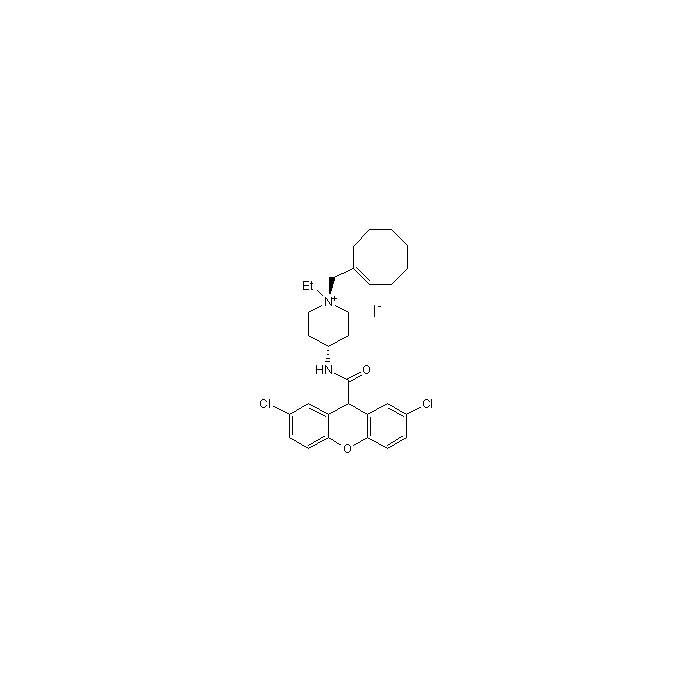
Potent chemokine CCR1 and CCR3 receptor antagonist. Inhibits MIP-1α-induced chemotaxis in CCR1 transfectants and eotaxin-induced chemotaxis in CCR3 transfectants (IC50values are 9.57 and 93.8 nM respectively). Antagonizes CCR3-mediated entry of HIV-1 isol
Condições de armazenamento de armazenamento
Store at 2-8°C
Enviado em
Wet ice
Este produto requer transporte de cadeia fria. Serviços terrestres e outros serviços econômicos não estão disponíveis.
This compound belongs to the class of organic compounds known as xanthenes. These are polycyclic aromatic compounds containing a xanthene moiety, which consists of two benzene rings joined to each other by a pyran ring.
External Descriptors
Not available
1. Djoumbou Feunang Y, Eisner R, Knox C, Chepelev L, Hastings J, Owen G, Fahy E, Steinbeck C, Subramanian S, Bolton E, Greiner R, and Wishart DS. ClassyFire: Automated Chemical Classification With A Comprehensive, Computable Taxonomy. Journal of Cheminformatics, 2016, 8:61.
Determine the necessary mass, volume, or concentration for preparing a solution.
Dilution Calculator
Determine the dilution needed to prepare a stock solution.
Reconstitution Calculator
Revisões
Avaliações dos Clientes
Application Protocols
No vendor-tested applications or protocols are provided in the Product Data for UCB 35625.
General guidance for small-molecule testing (non-item-specific):
Stock solution: Prepare 10–50 mM in anhydrous DMSO; aliquot and store at 2–8°C or as stability permits. Warm to room temperature before opening.
Dose–response: Use serial dilutions (e.g., 1:3 or 1:2) spanning at least 8 concentrations to define potency curves; include vehicle controls matching the highest DMSO percentage.
Assay controls: Include positive and negative controls relevant to the biological readout; confirm lack of assay interference (fluorescence/absorbance quenching, aggregation) via orthogonal methods.
Data quality: Monitor Z′ factor, signal window, and replicate variability. Confirm hits by retesting with fresh stock and independent lot if critical.
For item-specific protocols (concentrations, incubation times, readouts), consult the literature or develop assay-specific SOPs once the compound’s target and properties are established.
Biological Roles
Item-specific biological target information is not provided in the Product Data for UCB 35625.
General context for library compounds (literature/practice, not item-specific claims):
Compounds supplied under proprietary or shorthand names in screening libraries are often bioactive ligands originating from medicinal chemistry programs. They can serve as chemical probes or reference controls once their targets and potencies are confirmed with appropriate assays.
When employing such compounds, good practice includes target deconvolution (biochemical validation, orthogonal readouts, counter-screens to exclude assay interference), and verification of on-target vs off-target effects.
Physicochemical profiling (solubility, permeability, stability in buffer and cell culture media, serum protein binding) helps anticipate assay behavior and interpret concentration–response curves.
Recommendations:
If a specific biological target is essential for your study, request or determine the compound’s target profile through vendor documentation or in-house testing (e.g., binding, functional antagonism/agonism, selectivity panels).
Employ appropriate vehicle controls and, where possible, multiple chemotypes to reduce the risk of chemotype-specific artifacts.
Buffer Applications
This product is a discrete small-molecule library compound and is not a buffering agent. Therefore, buffer formulation guidance is generally not applicable.
Practical handling (general):
Prepare concentrated DMSO stocks and dilute into assay buffers (e.g., PBS, HEPES-buffered saline, cell culture media) to the desired working concentration while maintaining acceptable final vehicle levels.
If precipitation occurs upon dilution, adjust the sequence of addition (add compound to buffer under mixing), use gentle warming, or include a small fraction of co-solvent compatible with the assay.
Green Alternatives
Because UCB 35625 is a discrete small-molecule library compound (not a solvent or bulk reagent), “green alternative” considerations focus on handling media and workup rather than replacing the compound itself.
Greener handling choices (general):
Stock preparation: Prefer aqueous-buffered systems with minimal DMSO where feasible (e.g., ≤0.1–0.5% v/v), consistent with assay tolerance.
Co-solvent selection: If co-solvents are required, ethanol or PEG-400 can be more benign alternatives to DMF or NMP for some assays, provided compatibility is demonstrated.
Waste minimization: Use microplate-based assays and miniaturize volumes to reduce organic solvent waste. Consolidate DMSO-containing waste for appropriate disposal.
Illustrative comparison of common vehicles (general):
DMSO: High solvency, broadly accepted in bioassays; moderate environmental impact; manage as organic waste.
Ethanol: Renewable feedstock, good compatibility at low percentages; volatility can aid removal but may impact cells at >1–2% v/v.
PEG-400: Low volatility and safer handling; may affect viscosity and diffusion in assays.
Operational tips:
Thaw only what you need; aliquot to reduce freeze–thaw cycles and waste.
Validate the lowest effective vehicle percentage that maintains compound solubility and assay performance.
Pharmaceutical Uses
No pharmacopeial status, excipient role, or formulation-grade designation is provided for this item. It is supplied strictly for research use only.
General considerations for research compounds (not item-specific claims):
Such compounds are occasionally employed as reference standards, tool compounds, or positive/negative controls in discovery and preclinical research workflows.
If used as an analytical reference (e.g., LC–MS calibration), confirm purity and exact molecular weight and obtain a CoA with lot-specific data. Verify stability under storage and sample-preparation conditions.
For any development or GLP/GMP-adjacent work, procure comprehensive documentation (synthetic route summary, impurity profile, residual solvent data) and consider requalification or repurification as needed.
Note: No therapeutic or clinical use is implied or supported for this product.
Physical Properties
Item-specific physicochemical data are not included in the provided Product Data for UCB 35625 (CAS 202796-42-7).
Appearance: Not specified for this item; refer to CoA/Spec Sheet.
Melting point: Not specified for this item; refer to CoA/Spec Sheet.
Boiling point: Not specified for this item; refer to CoA/Spec Sheet.
Density: Not specified for this item; refer to CoA/Spec Sheet.
Refractive index: Not applicable/Not specified for this item; refer to CoA/Spec Sheet.
Solubility: Not specified for this item; refer to CoA/Spec Sheet.
logP/logD: Not specified for this item; refer to CoA/Spec Sheet.
pKa: Not specified for this item; refer to CoA/Spec Sheet.
General handling notes (literature/practice, not item-specific):
Many library screening compounds are shipped as solids or concentrated solutions and are commonly dissolved in high-purity DMSO (anhydrous, ≥99.9%) to make 10–50 mM stocks for biochemical and cell-based assays. If aqueous use is required, prepare a DMSO stock and dilute into buffer while maintaining final DMSO below typical assay tolerances (0.1–1% v/v).
If the compound contains ionizable functionality (unknown here), solubility may be improved by pH adjustment or co-solvent systems (e.g., DMSO/water, DMSO/PBS, DMSO/EtOH/water).
Always defer to the product CoA and SDS for authoritative properties and to confirm compatibility with your assay matrices.
Quality and Grades
Grade/Purity: Not specified for this item; refer to CoA/Spec Sheet.
Interpretation and implications:
Without an explicit grade (e.g., ≥98% by HPLC, BioX-grade, or screening-grade), the default assumption for library compounds is research-grade suitable for discovery screening. Confirm actual purity, residual solvents, and identity by reviewing the CoA.
For quantitative studies (e.g., potency ranking, PK sample spiking), request or verify:
Assay purity (HPLC/UPLC area %, reporting method and wavelength)
Identity (1H NMR, LC–MS/HRMS)
Water/volatile content (KF, GC residual solvents) where relevant
Salt form and counterions
Any stabilizers/additives (none stated here)
What grade means in practice (general guidance):
Screening grade: Typically ≥90–95% purity; suitable for primary screens.
Analytical or reference standard grade: Typically ≥98% purity with comprehensive characterization and stability data.
Recommendations:
If using for SAR or as a control ligand, consider repurification or in-house QC (HPLC, NMR) to confirm purity and identity, especially if the assay is sensitive to impurities or the extinction coefficient is unknown.
Reaction and Applications
This product is offered as a research small-molecule compound rather than a synthetic reagent. No manufacturer application notes are provided for chemical transformations.
Applicable uses (research context, general):
May serve as a reference or control compound in target-based or phenotypic assays within small-molecule screening workflows.
Suitable for profiling in biochemical binding/functional assays, cell-based assays, and secondary confirmation cascades after appropriate solubilization and QC.
Not typically applicable:
It is not generally used as a stoichiometric reagent, catalyst, or solvent for named organic reactions. Consequently, common reaction families (e.g., cross-coupling, nucleophilic substitutions) are not relevant here without a defined synthetic role or known reactive handle.
Best practices:
Verify identity/purity prior to biological testing (HPLC/LC–MS, NMR).
Establish solubility limits and assay-compatible vehicle controls (DMSO).
If analytical quantitation is needed (e.g., LC–MS bioanalysis), develop a compound-specific MS method, including an internal standard and stability assessment in your matrices.
For synthetic exploitation or derivatization, request structural details (SMILES/InChI) and consult IP/assay literature associated with the CAS if route scouting or analogue synthesis is intended.
Reaction Conditions
Not applicable. This item is not offered as a reagent or catalyst and no synthetic reaction conditions are associated with its intended use.
General analytical/handling conditions (for characterization; not item-specific specs):
LC–MS: Typical mobile phases are water/acetonitrile with 0.1% formic acid or ammonium acetate; gradients over 5–20 minutes can resolve many small molecules for purity checks.
NMR: 1H/13C spectra are commonly collected in DMSO-d6, CDCl3, or MeOD-d4 depending on solubility; ensure sample concentration and relaxation delays are appropriate for quantitative assessment if needed.
For any proposed chemical transformation involving this compound, obtain the full structural information and stability data before selecting conditions.
Safety and Handling
Safety information provided for this item is limited.
GHS classification: Not specified for this item; refer to SDS.
Signal word, pictograms, H-statements: Not specified for this item; refer to SDS.
Research use: For research use only (not for human or veterinary use).
Storage conditions (from Product Data): Store at 2–8°C. Shipped on wet ice.
General laboratory precautions (best practice; consult SDS for specifics):
PPE: Safety glasses, lab coat, appropriate chemically resistant gloves (e.g., nitrile). Handle in a fume hood to avoid inhalation exposure.
Avoid contact with skin, eyes, and clothing. Prevent ingestion and inhalation of dust/aerosols.
Incompatibilities: Unknown for this specific item. As a conservative practice for small organic molecules, avoid strong oxidizers, strong acids/bases, and reactive reducing agents until compatibility is known.
First aid (overview; defer to SDS): In case of skin or eye contact, rinse with water for at least 15 minutes; seek medical attention if irritation persists. If inhaled, move to fresh air; if ingested, seek medical advice.
Spill/leak: Absorb with inert material, collect for disposal. Prevent release to drains.
Always review the item-specific Safety Data Sheet (SDS) prior to first use and follow institutional chemical hygiene procedures.
Solvent Selection
Item-specific solubility data are not provided. The following guidance reflects common practice for small-molecule library compounds.
Primary solvent recommendation: High-purity DMSO for preparing concentrated stocks (e.g., 10–50 mM), due to broad solubilizing power and assay compatibility at low final %.
Aqueous dilution: Dilute DMSO stocks into assay buffers (PBS, HBSS, HEPES-based) while maintaining final DMSO at 0.1–1% v/v depending on cell line or enzyme tolerance.
Co-solvent strategies: If precipitation is observed on dilution, consider co-solvents such as ethanol or acetonitrile (≤1–2% v/v final), or add surfactant (e.g., 0.01–0.05% Tween-20) if assay-compatible.
pH effects: If the compound is weakly basic or acidic (unknown for this item), adjust buffer pH to favor solubility of the ionized form during stock preparation; neutralize to assay pH after dilution when needed.
Comparison (general):
DMSO vs DMF: DMSO is generally preferred for bioassays for lower toxicity and better aqueous miscibility; DMF is more volatile and often less compatible in cell assays.
DMSO vs 1,2-propanediol/glycerol: Diols may aid solubility for some lipophiles but can increase viscosity and complicate liquid handling.
Practical tips:
Warm to ambient temperature before opening cold-stored vials to avoid moisture condensation.
Vortex/sonicate to fully dissolve; filter through 0.22 µm if particulate persists and the compound is filter-stable.
Storage and Reconstitution
Storage conditions (from Product Data): Store at 2–8°C. Shipped on wet ice to maintain cold chain.
Container handling: Allow vial to equilibrate to room temperature before opening to minimize condensation. Reseal promptly to limit moisture uptake.
Reconstitution: Item-specific solvent/solubility data are not provided. As a general approach for small molecules, dissolve in anhydrous DMSO to prepare a concentrated stock (e.g., 10–50 mM), then aliquot.
Aliquoting: Prepare single-use aliquots to avoid repeated freeze–thaw cycles and headspace moisture ingress.
Working solutions: Dilute the DMSO stock into assay buffer or medium immediately before use. Maintain final DMSO at levels compatible with your system (commonly 0.1–1% v/v).
Stability: Not specified for this item; refer to CoA/Spec Sheet. Perform pilot stability checks (LC–MS or HPLC) after storage to confirm integrity.
Light/moisture sensitivity: Not specified. As a precaution, protect from light and moisture during storage and handling.
Dispose of unused materials and solutions according to institutional and regulatory guidelines for organic chemical waste.
Structure and Identity
UCB 35625 (SKU U287732; CAS 202796-42-7) is supplied as a research-use small molecule from a compound library collection.
Item identifiers (from Product Data):
CAS: 202796-42-7
SKU: U287732
Product name: UCB 35625
Category: Small molecules and compound library (全部 / 可售 / 小分子和化合物库)
Molecular formula: Not specified for this item; refer to CoA/Spec Sheet.
Molecular weight: Not specified for this item; refer to CoA/Spec Sheet.
SMILES: Not specified for this item; refer to CoA/Spec Sheet.
InChIKey: Not specified for this item; refer to CoA/Spec Sheet.
Structural features (general context):
Item-specific structural details are not provided in the current listing. For definitive structure, stereochemistry, and analytical identity (NMR/LC–MS), consult the item’s Certificate of Analysis (CoA) or Spectral Data Sheet.
2D structure (descriptive):
Not specified for this item; refer to CoA/Spec Sheet.
Notes for users:
If you are qualifying this compound as a reference standard, request full identity documentation (CoA, NMR, HRMS/LC–MS, chromatogram, and, where applicable, chiral purity) prior to use in regulated workflows.
Synthetic Utility
UCB 35625 is provided as a finished small-molecule library compound rather than a synthetic building block or reagent.
Without a disclosed structure, no specific functional-group reactivity or transformation guidance can be provided for this item.
It is generally not intended for use in multistep synthesis or as a coupling partner; instead, it may serve as a biological tool or reference compound after adequate characterization.
If derivatization is desired:
Request structural information (SMILES/InChI, functional group annotations) and analytical data to plan protection/deprotection strategies and compatible reaction conditions.
Consider IP status and freedom-to-operate if analog synthesis is contemplated.
Analytical considerations for method development (general):
Develop an LC–MS method using a gradient on a C18 column with a volatile modifier (e.g., 0.1% formic acid or 10 mM ammonium acetate) to assess purity, stability, and potential metabolites/degradants where relevant.
Target Specificity
Target, epitope, clone/isotype, and species reactivity data are not applicable to this small-molecule product and no target information is provided in the Product Data.
Item-specific target details: Not specified for this item; refer to CoA/Spec Sheet or supporting literature if available.
If using this compound as a tool ligand, establish target specificity experimentally via orthogonal assays and appropriate selectivity panels.
Perguntas frequentes
What is the purity of this product, and how is it determined?
This product is supplied at ≥98% purity, determined by HPLC. Lot-specific values are stated on the Certificate of Analysis.
How should this product be stored?
Store at 2–8 °C. Refrigerated storage is required to maintain the specified shelf life.
How is this product shipped?
This product ships chilled on wet ice. Unpack on arrival and transfer it to the storage condition stated above.
What are the CAS number, molecular formula and molecular weight?
The CAS Number is 202796-42-7, the molecular formula is C??H??Cl?IN?O?, and the molecular weight is 655.44 g/mol. InChIKey FOAFBMYSXIGAOX-LQGGPMKRSA-N.
What documentation is provided?
Available product documentation, including Certificates of Analysis (COA), Safety Data Sheets (SDS), and specification sheets, is shown in the product document area. Document availability and access follow the current site policy.
Usamos cookies para garantir o funcionamento adequado do site e, quando permitido, para melhorar a sua experiência. Você pode gerenciar suas preferências a qualquer momento nas Configurações. Saiba mais em nossa Política de Cookies.
Deseja que lhe enviemos uma mensagem quando tivermos descontos disponíveis?
Lembrar-me mais tarde
Obrigado! Por favor, verifique a sua caixa de entrada de e-mail para confirmar.
Products are supplied to verified businesses, institutions, and qualified professionals for research and development use only. Not for use in humans, animals, diagnosis, or therapy.