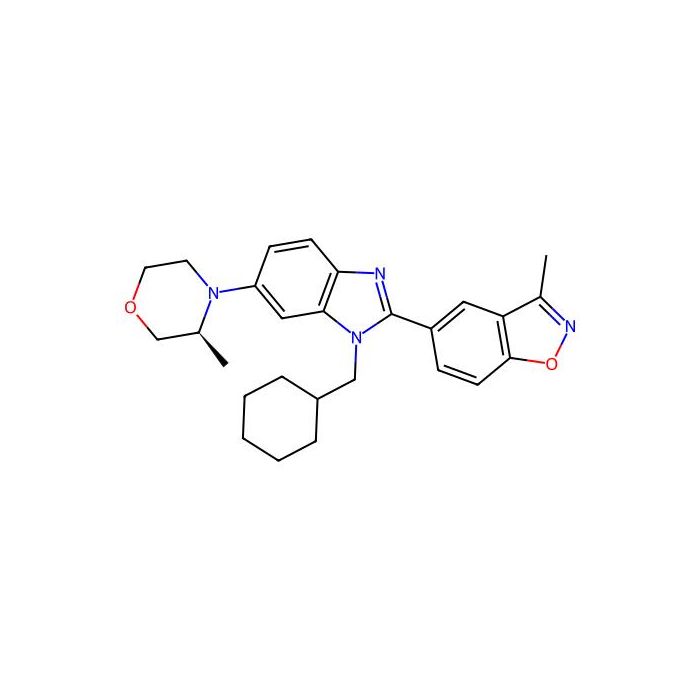
Y06137 - ≥99% , CAS No.2226534-49-0

CAS: 2226534-49-0 Cat. No.: Y648035 Fórmula: C27H32N4O2 Peso molecular: 444.57 PubChem CID: 137333445
Disponível para encomenda
GRAU & PUREZA ≥99%
Storage
Store at -20°C
Shipped In
Ice chest + Ice pads
★
Tamanho
USA
Alemanha (EU)*
Preço
Qtd
5mg
Y648035-5mg
Sob encomenda · 8–12 semanas

321,90US$

482,90US$
Gravar 161,00 US$ (33.34%)
10mg
Y648035-10mg
Sob encomenda · 8–12 semanas

577,90US$

866,90US$
Gravar 289,00 US$ (33.34%)
50mg
Y648035-50mg
Sob encomenda · 8–12 semanas

2166,90US$

3250,90US$
Gravar 1 084,00 US$ (33.34%)
100mg
Y648035-100mg
Sob encomenda · 8–12 semanas

3899,90US$

5849,90US$
Gravar 1 950,00 US$ (33.33%)
Enter a quantity for the sizes you want to add.

Visão geral

Y06137 is a potent and selective BET inhibitor for treatment of castration-resistant prostate cancer (CRPC). Y06137 binds to the BRD4(1) bromodomain with a K d of 81 nM

In Vitro

Y06137 (0.001-100 nM, 96 hours for LNCaP, C4-2B, and 22Rv1 cells; 144 hours for VCaP cells) exhibits low micromolar or nanomolar potencies (IC 50 : 0.29-2.6 μΜ) in the four androgen receptor (AR)-positive prostate cancer cell lines LNCaP, C4-2B, 22Rv1, and VCaP. Treatment of 22Rv1 cells with Y06137 (1, 2, 4, 8, and 16 μM, 48 hours) results in significant down-regulation of both full-length (AR-fl) and AR variants levels. MCE has not independently confirmed the accuracy of these methods. They are for reference only. Cell Viability AssayCell Line: AR-positive prostate cancer cell lines LNCaP, C4-2B, 22Rv1, and VCaP Concentration: 0.001-100 μM Incubation Time: 96 hours for LNCaP, C4-2B, and 22Rv1; 144 hours for VCaP Result: Inhibited LNCaP, C4-2B, 22Rv1, and VCaP cells with IC 50 s of 0.47, 0.84, 0.70, 0.29 μM, respectively. Western Blot AnalysisCell Line: AR-positive prostate cancer cell lines 22Rv1 Concentration: 1, 2, 4, 8, and 16 μM Incubation Time: 48 hours Result: Resulted in significant down-regulation of both AR-fl and AR variants levels.

In Vivo

Y06137 (50 mg/kg, i.p. injection, 5 times per week, 25 days) demonstrates therapeutic effects in a C4-2B CRPC xenograft tumor model in mice. Y06137 is well tolerated in the treated mice, based on the weight of the animal body and their general behavior . MCE has not independently confirmed the accuracy of these methods. They are for reference only. Animal Model: Four-week-old male mice (strain: C.B-17/IcrHsd- Prkdc scid for C4-2B) with C4-2B mouse xenograft model Dosage: 50 mg/kg, 100 μL Administration: Intraperitoneal (i.p.) injection, 5 times per week, 25 days Result: Exhibited strong antitumor activities during the 25-day treatment period, with a tumor growth inhibition (TGI) of 51%.

Form:Solid

IC50& Target:BRD4(1) 81 nM (Kd)

Especificações

Especificações e pureza
≥99%
Mecanismos bioquímicos e fisiológicos
Y06137 is a potent and selective BET inhibitor for treatment of castration-resistant prostate cancer (CRPC). Y06137 binds to the BRD4(1) bromodomain with a K d of 81 nM.
Condições de armazenamento de armazenamento
Store at -20°C
Enviado em
Ice chest + Ice pads
Este produto requer transporte de cadeia fria. Serviços terrestres e outros serviços econômicos não estão disponíveis.
Pureza
≥99%
Nomes e identificadores
SMILES
CC1COCCN1C2=CC3=C(C=C2)N=C(N3CC4CCCCC4)C5=CC6=C(C=C5)ON=C6C
IUPAC Name
5-[1-(cyclohexylmethyl)-6-[(3S)-3-methylmorpholin-4-yl]benzimidazol-2-yl]-3-methyl-1,2-benzoxazole
InChIKey
JYCNBHVRGVCHIQ-SFHVURJKSA-N
InChI
1S/C27H32N4O2/c1-18-17-32-13-12-30(18)22-9-10-24-25(15-22)31(16-20-6-4-3-5-7-20)27(28-24)21-8-11-26-23(14-21)19(2)29-33-26/h8-11,14-15,18,20H,3-7,12-13,16-17H2,1-2H3/t18-/m0/s1
SMILES isoméricas
C[C@H]1COCCN1C2=CC3=C(C=C2)N=C(N3CC4CCCCC4)C5=CC6=C(C=C5)ON=C6C
PubChem CID
137333445
Peso molecular
444.57

Dados avançados

Taxonomic Classification

Taxonomy Tree

KingdomOrganic compounds
SuperclassOrganoheterocyclic compounds
ClasseBenzisoxazoles
SubclassNot available
Intermediate Tree Nodes Not available
Direct ParentBenzisoxazoles
Alternative Parents Benzimidazoles  Dialkylarylamines  N-substituted imidazoles  Morpholines  Benzenoids  Isoxazoles  Heteroaromatic compounds  Oxacyclic compounds  Dialkyl ethers  Azacyclic compounds  Organopnictogen compounds  Hydrocarbon derivatives  
Molecular FrameworkAromatic heteropolycyclic compounds
Substituents Benzisoxazole - Benzimidazole - Dialkylarylamine - Tertiary aliphatic/aromatic amine - Benzenoid - Oxazinane - N-substituted imidazole - Morpholine - Heteroaromatic compound - Isoxazole - Azole - Tertiary amine - Oxacycle - Azacycle - Ether - Dialkyl ether - Organic nitrogen compound - Organic oxygen compound - Organopnictogen compound - Hydrocarbon derivative - Organooxygen compound - Organonitrogen compound - Amine - Aromatic heteropolycyclic compound
DescriçãoThis compound belongs to the class of organic compounds known as benzisoxazoles. These are aromatic compounds containing a benzene ring fused to an isoxazole ring. Isoxazole is five-membered ring with three carbon atoms, and an oxygen atom next to a nitrogen atom.
External Descriptors Not available
Estrutura 3D
Modelo de Estrutura Química Interativa


Alvos associados (humanos)
BRD4 Tchem Bromodomain-containing protein 4 (2 Activities)
Activity TypeActivity Value -log(M)Mechanism of ActionActivity ReferencePublications (PubMed IDs)
DU-145 (51482 Activities)
Activity TypeRelationActivity valueUnitsAction TypeJournalPubMed IddoiAssay Aladdin ID
HT-29 (80576 Activities)
Activity TypeRelationActivity valueUnitsAction TypeJournalPubMed IddoiAssay Aladdin ID
MCF7 (126967 Activities)
Activity TypeRelationActivity valueUnitsAction TypeJournalPubMed IddoiAssay Aladdin ID
NCI-H1975 (4994 Activities)
Activity TypeRelationActivity valueUnitsAction TypeJournalPubMed IddoiAssay Aladdin ID
PC-3 (62116 Activities)
Activity TypeRelationActivity valueUnitsAction TypeJournalPubMed IddoiAssay Aladdin ID
U2OS (164939 Activities)
Activity TypeRelationActivity valueUnitsAction TypeJournalPubMed IddoiAssay Aladdin ID
A549 (127892 Activities)
Activity TypeRelationActivity valueUnitsAction TypeJournalPubMed IddoiAssay Aladdin ID
Hs-578T (29457 Activities)
Activity TypeRelationActivity valueUnitsAction TypeJournalPubMed IddoiAssay Aladdin ID
LNCaP (8286 Activities)
Activity TypeRelationActivity valueUnitsAction TypeJournalPubMed IddoiAssay Aladdin ID
HeLa (62764 Activities)
Activity TypeRelationActivity valueUnitsAction TypeJournalPubMed IddoiAssay Aladdin ID
MV4-11 (7307 Activities)
Activity TypeRelationActivity valueUnitsAction TypeJournalPubMed IddoiAssay Aladdin ID
CWR22R (2180 Activities)
Activity TypeRelationActivity valueUnitsAction TypeJournalPubMed IddoiAssay Aladdin ID
HFL1 (586 Activities)
Activity TypeRelationActivity valueUnitsAction TypeJournalPubMed IddoiAssay Aladdin ID
EP300 Tchem Histone acetyltransferase p300 (1259 Activities)
Activity TypeRelationActivity valueUnitsAction TypeJournalPubMed IddoiAssay Aladdin ID
KAT2B Tchem Histone acetyltransferase PCAF (884 Activities)
Activity TypeRelationActivity valueUnitsAction TypeJournalPubMed IddoiAssay Aladdin ID
CREBBP Tchem CREB-binding protein (1602 Activities)
Activity TypeRelationActivity valueUnitsAction TypeJournalPubMed IddoiAssay Aladdin ID
BRD4 Tchem Bromodomain-containing protein 4 (13122 Activities)
Activity TypeRelationActivity valueUnitsAction TypeJournalPubMed IddoiAssay Aladdin ID
BRD2 Tchem Bromodomain-containing protein 2 (1296 Activities)
Activity TypeRelationActivity valueUnitsAction TypeJournalPubMed IddoiAssay Aladdin ID
BAZ2B Tchem Bromodomain adjacent to zinc finger domain protein 2B (56204 Activities)
Activity TypeRelationActivity valueUnitsAction TypeJournalPubMed IddoiAssay Aladdin ID
BRDT Tchem Bromodomain testis-specific protein (576 Activities)
Activity TypeRelationActivity valueUnitsAction TypeJournalPubMed IddoiAssay Aladdin ID
BRD3 Tchem Bromodomain-containing protein 3 (1086 Activities)
Activity TypeRelationActivity valueUnitsAction TypeJournalPubMed IddoiAssay Aladdin ID
BRD1 Tchem Bromodomain-containing protein 1 (256 Activities)
Activity TypeRelationActivity valueUnitsAction TypeJournalPubMed IddoiAssay Aladdin ID
BRD9 Tchem Bromodomain-containing protein 9 (684 Activities)
Activity TypeRelationActivity valueUnitsAction TypeJournalPubMed IddoiAssay Aladdin ID
TAF1 Tchem Transcription initiation factor TFIID subunit 1 (441 Activities)
Activity TypeRelationActivity valueUnitsAction TypeJournalPubMed IddoiAssay Aladdin ID
ASH1L Tbio Histone-lysine N-methyltransferase ASH1L (468 Activities)
Activity TypeRelationActivity valueUnitsAction TypeJournalPubMed IddoiAssay Aladdin ID
LNCaP C4-2B (271 Activities)
Activity TypeRelationActivity valueUnitsAction TypeJournalPubMed IddoiAssay Aladdin ID
Mecanismos de ação
Certificados(CoA,COO,BSE/TSE e Mapa de Análise)
C of A & Other Certificates(BSE/TSE, COO):
Analytical Chart:
Propriedades químicas e físicas
SolubilidadeDMSO : 62.5 mg/mL (140.59 mM; Need ultrasonic)
Calculadoras de soluções
Revisões

Avaliações dos Clientes

Application Protocols

Item-specific protocols

  • None are provided for this product. No validated analytical, biochemical, or cell-based protocols are included in the Product Data.

General guidance (not item-specific)

  • For analytical QC: LC-MS (electrospray ±), 1H/13C NMR, and HPLC purity determination (UV at compound-appropriate wavelength) are recommended upon receipt.
  • For screening use: prepare 10 mM DMSO stocks when solubility permits; store aliquots at -20°C; avoid repeated freeze–thaw; confirm assay compatibility with the chosen co-solvent.
Biological Roles

Not applicable with current information

  • No structural or mechanistic data are provided for this item; therefore, biological functions, pathways, or target associations cannot be responsibly discussed.

General note (not item-specific)

  • If this compound is intended for biochemical screening or target identification, ensure identity/purity and document assay interferences (e.g., aggregation, redox activity, fluorescence) through orthogonal counterscreens.

Compliance

  • For research use only (per Product Data). Not for human or veterinary use.
Buffer Applications

Applicability

  • Buffer usage is not typically defined for an unidentified small molecule with no disclosed acid/base properties. No pKa or solubility in aqueous media is provided.

Guidance (general, not item-specific)

  • If aqueous work is required, first establish aqueous solubility and stability across pH 2–10. Use co-solvents (e.g., ≤1% DMSO, ≤5% ethanol) only after compatibility checks with the assay system.
  • Select buffering systems matched to the compound’s pKa when known (e.g., phosphate pH 6–8, acetate pH 4–6, Tris pH 7–9).
Green Alternatives

Applicability

  • Without structural and use-context information, specific greener substitutions cannot be prescribed for this item.

General guidance (not item-specific)

  • Solvent selection: Prefer greener solvent classes where feasible (e.g., ethanol, isopropanol, ethyl acetate, 2-MeTHF, CPME) over chlorinated solvents; balance against solubility and reaction performance.
  • Process intensification: Consider telescoping steps or solvent recycling to reduce waste.
  • Energy: Reactions at ambient temperature and pressure minimize energy intensity when compatible with the chemistry.
  • Metrics: Track E-factor, PMI, and solvent selection guides (GSK/ACS) to benchmark improvements.

Trade-offs

  • Greener alternatives may alter reaction rates, selectivity, or impurity profiles; verify by small-scale DoE before scale-up.
Pharmaceutical Uses

Not applicable with current information

  • No data are provided regarding excipient roles, compendial status, or formulation uses for this item.

General note (not item-specific)

  • If evaluating for pre-formulation research, determine polymorph/solid form, hygroscopicity, and solution stability. Avoid any clinical application; this product is for research use only.
Physical Properties

Item-specific facts (from Product Data)

  • Appearance: Not specified for this item; refer to CoA/Spec Sheet.
  • Molecular weight: Not specified for this item; refer to CoA/Spec Sheet.
  • Other physicochemical parameters (BP/MP, density, solubility, logP, pKa, refractive index): Not specified for this item; refer to CoA/Spec Sheet.

Literature/general notes (not item-specific)

  • Without a disclosed structure or formula, literature values cannot be inferred responsibly. Typical data such as melting point, boiling point, solubility profile, and partition coefficient should be taken from the product CoA or determined experimentally on receipt.

Practical guidance

  • If the material is provided as a solid, determine approximate solubility by micro-scale screening in: water, MeOH, EtOH, acetonitrile, DMSO, DMF, acetone, EtOAc, toluene, and hexanes. Begin at 1–5 mg/mL.
  • If provided as an oil, record density by pycnometry or microbalance/volumetric methods before formulating stock solutions.
  • For chromatography set-up, note UV absorbance by scanning 200–400 nm after first dissolution to guide detection wavelength.
Quality and Grades

Item-specific facts (from Product Data)

  • Grade/purity: Not specified for this item; refer to CoA/Spec Sheet.

Guidance on grades (general, not item-specific)

  • Research grade: Typically suitable for discovery workflows and screening; may not meet pharmacopeial specifications.
  • Analytical reagent (AR) or ACS grade: Indicates tight control of inorganic impurities and assay; useful for quantitative analytical work.
  • HPLC grade solvents/reagents: Emphasize low UV background and low particulate/metals; required for trace analysis and LC/MS compatibility.
  • Biologic screening libraries: Often provided at defined purity thresholds (e.g., ≥95% by HPLC) with accompanying NMR/LC-MS characterization. Confirm exact threshold on the item’s CoA.

Practical quality verification

  • On receipt, verify identity and purity by LC-MS and/or 1H NMR, and document retention time and mass features. If the compound is chiral, check for enantiomeric excess where applicable.
  • Confirm water content (e.g., Karl Fischer) only if required by your application; no target value is specified in this listing.
Reaction and Applications

Scope

  • The specific synthetic or application profile cannot be described because the chemical structure and functional groups are not provided in the Product Data.

General recommendations for small-molecule library members (not item-specific)

  • If using as a screening hit or reference standard: establish a stable stock solution, confirm purity by LC-MS, and record exact concentration by quantitative NMR or UV if chromophore is present.
  • If using as a synthetic intermediate: characterize reactivity through micro-scale tests under acid/base and redox conditions before committing material.
  • Document stability under light, air, and moisture by short-term stress tests (e.g., 40°C, light exposure, pH 2/7/10), as appropriate to your workflow.

Note

  • For targeted reaction guidance (e.g., cross-coupling, condensation, nucleophilic substitutions), consult the CoA/SDS to identify functional groups and hazards.
Reaction Conditions

Item-specific conditions

  • None provided in the Product Data. No functional groups or reactivity cues are available; do not assume compatibility with standard reagents.

General guidance (not item-specific)

  • Conduct preliminary micro-scale tests to probe acid/base stability (0.5 M HCl, 0.5 M NaOH, room temperature to 50°C, 1–24 h) and oxidative/reductive sensitivity (e.g., H2/Pd, mCPBA) as appropriate.
  • If metal catalysis is anticipated, screen for ligand/catalyst tolerance on a 5–20 mg scale before committing material.
  • Record reaction monitoring traces (TLC, LC-MS, 1H NMR) to establish decomposition vs. conversion profiles.
Safety and Handling

Item-specific hazard information (from Product Data)

  • Signal word: Not specified for this item; refer to SDS.
  • H-statements: Not specified for this item; refer to SDS.
  • GHS classification/pictograms: Not specified for this item; refer to SDS.

General laboratory precautions (not item-specific; defer to SDS)

  • Handle in a chemical fume hood with appropriate PPE: lab coat, nitrile gloves, splash goggles.
  • Avoid inhalation, ingestion, and skin/eye contact. Wash thoroughly after handling.
  • Do not mix with incompatible reagents until the structure and functional groups are confirmed; be particularly cautious with strong oxidizers/reducers, acids/bases, and peroxide-forming solvents.
  • In case of exposure: rinse affected area with water for 15 minutes; remove contaminated clothing; seek medical attention per SDS guidance.

Storage and transport

  • Storage: Store at -20°C (per Product Data). Keep tightly closed in the original container; protect from moisture and light until more details are known from the CoA/SDS.
  • Shipping: Supplied on ice packs in an ice chest (per Product Data). Allow to equilibrate to room temperature in a desiccator before opening to minimize moisture condensation.
Solvent Selection

Applicability

  • Specific solvent recommendations cannot be made without structural information. No polarity class or solubility data are provided for this item.

General approach (not item-specific)

  • Solubility screening hierarchy for small molecules:
    • Polar aprotic: DMSO, DMF, acetonitrile.
    • Protic: methanol, ethanol, isopropanol, water (as feasible).
    • Moderately polar: acetone, ethyl acetate.
    • Nonpolar: dichloromethane, chloroform, toluene, hexanes.
  • Begin with 10 mM stock attempts in DMSO for screening libraries; dilute into assay buffer with final DMSO ≤0.5–1% v/v if biologically tested (research only).
  • For purification, select normal-phase (hexanes/EtOAc) or reverse-phase (water/acetonitrile + 0.1% formic acid) based on initial TLC/LC behavior.

Notes

  • Avoid moisture-sensitive solvents until the compound’s stability is known. Degas and dry solvents when performing reactions or when hydrolytic liability is suspected.
Storage and Reconstitution

Item-specific facts (from Product Data)

  • Storage condition: Store at -20°C.
  • Shipped in: Ice chest with ice pads.

Reconstitution and handling (general guidance; not item-specific)

  • Solvent for reconstitution: Not specified for this item; refer to CoA/Spec Sheet. If unknown, begin with DMSO for small-molecule libraries, then test alternative solvents as needed.
  • Procedure:
    • Equilibrate the sealed container to room temperature in a desiccator before opening to prevent condensation.
    • Open quickly, partition into single-use aliquots, and re-seal under inert gas if sensitivity is suspected.
    • Record exact concentration by weight-in/volume-out or quantitative NMR.
  • Stability:
    • Avoid repeated freeze–thaw cycles; store aliquots at -20°C or below.
    • Protect from light and moisture until stability data are available from the CoA.

Research use notice

  • For research use only (per Product Data). Not for diagnostic or therapeutic use.
Structure and Identity

Brief overview

  • Item-specific facts (from Product Data):

    • SKU: Y648035
    • Product Name: Y06137
    • CAS: 2226534-49-0
    • PubChem CID: 137333445
    • InChIKey: 173180 (as provided; note: this is shorter than a typical InChIKey)
    • Molecular formula: Not specified for this item; refer to CoA/Spec Sheet.
    • Molecular weight: Not specified for this item; refer to CoA/Spec Sheet.
    • SMILES: Not specified for this item; refer to CoA/Spec Sheet.
  • Structural features:

    • 2D/functional group description: Not available because the structural representation (SMILES/InChI) is not provided in the product data.
  • Notes for users:

    • For unambiguous identity confirmation, consult the product CoA/SDS for full identifiers (canonical SMILES, full-length InChIKey, molecular formula, and exact mass), and cross-check against the cited CAS and PubChem CID.
Synthetic Utility

Scope

  • Synthetic roles depend on functional groups not disclosed in the Product Data. As such, specific transformations, named reactions, or protecting group strategies cannot be outlined for this item.

General considerations (not item-specific)

  • Before using as a building block, establish:
    • Functional group tolerance to acids/bases, nucleophiles/electrophiles, and common catalysts.
    • Compatibility with standard purification methods (normal/reverse-phase chromatography, recrystallization).
    • Stability to heat/light/air to plan workup and storage.
  • If chirality is possible, assess stereochemical integrity under planned reaction conditions.
Target Specificity

Not applicable

  • This is not an antibody/biologic product, and no molecular target information is provided. No antigen, epitope, clone, isotype, or species reactivity applies.

Note

  • If used in biochemical assays, any observed target engagement should be independently verified with orthogonal methods; no target claims are made for this item.

Perguntas frequentes

What is the purity of this product?
This product is supplied at ≥99% purity (chemical assay). Lot-specific values are stated on the Certificate of Analysis.
How should this product be stored?
Store at ?20 °C. Freezer storage is required to maintain the specified shelf life.
How is this product shipped?
This product ships in an insulated container with ice pads. Unpack on arrival and transfer it to the storage condition stated above.
What are the CAS number, molecular formula and molecular weight?
The CAS Number is 2226534-49-0, the molecular formula is C27H32N4O2, and the molecular weight is 444.57 g/mol. InChIKey JYCNBHVRGVCHIQ-SFHVURJKSA-N.
What documentation is provided?
Available product documentation, including Certificates of Analysis (COA), Safety Data Sheets (SDS), and specification sheets, is shown in the product document area. Document availability and access follow the current site policy.

Deseja que lhe enviemos uma mensagem quando tivermos descontos disponíveis?

Lembrar-me mais tarde

Obrigado! Por favor, verifique a sua caixa de entrada de e-mail para confirmar.

Ops! As notificações estão desativadas.