Monocarboxylic acid or derivatives - Carboxylic acid - Organic oxygen compound - Organic oxide - Hydrocarbon derivative - Organic salt - Organooxygen compound - Carbonyl group - Aliphatic acyclic compound
Descripción
This compound belongs to the class of organic compounds known as carboxylic acids. These are compounds containing a carboxylic acid group with the formula -C(=O)OH.
External Descriptors
Not available
1. Djoumbou Feunang Y, Eisner R, Knox C, Chepelev L, Hastings J, Owen G, Fahy E, Steinbeck C, Subramanian S, Bolton E, Greiner R, and Wishart DS. ClassyFire: Automated Chemical Classification With A Comprehensive, Computable Taxonomy. Journal of Cheminformatics, 2016, 8:61.
1.Guanrui Huang, Haotian Shen, Kaiwang Xu, Yifan Shen, Jiale Jin, Guangyu Chu, Hongyuan Xing, Zhiyun Feng, Yue Wang. (2024) Single-Cell Microgel Encapsulation Improves the Therapeutic Efficacy of Mesenchymal Stem Cells in Treating Intervertebral Disc Degeneration via Inhibiting Pyroptosis. Research, [PMID:38371273][10.34133/research.0311]
2.Xiangmei Wang, Huimin Zhang, Pengru Chen, Chuntao Chen, Dongping Sun, Xin Xiao, Bo Pang. (2026) Engineering g-C3N4 with chlorine for efficient visible-light photocatalysis: Mechanistic insights into charge separation and pollutant degradation. JOURNAL OF ENVIRONMENTAL MANAGEMENT, [PMID:41519089][10.1016/j.jenvman.2025.128526]
Calculadoras de soluciones
Molarity Calculator
Determine the necessary mass, volume, or concentration for preparing a solution.
Dilution Calculator
Determine the dilution needed to prepare a stock solution.
Reconstitution Calculator
Reseñas
Reseñas de cliente
Application Protocols
No application protocols are provided in the Product Data. Because this is a small-molecule reagent, typical “assay protocols” (e.g., WB, IHC) do not apply.
General laboratory usage examples (literature/general; not item specifications):
Buffer preparation: Dissolve the calculated amount in deionized water to the desired molarity, verify pH, and adjust with acetic acid or dilute base as needed.
Catalytic condensation screening: Combine carbonyl substrates in ethanol, add 5–20 mol% ethylenediamine diacetate, and stir at ambient temperature to reflux; monitor by TLC/LC-MS. Optimize solvent and loading as necessary.
Workup aid: To remove basic diamines from organic mixtures, add acetic acid to form the diacetate salt, separate aqueous layer, and basify/extract if recovery of amine is needed.
For detailed, reaction-specific protocols, consult primary literature and validate on small scale.
Biological Roles
This product is a laboratory reagent, not intended for biological administration. The following are general, literature-oriented remarks to contextualize its chemistry.
Components:
Ethylenediamine (EDA) is a simple diamine that can coordinate metals and participate in hydrogen bonding; in living systems, free EDA is not a primary metabolite but diamines (e.g., putrescine) are relevant in polyamine biology. Protonated EDA as present here is expected to remain predominantly in the aqueous phase.
Acetate is a central metabolite in organisms, feeding into acetyl-CoA pathways. In buffer form, acetate contributes to pH control in the mildly acidic range.
In vitro utility (general):
The ethylenediaminium/acetate pair can provide ionic strength and buffering in biochemical assays tolerant of acetate at pH ~4.5–6.5, where avoidance of inorganic cations is desirable.
Protein/nucleic acid interactions:
Diammonium species can engage anionic biomolecules via electrostatic interactions; acetate is generally compatible with many enzymes at low concentrations but may inhibit specific enzymes sensitive to acetate or amine salts (case-dependent; literature screening required).
No clinical or in vivo claims are made. Suitability for any biological assay must be determined empirically, considering ionic strength, pH, and potential interactions with cofactors and metal ions.
Buffer Applications
Buffer system: Ethylenediaminium/acetate (derived from ethylenediamine diacetate) functions similarly to acetate buffers but with an organic diammonium counterion instead of Na+/K+/NH4+.
Useful pH range (literature/general): Approximately 4.5–6.5 dominated by acetic acid/acetate equilibrium (pKa ≈ 4.76). The presence of the ethylenediaminium dication can influence ionic strength and secondary equilibria near neutral pH due to the diamine’s pKa2 (~7.6), but the principal buffering action is acetate-based.
Preparation guidance:
To make 0.1 M total acetate in water: dissolve 17.8 g of ethylenediamine diacetate (MW ~178.19 g/mol, literature/computed) per liter. Adjust pH with small additions of acetic acid (to lower pH) or dilute ethylenediamine solution (to raise pH), verifying compatibility with your system.
Filter sterilize (0.22 µm) for cell-free biochemical assays; avoid autoclaving if composition/pH drift is a concern.
Applications (general):
Sample preparation, ion-exchange chromatography equilibration where avoidance of alkali metals is desired, enzyme assays tolerant to acetate.
Notes:
Check metal chelation: residual free ethylenediamine traces can sequester transition metals; for metalloprotein work, validate activity.
For electrophoresis, acetate buffers are used in select protocols; confirm conductivity and compatibility with matrix and stains.
Green Alternatives
Perspective on greener choices and positioning of ethylenediamine diacetate (EDDA):
Why EDDA can be green-leaning:
Metal-free, non-volatile solid; reduces exposure risks compared with free ethylenediamine.
Acetate is a biodegradable, low-toxicity counterion; aqueous processing is feasible.
Alternative options and trade-offs (literature/general):
Choose EDDA when a benign, metal-free promoter and acetate buffering are both desirable and when a diammonium environment may enhance rate/selectivity via hydrogen bonding.
For chromatography or high-volatility needs, TEAA or ammonium acetate may be greener in downstream removal. For bioprocessing with strict toxicity constraints, choline-based acetates may be preferable.
Pharmaceutical Uses
No therapeutic or clinical use is claimed. The notes below relate only to formulation research and process development (non-clinical, non-GMP) contexts.
Role in pre-formulation and salt screening (general):
The ethylenediaminium cation is occasionally explored in salt screening to probe API counterion effects, while acetate serves as a common, well-understood anion. Ethylenediamine diacetate can be used as a surrogate to study diammonium interactions without introducing inorganic cations.
Process aids:
As a water-soluble organic salt, it may assist in pH adjustment and buffering during crystallization studies where metal ions are undesirable.
Analytical method development:
Acetate-based mobile phases are used in LC/MS for volatile buffering; however, triethylammonium or ammonium acetate are more typical. EDDA is less volatile and better suited for preparative or non-MS contexts.
Regulatory considerations:
No pharmacopeial monograph is implied by this listing. Any use in regulated development would require full characterization, impurity profiling, and risk assessments for residual ethylenediamine/acetate, elemental impurities, and microbial limits.
For all pharmaceutical R&D uses, verify extractables/leachables and compatibility with container-closure systems. Not for human or veterinary administration.
Physical Properties
Item-specific specifications are not provided in the Product Data. Do not treat any values below as the product specification; consult the CoA/Spec Sheet for purchasing specifications.
Appearance: Not specified for this item; refer to CoA/Spec Sheet.
Melting point: Not specified for this item; refer to CoA/Spec Sheet. (Protic organic salts of this type typically melt/decompose above ambient temperature; literature values vary by hydration state.)
Boiling point: Not applicable for an ionic salt (decomposes before boiling under ambient pressure).
Density: Not specified for this item; refer to CoA/Spec Sheet.
Solubility (literature/general):
Highly soluble in water; readily soluble in polar protic solvents (MeOH, EtOH). Sparingly soluble to insoluble in nonpolar solvents (hexane, toluene).
pKa (literature for conjugate acid/base system):
Ethylenediamine pKa1 ≈ 10.7, pKa2 ≈ 7.6 (free base; for context). Acetic acid pKa ≈ 4.76. The salt solution behavior reflects these equilibria and yields mildly acidic to near-neutral aqueous solutions depending on concentration.
LogP: Not meaningful for an ionic salt in water; partitioning strongly favors aqueous phase.
Refractive index: Not applicable to solids; not specified.
Hygroscopicity: Many diammonium carboxylate salts show moisture affinity; handle in a dry environment if anhydrous composition is required (general guidance).
Always verify critical values for your application experimentally or via the item’s CoA.
Quality and Grades
Grade/Purity: Not specified for this item; refer to CoA/Spec Sheet.
Interpretation and implications (general guidance):
Research-grade salts like ethylenediamine diacetate are commonly supplied with low levels of inorganic residuals and controlled water content; however, exact limits (metals, residual solvents, water by KF, assay) must be verified on the item’s CoA.
UV/Chromatography use: If employing this salt to prepare mobile-phase modifiers or buffers, ensure the grade specifies low UV absorbance and low non-volatile residue. Without an HPLC grade designation, test for baseline stability at the intended detection wavelength.
Titrimetric/assay expectations: Diammonium carboxylate salts can include variable hydration. If stoichiometry is critical, confirm the water of hydration and perform standardization (e.g., acid–base titration) when formulating buffers.
Stabilizers/antioxidants: None specified in Product Data. If the application is oxidation-sensitive, prepare fresh aqueous solutions and store tightly sealed to minimize CO2 uptake and microbial growth.
Documentation
For procurement and QC release in regulated environments, request the batch CoA, specification sheet, and, if required, elemental impurity statement, residual solvent statement, and TSE/BSE declaration.
Reaction and Applications
This item is a protic organic salt useful where a controllable Brønsted acid–base environment or an acetate counterion is beneficial.
Catalysis/mediator roles (literature/general):
Diammonium carboxylates have been reported as mild, reusable Brønsted acid catalysts or proton shuttles for multicomponent condensations and C–C bond-forming reactions (e.g., aldehyde–amine–carbonyl condensations) under solvent-free or alcoholic conditions. Ethylenediamine diacetate specifically appears in reports as a benign, metal-free promoter in such contexts.
pH control and buffering:
Provides a convenient acetate/ethylenediaminium buffer system, useful in reaction media where mineral acids/bases would be too harsh or introduce metals. Useful for moderating basicity of free ethylenediamine in alkylation or protection steps, reducing over-alkylation risks.
Templating/ion-pair effects:
The dicationic ethylenediaminium can influence reaction pathways via ion pairing or hydrogen bonding, aiding selectivity in some condensations (general observation for diammonium salts).
Workup utility:
As a water-soluble salt, it can aid in phase separation and facilitate removal of basic diamine from organic phases by forming the salt in situ.
Practical notes:
Ensure complete dissolution for homogeneous catalysis. Start with 5–20 mol% loading as a scouting range (literature-style general guidance), then optimize.
If reactions are moisture sensitive, dry alcohols or anhydrous water-miscible solvents are preferred; the salt itself is non-volatile and easy to weigh.
Reaction Conditions
The product data include no item-specific reactivity specifications. The following are general, literature-oriented guidelines for using diammonium acetate salts such as ethylenediamine diacetate (EDDA):
Solvents: Water, methanol, ethanol, or solvent-free conditions are commonly reported. Polar aprotic solvents (DMF, DMSO) can also be used where substrates require.
Loadings: 5–20 mol% as a catalyst/promoter for condensations is a typical scouting range; stoichiometric use is common for buffering or when using EDDA as a reagent source of ethylenediamine and acetate.
Temperatures: Ambient to 80 °C in alcoholic media; higher temperatures may be applied under solvent-free conditions if thermal stability permits. Avoid excessive heating that could induce decomposition.
Atmosphere: Usually ambient air; dry conditions recommended for moisture-sensitive substrates. For base-triggered steps (liberating free EDA), work under inert gas to minimize amine oxidation.
Times and outcomes: Reaction times vary from 0.5–24 h depending on substrate and conditions; isolated yields span broad ranges and must be optimized case-by-case (consult primary literature).
Workup tips:
Dilute with water and extract organic products; EDDA remains in the aqueous phase. Adjust pH during workup to direct partitioning.
For recovery/reuse in catalytic applications, evaporate water from the aqueous layer under reduced pressure, then dry under vacuum.
Always confirm compatibility with sensitive functional groups (acid-labile acetals, anhydrides, acid chlorides). Pilot reactions at small scale are recommended.
Safety and Handling
GHS classification, signal word, and hazard statements: Not specified in the Product Data. Always consult the SDS for authoritative hazard and regulatory information.
General hazards (contextual):
Compared with free ethylenediamine (corrosive/volatile), the diacetate salt is non-volatile and typically less irritating; however, it may still cause skin/eye irritation upon contact and irritation if inhaled as dust (general chemical hygiene guidance).
Personal protective equipment (PPE):
Use lab coat, safety glasses or face shield, and appropriate chemical-resistant gloves (e.g., nitrile). Employ dust control (local exhaust) if handling powders.
Handling practices:
Avoid generation of dust and aerosols. Do not mix with strong oxidizers. Because it is a protonated diamine salt, avoid strong bases that may liberate free ethylenediamine vapors.
If used in aqueous media, note potential to shift pH; add slowly with stirring and monitor pH.
Storage incompatibilities (general):
Separate from strong oxidizers and strong acids/bases if pH control is critical. Avoid contact with acyl chlorides or anhydrides that may react with trace free amine.
First aid (summary; defer to SDS):
Skin/eye contact: Rinse with water for at least 15 minutes; remove contaminated clothing; seek medical evaluation if irritation persists.
Inhalation of dust: Move to fresh air; seek medical advice if symptoms occur.
Ingestion: Rinse mouth; do not induce vomiting; seek medical attention.
SDS supersedes all summaries; implement institutional risk assessments before use.
Nonpolars (hexane, toluene, ethers): Poorly soluble to insoluble
Practical selection guidance:
For buffer preparation, choose water or aqueous alcohols; monitor pH given the acid–base equilibria (ethylenediaminium/acetate/acetic acid).
For organocatalysis or condensation reactions reported with ammonium/diammonium acetates, alcoholic solvents or neat conditions are commonly used in literature; solubilize the salt completely to ensure catalytic turnover.
For extractions, its ionic nature confines it to the aqueous phase; to transfer into organics, convert to the free base (generates volatile ethylenediamine—handle with care) or use biphasic ion-pairing strategies.
When to choose vs alternatives:
Select this salt when a non-volatile, easy-to-handle source of diamine functionality and acetate counterion is desired, providing buffering capacity without introducing strong mineral acids.
Consider ammonium acetate or triethylammonium acetate if a monoammonium system or more volatile cation is preferred; consider acetate buffers with Na+/K+ if metal ions are acceptable and diamine is undesired.
Storage and Reconstitution
Storage conditions (Product Data): Room temperature. Keep container tightly closed in a dry, well-ventilated place. Protect from moisture and contaminants. Normal shipping conditions are acceptable (Product Data: Shipped In — Normal).
Shelf life: Not specified for this item; refer to CoA/Spec Sheet.
Reconstitution/preparation:
For aqueous solutions: Prepare using deionized water. Rinse weighing vessel to quantitative transfer. Filter (0.22 µm) if clarity is required. Record concentration as molarity and as % w/v if used for buffers.
pH management: Expect acetate-dominated buffering near pH ~4.5–6.5. Adjust with glacial acetic acid or dilute base (e.g., NaOH or carefully titrated ethylenediamine) as appropriate for your application.
Stability of solutions (general):
Aqueous solutions are typically stable for days at ambient conditions; for longer storage, refrigerate (2–8 °C) and consider adding bioburden controls where appropriate. Allow to warm to room temperature before use and check pH prior to critical experiments.
Freeze–thaw: Not generally required for salts; if freezing solutions, expect possible precipitation/crystallization—redissolve completely and verify pH and concentration after thawing.
Always consult the SDS for handling guidance and the batch CoA for any item-specific stability information.
Structure and Identity
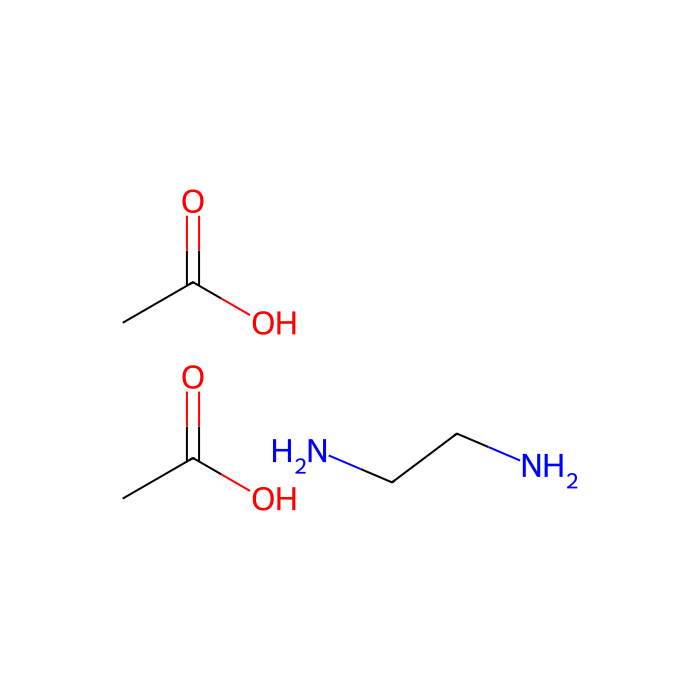
Item: 1,2-Ethanediamine, acetate (1:2) — commonly described as ethylenediamine diacetate (EDDA), a dialkylammonium carboxylate salt.
CAS: 38734-69-9 (Product Data)
CID: 10154317 (Product Data)
InChIKey: 331236 (as provided in Product Data; note: atypical/non-standard length)
SMILES: Not specified for this item; refer to CoA/Spec Sheet.
Molecular formula (literature/computed for the 1:2 salt): C6H14N2O4
Ionic pair comprising the doubly protonated diamine cation [H3N–CH2–CH2–NH3]2+ balanced by two acetate anions (CH3COO−).
Functional groups: two ammonium centers (protonated primary amines) and two carboxylate anions.
2D depiction in words: a –CH2–CH2– backbone with terminal –NH3+ groups; two discrete acetate ions each featuring a methyl-substituted carboxylate. No stereocenters.
This salt is distinct from free ethylenediamine (a volatile, strongly basic diamine) and from ammonium acetate; it combines a diammonium cation with acetate, often altering volatility, basicity, and handling characteristics.
Synthetic Utility
Functional group landscape:
Provides a diammonium (two –NH3+) cation capable of extensive hydrogen bonding; upon basification, ethylenediamine (a bidentate ligand and nucleophilic diamine) can be generated in situ. The acetate anion offers weakly nucleophilic/basic character and buffering.
Transformational roles (literature/general):
Mild Brønsted acid promoter for multicomponent condensations and C–C bond formations where ionic/hydrogen-bonding environments accelerate rates (e.g., aldehyde–carbonyl condensations, enamine-mediated steps). The diammonium environment can stabilize developing charges.
Temporary quench/“masking” of ethylenediamine basicity: using the diacetate form can mitigate over-alkylation during certain N-alkylations or serve as a more manageable solid source of diamine for stoichiometric additions after pH adjustment.
Ligand precursor: conversion to free ethylenediamine provides a chelating ligand for metal complexes; conducting the generation in situ minimizes handling of volatile EDA.
Workup and purification benefits:
High water solubility aids in separating organic products from amines: protonate with acetic acid to partition the diamine component into the aqueous phase as the diacetate.
Overall, this salt is a convenient, safer-to-handle proxy for ethylenediamine in settings where acetate buffering and ionic media confer selectivity or operational advantages.
Target Specificity
Not applicable. This product is a small-molecule salt, not a biological targeting reagent (e.g., antibody, enzyme inhibitor with defined target panel). No target specificity information is provided in the Product Data.
We use cookies to ensure the website functions properly and, where permitted, to improve your experience. You can manage your preferences at any time in Settings. Learn more in our Cookie Policy.
Shall we send you a message when we have discounts available?
Remind me later
Thank you! Please check your email inbox to confirm.
Products are supplied to verified businesses, institutions, and qualified professionals for research and development use only. Not for use in humans, animals, diagnosis, or therapy.

 F2214611