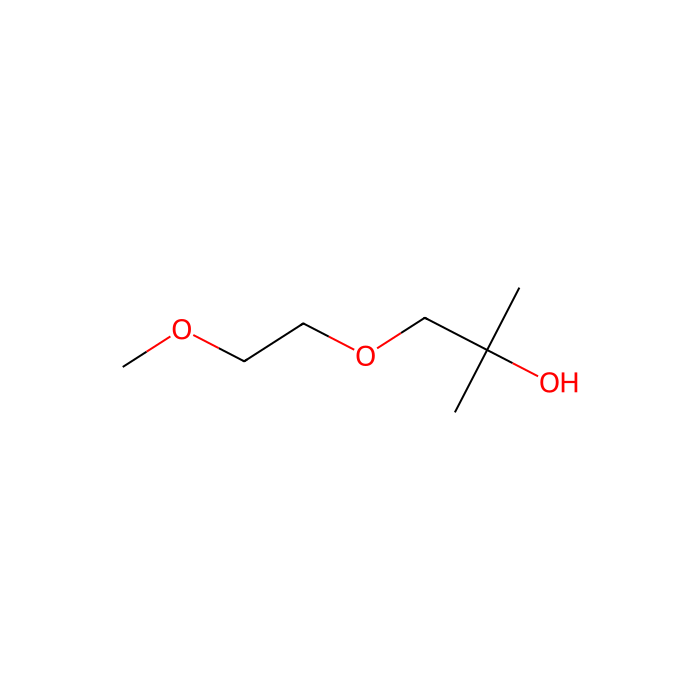
This compound belongs to the class of organic compounds known as tertiary alcohols. These are compounds in which a hydroxy group, -OH, is attached to a saturated carbon atom R3COH (R not H ).
External Descriptors
Not available
1. Djoumbou Feunang Y, Eisner R, Knox C, Chepelev L, Hastings J, Owen G, Fahy E, Steinbeck C, Subramanian S, Bolton E, Greiner R, and Wishart DS. ClassyFire: Automated Chemical Classification With A Comprehensive, Computable Taxonomy. Journal of Cheminformatics, 2016, 8:61.
Certificados (CoA, COO, BSE/TSE y tabla de análisis)
C of A & Other Certificates(BSE/TSE, COO):
Analytical Chart:
Propiedades químicas y físicas
Punto de ebullición (°C)
~203.3° C at 760 mmHg (Predicted)
Punto de fusión (°C)
-0.85° C (Predicted)
Peso molecular
148.200 g/mol
XLogP3
-0.100
Hydrogen Bond Donor Count
1
Hydrogen Bond Acceptor Count
3
Rotatable Bond Count
5
Exact Mass
148.11 Da
Monoisotopic Mass
148.11 Da
Topological Polar Surface Area
38.700 Ų
Heavy Atom Count
10
Formal Charge
0
Complexity
80.900
Isotope Atom Count
0
Defined Atom Stereocenter Count
0
Undefined Atom Stereocenter Count
0
Defined Bond Stereocenter Count
0
Undefined Bond Stereocenter Count
0
The total count of all stereochemical bonds
0
Covalently-Bonded Unit Count
1
Calculadoras de soluciones
Molarity Calculator
Determine the necessary mass, volume, or concentration for preparing a solution.
Dilution Calculator
Determine the dilution needed to prepare a stock solution.
Reconstitution Calculator
Reseñas
Reseñas de cliente
Application Protocols
No application protocols are specified for this item. As a small-molecule reagent/solvent candidate, procedures will be highly context-dependent (synthetic transformation, catalysis, or formulation).
General guidance:
When substituting this compound as a co-solvent/additive, begin with a small-scale screen (5–20% v/v) and include proper controls.
For derivatization (e.g., ester/carbonate formation), consult standard tertiary alcohol procedures and adjust activation/temperature accordingly.
Always reference the Aladdin Scientific CoA and SDS for lot-specific parameters and safety considerations before drafting SOPs.
Biological Roles
This product is a small organic compound intended for laboratory research and synthesis. No biological function, metabolic role, or signaling activity is provided for this SKU.
General notes (context only; not product-specific claims):
Glycol ethers and alcohols can interact with biological membranes and proteins due to mixed polarity; however, specific bioactivity varies widely with structure and is not characterized here.
If used as a solvent or vehicle in biochemical assays, evaluate potential assay interference (e.g., protein denaturation by alcohols, enzyme inhibition by ethers) and include appropriate solvent controls.
Reminder: For research use only. Not intended for food, drug, household, or cosmetic use.
Buffer Applications
Not typically applicable. 1-(2-Methoxyethoxy)-2-methyl-2-propanol is not a conventional buffering agent and does not constitute a defined acid/conjugate base pair for pH control.
Practical guidance:
If used as a co-solvent in biochemical buffers, confirm compatibility with your buffering system (e.g., phosphate, HEPES, TRIS) and assess effects on pKa, ionic strength, and enzyme stability.
Determine the maximum tolerated co-solvent percentage empirically for your assay or bioprocess, and maintain consistent solvent composition across controls and test conditions.
Green Alternatives
Context
Ethers and glycol ethers can raise concerns about peroxide formation and, in some cases, toxicity. Selection of greener media depends on the transformation and solubility needs.
Potential greener solvent choices for similar roles (general guidance; not item-specific)
2-Methyltetrahydrofuran (2-MeTHF): biorenewable origin, good solvency, lower toxicity profile relative to some glycol ethers; limited hydrogen-bond donation (no OH) but excellent for many organometallics.
Propylene carbonate: high polarity, non-volatile, good for electrochemistry; lacks HBD character and can coordinate strongly.
Short alcohols from bio-based sources (ethanol, isopropanol): renewable, readily recyclable; may be too volatile or too protic for sensitive chemistry.
If you require HBD plus coordination, consider bio-based alcohols with additives; if coordination without HBD is desired, 2-MeTHF/CPME are strong candidates.
Conduct small-scale DoE to validate performance and EHS metrics (worker exposure, recyclability) before adopting at scale.
Pharmaceutical Uses
No pharmacopeial designation or excipient role is specified for this item; refer to CoA/Spec Sheet if relevant to your application.
General, non-clinical context (not product-specific claims):
Glycol ether alcohols may serve as process solvents, co-solvents, or intermediates in drug substance syntheses where mixed polarity and coordinating ability are advantageous.
In formulation development, protic/ether-containing co-solvents can improve solubility of certain APIs for screening, though suitability requires comprehensive toxicological and regulatory evaluation.
Important: This product is supplied strictly for research and laboratory use. It is not approved for therapeutic, diagnostic, or household applications.
Physical Properties
Item-specific numeric specifications
Boiling point, melting point, density, refractive index, water content, residue on evaporation, UV cutoff, metal content: Not specified for this item; refer to CoA/Spec Sheet.
General/literature expectations for closely related glycol ether tertiary alcohols (context, not product specs)
Physical state: typically colorless liquids with moderate viscosity at ambient temperature.
Polarity: mixed character due to a hydrogen-bond donor tertiary hydroxyl and hydrogen-bond accepting ether oxygens; overall moderately polar and often miscible with many organic solvents; partial to high water miscibility is common among short-chain glycol ethers, though exact miscibility for this structure should be verified experimentally.
Volatility: expected to be lower volatility than simple tert-butanol because of the ether chain; vapor pressure typically lower than short, non-ether tertiary alcohols (qualitative).
Stability: ethers can slowly form peroxides upon prolonged air/oxygen exposure and light; tertiary alcohol function is generally stable but can dehydrate under strong acid/heat to give isobutylene derivatives (general behavior).
Practical notes for handling (general)
If used as a solvent or reagent, determine actual density and refractive index from the CoA for accurate volumetric dosing and purity checks.
Verify water miscibility and partitioning before scale-up; glycol ethers can significantly alter solvation of salts and organics.
Reminder
For precise numeric values and acceptance criteria for this SKU, consult the Aladdin Scientific CoA/Spec Sheet.
Quality and Grades
Item-specific grade/purity
Grade/Purity: Not specified for this item; refer to CoA/Spec Sheet.
Appearance: Not specified for this item; refer to CoA/Spec Sheet.
How to interpret common grades (general guidance)
Analytical Reagent (AR) or ACS grade emphasizes low inorganic/organic impurities for analytical work.
HPLC grade focuses on low UV-absorbing impurities and low particulate for chromatographic use; often paired with UV cutoff specs.
Anhydrous grades specify low water content (Karl Fischer), important for moisture-sensitive reactions.
“Stabilized” variants (if applicable) may include trace inhibitors to suppress peroxide formation in ethers; this impacts downstream reactions and should be disclosed in methods.
Practical quality controls for glycol ether alcohols (general)
Typical QC includes GC purity, water by KF, acidity/alkalinity, peroxides (for ether-containing materials), and color/APHA. Verify by reviewing the lot-specific CoA.
If using as a reaction solvent or stoichiometric reagent, consider in-house checks (e.g., quick KF, peroxide test strips) upon receipt and periodically during storage.
Documentation
For this SKU, please consult the Aladdin Scientific CoA/Spec Sheet for definitive grade, purity, and acceptance limits prior to regulated or quantitative work.
Reaction and Applications
Role in synthesis (general guidance for a tertiary alcohol with a glycol ether side chain)
Functions as a protic, coordinating medium or co-solvent that can solvate cations via ether oxygens while providing a hydrogen-bond donor site.
As a substrate, the tertiary alcohol can undergo classical derivatizations: esterification (e.g., acid chloride/anhydride–DMAP), carbonate formation, or dehydration under acidic conditions to give substituted isobutylene derivatives (caution: rearrangements possible under harsh conditions).
The ether chain is typically stable to many conditions but may participate in selective cleavages (e.g., BBr3/HI for aryl/alkyl methyl ethers in strong conditions) or oxidation at activated positions.
Representative application ideas (literature-informed, not item-specific)
Use as a hydrotropic co-solvent in transition-metal catalysis (e.g., cross-coupling) to balance substrate and base solubility; glycol ethers and alcohol cosolvents often enhance rates or selectivity in polar transformations.
Precursor to sterically hindered tert-alkyl esters or carbonates that can serve as protecting groups or leaving-group surrogates; tertiary alkyl carbonates can participate in substitution/elimination sequences.
Potential additive in organometallic reactions where modest coordination (to Li/Na/K/Mg) is beneficial while a protic site moderates reactivity (applies to carefully chosen systems; avoid with highly base-sensitive substrates).
Practical tips
Drying: molecular sieves (3Å/4Å) or azeotropic drying can reduce water; avoid strong drying agents that may catalyze dehydration.
If used as solvent, check for peroxides before concentration/evaporation; add inhibitors or use fresh material.
For esterifications, remove water continuously (Dean–Stark with a compatible co-solvent) or employ coupling reagents; tertiary alcohols may require stronger activation.
Reaction Conditions
General conditions for typical transformations of tertiary alcohols and glycol ethers (literature context; not product specs)
Esterification/carbonate formation: employ activating agents (e.g., acid chlorides with pyridine/DMAP; CDI or triphosgene analogs) at 0–25 °C to start, then warm to ambient/40 °C as needed. Tertiary alcohols often require stronger activation and longer times than primary/secondary.
Dehydration/elimination: catalytic mineral acid (H2SO4, p-TsOH) in aprotic solvent (e.g., toluene) or neat under reduced pressure; temperatures 60–120 °C depending on system. Vent evolved isobutylene-like alkenes; monitor for rearrangement/polymerization.
Ether cleavage (methyl ether scission): strong acids (HI, HBr) or Lewis acids (BBr3 for aryl/alkyl methyl ethers), typically at 0–25 °C initially; glycol ether substrates may require controlled addition and quench protocols.
As co-solvent in catalysis: 5–30% v/v with a primary solvent (e.g., MeCN, toluene, alcohols, 2-MeTHF) can tune solubility and rate; temperatures often 20–80 °C depending on catalyst and substrate.
Workup and purification notes
Peroxide screening prior to rotary evaporation or distillation; include a reducing scrub (e.g., sodium sulfite) if elevated peroxide levels are detected.
Aqueous workups may lead to emulsions with glycol ethers; add brine, gentle warming, or a co-solvent switch to aid phase separation.
Expected outcomes
Yields and selectivities are highly reaction-specific; consult primary literature and perform small-scale optimization for your substrate/catalyst system.
Safety and Handling
GHS/Regulatory (item-specific)
Signal Word: Not specified for this item; refer to SDS.
H-Statements: Not specified for this item; refer to SDS.
GHS Classification and Pictograms: Not specified for this item; refer to SDS.
General hazards and precautions for glycol ether tertiary alcohols (informational; defer to SDS for this SKU)
Potential hazards: eye and skin irritation; may cause respiratory irritation upon inhalation of vapors or aerosols; ingestion may cause GI discomfort. Glycol ethers may have systemic toxicity at sufficient doses—handle with care in well-ventilated areas.
Special risks: Peroxide formation can occur in ethers during storage, especially with air/light exposure; periodic testing and avoidance of concentration to dryness are prudent if the material is used as a solvent and stored long-term.
Incompatibilities: strong oxidizers; strong acids (risk of dehydration) and strong bases (may promote elimination/condensation); reactive acylation/alkylation reagents without appropriate controls.
PPE and engineering controls
Use chemical-resistant gloves (e.g., nitrile), safety goggles, lab coat. Employ local exhaust/hood to minimize inhalation exposure. Avoid breathing vapors/mists; prevent contact with eyes/skin.
First-aid overview (general)
Eye/skin: Rinse with water for at least 15 minutes; remove contaminated clothing.
Inhalation: Move to fresh air; seek medical attention if symptoms persist.
Ingestion: Rinse mouth; do not induce vomiting unless directed by medical personnel; seek medical attention.
Always consult the product-specific SDS for authoritative safety information and emergency procedures.
Solvent Selection
Applicability
1-(2-Methoxyethoxy)-2-methyl-2-propanol is primarily a small-molecule reagent with solvent-like properties due to its glycol ether chain and tertiary alcohol. Whether it is used as a solvent or as a substrate should be determined by your method; no item-specific solvent designation is provided.
General solvent characteristics for related structures (context, not product specs)
Polarity: moderate; possesses both H-bond donor (OH) and acceptors (ethers), enabling dissolution of a broad range of organics and some salts/ionic liquids.
Miscibility: glycol ethers are frequently miscible with water and many organics (alcohols, esters, ketones, aromatics). Verify actual miscibility for this exact compound experimentally.
Dielectric constant and Kamlet–Taft parameters are not available for this item; expect values intermediate between short alcohols and diglyme-like ethers (qualitative expectation only).
When to choose this medium (general use-cases)
As a co-solvent to improve solubility of polar substrates or catalysts that require both hydrogen bonding and ether coordination.
For reactions benefiting from a protic yet relatively non-volatile medium compared with lower alcohols.
Comparisons (general)
Versus tert-butanol: increased coordinating ability and often higher solubility for salts due to ether oxygens.
Versus PEG-like ethers (e.g., diglyme): retains HBD capability and potentially higher polarity; may reduce boiling point relative to higher glymes.
Note
For chromatography or formulation use, select grade by UV cutoff/water content as required; these specifications are not provided for this item.
Storage and Reconstitution
Item-specific conditions
Storage Conditions: Room temperature (per Product Data). Store tightly closed in a dry, well-ventilated place away from heat and direct sunlight.
Shipped In: Normal (per Product Data).
General storage guidance for glycol ether alcohols
Keep container airtight to limit moisture uptake and oxidation. Consider storing under inert gas for long-term use, especially if using as a solvent that may be concentrated by evaporation.
Protect from light to minimize peroxide formation. Test for peroxides periodically if the bottle is open for extended periods or before any distillation/concentration.
Avoid contact with strong oxidizers and strong acids/bases during storage.
Reconstitution/handling
This product is supplied as a neat liquid (appearance not specified). No reconstitution is required. If solidification occurs at low temperature, warm gently to ambient and homogenize before use.
If water content must be minimized for your application, dry over activated 3Å/4Å molecular sieves and verify by Karl Fischer titration (methodological guidance; not a product spec).
Shelf-life
Not specified for this item; refer to CoA/Spec Sheet. Practice FIFO inventory and document opening dates to manage quality over time.
InChIKey: Not specified for this item; refer to CoA/Spec Sheet. (Product Data lists a truncated placeholder.)
SMILES: Not specified for this item; refer to CoA/Spec Sheet.
Molecular Formula: Not specified for this item; refer to CoA/Spec Sheet.
Molecular Weight: Not specified for this item; refer to CoA/Spec Sheet.
Structural features (interpretation from the chemical name; general chemistry description)
The base skeleton is a 2-methyl-2-propanol (tert-butanol) framework, indicating a tertiary alcohol center (C(OH)(CH3)3-like quaternary carbon environment).
The “1-(2-methoxyethoxy)” substituent indicates a 2-methoxyethoxy group (–O–CH2–CH2–O–CH3) attached to the same quaternary carbon that bears the hydroxyl, yielding an overall structure that combines a tertiary alcohol with a glycol ether side chain.
Functional groups: one tertiary alcohol (–C(OH)–) and a diether segment (internal ether + terminal methoxy). No stereocenters expected based on the name (tertiary center is not stereogenic).
2D description in words: a central quaternary carbon bearing a hydroxyl, a 2-methoxyethoxy substituent via an ether linkage, and two methyl groups; the ether arm is an ethylene glycol monomethyl ether fragment.
Notes
The above description reflects conventional nomenclature parsing. For definitive structural confirmation (SMILES/InChI), consult the item’s CoA/Spec Sheet.
Synthetic Utility
Functional group behavior (general)
Tertiary alcohol: amenable to esterification (requires activation), carbonate/urethanes formation, and dehydration to yield substituted isobutylene-type alkenes under acidic conditions. Oxidation at a tertiary alcohol is limited (no easy carbonyl formation), favoring elimination pathways.
Glycol ether chain: provides Lewis-basic coordination to metals (Na+, K+, Li+, Mg2+), often enhancing solubility of salts/bases and modulating reactivity. Typically resistant to mild bases/nucleophiles; cleaves under strong Lewis/Brønsted acids (e.g., BBr3, HI for methyl ether scission) or under drastic oxidative conditions.
Retrosynthetic/forward-design roles
Can serve as a precursor to sterically hindered tert-alkyl esters (e.g., pivalate-like analogs) that are useful as protecting groups for carboxylic acids (as tert-alkyl esters) or as leaving groups after activation (e.g., carbonate-based).
As an additive/co-solvent, may stabilize reactive cationic or radical intermediates via solvation, potentially influencing selectivity in substitution or polymerization contexts (case-dependent).
Representative transformations (literature-informed, not item-specific)
Formation of tert-alkyl carbonates using phosgene equivalents (e.g., triphosgene) or carbonyl diimidazole followed by nucleophilic substitution.
Acid-catalyzed etherification/dehydration to generate tert-alkyl ethers or alkenes; control conditions to limit rearrangement/polymerization.
Use as a phase-behavior modifier in biphasic catalysis where modest water compatibility is advantageous.
Practical considerations
Maintain dry, oxygen-limited storage to minimize peroxide growth; test before concentration.
Choose catalysts (e.g., acid strength, nucleophile identity) based on the tertiary nature of the alcohol to avoid undesired eliminations.
Target Specificity
Not applicable. This product is a small organic chemical, not a biological targeting reagent (e.g., antibody, ligand with defined receptor specificity). No antigen, epitope, clone, isotype, or species reactivity information is relevant.
Preguntas frecuentes
What documentation is provided?
Available product documentation, including Certificates of Analysis (COA), Safety Data Sheets (SDS), and specification sheets, is shown in the product document area. Document availability and access follow the current site policy.
What is the purity of this product?
This product is supplied at ≥95% purity (chemical assay). Lot-specific values are stated on the Certificate of Analysis.
How should this product be stored?
Store at room temperature.
How is this product shipped?
This product ships under standard ambient conditions. No temperature-controlled packaging is required.
What are the CAS number, molecular formula and molecular weight?
The CAS Number is 211321-90-3, the molecular formula is C7H16O3, and the molecular weight is 148.2 g/mol. InChIKey SIUWDFVMEASCRP-UHFFFAOYSA-N.
Utilizamos cookies para garantizar el correcto funcionamiento del sitio web y, cuando esté permitido, para mejorar su experiencia. Puede gestionar sus preferencias en cualquier momento en Configuración. Más información en nuestra Política de Cookies.
¿Quieres que te enviemos un mensaje cuando tengamos descuentos disponibles?
Recordármelo más tarde
¡Gracias! Por favor, revisa tu bandeja de entrada de correo electrónico para confirmar.
Products are supplied to verified businesses, institutions, and qualified professionals for research and development use only. Not for use in humans, animals, diagnosis, or therapy.