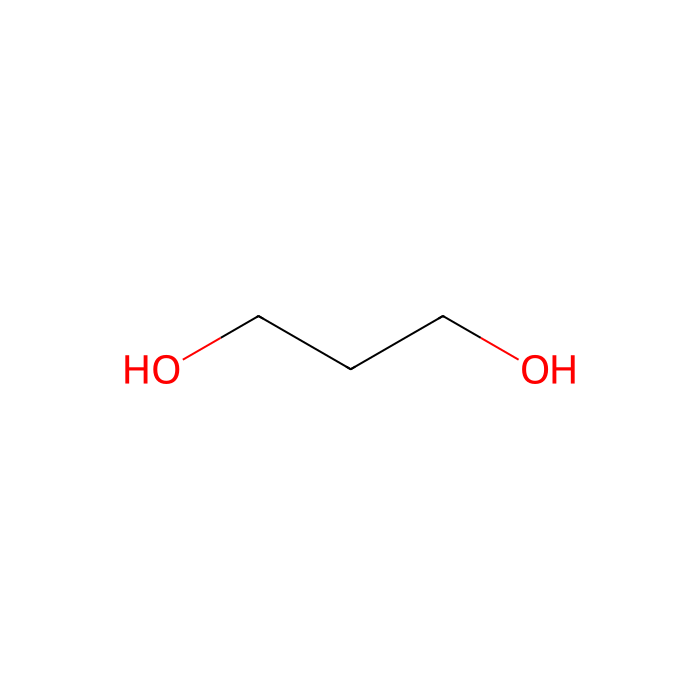
1,3-Propanediol - ≥98% , CAS No.504-63-2

CAS: 504-63-2 Cat. No.: P108208 Fórmula: C3H8O2 Peso molecular: 76.09 Beilstein Registry Number: 969155 Número EC: 207-997-3
Disponible para pedir
CALIDAD & PUREZA ≥98%
Synonyms
2-Deoxyglycerol | .beta.-Propylene glycol | beta-Propylene glycol | 1,3-Propylene glycol | Propane-1,3-diol | omega-Propanediol | 1,3-Dihydroxypropane | 2-(Hydroxymethyl)ethanol | Trimethylene glycol | 1,3-Propylenediol
Storage
Room temperature,Desiccated
Shipped In
Normal
★
Talla
Alemania (EU)
USA*
Precio
Cantidad
100ml
P108208-100ml
—
3 Disponible
19,00€
500ml
P108208-500ml
—
3 Disponible
49,37€
12×500ml
P108208-12×500ml
Fabricado bajo pedido · 8–12 semanas
483,24€
Enter a quantity for the sizes you want to add.
🧪
Por qué esta calidad

≥98% para flujos de trabajo cromatográficos y analíticos sensibles que requieren una interferencia mínima de la línea base.

🌡

Almacenamiento y envío

Room temperature,Desiccated Envío Normal. Consulte el COA específico del lote para conocer las especificaciones exactas.

📋

Documentos de calidad

SDS, COA, ficha técnica y hoja de especificaciones disponibles para descargar. COA específico del lote accesible mediante búsqueda por número de lote.

📚

Prueba documental

Citado en 179 publicaciones revisadas por pares sobre cromatografía, síntesis orgánica y reacciones de acoplamiento cruzado.

Especificaciones

Sinónimos
2-Deoxyglycerol | .beta.-Propylene glycol | beta-Propylene glycol | 1,3-Propylene glycol | Propane-1,3-diol | omega-Propanediol | 1,3-Dihydroxypropane | 2-(Hydroxymethyl)ethanol | Trimethylene glycol | 1,3-Propylenediol
Especificaciones y pureza
≥98%
Condiciones de almacenamiento de almacenamiento
Room temperature,Desiccated
Enviado en
Normal
Pureza
≥98%
Nombres e identificadores
Pubchem Sid
Pubchem Sid Url
https://pubchem.ncbi.nlm.nih.gov/substance/504751948
Sonrisas canónicas
C(CO)CO
IUPAC Name
propane-1,3-diol
InChIKey
YPFDHNVEDLHUCE-UHFFFAOYSA-N
INCHI
1S/C3H8O2/c4-2-1-3-5/h4-5H,1-3H2
Isómeros SMILES
C(CO)CO
WGK Alemania
1
RTECS
TY2010000
Peso molecular
76.09
Beilstein
969155
Reaxy-Rn
969155
Reaxys-RN_link_address
https://www.reaxys.com/reaxys/secured/hopinto.do?context=S&query=IDE.XRN=969155&ln=

Documentación

📋 Hoja de datos de seguridad (SDS)

Documento completo sobre peligros, manipulación, almacenamiento y cumplimiento normativo.

<<<<<<< HEAD Descargar SDS → ======= Descargar SDS → >>>>>>> release248-p3

✅ Certificado de análisis (COA)

Datos de calidad específicos del lote. Introduzca su número de lote para obtener el COA exacto.

Buscar COA →

📊 Ficha técnica

Resumen de referencia rápida de las especificaciones y aplicaciones del producto.

Ver ficha técnica →

🔬 Hoja de especificaciones

Atributos de calidad completos y criterios de aceptación para esta calidad.

Ver hoja de especificaciones →

Datos avanzados

Taxonomic Classification

Taxonomy Tree

KingdomOrganic compounds
SuperclassOrganic oxygen compounds
ClaseOrganooxygen compounds
SubclassAlcohols and polyols
Intermediate Tree Nodes Not available
Direct ParentPrimary alcohols
Alternative Parents Hydrocarbon derivatives  
Molecular FrameworkAliphatic acyclic compounds
Substituents Hydrocarbon derivative - Primary alcohol - Aliphatic acyclic compound
DescripciónThis compound belongs to the class of organic compounds known as primary alcohols. These are compounds comprising the primary alcohol functional group, with the general structure RCOH (R=alkyl, aryl).
External Descriptors a small molecule
Estructura 3D
Modelo de Estructura Química Interactiva


Mecanismos de acción
Certificados (CoA, COO, BSE/TSE y tabla de análisis)
C of A & Other Certificates(BSE/TSE, COO):
Analytical Chart:

Find and download the COA for your product by matching the lot number on the packaging.

49 results found

Lot NumberCertificate TypeFechaArticulo
J2626506J2626506Certificate of AnalysisOct 15, 2026 P108208
J2626505J2626505Certificate of AnalysisOct 15, 2026 P108208
J2626504J2626504Certificate of AnalysisOct 15, 2026 P108208
J2626503J2626503Certificate of AnalysisOct 15, 2026 P108208
G2624142G2624142Certificate of AnalysisJul 09, 2026 P108208
G2624117G2624117Certificate of AnalysisJul 09, 2026 P108208
G2624118G2624118Certificate of AnalysisJul 09, 2026 P108208
G2624141G2624141Certificate of AnalysisJul 09, 2026 P108208
A2628293A2628293Certificate of AnalysisJan 09, 2026 P108208
A2628292A2628292Certificate of AnalysisJan 09, 2026 P108208
A2628291A2628291Certificate of AnalysisJan 09, 2026 P108208
A2628290A2628290Certificate of AnalysisJan 09, 2026 P108208
I2522074I2522074Certificate of AnalysisJun 26, 2024 P108208
G2417650G2417650Certificate of AnalysisJun 26, 2024 P108208
G2417649G2417649Certificate of AnalysisJun 26, 2024 P108208
G2417648G2417648Certificate of AnalysisJun 26, 2024 P108208
G2417647G2417647Certificate of AnalysisJun 26, 2024 P108208
L2509053L2509053Certificate of AnalysisApr 24, 2024 P108208
E2406473E2406473Certificate of AnalysisApr 24, 2024 P108208
E2406472E2406472Certificate of AnalysisApr 24, 2024 P108208
E2406465E2406465Certificate of AnalysisApr 24, 2024 P108208
D2416421D2416421Certificate of AnalysisMar 15, 2024 P108208
D2416419D2416419Certificate of AnalysisMar 15, 2024 P108208
G2429076G2429076Certificate of AnalysisMar 15, 2024 P108208
G2429075G2429075Certificate of AnalysisMar 15, 2024 P108208
G2429190G2429190Certificate of AnalysisMar 15, 2024 P108208
G2429081G2429081Certificate of AnalysisMar 15, 2024 P108208
D2416417D2416417Certificate of AnalysisMar 15, 2024 P108208
D2416418D2416418Certificate of AnalysisMar 15, 2024 P108208
C2425423C2425423Certificate of AnalysisMar 13, 2024 P108208
C2425422C2425422Certificate of AnalysisMar 13, 2024 P108208
C2425421C2425421Certificate of AnalysisMar 13, 2024 P108208
C2425420C2425420Certificate of AnalysisMar 13, 2024 P108208
K2306309K2306309Certificate of AnalysisOct 27, 2023 P108208
K2306308K2306308Certificate of AnalysisOct 27, 2023 P108208
K2306307K2306307Certificate of AnalysisOct 27, 2023 P108208
K2306306K2306306Certificate of AnalysisOct 27, 2023 P108208
A2411007A2411007Certificate of AnalysisOct 27, 2023 P108208
A2312257A2312257Certificate of AnalysisDec 29, 2022 P108208
A2312258A2312258Certificate of AnalysisDec 29, 2022 P108208
A2312259A2312259Certificate of AnalysisDec 29, 2022 P108208
A2312260A2312260Certificate of AnalysisDec 29, 2022 P108208
H2316055H2316055Certificate of AnalysisAug 08, 2022 P108208
H2218644H2218644Certificate of AnalysisAug 08, 2022 P108208
H2218643H2218643Certificate of AnalysisAug 08, 2022 P108208
H2218642H2218642Certificate of AnalysisAug 08, 2022 P108208
G2321166G2321166Certificate of AnalysisAug 08, 2022 P108208
E2324239E2324239Certificate of AnalysisAug 08, 2022 P108208
C2211208C2211208Certificate of AnalysisMar 15, 2022 P108208
Propiedades químicas y físicas
SolubilidadMiscible with water and alcohol.
Índice de refracción1.44
Punto de inflamación (°F)165 °F
Punto de inflamación (°C)74 °C
Punto de ebullición (°C)214°C
Punto de fusión (°C)-27°C
Peso molecular76.090 g/mol
XLogP3-1.000
Hydrogen Bond Donor Count2
Hydrogen Bond Acceptor Count2
Rotatable Bond Count2
Exact Mass76.0524 Da
Monoisotopic Mass76.0524 Da
Topological Polar Surface Area40.500 Ų
Heavy Atom Count5
Formal Charge0
Complexity12.400
Isotope Atom Count0
Defined Atom Stereocenter Count0
Undefined Atom Stereocenter Count0
Defined Bond Stereocenter Count0
Undefined Bond Stereocenter Count0
The total count of all stereochemical bonds0
Covalently-Bonded Unit Count1
Preguntas frecuentes y artículos
Bio-based Chemicals: From Platform Molecules to Application Scenarios — Trend Insights and Aladdin’s Product Portfolio
A Practical Guide to Fragrance Compositions: Turning a Black-Box Formula into an Engineerable System—Compatibility, Stability, Controlled Release, Traceability, and Selection
Experimental Evaluation of Triphosgene in Organic Synthesis: Understanding Its Selection Logic Through Reaction Tasks
Understanding Polyester Resins for Coatings: Structure Design, Key Indicators, and Coating Film Performance
Failure Mechanisms, Application Limitations, and Systematic Improvement Directions for Polyester Coatings
Solvents, Co-solvents, and Solubilization Systems in Home and Personal Care Formulations: Classification, Functions, and Selection Guide
Why Do Alcohols Differ in Function: Why Is Glycerol Mainly Moisturizing, Propylene Glycol Mainly Solubilizing, and Isopropyl Alcohol Fast-Drying? — Understanding Personal Care Formulation Functions from Structural Differences
Thickening, Suspension, Auxiliary Stabilization, and Agglomeration Mechanisms of Xanthan Gum in Personal Care Formulations: From Molecular Structure to Processing Applications
Why Limonene Can Soften Greasy Soils Yet Is Difficult to Dissolve in Water: Understanding the Cleaning Mechanism and Formulation Applications of Naturally Derived Solvents from Molecular Structure
What Is Synthetic Biology? The Industrialization Pathway from Upstream Reagent Toolchains to Biomanufacturing Applications
Analysis of Structural Differences in Diols: Moisturization, Co-solvency, Skin Feel, and Formulation Selection for Propylene Glycol, Butylene Glycol, and Medium- to Long-Chain 1,2-Alkanediols
Performance Sources and Formulation Applications of Enzyme-Based Ingredients in Daily Chemical Products: Fermentation Transformation, Enzymatic Reactions, and Application Principles
Mechanistic Analysis of Topical Glutathione in Skincare: Cellular Redox Regulation, Skin Delivery Challenges, and SLN-Based Delivery Strategies
Structure, Degradation Behavior, and Applications of Poly(trimethylene carbonate) (PTMC) in Flexible Absorbable Materials
Antioxidant Mechanisms of Ferulic Acid in Skincare, Vitamin C/E Synergy, and Stable Delivery Applications
Structure, Stratum Corneum Distribution, and Stratum Corneum Conditioning Mechanism of Capryloyl Salicylic Acid: Barrier Effects and Safety Evaluation
Differences Between Cast CPU and Thermoplastic TPU in Structure, Processing, Performance, and Applications
Rotary-Evaporation-Assisted Reversible Dehydration Reactions: Reduced-Pressure Evaporation, Removal of Volatile Components, and Equilibrium Response
Citations of This Product
Calculadoras de soluciones
Reseñas

Reseñas de cliente

Artículos relacionados

(1R,2R)-(-)-2-Amino-1-phenyl-1,3-propanediol - ≥98% , CAS No.46032-98-8
1,3-Propanediol - Standard for GC, ≥99.5%(GC) , CAS No.504-63-2
9,9-Dioctylfluorene-2,7-diboronic acid bis(1,3-propanediol) ester - ≥97% , CAS No.317802-08-7
N-Cbz-2-amino-1,3-propanediol - ≥97% , CAS No.71811-26-2
Phenylboronic acid 1,3-propanediol ester - ≥99% , CAS No.4406-77-3
D-(-)-threo-2-Amino-1-(4-nitrophenyl)-1,3-propanediol - ≥98%(T) , CAS No.716-61-0
2-(hydroxymethyl)-2-methylpentyl isopropyl-carbamate - ≥95% , CAS No.25462-17-3
2-Ethyl-2-methyl-1,3-propanediol - ≥97% , CAS No.77-84-9
2-Methyl-2-propyl-1,3-propanediol - ≥98%(GC) , CAS No.78-26-2
2,2-Di-n-octyl-1,3-propanediol - ≥95%(GC) , CAS No.106868-09-1
1,3-Propanediol cyclic sulfate - ≥98% , CAS No.1073-05-8
2-Butyl-2-ethyl-1,3-propanediol - ≥99%(GC) , CAS No.115-84-4
2,2-Dibenzyl-1,3-propanediol - ≥97%(HPLC) , CAS No.31952-16-6
2-Methoxybenzeneboronic acid 1,3-propanediol ester - ≥97% , CAS No.141522-26-1
2,2-Dibutyl-1,3-propanediol - ≥97% , CAS No.24765-57-9
D-threo-1-(4-Aminophenyl)-2-dichloroacetylamino-1,3-propanediol Hydrochloride - ≥98% , CAS No.57704-36-6
2-Phenyl-1,3-propanediol - ≥98%(GC) , CAS No.1570-95-2
2,2-Bis(bromomethyl)-1,3-propanediol - ≥98% , CAS No.3296-90-0
2-Methyl-1,3-propanediol (MPO) - ≥98%, used for 2-Methyl-1,3-propanediol is used: In the preparation of solid polymer electrolytes for lithium metal batteries. To obtain methyl methacrylate (precursor for polymethyl methacrylate glass) via a partial oxida
2-(Bromomethyl)-2-(hydroxymethyl)-1,3-propanediol - ≥98% , CAS No.19184-65-7
2-(Dibenzylamino)propane-1,3-diol - ≥97% , CAS No.246232-73-5
2-(2,2-Diethoxyethyl)-1,3-propanediol - ≥95% , CAS No.55387-85-4
2-Amino-2-ethyl-1,3-propanediol - ≥98% , CAS No.115-70-8
2,2-Diisoamyl-1,3-propanediol - ≥98%(GC) , CAS No.403519-64-2
(1S,2S)-(+)-2-Amino-1-phenyl-1,3-propanediol - ≥97% , CAS No.28143-91-1
2-Hydroxymethyl-1,3-propanediol - ≥97% , CAS No.4704-94-3
2-Methylene-1,3-propanediol - ≥96%(GC) , CAS No.3513-81-3
2-Benzyloxy-1,3-propanediol - ≥97% , CAS No.14690-00-7
(1S,2S)-(+)-2-Amino-1-(4-nitrophenyl)-1,3-propanediol - ≥99% , CAS No.2964-48-9
(R)-(+)-1-Phenyl-1,3-propanediol - ≥99%(GC), sum of enantiomers , CAS No.103548-16-9
1,3-Distearoyl-2-chloropropanediol Solution in Toluene - 100μg/mL in Toluene , CAS No.26787-56-4
2,2-Dietil-1,3-propanediol - Moligand™,≥98% , CAS No.115-76-4
2-Amino-1,3-propanediol - ≥98% , CAS No.534-03-2
3-Pyridineboronic acid 1,3-propanediol ester - ≥97% , CAS No.131534-65-1
9,9-Di(2-ethylhexyl)fluorene-2,7-diboronic acid bis(1,3-propanediol) ester solution , CAS No.344782-49-6
2,2-Diisobutyl-1,3-propanediol - ≥98%(GC) , CAS No.10547-96-3
2-Butyl-2-ethyl-1,3-propanediol - ≥98%(GC) , CAS No.115-84-4
1,3-Propanediol - analytical standard , CAS No.504-63-2
2-Methyl-2-nitro-1,3-propanediol - ≥98%(GC) , CAS No.77-49-6
1,3-Propanediol - for synthesis , CAS No.504-63-2
2-(2-Hydroxyethylamino)-2-(hydroxymethyl)-1,3-propanediol - ≥95% , CAS No.7343-51-3
2-(4-Phenoxyphenyl)-1,3,2-dioxaborinane - ≥98% , CAS No.2222401-82-1
2-Propylpropane-1,3-diol - ≥98% , CAS No.2612-28-4
2-(4-Nitrophenyl)-1,3,2-dioxaborinane - ≥98% , CAS No.85107-43-3
2-(3-Nitrophenyl)-1,3,2-dioxaborinane - ≥98% , CAS No.85107-44-4
BIS-TRIS(Bis-Tris) - UltraBio™, Ultra pure, ≥98%(T) , CAS No.6976-37-0
BIS-TRIS(Bis-Tris) - Anhydrous Grade, ≥98% , CAS No.6976-37-0
2-(Azido-PEG2-amido)-1,3-propandiol - ≥97% , CAS No.1398044-52-4

¿Quieres que te enviemos un mensaje cuando tengamos descuentos disponibles?

Recordármelo más tarde

¡Gracias! Por favor, revisa tu bandeja de entrada de correo electrónico para confirmar.

¡Vaya! Las notificaciones están desactivadas.