This compound belongs to the class of organic compounds known as quinolines and derivatives. These are compounds containing a quinoline moiety, which consists of a benzene ring fused to a pyrimidine ring to form benzo[b]azabenzene.
External Descriptors
Not available
1. Djoumbou Feunang Y, Eisner R, Knox C, Chepelev L, Hastings J, Owen G, Fahy E, Steinbeck C, Subramanian S, Bolton E, Greiner R, and Wishart DS. ClassyFire: Automated Chemical Classification With A Comprehensive, Computable Taxonomy. Journal of Cheminformatics, 2016, 8:61.
Determine the necessary mass, volume, or concentration for preparing a solution.
Dilution Calculator
Determine the dilution needed to prepare a stock solution.
Reconstitution Calculator
Reseñas
Reseñas de cliente
Application Protocols
Not applicable for immunoassays or bioassays (e.g., WB, IHC, IF, FC). This product is a chemical reagent/building block. Application protocols instead align with synthetic procedures (see Reaction Conditions and Synthetic Utility tabs). If you require guidance on a particular transformation (e.g., N-oxidation, benzylic bromination), contact Technical Support with your target structure and constraints.
Biological Roles
Item-specific biological data are not provided. The compound is supplied for research use only.
Literature/general context for quinoline scaffolds:
Structural motif: quinoline is a privileged heteroaromatic present in numerous natural products (e.g., alkaloids) and research compounds. Methyl substitution modulates lipophilicity, pKa of the ring nitrogen, and π–π stacking behavior.
Protonation/partitioning: the ring nitrogen forms a quinolinium cation under acidic conditions (conjugate acid pKa for quinoline ~4.9, often slightly higher for alkylated derivatives). This affects membrane partitioning and binding in biochemical assays.
Coordination: the aromatic N can weakly coordinate to metal centers, a feature leveraged in metalloenzyme probes and synthetic model complexes (research context).
Photophysics: quinoline derivatives exhibit characteristic UV absorption and sometimes fluorescence; methyl substitution can tune emission/absorption, making the scaffold useful in probe/materials development.
No claims are made here regarding pharmacology, toxicity thresholds, ADME, or therapeutic relevance for this specific item. For any biological experiments, consult the SDS and perform appropriate dose–response and control studies.
Buffer Applications
Not typically used as a buffering agent. 2,4-Dimethylquinoline is a hydrophobic, weakly basic heteroaromatic and does not form a defined buffer system in water at relevant pH ranges.
Practical note: If working in aqueous systems (e.g., extraction/partition studies or biophysical assays), choose an appropriate external buffer (e.g., phosphate, acetate, citrate) and consider the compound’s low water solubility and protonation around acidic pH (quinolinium formation). Cosolvents (DMSO, MeOH) at minimal percentages may be required to prepare stock solutions.
Green Alternatives
While 2,4-dimethylquinoline is the substrate/building block (not a solvent), greener choices can be made around it.
Greener solvent choices (literature guidance):
Replace DCM/chloroform with EtOAc, 2-MeTHF, CPME where solubility allows.
For radical brominations, consider bromination in safer media (e.g., EtOAc, MeCN) rather than CCl4 or benzene; explore photoredox bromination using NBS under blue LEDs to avoid AIBN.
Oxidations: switch from Cr(VI)/Mn(VII) to TEMPO/oxammonium, Ru-catalyzed aerobic, or Oxone®/O2 systems; use AcOH or MeCN/H2O instead of halogenated solvents.
Hydrogenations: use ethanol or iPrOH as solvent and H2 at the lowest effective pressure; explore transfer hydrogenation (formate, isopropanol) to avoid high-pressure hydrogen.
Illustrative comparison (general):
DCM (halogenated, high impact) vs EtOAc (readily biodegradable, low toxicity): EtOAc preferred if substrate solubility/reactivity are adequate.
Toluene (petroleum-derived) vs 2-MeTHF (biorenewable from hemicellulose): 2-MeTHF offers better EHS profile and water tolerance, often with similar performance in benzylic functionalizations.
Trade-offs: greener solvents can change regioselectivity, rates, or catalyst stability; verify by small-scale screening. Waste minimization via telescoped steps (e.g., in situ N-oxide formation/functionalization) can further improve process greenness.
Pharmaceutical Uses
No pharmacopeial grade or excipient role is specified for this item. It is sold for research use only.
Literature/general context:
Quinoline-derived scaffolds are widely used as intermediates in the discovery-scale synthesis of candidate molecules. 2,4-Dimethyl substitution can serve as a handle for benzylic oxidation or cross-coupling to elaborate diversity around the core.
Quinolinium salts generated by N-alkylation may function as ionic liquid components or phase-transfer catalysts in process development studies (non-therapeutic roles).
For GMP or clinical manufacturing, do not use this research-grade material. If a regulated application is intended (e.g., as a process intermediate under ICH), request documentation of impurity profiles, residual solvents, and elemental impurities per ICH Q3A/Q3C/Q3D.
Physical Properties
Item-specific physical specifications are not provided in the Product Data. Do not use literature values as specifications; consult the CoA/Spec Sheet for this lot.
Literature/general data for 2,4-dimethylquinoline (for context only):
Physical state: typically a colorless to pale yellow, high-boiling liquid or low-melting solid (literature; appearance varies with purity/temperature).
Boiling point: often reported in the high-200s °C range for dimethylquinolines (literature; exact value depends on isomer/purity).
Melting point: may be liquid at ambient conditions; reported values vary (literature).
Density (20–25 °C): expected near ~1.0–1.1 g/mL for alkylated quinolines (literature trend, not a spec).
Solubility: sparingly soluble in water; freely soluble in common organic solvents (EtOAc, DCM, toluene, THF, MeCN, alcohols) (literature, typical for quinolines).
LogP: aromatic N-heterocycles with two methyl groups commonly show moderate lipophilicity (literature trend).
pKa (conjugate acid, quinolinium): quinoline ca. 4.9; alkyl substitution can increase basicity slightly (literature). Exact pKa for the 2,4-dimethyl isomer varies by source.
Refractive index: often reported in the nD ≈ 1.60–1.62 range for related quinolines (literature range only).
Use the above solely as planning guidance. For precise values relevant to your work, obtain and rely on the item’s CoA/SDS.
Quality and Grades
Grade/purity: Not specified for this item; refer to CoA/Spec Sheet for assay, identity, and impurity profile.
What to look for on the CoA (general guidance):
Identity confirmation: 1H/13C NMR consistent with 2,4-dimethyl substitution; MS (M+ at ~159 m/z); IR with aromatic C–H and ring modes; optional GC/LC retention.
Purity assay: GC/GC–MS or HPLC area %; residual solvents; water (KF) if applicable. For trace metals (if catalysis-sensitive), request ICP if needed.
Color index/APHA: useful for heteroaromatic bases that can darken on storage.
Stabilizers/inhibitors: None specified for this item. Quinoline derivatives generally do not require polymerization inhibitors; if present in a lot, it will be declared on the CoA.
UV/LC suitability: If planning spectroscopic or chromatographic uses (e.g., as an internal standard or analyte), request low-UV background and reportable UV cutoff. Not specified for this item; refer to CoA/Spec Sheet.
Regulatory notes: Provided for research use only (per Product Data). Not for human or veterinary use.
If you need an application-matched grade (e.g., high-purity for photophysics or trace-metal controlled for cross-coupling), contact us with your specifications before ordering.
Reaction and Applications
This heteroaromatic scaffold is widely used as a building block and reactivity probe in synthetic and materials chemistry.
Key application families (literature-based):
Quaternization to quinolinium salts: reaction with alkyl halides (e.g., MeI, BnBr) affords salts useful as phase-transfer catalysts, IL precursors, or as handles for further N-dealkylative chemistry.
N-Oxidation: m-CPBA or H2O2/AcOH gives the N-oxide, enabling electrophilic substitution at C-2/C-4/C-5/C-8 via the Polonovski/Meisenheimer manifolds and facilitating directed functionalization.
Benzylic C–H functionalization: the 2- and 4-methyl groups can undergo radical bromination (NBS/AIBN) or oxidation to the corresponding aldehydes/acids (e.g., SeO2 oxidation to aldehydes; KMnO4/Cr-free variants for acids). Photoredox benzylic C–H abstraction strategies are also reported.
Metal-catalyzed C–H activation/cross-coupling: Pd/Cu-catalyzed arylation/alkylation at activated positions of quinolines; prefunctionalization (e.g., benzylic bromides) can streamline couplings.
Hydrogenation/reduction: partial hydrogenation gives 1,2,3,4-tetrahydro derivatives (THQ) relevant to ligand design and medicinal scaffold exploration; catalytic systems often require acid co-solvents to mitigate N-poisoning of the catalyst.
Electrophilic substitution on the benzene ring: nitration/sulfonation/halogenation typically favor the 5- and 8-positions in quinolines; methyl substituents modulate regioselectivity and can serve as directing/activating groups.
Practical tips:
Dry, oxygen-controlled conditions improve outcomes for base-/radical-sensitive steps.
The ring nitrogen can coordinate metals; consider protonation or competitive ligands to tune catalysis.
Use buffered or non-nucleophilic bases for alkylations to avoid undesired side reactions at benzylic sites.
Reaction Conditions
General, literature-based starting points. Optimize for your specific setup and scale.
Quaternization (to quinolinium salts):
Reagents: MeI, EtI, BnBr, or alkyl tosylates.
Solvent: MeCN, acetone, DMF; sometimes neat.
Conditions: 25–80 °C, 2–24 h. Base typically not required; exclude moisture for hygroscopic salts.
N-Oxidation:
Reagents: m-CPBA (1.1–1.5 equiv) in DCM/EtOAc at 0–25 °C; or H2O2 (30%) in AcOH/MeOH with catalytic tungstate.
Workup: wash with Na2S2O3/NaHCO3 to destroy peracids; avoid strong base that can rearrange N-oxides.
Benzylic bromination (C-2/C-4 methyl):
Reagents: NBS (1.0–1.2 equiv), radical initiator (AIBN or photolysis).
Solvent: CCl4, toluene, or greener options (EtOAc, MeCN).
Conditions: reflux (solvent bp) or blue LED, 2–8 h. Control equivalents to limit over-bromination.
Benzylic oxidation to aldehyde:
Reagents: SeO2 (0.5–1.0 equiv) with t-BuOOH or AcOH; or TEMPO/NaOCl under biphasic conditions.
Solvent: dioxane, toluene, or AcOH; 40–100 °C.
Partial hydrogenation to THQ:
Catalyst: Pd/C (5–10 wt%), PtO2, or Raney Ni.
Solvent: EtOH/iPrOH/AcOH.
Conditions: 1–5 bar H2, 20–60 °C, 2–12 h. Add acid (e.g., HOAc) to mitigate catalyst poisoning by the ring N.
Strong-base benzylic functionalization:
Base: LDA, s-BuLi (−78 to 0 °C), then electrophile (RX, carbonyl, CO2).
Note: rigorously dry, oxygen-free; quench carefully to avoid over-alkylation.
Reported yields vary widely (40–90%) depending on substitution and conditions; conduct small-scale optimization.
Safety and Handling
GHS/Signal word/pictograms: Not specified for this item; refer to SDS.
Likely hazards (literature, general for quinoline derivatives): harmful if swallowed or inhaled, skin/eye irritation; toxic to aquatic life. Avoid creating aerosols/vapors and environmental release.
PPE: laboratory coat, chemical-resistant gloves (e.g., nitrile), splash goggles. Use in a fume hood to control vapors and odors.
Incompatibilities: strong oxidizers (risk of vigorous reaction); strong acids form quinolinium salts; alkali metals/strong bases can induce deprotonation at benzylic positions. Keep away from ignition sources and halogenating agents unless intended.
Special risks/behaviors (literature): aromatic tertiary amine; can undergo N-oxidation; benzylic methyls may be susceptible to radical bromination/oxidation. High boiling—spills can persist; ensure good ventilation.
First aid (overview; follow SDS):
Inhalation: move to fresh air, monitor breathing; seek medical advice.
Skin/eye contact: rinse with water for at least 15 minutes; remove contaminated clothing; seek medical attention if irritation persists.
Ingestion: rinse mouth; do not induce vomiting; seek medical attention.
Spill response: absorb with inert material, collect in suitable container; ventilate area. Prevent entry to drains.
Fire-fighting: use dry chemical, CO2, or alcohol-resistant foam. Combustion may produce NOx and CO/CO2.
Waste: dispose in accordance with local regulations as organic hazardous waste.
Always defer to the current SDS for authoritative safety, toxicology, and regulatory information.
Solvent Selection
2,4-Dimethylquinoline is a moderately basic, lipophilic N-heteroaromatic. Solvent choice is usually driven by the intended transformation.
N-oxidation: DCM or EtOAc with m-CPBA; AcOH or MeOH for H2O2-based protocols.
Hydrogenation: alcohols (EtOH, iPrOH) or acetic acid; ensure compatibility with catalyst poisons (ring N can coordinate—adjust with acid if needed).
Comparison (literature, general):
Toluene vs 2-MeTHF: similar nonpolarity; 2-MeTHF offers better sustainability and water tolerance.
DCM vs EtOAc: DCM offers higher substrate solubility; EtOAc is greener and often sufficient for oxidations.
Always confirm solubility and stability at reaction temperature with a small-scale test. Avoid highly acidic aqueous media if free base solubility/partitioning is a concern.
Storage and Reconstitution
Storage conditions (from Product Data): Room temperature. Store tightly capped in a dry, well-ventilated area.
Shipping: Normal (ambient) per Product Data.
Light/air sensitivity: quinoline derivatives can darken on prolonged light/air exposure; store in amber glass where feasible. This is a general recommendation; not item-specific.
Moisture: keep container tightly closed to limit water uptake and acid/base contamination.
Freeze–thaw: not applicable; typically supplied as a neat liquid/solid. Avoid unnecessary temperature cycling to prevent condensation and degradation.
Reconstitution: Not required. If preparing stock solutions, use dry, oxygen-free solvents as needed (e.g., anhydrous DCM, toluene, MeCN, THF). Filter through PTFE syringe filters if particulates are observed.
Stability: Not specified for this item; refer to CoA/Spec Sheet and SDS. As good practice, retest (GC/HPLC) after extended storage before critical use.
Research Use Note: For research use only (per Product Data). Not for human or veterinary use.
Structure and Identity
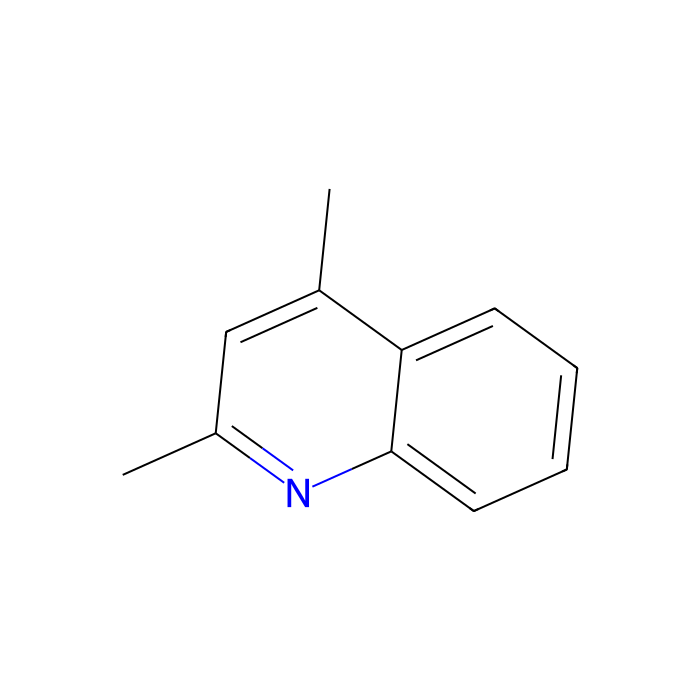
A fused bicyclic nitrogen heteroaromatic from the quinoline family, bearing methyl substituents at the 2- and 4-positions.
InChIKey: Provided by catalog: 466083 (note: atypical format; verify against CoA/SDS)
SMILES: Not specified for this item; refer to CoA/Spec Sheet.
Molecular formula: C11H13N (literature)
Molecular weight: ~159.23 g/mol (literature)
Structural features (general, literature-based):
Core scaffold: quinoline (benzopyridine) — a benzene ring fused to a pyridine ring, with one ring nitrogen at the “quinoline N”.
Substitution pattern: methyl groups at C-2 (alpha to N on the pyridine ring) and C-4 (on the pyridine ring across from N).
Functional groups: aromatic tertiary ring nitrogen (basic), two benzylic methyl groups capable of radical/oxidative functionalization.
2D description: a bicyclic, planar aromatic system; the pyridine-like ring (bearing N) is fused ortho to a benzene ring; Me substituents appear ortho (C-2) and para (C-4) relative to the ring N within the pyridine portion. No stereocenters present.
Synthetic Utility
Reactivity map (literature-based) for 2,4-dimethylquinoline:
Ring nitrogen chemistry:
Quaternization with alkyl/benzyl halides to give quinolinium salts (handles for ion-pair catalysis or oxidative N–dealkylations).
N-oxidation (m-CPBA, H2O2/AcOH) to activate the ring toward electrophilic substitution and rearrangements (e.g., Polonovski-type).
Benzylic methyls (C-2 and C-4):
Radical halogenation (NBS/AIBN or photochemical) to benzyl bromides → further SN2, substitution, or cross-coupling (via benzyl metals).
Oxidation to aldehydes/acids (SeO2 for −CHO; environmentally improved variants: TEMPO/bleach or Oxone® with catalysts).
Strong-base deprotonation (e.g., s-BuLi, LDA, t-BuOK under specialized conditions) to form benzyl anions for alkylation/acylation.
Aromatic ring functionalization:
Electrophilic substitution preferentially at 5- and 8-positions in quinoline systems; methyl groups tune directing effects and block 2/4.
Metal-catalyzed C–H activation/annulation on quinoline frameworks to access polycyclic systems; N-coordination can be leveraged for directing.
Reductive chemistry: Partial hydrogenation to tetrahydroquinoline motifs; Birch-type reductions are less common but possible.
Retrosynthetic value:
Serves as a convergent node to access diverse 2- or 4-substituted quinolines via benzylic derivatization, enabling library synthesis without de novo ring construction.
Analytical tips:
Monitor benzylic transformations by GC–MS (diagnostic M+ 159; benzyl bromide adducts +80) and by 1H NMR (benzylic singlets ~2.4–2.7 ppm shift upon functionalization).
Target Specificity
Not applicable. This product is a small-molecule heteroaromatic building block, not a biological macromolecule or affinity reagent. No antigen/epitope, clone, or species reactivity applies.
Preguntas frecuentes
What is the purity of this product, and how is it determined?
This product is supplied at ≥95% purity, determined by gas chromatography (GC). Lot-specific values are stated on the Certificate of Analysis.
How should this product be stored?
Store at room temperature.
How is this product shipped?
This product ships under standard ambient conditions. No temperature-controlled packaging is required.
What are the CAS number, molecular formula and molecular weight?
The CAS Number is 1198-37-4, the molecular formula is C11H11N, and the molecular weight is 157.21 g/mol. InChIKey ZTNANFDSJRRZRJ-UHFFFAOYSA-N.
What documentation is provided?
Available product documentation, including Certificates of Analysis (COA), Safety Data Sheets (SDS), and specification sheets, is shown in the product document area. Document availability and access follow the current site policy.
Utilizamos cookies para garantizar el correcto funcionamiento del sitio web y, cuando esté permitido, para mejorar su experiencia. Puede gestionar sus preferencias en cualquier momento en Configuración. Más información en nuestra Política de Cookies.
¿Quieres que te enviemos un mensaje cuando tengamos descuentos disponibles?
Recordármelo más tarde
¡Gracias! Por favor, revisa tu bandeja de entrada de correo electrónico para confirmar.
Products are supplied to verified businesses, institutions, and qualified professionals for research and development use only. Not for use in humans, animals, diagnosis, or therapy.

 G1901157