Determine the necessary mass, volume, or concentration for preparing a solution.
| Activity Type | Relation | Activity value | Units | Action Type | Journal | PubMed Id | doi | Assay Aladdin ID |
|---|

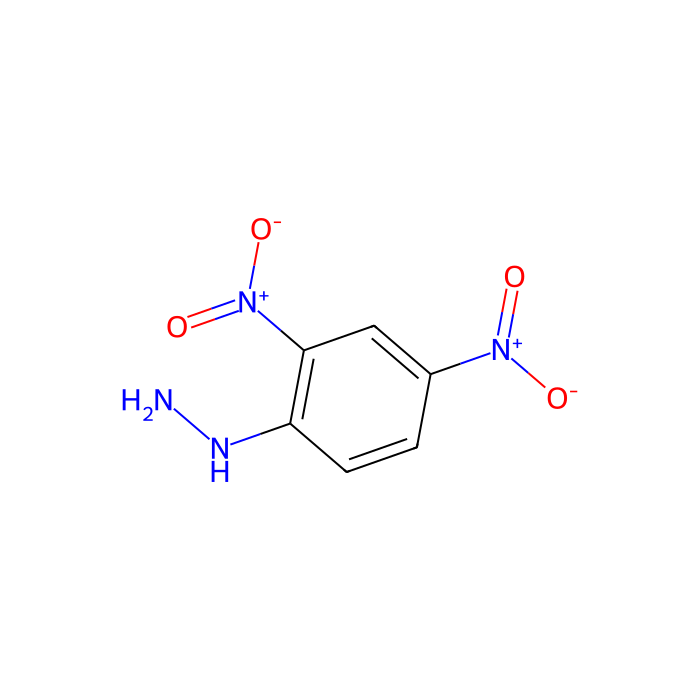
2,4-Dinitrophenylhydrazine (DNPH), a hydrazine derivative, is a potential mutagenic agent. Its molecular and crystal structure has been analyzed. The intra- and intermolecular hydrogen bonds in DNPH have been investigated by vibrational spectroscopic analysis.The mechanism of isothermal degradation of DNPH has been studied by differential scanning calorimetry (DSC).
2,4-Dinitrophenylhydrazine has been used as a reagent to detect the presence of aldehydes and ketones in protein carbonyls. It may be used as a colorimetric reagent in the quantitative estimation of prednisone.
Taxonomy Tree
| Kingdom | Organic compounds |
|---|---|
| Superclass | Benzenoids |
| Clase | Benzene and substituted derivatives |
| Subclass | Nitrobenzenes |
| Intermediate Tree Nodes | Not available |
| Direct Parent | Nitrobenzenes |
| Alternative Parents | Phenylhydrazines Nitroaromatic compounds Propargyl-type 1,3-dipolar organic compounds Organic oxoazanium compounds Organopnictogen compounds Organic zwitterions Organic oxides Hydrocarbon derivatives Hydrazines and derivatives |
| Molecular Framework | Aromatic homomonocyclic compounds |
| Substituents | Nitrobenzene - Nitroaromatic compound - Phenylhydrazine - C-nitro compound - Organic nitro compound - Organic oxoazanium - Allyl-type 1,3-dipolar organic compound - Propargyl-type 1,3-dipolar organic compound - Organic 1,3-dipolar compound - Hydrazine derivative - Organic zwitterion - Organopnictogen compound - Organonitrogen compound - Organic nitrogen compound - Organic oxygen compound - Organic oxide - Hydrocarbon derivative - Aromatic homomonocyclic compound |
| Descripción | This compound belongs to the class of organic compounds known as nitrobenzenes. These are compounds containing a nitrobenzene moiety, which consists of a benzene ring with a carbon bearing a nitro group. |
| External Descriptors | a small molecule |
| Activity Type | Relation | Activity value | Units | Action Type | Journal | PubMed Id | doi | Assay Aladdin ID |
|---|
Find and download the COA for your product by matching the lot number on the packaging.
| Lot Number | Certificate Type | Fecha | Articulo |
|---|---|---|---|
 I2623338 | Certificate of Analysis | Sep 29, 2026 | D489117 |
| I2623337 | Certificate of Analysis | Sep 29, 2026 | D489117 |
| D2615284 | Certificate of Analysis | Apr 18, 2026 | D489117 |
| D2615280 | Certificate of Analysis | Apr 18, 2026 | D489117 |
| C2618516 | Certificate of Analysis | Mar 21, 2026 | D489117 |
| I2524285 | Certificate of Analysis | Oct 13, 2025 | D489117 |
| C2513651 | Certificate of Analysis | Mar 15, 2025 | D489117 |
| L2522070 | Certificate of Analysis | Dec 25, 2024 | D489117 |
| A2510293 | Certificate of Analysis | Dec 25, 2024 | D489117 |
| A2510294 | Certificate of Analysis | Dec 25, 2024 | D489117 |
| H2420197 | Certificate of Analysis | Jul 27, 2024 | D489117 |
| H2420198 | Certificate of Analysis | Jul 27, 2024 | D489117 |
| H2420199 | Certificate of Analysis | Jul 27, 2024 | D489117 |
| D2416249 | Certificate of Analysis | Mar 26, 2024 | D489117 |
| D2416248 | Certificate of Analysis | Mar 26, 2024 | D489117 |
| F2412049 | Certificate of Analysis | Mar 26, 2024 | D489117 |
| C2318046 | Certificate of Analysis | Feb 24, 2023 | D489117 |
| C2318024 | Certificate of Analysis | Feb 24, 2023 | D489117 |
| B2427574 | Certificate of Analysis | Feb 24, 2023 | D489117 |
| Sensibilidad | Air and Light Sensitive |
|---|---|
| Punto de inflamación (°C) | 14°C |
| Punto de fusión (°C) | 196~199°C |
| Peso molecular | 198.14 |
| XLogP3 | 1.500 |
| Hydrogen Bond Donor Count | 2 |
| Hydrogen Bond Acceptor Count | 6 |
| Rotatable Bond Count | 1 |
| Exact Mass | 198.039 Da |
| Monoisotopic Mass | 198.039 Da |
| Topological Polar Surface Area | 130.000 Ų |
| Heavy Atom Count | 14 |
| Formal Charge | 0 |
| Complexity | 235.000 |
| Isotope Atom Count | 0 |
| Defined Atom Stereocenter Count | 0 |
| Undefined Atom Stereocenter Count | 0 |
| Defined Bond Stereocenter Count | 0 |
| Undefined Bond Stereocenter Count | 0 |
| The total count of all stereochemical bonds | 0 |
| Covalently-Bonded Unit Count | 1 |
H228:Flammable solid
H302:Harmful if swallowed
H319:Causes serious eye irritation
P210:Keep away from heat, hot surface, sparks, open flames and other ignition sources. - No smoking.
P240:Ground/bond container and receiving equipment.
P241:Use explosion-proof [electrical/ventilating/lighting/.../] equipment.
P264:Wash hands [and …] thoroughly after handling.
P270:Do not eat, drink or smoke when using this product.
P280:Wear protective gloves/protective clothing/eye protection/face protection.
P330:Rinse mouth.
P305+P351+P338:IF IN EYES: Rinse cautiously with water for several minutes. Remove contact lenses if present and easy to do - continue rinsing.
P370+P378:In case of fire: Use ... to extinguish.
P501:Dispose of contents/container to an approved waste disposal plant.
P264+P265:Wash hands [and …] thoroughly after handling. Do not touch eyes.
P301+P317:IF SWALLOWED: Get medical help.
P337+P317:If eye irritation persists: Get medical help.
Nuestra guía de selección de calidades cubre la pureza, el estado del estabilizador y la idoneidad de la aplicación para todas las variantes de nuestro catálogo.
Ver la guía de calidades Reagent Grade →