This compound belongs to the class of organic compounds known as chloroquinolines. These are compounds containing a quinoline moiety, which carries one or more chlorine atoms.
External Descriptors
Not available
1. Djoumbou Feunang Y, Eisner R, Knox C, Chepelev L, Hastings J, Owen G, Fahy E, Steinbeck C, Subramanian S, Bolton E, Greiner R, and Wishart DS. ClassyFire: Automated Chemical Classification With A Comprehensive, Computable Taxonomy. Journal of Cheminformatics, 2016, 8:61.
Determine the necessary mass, volume, or concentration for preparing a solution.
Dilution Calculator
Determine the dilution needed to prepare a stock solution.
Reconstitution Calculator
Reseñas
Reseñas de cliente
Application Protocols
No biological assay or immunoassay protocols are associated with this small-molecule reagent.
Synthetic protocols: See the Reaction Conditions, Reaction & Applications, and Synthetic Utility sections for guidance on typical transformations.
Analytical QC suggestions (general): Verify identity/purity by 1H/13C NMR, HRMS/LC–MS, and HPLC. For metal-sensitive applications, ICP-MS for Pd/Ni residues after coupling steps may be appropriate.
For any specific, item-level protocols or assay validations, refer to the Aladdin CoA/Spec Sheet if provided.
Biological Roles
This product is a synthetic heteroaromatic building block rather than a biological metabolite.
Not typically associated with endogenous biological roles or metabolic pathways.
Quinoline frameworks occur in various bioactive research compounds; however, 2,5-dichloro substitution is primarily a synthetic handle for derivatization and SAR exploration in discovery chemistry.
Any biological activity of derivatives arises from subsequent functionalization; no claims are made for this parent compound. Experimental characterization (e.g., receptor binding, enzyme assays) would pertain to synthesized analogs, not the starting material.
For laboratory use only. No clinical or diagnostic applications are implied or endorsed.
Buffer Applications
Not typically applicable. 2,5-Dichloroquinoline is an organic synthetic intermediate, not a buffering agent.
It does not form defined buffer systems in aqueous media and has low water solubility (literature, qualitative).
For workups/purifications, standard aqueous buffers (e.g., phosphate, carbonate) may be used to adjust pH during extraction, but the compound itself is not used to prepare buffers.
Refer instead to the Reaction & Applications, Synthetic Utility, and Reaction Conditions sections for relevant usage guidance.
Green Alternatives
Greener solvent choices for couplings and SNAr
Replace 1,4-dioxane with 2-MeTHF or CPME where feasible; both offer lower peroxide hazard than ethers like THF and improved sustainability profiles.
Consider aqueous micellar catalysis (TPGS-750-M or similar) for Suzuki/Buchwald–Hartwig transformations, enabling room-temperature to moderate-temperature conditions with minimal organic solvent.
Use bio-derived solvents: Cyrene (dihydrolevoglucosenone) or propylene carbonate can substitute for DMF/DMA in some SNAr reactions; verify solubility and base compatibility.
Bases and reagents
Favor inorganic bases with lower EHS burden (K3PO4, K2CO3) over strong alkoxides when compatible with reactivity.
Employ preformed, recyclable Pd catalysts or ligand-minimized systems; heterogeneous Pd/C under micellar conditions can be effective for certain couplings with aryl chlorides.
Energy and process intensification
Apply continuous flow or microwave heating to reduce reaction time and energy consumption; flow can enhance heat/mass transfer with aryl chlorides.
Waste minimization
Telescoping: Perform sequential C2 then C5 functionalization without isolating intermediates to reduce solvent use.
Comparison snapshot (general)
Conventional: DMF or 1,4-dioxane, strong base, 100–120 °C, high Pd loadings (1–5 mol%).
Greener alternative: 2-MeTHF or water/micelles, K3PO4, 60–90 °C, low Pd (≤0.5 mol%) or Ni catalysis; reduced VOC and improved E-factor.
Note: Validate greener substitutions at small scale; substrate solubility and selectivity can vary.
Pharmaceutical Uses
No excipient or compendial status is provided for this item; it is intended for research and laboratory synthesis only.
Role in pharma R&D (general): Serves as a heteroaryl chloride scaffold to build quinoline-based libraries for structure–activity relationship (SAR) studies, intermediate generation, and target exploration.
Formulation context: The neat compound is not used as a pharmaceutical excipient. If incorporated into screening libraries, it is typically dissolved in organic solvents (e.g., DMSO) at stock concentrations for parallel synthesis, not for biological dosing.
Regulatory status: Not specified for this item; not claimed to meet pharmacopeial monographs.
No therapeutic or clinical claims are made for this material.
Physical Properties
Item-specific values
Boiling point: Not specified for this item; refer to CoA/Spec Sheet.
Melting point: Not specified for this item; refer to CoA/Spec Sheet.
Density: Not specified for this item; refer to CoA/Spec Sheet.
Refractive index: Not specified for this item; refer to CoA/Spec Sheet.
Solubility profile: Not specified for this item; refer to CoA/Spec Sheet.
LogP, pKa: Not specified for this item; refer to CoA/Spec Sheet.
Phase: Typically a crystalline solid at ambient conditions (literature, for closely related dichloroquinolines).
Polarity: Moderately nonpolar aromatic heterocycle with limited hydrogen-bond donor capability; one ring nitrogen as a weak base.
Solubility (qualitative, literature): Low in water; soluble in common organic solvents such as dichloromethane, chloroform, THF, acetonitrile, ethyl acetate, toluene, and hot alcohols. Solubility often improves with mild heating or addition of polar aprotic co-solvents (DMF, DMSO, NMP) for reaction setups.
Acid-base behavior: The ring nitrogen is weakly basic (pyridine-like); salts can form under strongly acidic conditions, often increasing aqueous solubility.
Practical notes (general)
Handling as a solid substrate typically benefits from gentle warming to dissolve completely in dry, oxygen-free solvent when moisture/oxygen-sensitive catalytic reactions are planned.
For analytical methods, UV absorption is expected in the 250–330 nm region due to the quinoline chromophore (literature behavior of quinoline derivatives).
All numeric specifications for this specific item are not provided and should be confirmed on the CoA/Spec Sheet.
Quality and Grades
Item-specific grade/purity
Grade/Purity: Not specified for this item; refer to CoA/Spec Sheet.
Appearance: Not specified for this item; refer to CoA/Spec Sheet.
How to interpret grades (general guidance)
Research grade: Suitable for general laboratory synthesis and screening; impurity thresholds defined by internal specifications.
Purified/98%+ or 99%+ (if applicable on CoA): Indicates assay by NMR/GC/HPLC exceeding the stated threshold; residual solvents, related impurities, and inorganic residues controlled per internal spec.
HPLC grade (for solvents) or LC-MS grade (for analytes) typically signifies low UV background and very low metal/ionic content; for solid reagents like heteroaryl halides, “high-purity” specifications generally focus on assay, isomeric purity, and residual halogenated by-products.
Stabilizers and metal content
Stabilizer: Not applicable/Not specified for this item; refer to CoA/Spec Sheet.
Metal trace limits/halide content: Not specified for this item; refer to CoA/Spec Sheet. For cross-coupling applications, users may wish to pre-screen metal content if sensitive downstream assays are planned.
What to check on receipt
Verify batch-specific assay, identity (1H/13C NMR, MS), water content (if reported), and residual solvent. Confirm appearance matches CoA. For sensitive catalysis, consider an additional pass through silica or recrystallization if needed.
All quantitative quality parameters for this specific SKU should be taken from the Aladdin CoA/Spec Sheet.
Reaction and Applications
Use as a bifunctional aryl chloride
Differential reactivity: The 2-chloro position (on the quinoline ring adjacent to N) is typically more activated than the 5-chloro (on the benzene ring). This allows stepwise, regioselective functionalization.
SNAr aminations/oxygenations at C2: Secondary amines, anilines, or alkoxides can displace the 2-chloro under heated polar aprotic conditions; electron-withdrawing influence of ring N facilitates addition–elimination.
Cross-couplings (Pd/Ni catalysis): Suzuki–Miyaura, Buchwald–Hartwig amination, Sonogashira, Negishi, and Stille couplings at aryl C–Cl positions. Catalysts/ligands such as Pd(dppf)Cl2, Pd-PEPPSI (NHC), BrettPhos/SPhos/XPhos systems, or Ni(cod)2 with suitable ligands enable oxidative addition to aryl chloride.
Lithiation/metal–halogen exchange (more challenging with Ar–Cl): Prefer halogen–metal exchange at low temperature with iPrMgCl·LiCl (Turbo Grignard) for C2; quench with electrophiles (CO2, aldehydes) when catalysis is not desired.
Directed N-oxide chemistry: Temporary formation of the quinoline N-oxide (with mCPBA) can guide regioselective functionalization, followed by deoxygenation (e.g., PCl3/Zn).
Strategic value
Scaffold diversification: Enables rapid library synthesis of 2,5-disubstituted quinolines (e.g., 2-amino/arylated plus 5-aryl/alkynyl variants) relevant in materials, ligands, and discovery chemistry.
Protecting-group-free tactics: Exploit innate activation at C2 to install the most sensitive substituent first, then functionalize C5 under stronger (higher-temperature) coupling conditions.
Practical considerations
Rigorous exclusion of water/air for cross-couplings improves yields and catalyst longevity.
Use slight excess of nucleophile or boronic partner (1.2–1.5 equiv) for stepwise selectivity; monitor by LC–MS to avoid overfunctionalization.
Reaction Conditions
All conditions below are literature-style general guidance for aryl chlorides/quinolines; optimize for your substrate and scale.
SNAr Amination at C2 (general)
Substrate: 2,5-dichloroquinoline (1.0 equiv); amine (1.2–2.0 equiv); base (K2CO3 or DIPEA, 2.0–3.0 equiv).
Solvent: DMF, DMSO, or NMP (0.1–0.5 M).
Temperature/time: 80–140 °C, 2–16 h.
Notes: Electron-rich anilines may require higher temp or catalytic Cu (Ullmann-type) assistance.
Boron partner: 1.2–1.5 equiv; base: K3PO4 or Cs2CO3 (2–3 equiv).
Solvent: 1,4-dioxane/H2O (4:1) or 2-MeTHF/H2O; 0.1–0.3 M; 70–100 °C; 2–12 h.
Sonogashira (alkynylation at C5)
Catalyst: Pd(PPh3)2Cl2 (1–2 mol%) + CuI (2–5 mol%); base: Et3N or iPr2NH.
Solvent: THF, toluene, or 2-MeTHF; 25–80 °C; 2–10 h.
Workup and purification
Quench with water/brine; extract with EtOAc or DCM. Purify by silica gel chromatography using hexanes/EtOAc or toluene gradients. Confirm regiochemistry by 2D NMR.
Note: Expected yields vary widely (40–90%) depending on partners/ligands; screen ligands/bases to optimize.
Safety and Handling
Item-specific hazard data
Signal word: Not specified for this item; refer to SDS.
Hazard statements (H-codes): Not specified for this item; refer to SDS.
GHS classification: Not specified for this item; refer to SDS.
Pictograms: Not specified for this item; refer to SDS.
General safety profile (literature/generic for chlorinated quinolines; not a substitute for SDS)
Likely hazards: May cause skin/eye irritation and respiratory irritation upon dust or vapor exposure; harmful if swallowed. Avoid inhalation of dust and contact with skin/eyes. Combustible organic solid.
Reactivity: Stable under recommended storage. Avoid strong oxidizers and strong bases/acids that may induce side reactions or decomposition at elevated temperatures.
Incompatibilities: Strong oxidants; very strong bases in protic media; prolonged exposure to moisture may affect certain reactions (though the neat compound is typically moisture-stable).
PPE and engineering controls
Use in a chemical fume hood. Wear safety glasses (ANSI/EN166), lab coat, and suitable chemical-resistant gloves (nitrile commonly used). Consider respiratory protection if dust cannot be controlled.
First-aid overview (consult SDS and institutional protocols)
Inhalation: Move to fresh air; seek medical attention if symptoms persist.
Skin/eye contact: Rinse with water for at least 15 minutes; remove contaminated clothing; obtain medical evaluation if irritation continues.
Ingestion: Rinse mouth; do not induce vomiting; seek medical advice.
Always defer to the product-specific SDS for authoritative hazard classification and emergency measures.
Solvent Selection
Role and polarity
Compound type: Aromatic heterocycle (quinoline) with two aryl chlorides; overall moderately nonpolar with a weakly basic ring nitrogen.
Water solubility: Generally low (literature). Prefer organic media.
Solvent choices for dissolution and reactions (general)
Polar aprotic (excellent for SNAr/couplings): DMF, DMA, NMP, DMSO, acetonitrile.
Etheric/ethereal (common in Pd catalysis): 1,4-dioxane, THF, CPME, 2-MeTHF.
Halogenated: DCM, CHCl3 for analytical prep or small-scale manipulations; avoid for high-temperature reactions.
Alcohols: Hot ethanol or isopropanol may dissolve for recrystallization; less ideal for base-sensitive couplings.
When to choose what
SNAr with amines: Polar aprotic (DMF/DMSO/DMA) with base; heat as needed.
Suzuki/Negishi/Buchwald–Hartwig: 1,4-dioxane/water, toluene, 2-MeTHF, or tert-amyl alcohol; pair with base (K3PO4, Cs2CO3, NaOtBu) and ligand system.
High-temperature transformations: Toluene or xylene for >110 °C operations.
Practical tips
Ensure anhydrous, degassed solvent for cross-couplings to maximize oxidative addition to the aryl C–Cl bond.
Start with 0.05–0.2 M substrate concentration for homogeneous catalysis; adjust to balance solubility vs rate.
For workups, biphasic DCM/H2O or EtOAc/H2O systems extract efficiently; silica chromatography using hexanes/EtOAc or toluene gradients often separates quinoline derivatives cleanly.
Storage and Reconstitution
Item-specific storage and shipping
Storage Conditions: Store at 2–8 °C, Argon charged (from Product Data).
Shipped In: Wet ice (from Product Data).
Container: Keep tightly closed under inert gas to minimize oxidative or moisture exposure during long-term storage.
General handling guidance
Allow the container to warm to room temperature under inert atmosphere before opening to minimize condensation.
Reseal under argon or nitrogen promptly after use. Use dry tools/solvents when weighing and transferring for air/moisture-sensitive reactions.
Prepare concentrated stocks in dry, oxygen-free solvents such as DMSO, DMF, acetonitrile, THF, toluene, or 2-MeTHF as required for planned reactions. Typical screening stocks: 0.1–1.0 M.
Filter solutions (PTFE, 0.45 μm) if particulates are present. Store solutions in sealed, inerted vials at 2–8 °C or −20 °C depending on solvent stability; avoid repeated freeze–thaw.
Stability notes
The neat solid is generally stable when protected from light, heat, and air/moisture. Inspect periodically for discoloration or off-odors; if observed, repurify before critical use.
For definitive, lot-specific stability/shelf-life, consult the CoA/Spec Sheet and SDS. For research use only.
Structure and Identity
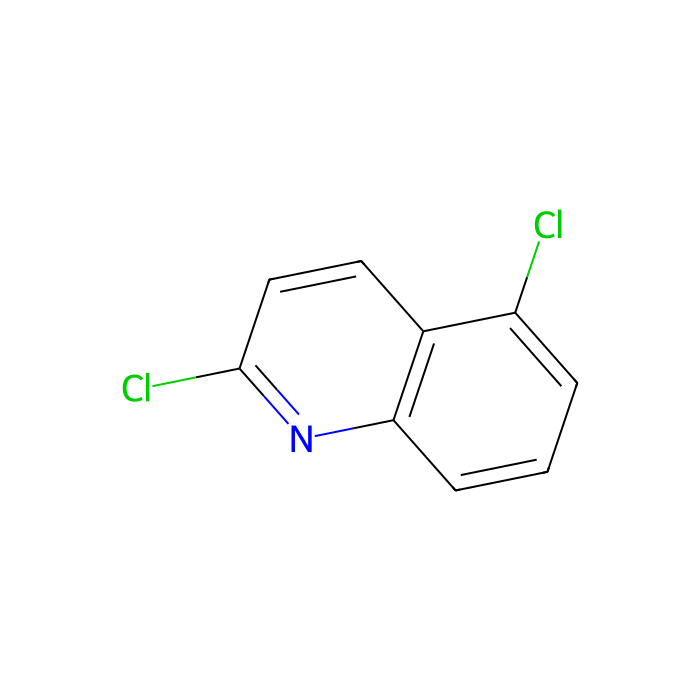
Brief overview: 2,5-Dichloroquinoline is a chlorinated quinoline scaffold bearing chloro substituents at the 2-position (adjacent to the ring nitrogen) and the 5-position on the fused benzene ring, making it a versatile heteroaryl halide building block.
Item-specific (from Product Data)
Product name: 2,5-Dichloroquinoline
CAS: 59412-12-3
CID: 676552
InChIKey: 327142 (as provided)
SMILES: Not specified for this item; refer to CoA/Spec Sheet.
Molecular formula: Not specified for this item; refer to CoA/Spec Sheet.
Molecular weight: Not specified for this item; refer to CoA/Spec Sheet.
Functional groups: Two aryl C–Cl bonds; one ring nitrogen (sp2) in the quinoline core; no stereocenters.
Substitution pattern: 2-chloro at the electron-deficient heteroaryl carbon adjacent to N; 5-chloro on the benzene portion. The 2-chloro is typically more reactive toward oxidative addition/SNAr than 5-chloro.
2D structural description (general)
A bicyclic aromatic system with one ring nitrogen (pyridine-like). Chlorine substituents occupy one position on the heteroaryl ring (alpha to N) and one on the benzene ring, enabling orthogonal reactivity profiles in cross-coupling and nucleophilic aromatic substitution.
Note: Identity parameters not specified in the Product Data should be verified against the item’s CoA/Spec Sheet.
Synthetic Utility
Bifunctional electrophile
Two aryl C–Cl bonds of differing activation enable sequential, chemoselective modifications: first at C2 (heteroaryl, activated) then at C5 (aryl, less activated), or vice versa under tailored conditions.
Key reaction manifolds (literature/general)
C–N bond formation: SNAr with amines at C2; Buchwald–Hartwig amination at C2 and/or C5 with appropriate ligands (e.g., BrettPhos/XPhos for aryl chlorides).
C–C bond formation: Suzuki coupling with aryl/heteroaryl boronic acids; Sonogashira alkynylation at C5 to introduce alkyne handles; Negishi/Stille for sensitive substrates.
C–O/S bond formation: Aryloxides/thiolates can substitute at C2 (SNAr) or undergo Pd-catalyzed couplings to furnish ethers/thioethers.
Metalation strategies: Turbo-Grignard (iPrMgCl·LiCl) can effect halogen–magnesium exchange at low temperature on the more activated position, followed by electrophile trapping.
Retrosynthetic value
Serves as a convergent junction for late-stage diversification of quinoline cores, enabling rapid access to 2,5-disubstituted patterns common in ligands, dyes, and discovery compounds.
Practical synthesis notes
Start with stepwise functionalization guided by reactivity differences; monitor regioselectivity by HMBC/NOESY correlations on the quinoline framework.
Residual chloride at the unreacted position provides a built-in handle for subsequent diversification, facilitating parallel synthesis workflows.
Target Specificity
Not applicable. This product is a small-molecule synthetic intermediate and has no antibody/biologic target attributes.
No antigen, epitope, clone, isotype, or species reactivity information applies.
Any target engagement would be defined by derivatives synthesized from this scaffold in downstream research, not by the parent compound itself.
We use cookies to ensure the website functions properly and, where permitted, to improve your experience. You can manage your preferences at any time in Settings. Learn more in our Cookie Policy.
Shall we send you a message when we have discounts available?
Remind me later
Thank you! Please check your email inbox to confirm.
Products are supplied to verified businesses, institutions, and qualified professionals for research and development use only. Not for use in humans, animals, diagnosis, or therapy.

 C2330582