This compound belongs to the class of organic compounds known as thiazolines. These are heterocyclic compounds containing a five-member unsaturated aliphatic ring with one nitrogen atom, one sulfur atom, three carbon atoms.
External Descriptors
Not available
1. Djoumbou Feunang Y, Eisner R, Knox C, Chepelev L, Hastings J, Owen G, Fahy E, Steinbeck C, Subramanian S, Bolton E, Greiner R, and Wishart DS. ClassyFire: Automated Chemical Classification With A Comprehensive, Computable Taxonomy. Journal of Cheminformatics, 2016, 8:61.
Determine the necessary mass, volume, or concentration for preparing a solution.
Dilution Calculator
Determine the dilution needed to prepare a stock solution.
Reconstitution Calculator
Reseñas
Reseñas de cliente
Application Protocols
No application protocols (e.g., WB, IHC, IF, FC) are applicable to this small‑molecule reagent. For practical laboratory use:
Preparation of analytical standards: Dissolve an accurately weighed amount in dry MeCN or MeOH at low temperature to prepare stock solutions; store aliquots at 2–8 °C, protected from air/light. Verify stability by GC‑MS/LC‑MS prior to use.
Synthetic dosing: For reactions sensitive to moisture/oxygen, pre‑cool the reaction solvent, add under inert atmosphere, and rinse transfer lines/syringes with a small volume of solvent to ensure quantitative delivery.
Refer to the Reaction Conditions section for transformation‑specific guidance.
Biological Roles
Item‑specific biological data are not provided for this product; the following is general literature context for the thiazoline motif.
Thiazoline occurrence: Thiazoline rings appear in natural products and post‑translationally modified peptides (e.g., thiazoline linkages formed from cysteine in ribosomal peptides) and are intermediates en route to thiazoles in biosynthesis.
Maillard chemistry: 2‑Acetyl‑2‑thiazoline is a well‑known heterocycle formed in model Maillard systems involving cysteine (or other sulfur donors) and reducing sugars under thermal conditions (literature). It is often used as a reference standard in analytical studies of thermally generated aroma compounds.
Reactivity in biological matrices: The thiazoline ring can be susceptible to hydrolysis/oxidation, and the acetyl carbonyl can form Schiff bases with amines under dehydrating conditions, though such transformations are context‑dependent.
Research use only: No claims are made regarding physiological activity, toxicology, or clinical relevance for this SKU. For any biological testing, establish your own controls and refer to primary literature for mechanisms and pathways.
Buffer Applications
This compound is a reactive heterocycle rather than a buffering agent. It does not form a defined conjugate acid/base pair with a useful pKa range for routine buffer preparation. Consequently:
Not typically used as a buffer component in biochemical assays.
If aqueous handling is required (e.g., spiking into model systems), use neutral pH buffered media (phosphate, HEPES) and keep contact times short and temperatures low to minimize hydrolysis/oxidation.
Refer instead to the Reaction & Applications and Synthetic Utility sections for relevant uses.
Green Alternatives
Because 2‑acetyl‑2‑thiazoline is itself a target building block rather than a solvent, green chemistry considerations focus on solvent selection and synthesis routes.
Greener solvent choices for handling/processing (literature guidance):
Prefer ethyl acetate, 2‑MeTHF, CPME, or MeOH/EtOH (renewable content, lower toxicity) over chlorinated solvents when compatible with stability and analytical needs.
Use heptane/EtOAc biphasic systems for extractions instead of DCM when partitioning allows.
Illustrative comparison (qualitative):
Ethyl acetate: bio‑based options available; good solvency; moderate volatility; generally safer profile.
2‑MeTHF/CPME: hydrophobic ethers with lower peroxide tendency (vs THF/Et2O) and favorable life‑cycle metrics; check for ring stability under acid catalysis.
Acetonitrile/MeOH: common analytical solvents; manageable hazards; ensure waste minimization.
DCM: effective but with higher environmental/health concerns; reserve for cases requiring chlorinated solvent performance.
Synthesis route considerations (general):
Employ catalytic aerobic oxidation for thiazoline→thiazole aromatization instead of stoichiometric oxidants when applicable.
Choose atom‑efficient condensations (e.g., thioamide + halo‑carbonyl cyclizations) under solvent‑lean conditions or flow chemistry to reduce waste.
Note: Selection must balance green metrics with chemical compatibility; always verify ring stability in the chosen medium.
Pharmaceutical Uses
No pharmacopeial/excipient status or pharmaceutical grade is specified for this item; it is supplied strictly for research use only.
General considerations for formulation research (non‑clinical, literature context):
As a volatile, moderately polar organic compound, it can be incorporated into organic phases or encapsulated matrices for release studies; however, thiazolines may undergo oxidative/aromatization processes over time, impacting stability.
If used as an analytical reference standard in QC method development (e.g., GC‑MS), prepare fresh standard solutions at low temperature in suitable solvents (MeCN, MeOH, EtOAc) and verify stability over the intended analysis window.
No therapeutic, diagnostic, or clinical applications are claimed or supported for this SKU.
Physical Properties
Item‑specific measured specifications (bp, mp, density, refractive index, water/peroxide/metal content, UV cutoff): Not specified for this item; refer to CoA/Spec Sheet.
General/literature information (for research planning only):
Appearance: Often described as a colorless to pale yellow liquid with a characteristic roasted/nutty odor (literature; odor descriptions are subjective and not a product specification).
Molecular weight: ~129.18 g/mol (literature; from formula C5H7NOS)
Volatility: Moderately volatile; tends to evaporate at ambient conditions (literature observation for closely related thiazolines).
Solubility: Expected to be miscible with many polar organic solvents (e.g., alcohols, ethers, esters) and sparingly soluble to moderately soluble in water due to the polar carbonyl coupled with a heteroaromatic ring (literature/structure-based rationale).
Partitioning/logP: Anticipated to be low‑to‑moderate due to one carbonyl and a heterocycle containing heteroatoms (qualitative, structure‑based rationale).
Stability: Thiazolines can be sensitive to hydrolysis and oxidation; neat materials are commonly stored cold to limit degradation to corresponding thiazoles or ring‑opened products (literature trend). Always confirm by stability study/SDS for your lot.
Note: Use the product’s CoA/SDS for authoritative numeric data needed for regulatory filings or method validation.
Quality and Grades
Grade/Purity: Not specified for this item; refer to CoA/Spec Sheet.
Appearance: Not specified for this item; refer to CoA/Spec Sheet.
Context for professional users:
In the absence of an explicit grade (e.g., ≥98%, GC; FCC; HPLC grade), rely on the lot‑specific CoA for assay method (e.g., GC‑FID/GC‑MS), main component %, and impurity profiles (positional isomers, ring‑opened species, oxidation products such as the corresponding thiazole).
Stabilizers/inhibitors: Not specified for this item; refer to CoA/Spec Sheet. If none are listed, assume the material is neat and consider inert‑gas blanketing and low‑temperature storage to limit oxidative changes.
UV/Chromatography suitability: If you plan UV‑based quantification or HPLC/GC analysis, verify the UV cutoff, residual solvents, and baseline characteristics from the CoA/SDS; do not assume “HPLC grade” unless explicitly stated.
Odor threshold and organoleptic descriptors are not quality specifications. Use instrumental criteria (GC/HPLC/NMR) for identity and purity control.
Tip: For critical applications, request a recent CoA and, when needed, perform a small qualification run (GC‑MS/NMR) to confirm identity (thiazoline ring signals and acetyl carbonyl) and to check for thiazole byproducts.
Reaction and Applications
2‑Acetyl‑2‑thiazoline (2A2T) is a versatile heterocyclic building block combining an enolizable acetyl group with a thiazoline ring. It is used in:
Precursor to thiazoles: Mild oxidation (e.g., DDQ or aerobic catalysis) can aromatize the thiazoline to 2‑acetylthiazole, a valuable heteroaromatic motif in materials and flavors research (literature).
Electrophile at the carbonyl: The acetyl group undergoes nucleophilic additions (e.g., with amines, hydrazines) to form imines/hydrazones for derivatization or analytical tagging.
Enolate chemistry: Under carefully buffered basic conditions, the acetyl can form enolates for C–C bond formation (e.g., aldol‑type couplings). Strong bases risk ring degradation; employ mild bases (e.g., DBU, carbonate) at low temperature.
Heterocycle transformations: Protonation or Lewis acid activation at the ring nitrogen can direct reactions such as acylations or facilitate ring aromatization.
Maillard model studies: Frequently employed as a reference standard or model compound in thermal reactions of amino acids/reducing sugars to dissect heterocycle formation pathways (research use only; literature).
Practical tips:
Work cold and under inert atmosphere if prolonged handling is required to minimize oxidation to thiazole derivatives.
For GC/GC‑MS analysis, avoid high injector temperatures and long residence times; rapid split injections with cool on‑column or PTV methods help preserve the thiazoline.
Use dry solvents and avoid strong acids/bases to maintain ring integrity during synthesis/sampling.
Reaction Conditions
General literature guidance for transformations involving 2‑acetyl‑2‑thiazoline (optimize per your system; values are illustrative, not product specifications):
Oxidative aromatization to 2‑acetylthiazole:
Oxidants: DDQ (1.1–1.5 equiv) or catalytic aerobic oxidation (e.g., Cu/air) in toluene, MeCN, or DCM.
Temperature: 20–80 °C depending on oxidant; monitor by GC/MS.
Notes: Control exotherm; minimize over‑oxidation of sulfur.
Imine/hydrazone formation (derivatization):
Reagents: hydroxylamine hydrochloride or 2,4‑DNPH (acid catalysis), hydrazine derivatives.
Solvent: EtOH/MeOH or MeCN with catalytic acid (AcOH, p‑TsOH), molecular sieves to remove water.
Temperature/time: 20–50 °C, 0.5–4 h.
Aldol‑type C–C coupling at acetyl group:
Base: DBU, K2CO3, or tertiary amine bases in polar aprotic solvent (DMF, MeCN, THF).
Temperature: −20 to 25 °C to limit side reactions; slow electrophile addition.
Notes: Avoid strong alkoxides or LDA unless stability is established.
Reduction of C=N (ring saturation):
Reagents: NaBH3CN or catalytic hydrogenation (Pd/C) under mild conditions.
Caution: Monitor for over‑reduction or ring opening.
These conditions are compiled from general heterocycle literature and analogous substrates; perform small‑scale trials and analytical monitoring to tune equivalents, temperature, and time.
Safety and Handling
GHS classification, signal word, H/P statements, and pictograms: Not specified for this item; refer to the SDS.
General laboratory safety considerations (not a substitute for SDS):
Likely hazards: Organic heterocycle with a reactive carbonyl; may cause skin, eye, and respiratory irritation. Organosulfur compounds can have strong odors and low odor thresholds.
PPE: Safety glasses or face shield, lab coat, and appropriate chemically resistant gloves (e.g., nitrile). Handle in a certified fume hood to control vapors and odor.
Handling: Minimize exposure to air, heat, and light. Keep containers tightly closed; purge headspace with inert gas if feasible. Avoid contact with strong acids/bases (risk of hydrolysis), strong oxidizers (risk of exothermic oxidation), and reducing agents (possible ring/imine reduction).
Spills: Absorb with inert material (vermiculite, silica, or wipe with suitable absorbent pads), transfer to a waste container, ventilate area. Prevent entry to drains. Dispose per local regulations.
First aid (overview):
Inhalation: Move to fresh air, seek medical attention if symptoms persist.
Skin: Wash with soap and water, remove contaminated clothing.
Eyes: Rinse cautiously with water for several minutes; remove contact lenses if easy to do.
Ingestion: Rinse mouth; do not induce vomiting unless instructed by medical personnel.
Fire: Use CO2, dry chemical, or foam. Combustion may produce SOx/NOx.
Always consult the Aladdin Scientific SDS for definitive hazard and response information for this SKU.
Solvent Selection
This compound is a moderately polar, heteroatom‑rich organic liquid/low‑melting solid. Solvent choice should balance polarity for dissolution with chemical stability of the thiazoline ring and acetyl group.
Polarity class (qualitative, literature/structure‑based): polar aprotic/polar protic compatible; higher solubility expected in ethers, esters, ketones, alcohols; limited in alkanes.
Water: Anticipate limited solubility and possible hydrolysis under acidic/basic aqueous conditions. Use neutral pH and cold temperatures for brief aqueous handling only.
Avoid strongly basic media that can promote enolization/condensation at the acetyl group.
Avoid strong acids that can catalyze ring opening of the thiazoline.
Comparison guidance (qualitative):
vs. highly polar solvents (MeCN, DMSO): higher solubility but assess potential for ring tautomerization; use for analytical stocks.
vs. mid‑polarity ethers/esters (THF, EtOAc): good balance of solubility and gentler chemical environment for storage/dosing.
For formulation/stock solutions, cold EtOAc or DCM are often practical for short‑term use; for analytical reference solutions, dry MeCN or MeOH at low temperature can be suitable.
Storage and Reconstitution
Storage conditions (item‑specific): Store at 2–8 °C. Shipped on wet ice.
Container: Keep tightly closed in an amber glass vial or other vapor‑tight, chemically compatible container. Consider inert gas (N2/Ar) headspace to limit oxidation/aromatization.
Protection: Minimize exposure to air, heat, and light. Avoid prolonged storage at room temperature.
Stability: Thiazoline rings can slowly oxidize to thiazoles and/or undergo ring opening under acidic/basic conditions; monitor material by GC/GC‑MS or NMR periodically if stored for extended periods.
Reconstitution/stock solutions: If solidified at low temperature, allow to equilibrate briefly on ice and redissolve in a dry, compatible solvent (e.g., EtOAc, MeCN, MeOH, DCM) at 0–5 °C. Prepare small aliquots to avoid repeated freeze–thaw/warm–cool cycles.
Incompatibilities: Strong acids/bases, strong oxidizers, and prolonged contact with reactive metals.
Research use only: Not for human or animal consumption. Always consult the SDS for detailed handling and disposal guidance.
Structure and Identity
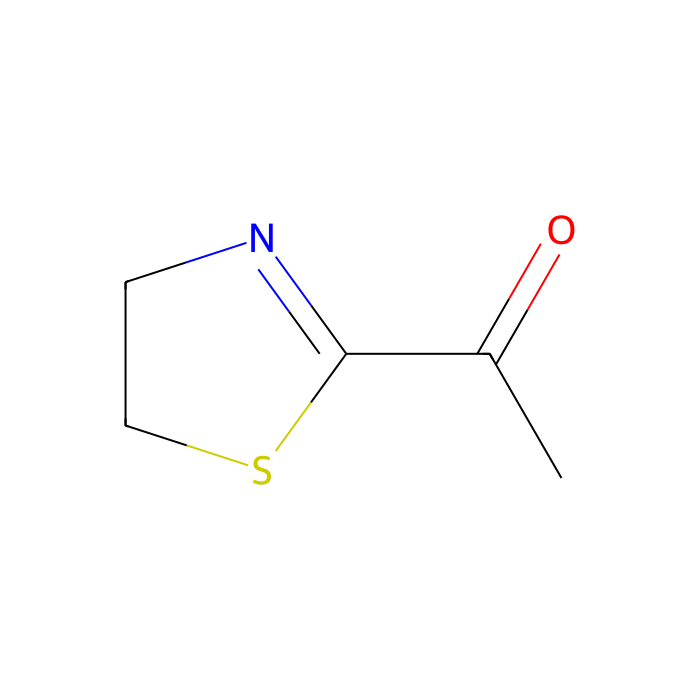
A heteroaromatic building block featuring a 5‑membered thiazoline ring bearing an acetyl substituent at the 2‑position. The ring contains both sulfur and nitrogen, with one degree of unsaturation (C=N) characteristic of thiazolines.
EC/MDL/UN: Not specified for this item; refer to CoA/Spec Sheet.
Molecular formula (literature): C5H7NOS
Molecular weight (literature): ~129.18 g/mol
SMILES: Not specified for this item; refer to CoA/Spec Sheet.
InChI / InChIKey: Not specified for this item; refer to CoA/Spec Sheet.
Structural features:
5‑membered thiazoline ring (C3NS) with adjacent N and S heteroatoms
Imine-like C=N within the ring (partially saturated relative to thiazole)
Acetyl (–COCH3) substituent at the 2‑position, providing a conjugated ketone
No stereocenters; planar features around the C=N and carbonyl
2D description: a 5‑membered ring containing S and N (adjacent), with one ring double bond (C=N). The ring carbon at position 2 bears an acetyl carbonyl substituent.
Synthetic Utility
Key functional elements enabling diverse transformations:
Acetyl ketone: Enables enolate chemistry for C–C bond formation (e.g., aldol additions, Michael‑type additions to activated alkenes). Employ mild, non‑nucleophilic bases to protect the thiazoline ring.
Thiazoline ring (C=N): Can be oxidized to the corresponding thiazole (aromatization), reduced at C=N to give saturated thiazolidine analogs, or undergo ring opening under strongly acidic/basic conditions—useful for divergent synthesis.
Heteroatom coordination: The ring nitrogen and sulfur can coordinate to metals/Lewis acids, enabling activation in catalysis (e.g., electrophilic substitutions adjacent to the carbonyl under Lewis acidic conditions).
Retrosynthetic value:
Serves as a masked thiazole unit: 2‑acetyl‑2‑thiazoline → oxidation → 2‑acetylthiazole.
Acts as an acetyl donor into heteroaromatic frameworks via cross‑condensation or acyl transfer strategies.
Analytical/derivatization uses:
Formation of oximes/hydrazones/semicarbazones from the acetyl carbonyl supports characterization or stabilization for GC/LC methods.
Handling for synthesis:
Inert atmosphere, anhydrous solvents, and ≤0–5 °C recommended for sensitive steps. Avoid strong mineral acids/bases that compromise ring integrity.
Target Specificity
Not applicable. This product is a small‑molecule heterocycle and is not an antibody, enzyme, or affinity reagent. No target specificity, epitope, or species reactivity data apply.
Preguntas frecuentes
What is the purity of this product?
This product is supplied at ≥97% purity (chemical assay). Lot-specific values are stated on the Certificate of Analysis.
How should this product be stored?
Store at 2–8 °C. Refrigerated storage is required to maintain the specified shelf life.
How is this product shipped?
This product ships chilled on wet ice. Unpack on arrival and transfer it to the storage condition stated above.
What are the CAS number, molecular formula and molecular weight?
The CAS Number is 29926-41-8, the molecular formula is C5H7NOS, and the molecular weight is 129.18 g/mol. InChIKey FZOZFDAMVVEZSJ-UHFFFAOYSA-N.
What documentation is provided?
Available product documentation, including Certificates of Analysis (COA), Safety Data Sheets (SDS), and specification sheets, is shown in the product document area. Document availability and access follow the current site policy.
Utilizamos cookies para garantizar el correcto funcionamiento del sitio web y, cuando esté permitido, para mejorar su experiencia. Puede gestionar sus preferencias en cualquier momento en Configuración. Más información en nuestra Política de Cookies.
¿Quieres que te enviemos un mensaje cuando tengamos descuentos disponibles?
Recordármelo más tarde
¡Gracias! Por favor, revisa tu bandeja de entrada de correo electrónico para confirmar.
Products are supplied to verified businesses, institutions, and qualified professionals for research and development use only. Not for use in humans, animals, diagnosis, or therapy.

 L2219116