2-Amino-3-chlorophenol - ≥98% , CAS No.56962-00-6

CAS: 56962-00-6 Cat. No.: A193993 Fórmula: C6H6ClNO Peso molecular: 143.57 Número EC: 809-471-4
Disponible para pedir
GRADE & PURITY ≥98%
Synonyms
salzsaurem o-Aminophenol | SY107143 | 2-Amino-3-chlorophenol | 2-AMINO-3-CHLORO-PHENOL | 2-amino-chlorophenol | FT-0726826 | TS-01875 | AMY14266 | DTXSID40600402 | chloro-aminophenol | AKOS006339183 | 2-Amino-3-chloro-phenol, AldrichCPR | MFCD11848418 | P
Storage
Room temperature
Shipped In
Normal
★
Size
Alemania (EU)
USA*
Price
Qty
50mg
A193993-50mg
—
3 Disponible

8,59€

12,93€
Guardar 4,34 € (33.56%)
250mg
A193993-250mg
—
3 Disponible

12,06€

18,14€
Guardar 6,07 € (33.49%)
1g
A193993-1g
—
2 Disponible

23,34€

35,49€
Guardar 12,15 € (34.23%)
5g
A193993-5g
—
1 Disponible

93,63€

140,49€
Guardar 46,86 € (33.35%)
10g
A193993-10g
Fabricado bajo pedido · 8–12 semanas

184,74€

277,59€
Guardar 92,85 € (33.45%)
Enter a quantity for the sizes you want to add.
🧪
Why this grade

≥98% for sensitive chromatographic and analytical workflows requiring minimal baseline interference.

🌡

Storage & shipping

Room temperature Ships Normal Check lot-specific COA for exact specifications.

📋

Quality documents

SDS, COA, datasheet, and spec sheet available for download. Lot-specific COA accessible via lot number lookup.

📚

Literature proof

Cited in 0 peer-reviewed publications across chromatography, organic synthesis, and cross-coupling reactions.

Specifications

Sinónimos
salzsaurem o-Aminophenol | SY107143 | 2-Amino-3-chlorophenol | 2-AMINO-3-CHLORO-PHENOL | 2-amino-chlorophenol | FT-0726826 | TS-01875 | AMY14266 | DTXSID40600402 | chloro-aminophenol | AKOS006339183 | 2-Amino-3-chloro-phenol, AldrichCPR | MFCD11848418 | P
Especificaciones y pureza
≥98%
Condiciones de almacenamiento de almacenamiento
Room temperature
Enviado en
Normal
Pureza
≥98%
Nombres e identificadores
Pubchem Sid
Pubchem Sid Url
https://pubchem.ncbi.nlm.nih.gov/substance/504768862
Sonrisas canónicas
C1=CC(=C(C(=C1)Cl)N)O
IUPAC Name
2-amino-3-chlorophenol
InChIKey
JSHJJLQJRLNBBA-UHFFFAOYSA-N
INCHI
1S/C6H6ClNO/c7-4-2-1-3-5(9)6(4)8/h1-3,9H,8H2
Isómeros SMILES
C1=CC(=C(C(=C1)Cl)N)O
Peso molecular
143.57
Reaxy-Rn
2802698
Reaxys-RN_link_address
https://www.reaxys.com/reaxys/secured/hopinto.do?context=S&query=IDE.XRN=2802698&ln=

Documentation

📋 Safety Data Sheet (SDS)

Comprehensive hazard, handling, storage, and regulatory compliance document.

Download SDS →

✅ Certificate of Analysis (COA)

Lot-specific quality data. Enter your lot number to retrieve the exact COA.

Look up COA →

📊 Datasheet

Quick-reference summary of product specifications and applications.

View datasheet →

🔬 Specification Sheet

Full quality attributes and acceptance criteria for this grade.

View spec sheet →

Advanced Data

Taxonomic Classification

Taxonomy Tree

KingdomOrganic compounds
SuperclassBenzenoids
ClasePhenols
SubclassHalophenols
Intermediate Tree Nodes Chlorophenols
Direct ParentM-chlorophenols
Alternative Parents o-Aminophenols  Aniline and substituted anilines  Chlorobenzenes  1-hydroxy-4-unsubstituted benzenoids  1-hydroxy-2-unsubstituted benzenoids  Aryl chlorides  Primary amines  Organooxygen compounds  Organochlorides  Hydrocarbon derivatives  
Molecular FrameworkAromatic homomonocyclic compounds
Substituents Aminophenol - O-aminophenol - Aniline or substituted anilines - 3-chlorophenol - 1-hydroxy-4-unsubstituted benzenoid - 1-hydroxy-2-unsubstituted benzenoid - Chlorobenzene - Halobenzene - Aryl chloride - Aryl halide - Monocyclic benzene moiety - Amine - Organohalogen compound - Organochloride - Organonitrogen compound - Organooxygen compound - Primary amine - Hydrocarbon derivative - Organic oxygen compound - Organic nitrogen compound - Aromatic homomonocyclic compound
DescripciónThis compound belongs to the class of organic compounds known as m-chlorophenols. These are chlorophenols carrying a iodine at the C3 position of the benzene ring.
External Descriptors Not available
Estructura 3D
Modelo de Estructura Química Interactiva


Certificados (CoA, COO, BSE/TSE y tabla de análisis)
C of A & Other Certificates(BSE/TSE, COO):
Analytical Chart:

Find and download the COA for your product by matching the lot number on the packaging.

7 results found

Lot NumberCertificate TypeFechaArticulo
K2525131Certificate of AnalysisDec 02, 2025 A193993
F2511691Certificate of AnalysisJun 12, 2025 A193993
E2113090Certificate of AnalysisFeb 05, 2024 A193993
E2113093Certificate of AnalysisFeb 05, 2024 A193993
E2113094Certificate of AnalysisFeb 05, 2024 A193993
E2113095Certificate of AnalysisFeb 05, 2024 A193993
E2113098Certificate of AnalysisFeb 05, 2024 A193993
Propiedades químicas y físicas
Peso molecular143.570 g/mol
XLogP31.800
Hydrogen Bond Donor Count2
Hydrogen Bond Acceptor Count2
Rotatable Bond Count0
Exact Mass143.014 Da
Monoisotopic Mass143.014 Da
Topological Polar Surface Area46.300 Ų
Heavy Atom Count9
Formal Charge0
Complexity99.100
Isotope Atom Count0
Defined Atom Stereocenter Count0
Undefined Atom Stereocenter Count0
Defined Bond Stereocenter Count0
Undefined Bond Stereocenter Count0
The total count of all stereochemical bonds0
Covalently-Bonded Unit Count1
Calculadoras de soluciones
Reseñas

Reseñas de cliente

Application Protocols

Not applicable. No tested biological assay protocols (e.g., WB, IHC, IF, FC) or analytical kit procedures are provided for this small-molecule reagent. For synthetic applications, refer to the Reaction Conditions and Synthetic Utility sections for general literature guidance.

Biological Roles

This product is intended for research use only. No biological or clinical claims are made for the material itself.

General context (literature/biochemistry, not product-specific)

  • o-Aminophenol motifs are prevalent in small-molecule ligands and probes due to their ability to chelate metals (O,N-bidentate), enabling formation of coordination complexes used in bioinorganic studies.
  • Condensation products (e.g., salicylaldimines, benzoxazoles) derived from o-aminophenols are widely used as fluorophores, sensors, and enzyme model ligands in biochemical research.
  • Proton-coupled electron-transfer (PCET) chemistry is characteristic of o-aminophenols; such reactivity underpins their roles as redox-active ligands in metalloenzyme mimics.

Relevance to assays

  • As a precursor, 2-amino-3-chlorophenol can be elaborated into libraries for SAR against enzymes or receptors; the preinstalled aryl chloride provides a coupling handle for diversification without modifying the O/N core first.

Note: Any biological behavior of derivatives depends on the specific transformation and target; evaluate cytotoxicity, solubility, and stability empirically for each use case.

Buffer Applications

2-Amino-3-chlorophenol is not a dedicated buffering agent and is not typically used to prepare biological buffers. While it possesses acid–base functionalities (phenol and aniline), its pKa values and solubility profile are not optimized for classical buffer ranges or compatibility.

Practical guidance

  • For buffer preparation, use established systems (e.g., phosphate, Tris, HEPES, MOPS) with well-characterized pKa and biological compatibility.
  • If pH-dependent solubility manipulation is desired during synthesis or extraction (e.g., converting to phenoxide under basic conditions or forming anilinium salts under acidic conditions), this is an organic workup strategy rather than a buffer application.
Green Alternatives

While 2-amino-3-chlorophenol itself is a substrate rather than a solvent, greener choices can be made for processes involving it.

Greener solvent choices (literature/general)

  • Replace chlorinated solvents (e.g., DCM) with ethyl acetate or 2-MeTHF for extractions and some condensations when feasible.
  • Favor bio-derived alcohols (ethanol, isopropanol) over higher-toxicity polar aprotics when reaction compatibility allows.
  • For high-polarity needs, Cyrene or propylene carbonate can sometimes substitute for DMF/DMSO.

Comparison (general guidance)

  • Ethanol: low toxicity, renewable, easy workup; may affect selectivity via H-bonding.
  • 2-MeTHF: greener ether with broader temperature range than THF; good for base-promoted O-acylations; limited polarity vs DMF.
  • Acetonitrile: low viscosity and good solvating power; not bio-based but lower environmental impact than DMF; ensure proper recovery.
  • DMF/DMSO: effective but with higher EHS concerns; use minimized volumes and recovery where possible.

Process-intensification strategies

  • Microwaves or flow reactors can reduce reaction times and solvent volumes for condensations and cyclodehydrations of o-aminophenols (literature reports).
  • Solid-supported reagents (e.g., polymer-bound acids/bases) may simplify workup and reduce solvent consumption.

Waste and safety

  • Segregate halogenated waste if aryl chloride-containing byproducts/solvents are used.
  • Employ in-process controls to avoid over-acylation/over-oxidation, reducing rework and waste.
Pharmaceutical Uses

No pharmacopeial or excipient status is specified for this item. It is supplied for research use only.

General context in pharmaceutical R&D (literature/industry practice)

  • Synthetic intermediate: o-Aminophenol scaffolds are frequently employed in medicinal chemistry to access benzoxazoles, salicylaldimines, and aryl amide/sulfonamide derivatives for SAR exploration.
  • Late-stage diversification: The aryl chloride at C3 allows Pd-catalyzed cross-coupling to introduce diverse pharmacophores without first masking the o-aminophenol.
  • Salt formation: The aniline can be protonated to improve solubility for processing; conversely, the phenol can be deprotonated to form phenoxide salts for coupling or crystallization studies.

Formulation note

  • This compound is not typically used as an excipient. Any use in GMP or clinical contexts would require qualification and specification setting well beyond research-grade practices.
Physical Properties

Item-specific specifications

  • Appearance: Not specified for this item; refer to CoA/Spec Sheet.
  • Grade/Purity: Not specified for this item; refer to CoA/Spec Sheet.

Literature/general properties (for reference only; not item specifications)

  • State at ambient: typically a solid aromatic aminophenol.
  • Molecular formula: C6H6ClNO (literature)
  • Molecular weight: ~143.57 g/mol (literature)
  • Acid–base behavior: bifunctional; phenolic pKa typically ~9–10; anilinium conjugate acid pKaH typically ~4–6 (literature, general ranges for o-aminophenols; exact values for this specific isomer not confirmed).
  • Solubility profile (qualitative, literature):
    • Moderately to highly soluble in polar organic solvents (ethanol, methanol, acetone, acetonitrile, DMF, DMSO).
    • Limited solubility in water at neutral pH; increased solubility in basic media (phenoxide formation) or acidic media (anilinium salt formation), depending on pH.
  • Partitioning/logP: expected moderate aromatic hydrophobicity countered by H-bond donors; specific value not confirmed (literature not cited here).
  • UV–Vis: aromatic π–π* absorption in UV region typical of aminophenols; exact cutoffs/ε not specified for this item.

Handling notes (practical)

  • Hygroscopicity/oxidation: o-Aminophenols can slowly oxidize or darken on air exposure; minimize prolonged exposure to air and light for optimal stability.
  • For authoritative, item-specific data (mp, bp, density, refractive index, water, metals, residual solvents), consult the CoA/Spec Sheet.
Quality and Grades
  • Item-specific grade/purity: Not specified for this item; refer to CoA/Spec Sheet.

Guidance on grades (general information for selection)

  • Research grade: Suitable for most synthetic and analytical research uses where trace-level impurities are not critical.
  • High-purity/synthetic grade: Preferred for sensitive organometallic couplings (e.g., Pd/Cu-catalyzed) or for materials chemistry where metal and halide backgrounds impact performance.
  • Chromatography (HPLC/UV) grade is typically relevant to solvents; for solids like 2-amino-3-chlorophenol, low UV background is generally not a grading criterion.

Stabilizers and additives

  • No stabilizer is listed for this item. If your application is moisture- or oxygen-sensitive, consider handling under inert atmosphere and storing with desiccant to minimize oxidation/darkening common to o-aminophenols (general practice; not a specification).

Quality control considerations (practical)

  • Typical identity confirmation: 1H/13C NMR (diagnostic o-aminophenol pattern, phenolic OH/NH2 exchangeable signals), FTIR (broad OH/NH stretches, Ar–Cl), MS (M+ at ~143/145 isotope pair), and HPLC purity.
  • Trace metals, residual solvents, water, and peroxides: Not specified for this item; refer to CoA/Spec Sheet if such limits are critical to your application.
Reaction and Applications

2-Amino-3-chlorophenol is a versatile building block combining an aniline, a phenol, and an aryl chloride. This enables orthogonal transformations for assembling heterocycles, ligands, and substituted aromatics.

Representative reaction families (literature/general)

  • Condensation with carbonyls: Formation of Schiff bases with aldehydes/ketones (salicylaldimines), often proceeding in alcoholic solvents with acid catalysis or Dean–Stark in toluene for water removal.
  • Cyclodehydration to benzoxazoles: o-Aminophenols react with carboxylic acids/esters or aldehydes under dehydrative conditions (e.g., POCl3, PPA, or catalytic acid + oxidant) to give 2-substituted benzoxazoles.
  • Selective acylation/sulfonylation: Control N- vs O-acylation by base/solvent choice; N-acylation favored under mild base in aprotic solvents, O-acylation under stronger base (phenoxide formation).
  • Metal-catalyzed N-arylation / amidation: The aniline can undergo Buchwald–Hartwig amination or Chan–Lam couplings as nucleophile with suitable partners. The aryl chloride on the ring can serve as a handle for further cross-coupling (Pd-catalyzed Suzuki, Buchwald–Hartwig, etc.) after appropriate activation conditions for aryl chlorides.
  • Directed electrophilic substitution: The NH2 and OH groups strongly activate the ring; the Cl substituent is deactivating but ortho/para-directing. Overall regiochemistry is influenced by intramolecular H-bonding and directing effects.
  • Metal chelation/ligand scaffolds: o-Aminophenol-derived Schiff bases and benzoxazoles are common bidentate ligands for transition metals.

Practical tips

  • Drying: If necessary, dry under vacuum at ambient to 40 °C before moisture-sensitive steps.
  • Protection strategies: Use Boc/CBz for N-protection or silyl/benzyl for O-protection to steer chemoselectivity.
  • For cross-coupling at the aryl chloride, use Pd catalysts/ligands tuned for challenging Ar–Cl activation (e.g., BrettPhos, XPhos systems; literature guidance).
Reaction Conditions

The following are general literature conditions using o-aminophenols; adapt and optimize for 2-amino-3-chlorophenol and your substrate set. These are guidance, not item specifications.

  • Schiff base formation (with aldehydes)

    • Solvent: ethanol or toluene; catalyst: trace acetic acid or p-toluenesulfonic acid.
    • Conditions: reflux 1–6 h; use Dean–Stark in toluene to remove water.
    • Workup: cool, filter/recrystallize; typical yields often 70–95% (substrate-dependent).
  • Benzoxazole synthesis (cyclodehydration)

    • From o-aminophenol + aldehyde: oxidative cyclization using I2/DMSO, PIDA, or air/O2 with acid catalyst; 50–120 °C, 2–12 h.
    • From o-aminophenol + carboxylic acid/ester: dehydrating agents such as POCl3, PPA, or SOCl2; 60–120 °C.
  • N- vs O-acylation

    • N-Acylation: acyl chloride (1.0–1.2 eq), base (DIPEA or pyridine), solvent CH2Cl2 or MeCN, 0–25 °C, 1–3 h.
    • O-Acylation: stronger base (NaH or K2CO3), solvent THF/acetone/MeCN, 0–25 °C, 1–4 h.
  • Cross-coupling at Ar–Cl (C3)

    • Suzuki–Miyaura: Pd2(dba)3 (1–2 mol%), XPhos/BrettPhos (2–4 mol%), base K3PO4 or Cs2CO3, solvent dioxane/H2O or toluene, 80–110 °C, 4–16 h.
    • Buchwald–Hartwig amination (as aryl chloride electrophile): Pd(OAc)2 (1–3 mol%), bulky dialkylbiaryl phosphine, NaOtBu, toluene/dioxane, 90–110 °C.

Notes

  • Protect or transiently mask OH/NH2 as needed to prevent catalyst inhibition.
  • Exclude moisture/air where oxidants or sensitive catalysts are used.
Safety and Handling

Product Data safety fields are not specified for this item. Always consult the SDS for authoritative information.

General GHS considerations for aromatic aminophenols (literature/generic; not product-specific)

  • Likely hazards: skin and eye irritation; may cause respiratory irritation; harmful if swallowed. Phenolic functionality can be irritating/corrosive at high concentrations; aromatic amines may present acute toxicity concerns.
  • GHS classification, signal word, H-statements, and pictograms: Not specified for this item; refer to SDS.

Recommended PPE and controls

  • Wear lab coat, safety glasses or face shield, and appropriate chemically resistant gloves (e.g., nitrile). Work in a fume hood to avoid inhalation of dust or vapors during reactions.
  • Avoid contact with strong oxidizers; prevent dust generation. Wash thoroughly after handling.

First-aid overview (consult SDS for details)

  • Inhalation: Move to fresh air; seek medical attention if symptoms persist.
  • Skin contact: Remove contaminated clothing; rinse with water for ≥15 minutes; seek medical advice for irritation.
  • Eye contact: Rinse cautiously with water for ≥15 minutes; remove lenses if easy; obtain medical attention.
  • Ingestion: Rinse mouth; do not induce vomiting; seek medical attention.

Storage and incompatibilities

  • Storage condition (from Product Data): Room temperature. Keep container tightly closed in a dry, well-ventilated area.
  • Incompatibilities (general): strong oxidizing agents, strong acids/bases (may salt/neutralize or degrade), acylating agents without controls.
  • Thermal decomposition may release HCl and nitrogen oxides; avoid overheating.
Solvent Selection

This product is a multifunctional aromatic solid; solvent choice is application-driven (synthesis, purification, or analysis).

General solubility/miscibility guidance (literature/general)

  • Polar protic solvents: ethanol, methanol, isopropanol often dissolve aminophenols well; useful for condensations with aldehydes (Schiff base formation) and for recrystallization.
  • Polar aprotic solvents: acetonitrile, DMF, DMSO, NMP provide excellent solubility and are favored for metal-catalyzed couplings (e.g., amidation, N-arylation as nucleophile) and cyclodehydrations.
  • Aqueous systems: solubility is pH-dependent. Basic solutions increase O-deprotonation (phenoxide), acids form anilinium salts; both can enhance aqueous handling and extraction strategies.

When to choose alternatives

  • If minimizing high-boiling residues is important, prefer acetonitrile or ethanol over DMF/DMSO.
  • For greener profiles, consider ethanol or 2-MeTHF (for compatible steps) rather than chlorinated solvents.

Small comparison (general)

  • Ethanol: green, good solubility, easy removal; may participate in H-bonding.
  • Acetonitrile: polar aprotic, low viscosity, good for condensations/couplings; dries easily.
  • DMF/DMSO: maximal solubilization for polar substrates; removal requires caution (vacuum, co-evaporation).

Tip: For selective N- vs O-acylation, solvent polarity and basicity matter—use non-nucleophilic bases (e.g., DIPEA) in acetonitrile or dichloromethane for N-acylation; use stronger bases (e.g., NaH) in THF for O-acylation (general literature guidance).

Storage and Reconstitution
  • Storage conditions (from Product Data): Room temperature.
  • Shipping (from Product Data): Normal.

Best practices (general)

  • Keep tightly closed in the original container. Store in a dry, well-ventilated place away from direct light. Use desiccation to minimize moisture uptake and potential slow oxidation common to o-aminophenols.
  • If long-term storage is planned, consider inert atmosphere (e.g., nitrogen) to reduce oxidative discoloration; this is a precautionary measure, not a requirement.

Reconstitution/solution preparation

  • Solid reagent; no reconstitution needed. For stock solutions, dissolve in a suitable solvent (e.g., ethanol, acetonitrile, DMF, or DMSO) to the desired concentration. Filter if particulates are present.
  • Store prepared solutions in amber vials at low temperature (e.g., 2–8 °C) when compatible with the solvent to mitigate degradation; bring to ambient before use to avoid precipitation.

Stability notes

  • Avoid prolonged exposure to air and light; inspect for discoloration before use. If significant darkening or insoluble residues are observed, consider re-purification or freshly opening a new container.

For any item-specific stability limits or impurity controls, refer to the CoA/Spec Sheet.

Structure and Identity

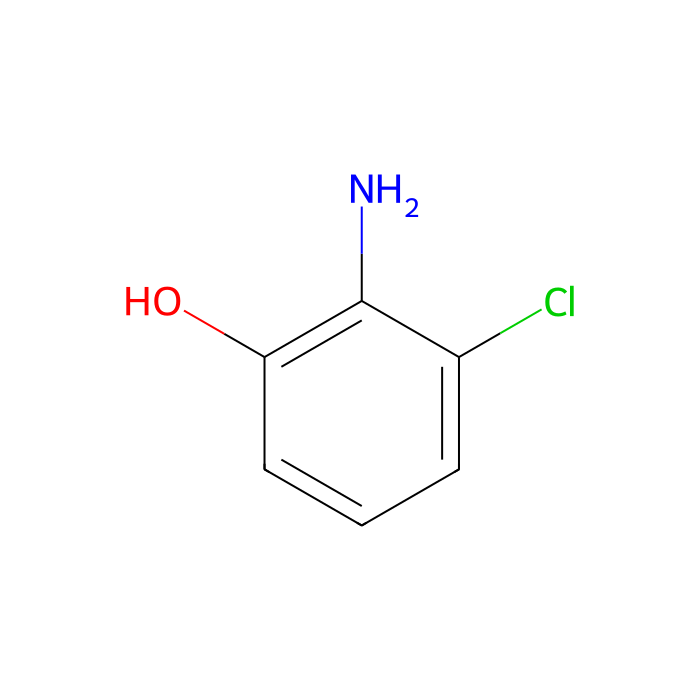
Brief description: 2-Amino-3-chlorophenol is an ortho-aminophenol bearing a chlorine substituent at the position meta to the phenolic OH (i.e., OH at C1, NH2 at C2, Cl at C3). It is an electron-rich, multifunctional aromatic building block enabling orthogonal N/O derivatization and further substitution on the ring.

  • Product identifiers (from Product Data)
    • SKU: A193993
    • CAS: 56962-00-6
    • PubChem CID: 19828962
    • InChIKey: 168734 (as provided)
  • Structure descriptors (literature/computed)
    • Molecular formula (literature): C6H6ClNO
    • Molecular weight (literature): ~143.57 g/mol
    • Preferred SMILES (literature): Oc1c(N)cccc1Cl (equivalently: Nc1c(O)cccc1Cl)
    • 2D structural features (literature):
      • Aromatic benzene core with adjacent phenolic OH (at C1) and anilino NH2 (at C2), enabling intramolecular H-bonding (O–H···N or N–H···O tautomers possible).
      • Chlorine at C3 is ortho to NH2 and meta to OH; it is deactivating but ortho/para-directing in electrophilic substitution.
      • Functional groups: phenol (Ar–OH), primary aniline (Ar–NH2), aryl chloride (Ar–Cl).
  • Stereochemistry: Not applicable (achiral, planar aromatic).

Notes

  • Any structural identifiers not listed under Product Data are provided as literature information for reference only. Refer to the product CoA/Spec Sheet for definitive specifications.
Synthetic Utility

Functional group leverage

  • Phenol (Ar–OH): amenable to O-alkylation, O-acylation, carbonate/carbamate formation, and activation to aryl triflates/mesylates for further cross-coupling.
  • Aniline (Ar–NH2): nucleophile in amide/sulfonamide formation, urea/carbamate synthesis, reductive amination after protection, and metal-catalyzed N-arylation.
  • Aryl chloride (Ar–Cl at C3): handle for Pd-catalyzed cross-couplings (Suzuki–Miyaura, Buchwald–Hartwig, Sonogashira) using catalysts/ligands tailored for aryl chlorides.

Strategic considerations (literature/general)

  • Chemoselectivity control: Protect NH2 (e.g., Boc, Ac) when O-functionalization is desired, or protect OH (e.g., benzyl, silyl) when N-functionalization is targeted. Sequential orthogonal protection enables convergent syntheses.
  • Intramolecular cyclizations: Condense with aldehydes/acids followed by dehydrative cyclization to assemble benzoxazoles; halogen at C3 can be retained for further diversification.
  • Directed metalation: The o-aminophenol motif can direct ortho-metalation under strong base, though the presence of Cl and two directing groups requires careful condition selection.
  • Ligand synthesis: Schiff bases from salicylaldehydes yield O,N-bidentate ligands for metal complexation.

Analytical handles

  • MS: diagnostic isotope pattern for chlorine (M/M+2 ~3:1) at m/z ~143/145.
  • NMR: exchangeable OH/NH2; characteristic aromatic pattern perturbed by ortho substitution; intramolecular H-bonding can shift OH/NH signals downfield.
Target Specificity

Not applicable. This product is a small-molecule chemical building block and is not an antibody, enzyme, or biological probe with a defined antigen/target. No target specificity data are provided in the Product Data.

Shall we send you a message when we have discounts available?

Remind me later

Thank you! Please check your email inbox to confirm.

Oops! Notifications are disabled.