≥97% for sensitive chromatographic and analytical workflows requiring minimal baseline interference.
🌡
Storage & shipping
Room temperature Ships Normal Check lot-specific COA for exact specifications.
📋
Quality documents
SDS, COA, datasheet, and spec sheet available for download. Lot-specific COA accessible via lot number lookup.
📚
Literature proof
Cited in 1 peer-reviewed publications across chromatography, organic synthesis, and cross-coupling reactions.
Descripción general
Application: 2-Chloro-4,6-dinitrophenol was used in identification of components in chemical waste water and in effluents from biological wastewater treatment plant using electrospray ionization and tandem mass spectrometry.
This compound belongs to the class of organic compounds known as dinitrophenols. These are organic aromatic compounds containing a benzene that carries a single phenol group and exactly two nitro groups.
External Descriptors
Not available
1. Djoumbou Feunang Y, Eisner R, Knox C, Chepelev L, Hastings J, Owen G, Fahy E, Steinbeck C, Subramanian S, Bolton E, Greiner R, and Wishart DS. ClassyFire: Automated Chemical Classification With A Comprehensive, Computable Taxonomy. Journal of Cheminformatics, 2016, 8:61.
Determine the necessary mass, volume, or concentration for preparing a solution.
Dilution Calculator
Determine the dilution needed to prepare a stock solution.
Reconstitution Calculator
Reseñas
Reseñas de cliente
Application Protocols
Not applicable.
No immunoassay or bioassay protocols (WB, IHC, IF, FC) are associated with this small-molecule building block. For synthetic uses, refer to the Reaction Conditions and Synthetic Utility sections for practical guidance.
Biological Roles
Applicability
This compound is a synthetic aromatic building block. It does not have an established physiological role.
General biochemical considerations (not product-specific; no clinical claims)
Phenolic nitroaromatics are strong hydrogen-bond donors/acceptors and can interact with proteins and membranes. Their acidity is enhanced by electron-withdrawing groups, leading to pH-dependent ionization (phenolate formation) that can alter partitioning between aqueous and lipid phases.
Nitro groups can undergo enzymatic or chemical reduction in biological systems to form nitroso/hydroxylamine/aniline derivatives. Such transformations are context-dependent and are mentioned here as general chemical knowledge, not as a recommendation for biological use.
Use in bio-oriented research
As a chromophoric motif, nitroaromatics exhibit strong UV absorbance, which may be leveraged in analytical method development for derivatives bearing this scaffold (e.g., as UV tags or internal standards). However, 2-chloro-4,6-dinitrophenol itself is not a common biochemical probe.
Note
Any biological testing must follow appropriate safety approvals and is strictly for research use only (per Product Data). No medical, diagnostic, or therapeutic use is intended.
Buffer Applications
Not typically applicable.
2-Chloro-4,6-dinitrophenol is not used as a buffering agent. While the phenolic OH is acidic, substituted nitrophenols are not standard buffer components due to toxicity and narrow useful pH windows.
For aqueous work, use established buffers (e.g., phosphate, Tris, acetate) and handle this compound in organic media or under controlled basic conditions when generating its phenolate.
Green Alternatives
Context
2-Chloro-4,6-dinitrophenol is a functionalized aromatic building block. “Green alternatives” relate mainly to reaction choices (media, bases, leaving groups) rather than substitution of the molecule itself.
Greener choices in usage (general guidance)
Solvents: Favor propylene carbonate, 2-MeTHF, CPME, EtOAc, or MeCN over DMF/NMP/DMSO when reaction scope allows. For SNAr with amines, MeCN or 2-MeTHF can often replace DMF with modest rate tradeoffs.
Bases: Replace strong inorganic bases (NaH) with milder, safer options (K2CO3, Cs2CO3) or organic superbases in catalytic amounts with bicarbonate where feasible. For phenolate formation, K2CO3 in MeCN/acetone is often sufficient.
Energy: Exploit microwave or continuous-flow heating to shorten residence times and lower overall energy use, especially for SNAr.
Workup: Minimize halogenated solvents; choose EtOAc/MeOH/aqueous systems for extractions and crystallizations.
Tradeoffs (illustrative)
DMF vs MeCN: DMF offers higher rates/solubility for SNAr but is problematic for EHS and removal; MeCN is more volatile and easier to recover but may require higher temperature or longer times.
DMSO vs 2-MeTHF: DMSO maximizes solubility; 2-MeTHF is bio-derived and readily separable but may not dissolve inorganic bases as well.
Waste and safety
Nitroaromatic waste should be segregated and minimized; consider telescoping steps to reduce intermediate isolations and washes. Employ in-line adsorption or crystallization to avoid large-volume solvent exchanges.
Pharmaceutical Uses
Not a formulated excipient.
This substance is a synthetic intermediate/building block and is not a recognized pharmaceutical excipient. Any use would be limited to laboratory-scale synthesis under GMP development if applicable.
General formulation context (non-item-specific)
Aromatic nitrophenols are typically excluded from finished dosage forms due to safety/toxicity considerations. However, their derivatives can appear as process intermediates during API synthesis, particularly when exploiting SNAr chemistry on electron-poor aryl chlorides.
If used in process chemistry, stringent purge studies are required to ensure acceptable residual levels in downstream materials. Reference pharmacopeial guidance for impurity qualification as applicable.
Regulatory note
For research use only (per Product Data). Not for human or veterinary use.
Physical Properties
Item-specific (from Product Data)
Appearance: Not specified for this item; refer to CoA/Spec Sheet.
Literature/computed (for reference; not item specifications)
State at ambient conditions: typically a crystalline solid (aromatic nitrophenols are commonly yellow to orange solids)
Molecular weight: ~218.55 g/mol (from C6H3ClN2O5)
Acid–base: phenolic OH strongly acidified by −NO2/−Cl; pKa for related 2,4-dinitrophenols ≈ 4.0 (literature). The 2-chloro-4,6 isomer is expected to be in a similar range; confirm experimentally for your system.
Solubility (qualitative): sparingly soluble in water in the neutral form; readily soluble in polar organic solvents (e.g., acetone, acetonitrile, DMSO, DMF, alcohols). Solubility in water increases markedly upon deprotonation (formation of the phenolate at basic pH).
Partitioning: electron-withdrawing substituents reduce basicity/lipophilicity vs unsubstituted phenol; expect moderate logP; consult experimental data for method development.
Thermal behavior: aromatic nitro compounds can decompose on strong heating; avoid distillation—use melting characterization instead.
General notes
The phenolic proton, activated by two nitro groups, facilitates salt formation (Na/K phenolates) that are much more soluble in polar aprotic solvents and are synthetically useful nucleophiles.
For quantitative parameters (mp, bp, density, refractive index, UV cutoff), consult primary literature or measure under your lab conditions; they are Not specified for this item; refer to CoA/Spec Sheet.
Quality and Grades
Item-specific (from Product Data)
Grade/purity: Not specified for this item; refer to CoA/Spec Sheet.
Stabilizers: Not specified for this item; refer to CoA/Spec Sheet.
General guidance on grades (context for selection)
Research-grade substituted nitrophenols are typically offered at technical to ≥95% purity. If using as an electrophile for SNAr or as a calibration material, consider higher assay grade to minimize side reactions from adventitious phenolate salts or hydrolysis products.
HPLC grade is generally a solvent designation, not applicable to solids like this compound. For chromatography-sensitive workflows (analytical reference standards), look for “certified reference material” or an assay with traceable purity determination (qNMR/GC/LC).
Metals/ionic contaminants: Not usually specified for aromatic building blocks; if planning metal-catalyzed cross-couplings on the derived products, ensure residual metals in this starting material are controlled upstream. Specific limits are Not specified for this item; refer to CoA/Spec Sheet.
Water/peroxide/spec-UV metrics: Not applicable or Not specified for this item; refer to CoA/Spec Sheet.
Practical QC notes
Verify identity by 1H/13C NMR (phenolic OH often broad, nitro-substituted aromatic signals downfield), IR (strong NO2 asymmetric/symmetric stretches ~1520/1345 cm−1, literature), and MS (M+ at ~218/220 due to 35/37Cl isotopes). Titrate acidity or use LC purity for assay as needed.
Reaction and Applications
Scope overview (general chemistry knowledge; expand per your use case)
Activated aryl chloride for SNAr: The 2-chloro substituent is strongly activated by the 4,6-dinitro array and the phenolic −I/−M effects, enabling displacement by amines, alkoxides, thiolates, azide, cyanide, and other hard nucleophiles under relatively mild conditions. Expect Meisenheimer intermediate formation; rates increase with stronger electron withdrawal and with polar aprotic solvents.
Phenolic handle for O-functionalization: Deprotonation (e.g., K2CO3, Cs2CO3, NaH) affords the phenolate, enabling formation of aryl carbonates, carbamates, ethers, and esters. The electron-poor ring reduces competing EAS side reactions, improving selectivity.
Building block in heteroaryl fusion or dye precursors: The dinitro pattern provides handles for stepwise reduction (to diamino derivatives) or cyclizations after selective substitutions, useful in materials and pigment precursors.
Ligand/ion-pairing motifs: The acidic phenol can form robust ion pairs/salts with quaternary ammonium or alkali metals, occasionally exploited in phase-transfer or crystallographic derivatization.
Practical tips
Control chemoselectivity: For SNAr at C–Cl versus O-alkylation, choose nucleophile/basicity and solvent carefully. Amines in DMF at moderate temperatures (25–80 °C) often favor C–N formation; alkyl halides with K2CO3 in MeCN favor O-alkylation.
Monitor by UV–vis/HPLC: Nitroaromatics are strongly chromophoric (π–π* transitions); in situ UV traces are convenient for kinetics and endpoint detection.
Workup considerations: Nitroaromatics can adsorb to silica; adjust eluent polarity (add 1–2% MeOH in DCM/EtOAc) or switch to reversed-phase for analytical separations.
Reaction Conditions
General guidance (literature-informed; not product-specific specifications)
Base: K2CO3, Cs2CO3, NaOMe/NaOEt (for alkoxides), or amine as both nucleophile/base.
Temperature: 25–100 °C depending on nucleophile strength; electron-poor aryl chloride often reacts at markedly lower temperatures than unactivated systems.
Atmosphere: inert (N2/Ar) beneficial to limit side reactions and oxidation; rigor not always required.
Monitoring: HPLC/LC–MS; nitroaromatic UV at 254–360 nm is typically strong.
O-Alkylation (phenolate formation)
Base: K2CO3 or Cs2CO3 (1.2–2.0 equiv) in MeCN/acetone; NaH (0.9–1.1 equiv) in THF/DMF for challenging substrates.
Temperature: 0–60 °C; avoid excessive heat to limit side reactions.
Nitro reduction (if desired downstream)
Reagents: Fe/HCl, SnCl2/HCl, catalytic hydrogenation (Pd/C, H2) with careful control to avoid dechlorination or over-reduction.
Solvents: ethanol, acetic acid, or mixed aqueous media.
Expected outcomes
Electron-poor aryl chloride typically affords high conversions in SNAr (literature often reports good to excellent yields under mild conditions). Optimize equivalents and temperature for your specific nucleophile/electrophile pairing.
Safety and Handling
Item-specific (from Product Data)
GHS signal word / pictograms / H-statements / classification: Not specified for this item; refer to SDS.
Storage conditions: Room temperature (per Product Data)
Shipping: Normal (per Product Data)
General safety guidance (consult the SDS for authoritative instructions)
Hazard profile: Nitro-phenols are commonly harmful if swallowed, inhaled, or in contact with skin, and irritating to eyes/skin. Many members of this class are hazardous to aquatic environments. Handle as a toxic, environmentally hazardous organic solid unless your SDS indicates otherwise.
PPE: Use lab coat, chemical-resistant gloves (e.g., nitrile), splash goggles; handle powders in a fume hood to minimize dust inhalation.
Incompatibilities: Strong bases (will form phenolate salts—may increase corrosivity and reactivity), strong reducing agents (risk of nitro reduction), strong oxidizers, reactive metals. Avoid contact with amines and strong nucleophiles unless intended (can undergo rapid SNAr at the aryl chloride).
Thermal/chemical stability: Avoid grinding/impact and heating to decomposition; some nitroaromatics can deflagrate if strongly heated. Do not distill under reduced pressure.
First aid (overview): If inhaled—move to fresh air; if on skin—wash with soap/water; if in eyes—rinse with water for several minutes; if ingested—seek medical attention. Always follow your institutional protocols and the SDS.
Environmental: Prevent release to the environment; collect waste in halogenated organic waste streams or per facility guidance.
Solvent Selection
Applicability
This product is a solid aromatic building block rather than a reaction solvent. Solvent considerations below address dissolution, purification, and reaction media.
General solvent behavior (literature-informed)
Polarity class: moderately polar aromatic acid (phenol). Neutral form has limited water solubility; deprotonated phenolate is highly polar and water-soluble.
Good solvents for dissolution: DMSO, DMF, NMP, acetone, acetonitrile, ethyl acetate, methanol/ethanol, dichloromethane. Limited in alkanes and nonpolar ethers.
Ionization leverage: Solubility increases strongly at basic pH (carbonate/alkoxide bases) via phenolate formation; decreases in strongly acidic media where H-bonding may cause aggregation/crystallization.
Choosing media for common tasks
SNAr (nucleophile → displace aryl Cl): polar aprotic solvents (DMF, DMSO, NMP, MeCN) often enhance rates and solubilize inorganic bases; alcohols can participate but risk O-alkylation or transesterification side reactions.
O-functionalization (acylation/alkylation of phenolic OH): employ anhydrous polar aprotics (DMF/MeCN) with base (K2CO3, Cs2CO3) or biphasic systems (toluene/aqueous base with PTC) when substrates are hydrophobic.
Crystallization/purification: Ethyl acetate/hexane or toluene/heptane pairs can be tuned; methanol or isopropanol sometimes provide good crystallizates due to strong H-bonding.
Comparison snapshot (general)
DMF/DMSO: maximal solubility and reactivity; challenging workup.
MeCN/Acetone: good balance of polarity/volatility; preferred for small-scale kinetics and easier removal.
Alcohols: useful for recrystallization; may compete as nucleophiles in some reactions.
Storage and Reconstitution
Item-specific (from Product Data)
Storage conditions: Room temperature
Shipped in: Normal
General handling and storage guidance
Keep container tightly closed in a dry, well-ventilated place. Protect from moisture to prevent formation of hygroscopic phenolate salts under basic contamination.
Light/heat sensitivity: Store away from direct light and heat sources. Avoid prolonged exposure to elevated temperatures to minimize risk of nitroaromatic decomposition.
Inerting: Not strictly required, but storing under dry nitrogen can be beneficial for long-term stability in humid environments.
Packaging: Use amber glass with PTFE-lined cap to minimize permeation and adsorption; avoid reactive metal caps.
Reconstitution/solution preparation
This is supplied as a solid (appearance Not specified for this item; refer to CoA/Spec Sheet). To prepare solutions, dissolve in an appropriate organic solvent (e.g., DMSO, DMF, MeCN, acetone). For aqueous systems, adjust to basic pH to form the soluble phenolate; prepare immediately before use to limit hydrolysis or side reactions.
Freeze–thaw: Not applicable to solids; for stock solutions, aliquot and store at low temperature (e.g., 2–8 °C or −20 °C) based on solvent stability, and minimize repeated freeze–thaw cycles.
Shelf life
Follow CoA/Spec Sheet for retest period. If unspecified, verify integrity periodically by HPLC/1H NMR prior to critical experiments.
Structure and Identity
Item-specific (from Product Data)
SKU: C352397
Product name: 2-Chloro-4,6-dinitrophenol
CAS: 946-31-6
PubChem CID: 13681
InChIKey: Not specified for this item; refer to CoA/Spec Sheet.
SMILES: Not specified for this item; refer to CoA/Spec Sheet.
Literature/computed (for reference; not item specifications)
Molecular formula (literature): C6H3ClN2O5
Molecular weight (literature): ~218.55 g/mol
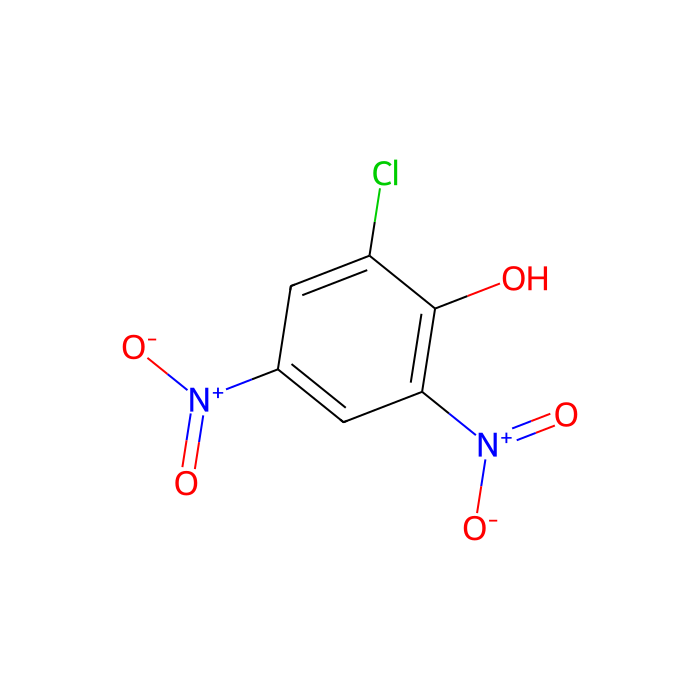
Core scaffold: substituted phenol (benzene ring bearing one phenolic OH, one chloro substituent, and two nitro groups)
Substitution pattern: phenolic OH at position 1; chloro at ortho (2-position); nitro groups at 4- and 6-positions (para and ortho relative to OH, meta to each other)
Functional groups: phenol (acidic OH), aryl chloride (activated by −NO2), two nitro groups (strong −I/−M withdrawing)
2D structural description (general)
A benzene ring with the hydroxyl at C1. The chlorine substituent is adjacent (C2). Nitro groups occupy C4 (para to OH) and C6 (ortho to OH). The strong −NO2 substituents and −Cl decrease ring electron density, activating the aryl chloride toward nucleophilic aromatic substitution and increasing the acidity of the phenolic proton.
Synthetic Utility
Functional group leverage (general)
Aryl chloride (activated): The 2-chloro group, flanked by the phenolic and dinitro substituents, is highly activated toward SNAr. This enables efficient C–N/C–O/C–S bond formation with amines, alkoxides, and thiolates.
Phenol (acidic): Readily deprotonated to the phenolate, enabling O-alkylation/acylation and carbonate/carbamate formation. The electron-poor ring diminishes electrophilic aromatic substitution, favoring nucleophilic routes.
Nitro groups: Serve as synthetic handles—chemoselective reduction to anilines (Pd/C, Fe/HCl, SnCl2) or partial reduction to hydroxylamines can open pathways to heterocycles or azo coupling.
SNAr amination: 2-chloro displacement by secondary amines in DMF or MeCN with K2CO3 or DIPEA, 25–80 °C, affording 2-amino-4,6-dinitrophenol derivatives.
Ether formation: Alkylation of the phenolate with alkyl halides/tosylates (MeCN, acetone; K2CO3) to give aryl ethers; carbonate formation via CDI or chloroformates.
Reductive elaboration: Stepwise reduction of one nitro group followed by intramolecular cyclization can produce benzoxazoles/benzimidazoles from appropriately substituted intermediates (route dependent).
Retrosynthetic value
Functions as an activated aryl electrophile and as an acidic nucleophile, enabling orthogonal diversification at C–Cl and O–H in either order, with nitro groups reserved for downstream functional switching.
Target Specificity
Not applicable.
This product is a small-molecule building block, not a biological targeting reagent (e.g., antibody, inhibitor). No antigen/epitope or species reactivity applies.
We use cookies to ensure the website functions properly and, where permitted, to improve your experience. You can manage your preferences at any time in Settings. Learn more in our Cookie Policy.
Shall we send you a message when we have discounts available?
Remind me later
Thank you! Please check your email inbox to confirm.
Products are supplied to verified businesses, institutions, and qualified professionals for research and development use only. Not for use in humans, animals, diagnosis, or therapy.

 H2219376