2-Chloro-5-nitropyridine - ≥99% , CAS No.4548-45-2

CAS: 4548-45-2 Cat. No.: C106559 Fórmula: C5H3ClN2O2 Peso molecular: 158.54 Beilstein Registry Number: 120453 Número EC: 224-908-3
Disponible para pedir
GRADE & PURITY ≥99%
Synonyms
MFCD00001909 | BP-11373 | chloro-5-nitropyridine | SCHEMBL14145676 | SCHEMBL5473 | Q-200258 | Z57834470 | 2-chloro-5-nitropyridin | 2-chloro-5-riitropyridine | 2-chloro--5-nitropyridine | 2-Chloro-5-nitropyridine | 2-chloro-5-nitro-pyridine | 2chloro-5-ni
Storage
Room temperature
Shipped In
Normal
★
Size
Alemania (EU)
USA*
Price
Qty
5g
C106559-5g
—
5 Disponible
8,59€
25g
C106559-25g
—
6 Disponible
18,14€
100g
C106559-100g
—
6 Disponible
45,90€
500g
C106559-500g
1 Disponible
2 Disponible
204,70€
Enter a quantity for the sizes you want to add.
🧪
Why this grade

≥99% for sensitive chromatographic and analytical workflows requiring minimal baseline interference.

🌡

Storage & shipping

Room temperature Ships Normal Check lot-specific COA for exact specifications.

📋

Quality documents

SDS, COA, datasheet, and spec sheet available for download. Lot-specific COA accessible via lot number lookup.

📚

Literature proof

Cited in 1 peer-reviewed publications across chromatography, organic synthesis, and cross-coupling reactions.

Specifications

Sinónimos
MFCD00001909 | BP-11373 | chloro-5-nitropyridine | SCHEMBL14145676 | SCHEMBL5473 | Q-200258 | Z57834470 | 2-chloro-5-nitropyridin | 2-chloro-5-riitropyridine | 2-chloro--5-nitropyridine | 2-Chloro-5-nitropyridine | 2-chloro-5-nitro-pyridine | 2chloro-5-ni
Especificaciones y pureza
≥99%
Condiciones de almacenamiento de almacenamiento
Room temperature
Enviado en
Normal
Pureza
≥99%
Nombres e identificadores
Pubchem Sid
Pubchem Sid Url
https://pubchem.ncbi.nlm.nih.gov/substance/488185559
Sonrisas canónicas
C1=CC(=NC=C1[N+](=O)[O-])Cl
IUPAC Name
2-chloro-5-nitropyridine
InChIKey
BAZVFQBTJPBRTJ-UHFFFAOYSA-N
INCHI
1S/C5H3ClN2O2/c6-5-2-1-4(3-7-5)8(9)10/h1-3H
Isómeros SMILES
C1=CC(=NC=C1[N+](=O)[O-])Cl
WGK Alemania
3
RTECS
US7175000
Peso molecular
158.54
Beilstein
120453
Reaxy-Rn
120453
Reaxys-RN_link_address
https://www.reaxys.com/reaxys/secured/hopinto.do?context=S&query=IDE.XRN=120453&ln=

Documentation

📋 Safety Data Sheet (SDS)

Comprehensive hazard, handling, storage, and regulatory compliance document.

Download SDS →

✅ Certificate of Analysis (COA)

Lot-specific quality data. Enter your lot number to retrieve the exact COA.

Look up COA →

📊 Datasheet

Quick-reference summary of product specifications and applications.

View datasheet →

🔬 Specification Sheet

Full quality attributes and acceptance criteria for this grade.

View spec sheet →

Advanced Data

Taxonomic Classification

Taxonomy Tree

KingdomOrganic compounds
SuperclassOrganic 1,3-dipolar compounds
ClaseAllyl-type 1,3-dipolar organic compounds
SubclassOrganic nitro compounds
Intermediate Tree Nodes C-nitro compounds
Direct ParentNitroaromatic compounds
Alternative Parents 2-halopyridines  Aryl chlorides  Heteroaromatic compounds  Propargyl-type 1,3-dipolar organic compounds  Organic oxoazanium compounds  Azacyclic compounds  Organopnictogen compounds  Organonitrogen compounds  Organochlorides  Organic oxides  Hydrocarbon derivatives  
Molecular FrameworkAromatic heteromonocyclic compounds
Substituents Nitroaromatic compound - 2-halopyridine - Aryl chloride - Aryl halide - Pyridine - Heteroaromatic compound - Organic oxoazanium - Propargyl-type 1,3-dipolar organic compound - Organoheterocyclic compound - Azacycle - Organic nitrogen compound - Organopnictogen compound - Organonitrogen compound - Organochloride - Organic oxygen compound - Organohalogen compound - Organic oxide - Hydrocarbon derivative - Aromatic heteromonocyclic compound
DescripciónThis compound belongs to the class of organic compounds known as nitroaromatic compounds. These are c-nitro compounds where the nitro group is C-substituted with an aromatic group.
External Descriptors Not available
Estructura 3D
Modelo de Estructura Química Interactiva


Certificados (CoA, COO, BSE/TSE y tabla de análisis)
C of A & Other Certificates(BSE/TSE, COO):
Analytical Chart:

Find and download the COA for your product by matching the lot number on the packaging.

14 results found

Lot NumberCertificate TypeFechaArticulo
I2115112Certificate of AnalysisJun 09, 2025 C106559
I2115113Certificate of AnalysisJun 09, 2025 C106559
I2115170Certificate of AnalysisJun 09, 2025 C106559
L2425259Certificate of AnalysisJun 27, 2024 C106559
L2425260Certificate of AnalysisJun 27, 2024 C106559
K1905001Certificate of AnalysisAug 09, 2023 C106559
D23181406Certificate of AnalysisFeb 28, 2023 C106559
D23181410Certificate of AnalysisFeb 28, 2023 C106559
D23181411Certificate of AnalysisFeb 28, 2023 C106559
D23181413Certificate of AnalysisFeb 28, 2023 C106559
D23181416Certificate of AnalysisFeb 28, 2023 C106559
D23181417Certificate of AnalysisFeb 28, 2023 C106559
D23181443Certificate of AnalysisFeb 28, 2023 C106559
B2318388Certificate of AnalysisJun 01, 2021 C106559
Propiedades químicas y físicas
SolubilidadSolubility in hot methanol. Insoluble in water.
Punto de inflamación (°F)316°F
Punto de inflamación (°C)158°C
Punto de fusión (°C)106-110°C
Peso molecular158.540 g/mol
XLogP32.200
Hydrogen Bond Donor Count0
Hydrogen Bond Acceptor Count3
Rotatable Bond Count0
Exact Mass157.988 Da
Monoisotopic Mass157.988 Da
Topological Polar Surface Area58.700 Ų
Heavy Atom Count10
Formal Charge0
Complexity136.000
Isotope Atom Count0
Defined Atom Stereocenter Count0
Undefined Atom Stereocenter Count0
Defined Bond Stereocenter Count0
Undefined Bond Stereocenter Count0
The total count of all stereochemical bonds0
Covalently-Bonded Unit Count1
Citations of This Product
Calculadoras de soluciones
Reseñas

Reseñas de cliente

Application Protocols

No validated bioassay or immunoassay protocols are specified for this item; refer to CoA/Spec Sheet. For synthetic applications, see the Reaction Conditions and Application notes provided in other sections, and adapt standard organic synthesis protocols (inert atmosphere, dry solvents, controlled heating, and chromatographic purification) as appropriate for your transformation.

Biological Roles

This compound is a synthetic heteroaromatic building block without known endogenous biological role. The following notes are general, literature-based considerations for researchers; they are not medical or clinical claims.

  • The pyridine ring is a common pharmacophore and coordination motif; 2-chloro-5-nitropyridine is frequently used to access substituted pyridines relevant to medicinal chemistry SAR programs.
  • Functional group behavior in biological contexts (general):
    • The nitro group is strongly electron-withdrawing and can modulate lipophilicity, basicity, and redox properties of derived molecules; nitro groups are often reduced in biological milieus to anilines/hydroxylamines in metabolically competent systems.
    • The ring nitrogen can act as a hydrogen-bond acceptor and metal-binding site in chelation assays once incorporated into ligands.
  • Cytotoxicity/biological safety: nitroaromatics and halopyridines may show non-specific cytotoxicity; handle strictly for research use and evaluate only in appropriate in vitro systems if needed.

Research use only: not intended for human or veterinary use, diagnostic procedures, or clinical applications.

Buffer Applications

Not typically applicable. 2-Chloro-5-nitropyridine is not a buffering agent and is poorly suited for preparing aqueous buffers. For work involving this substrate, refer instead to the Reaction & Applications, Synthetic Utility, and Reaction Conditions sections for guidance on solvent systems and conditions.

Green Alternatives

While the substrate itself is fixed, greener choices can be made in solvents, bases, and catalysts used with 2-chloro-5-nitropyridine.

Greener solvent options (literature/general):

  • Replace DMF/DMAc/NMP where possible with 2-MeTHF, CPME, EtOAc, propylene carbonate, or aqueous ethanol mixtures, balancing solubility and reactivity.
  • Use water-tolerant coupling systems (e.g., dioxane/H2O or MeCN/H2O) and heterogeneous bases to reduce solvent burden.

Comparison snapshot (general guidance):

  • DMF: excellent solvency for SNAr; reproductive toxicity concerns; difficult to remove.
  • 2-MeTHF/CPME: good for Pd couplings; renewable origin (2-MeTHF); better phase separation; lower EHS footprint; may require higher temperatures for SNAr.
  • EtOAc/toluene: lower toxicity than DMF; may need co-solvent to dissolve salts/bases.

Catalyst and base choices:

  • Modern Pd catalysts with highly active ligands (Buchwald biaryl phosphines, PEPPSI-type NHCs) allow lower loadings and milder conditions, reducing energy and waste.
  • Bases such as K3PO4 or K2CO3 in water-containing media can reduce reliance on strong, hazardous bases.

Process-intensification:

  • Flow chemistry for exothermic SNAr or hydrogenations improves thermal management and safety.
  • Solvent recycling and real-time reaction monitoring (FTIR, calorimetry) reduce inventory and emissions.

Note: Select greener options case-by-case, guided by solubility, kinetics, and downstream purification constraints.

Pharmaceutical Uses

No excipient or pharmacopeial status is specified for this item; refer to CoA/Spec Sheet.

General, non-clinical context (literature/industry practice):

  • Role: synthetic intermediate for preparing substituted 2-aminopyridines, 2-arylpyridines, and 5-aminopyridine derivatives after nitro reduction—scaffolds frequently explored in medicinal chemistry.
  • Process considerations: aryl chloride activation via Pd catalysis allows late-stage diversification; nitro-to-amino reduction enables convergent routes to diamino- or amino-aryl products.
  • Manufacturability: solid-state handling and thermal behavior favor batch processing; careful control of residual metals and nitro reduction byproducts is required for API-adjacent intermediates.

No therapeutic claims are made. This product is provided strictly for research and laboratory synthesis.

Physical Properties

Item-specific physical property specifications (bp, mp, density, UV cutoff, metals, water, etc.): Not specified for this item; refer to CoA/Spec Sheet.

Literature/general reference values (non-specification):

  • Appearance: typically a pale yellow to light tan crystalline solid (literature).
  • Melting point: often reported around 70–73 °C (literature; check batch-specific CoA).
  • Boiling point: reports in the ~250–260 °C range at ambient pressure (literature; decompositions possible; verify before distillation attempts).
  • Solubility profile: good solubility in polar aprotic organics (DMSO, DMF, NMP, acetonitrile, EtOAc); moderate in chlorinated solvents; low in water (literature/experience).
  • Acid–base: basic ring nitrogen (pKaH of the conjugate acid typically ~1–2 for pyridine analogs; literature trend), enabling salt formation with mineral acids.

General physicochemical notes:

  • The nitro and ring nitrogen render the ring electron-deficient, increasing susceptibility of the aryl chloride to SNAr and facilitating oxidative addition in Pd-catalyzed couplings.
  • Hygroscopicity is generally low, but dry conditions improve reproducibility in substitutions and cross-couplings.

Always consult the product’s CoA/SDS for authoritative, lot-specific physical data before process design.

Quality and Grades
  • Grade/Purity: Not specified for this item; refer to CoA/Spec Sheet.
  • Stabilizers/Inhibitors: Not specified for this item; refer to CoA/Spec Sheet.

Guidance on interpreting common grades (general, for context only):

  • Research/technical grade: suitable for general synthesis and screening; impurity profiles may vary between lots.
  • 95–99% purity (typical for building blocks): adequate for most coupling/SNAr steps; consider purification for sensitive catalysis (e.g., ppm-level sulfur/amines can poison Pd catalysts).
  • HPLC or assay trace: when provided, indicates analytical method and threshold; consult CoA for residual solvents, elemental analysis, and GC/HPLC purity traces.

Practical quality tips for this substrate:

  • Halopyridines bearing nitro groups can carry residual inorganic salts or nitration byproducts; brief recrystallization (e.g., from EtOAc/hexanes) or trituration may sharpen purity for demanding steps.
  • For Pd-catalyzed cross-couplings, trace metal content and halide speciation matter—verify with CoA if your application is catalyst-sensitive.
Reaction and Applications

2-Chloro-5-nitropyridine is a versatile electrophilic building block combining a reactive aryl chloride with an electron-withdrawing nitro group on a pyridine ring.

Key application families (literature/general):

  • Nucleophilic aromatic substitution (SNAr): Amines, alkoxides, and thiolates can displace the 2-chloro under forcing conditions (the pyridine N and nitro group render the ring electron-poor). Typical for installing 2-amino/alkoxy/thiol substituents on nitropyridine scaffolds.
  • Cross-coupling chemistry: The C–Cl can engage in Pd-catalyzed Suzuki–Miyaura (C–C), Buchwald–Hartwig (C–N), and, with appropriate ligands, Stille/Negishi couplings. Biaryl phosphines (e.g., XPhos, SPhos, RuPhos) or NHC ligands improve oxidative addition to aryl chlorides.
  • Reductive transformations: Nitro group reductions (e.g., to 5-aminopyridine derivatives) via catalytic hydrogenation or transfer hydrogenation, enabling orthogonal diversification after coupling at C2.
  • Directed metalation/sequential functionalization: The pyridine nitrogen can coordinate metals, enabling regioselective transformations (e.g., lithiation strategies under carefully controlled conditions, though the nitro group limits strong base usage).

Practical tips:

  • For SNAr, ensure rigorous exclusion of water and use sufficiently strong base (e.g., NaOtBu, K2CO3 with polar aprotic solvent) and heat (100–140 °C) or catalytic activation (Cu, Pd) to achieve efficient displacement.
  • For cross-couplings, pre-dry the substrate and use degassed solvents. Base choice (K3PO4, Cs2CO3) and water content strongly affect rate and selectivity.
  • Sequence planning: Execute cross-coupling at C2 first, then reduce/modify the nitro group to avoid deactivating the aryl chloride prematurely.
Reaction Conditions

General literature guidance (optimize for your system; not item specifications):

  • SNAr (amines):

    • Solvent: DMF, DMAc, NMP, or DMSO.
    • Base: K2CO3, Cs2CO3, or NaOtBu.
    • Temperature: 100–140 °C (sealed tube or oil bath); 4–16 h.
    • Note: Adding catalytic CuI and a diamine ligand can accelerate reactions at lower temperatures.
  • Buchwald–Hartwig amination (C2):

    • Catalyst: Pd2(dba)3 (0.5–2 mol% Pd) or Pd(OAc)2 with XPhos/SPhos/RuPhos or BrettPhos.
    • Base: K3PO4, NaOtBu, or Cs2CO3.
    • Solvent: toluene, dioxane, or tBuOH; co-solvent (DMF) as needed.
    • Temperature: 80–110 °C; 2–12 h.
  • Suzuki–Miyaura (C–C):

    • Catalyst: Pd(PPh3)4 or Pd-precatalyst + bulky biaryl phosphine; 0.5–2 mol% Pd.
    • Base: K2CO3, K3PO4, or Cs2CO3.
    • Solvent: dioxane/H2O or THF/H2O; degas thoroughly.
    • Temperature: 70–100 °C; 2–10 h.
  • Nitro reduction to amine:

    • Conditions: H2 (1–5 bar) with Pd/C (5–10 wt% of substrate) in EtOH/EtOAc; ambient to 50 °C; monitor for over-reduction.
    • Alternatives: Fe/NH4Cl or SnCl2/HCl in EtOH or iPrOH; typically reflux 1–4 h; appropriate workup to remove inorganic residues.

Yields in the literature are highly substrate- and ligand-dependent; pilot small-scale screens are recommended to identify optimal catalyst/base/solvent combinations.

Safety and Handling

Hazard classification, signal word, H/P statements, and pictograms: Not specified for this item; refer to SDS.

General laboratory safety guidance for nitro-heteroaromatics (informational, not a substitute for SDS):

  • Likely hazards: may cause skin/eye irritation and respiratory irritation; harmful if swallowed or inhaled; nitroaromatics can display toxicity—minimize exposure.
  • PPE: lab coat, safety glasses or goggles, and appropriate chemical-resistant gloves (e.g., nitrile). Use in a fume hood to avoid inhalation.
  • Handling: avoid dust formation; prevent contact with skin and eyes. Transfer solids carefully; use grounded equipment if charging into flammable solvents.
  • Incompatibilities: strong reducing agents (may reduce the nitro group), strong bases at high temperature (can drive substitution reactions exothermically), strong oxidizers (general incompatibility). Avoid prolonged contact with reactive metals.
  • Special risks/notes: though not an ether, ensure peroxide-free solvent systems for sensitive metal-catalyzed couplings. Nitroaromatics can be sensitizers in rare cases—monitor for symptoms.
  • First aid (overview): move exposed person to fresh air for inhalation; rinse skin/eyes with water for several minutes and remove contaminated clothing; seek medical attention if symptoms persist.
  • Fire: use dry chemical, CO2, or foam. Combustion may produce NOx, HCl, CO/CO2.

Always defer to the product’s SDS for authoritative safety measures, spill response, disposal, and transport information.

Solvent Selection

This product is a solid heteroaromatic substrate, not a solvent. Solvent choice should support its reactivity and solubility.

General miscibility/solubility guidance (literature/experience):

  • Polar aprotic solvents (DMF, DMAc, NMP, DMSO, MeCN) typically dissolve 2-chloro-5-nitropyridine well and support SNAr and cross-couplings.
  • Ethers (dioxane, THF, 2-MeTHF) and ethyl acetate offer moderate solubility; often used in Pd-catalyzed transformations.
  • Biphasic systems (toluene or dioxane with aqueous base) are common for Suzuki–Miyaura couplings.

Selection tips by transformation:

  • SNAr with amines/alkoxides: DMF/DMAc/NMP or DMSO at elevated temperature; ensure base compatibility.
  • Buchwald–Hartwig amination: toluene, dioxane, or tBuOH with bulky biaryl phosphine ligands; polar co-solvent can help dissolve inorganic base.
  • Suzuki coupling: dioxane/H2O, THF/H2O, or MeCN/H2O with K2CO3, Cs2CO3, or K3PO4.

If low solubility is encountered, consider gentle heating, co-solvent addition, or in situ salt formation (for ring N protonation) to tune solubility; always verify solvent dryness for moisture-sensitive steps.

Storage and Reconstitution
  • Storage conditions (from Product Data): store at room temperature. Keep container tightly closed in a dry, well-ventilated place. Shipped under normal conditions.
  • Reconstitution: Not applicable; supplied as a neat solid. If a stock solution is required, dissolve in a suitable dry organic solvent (e.g., DMF, DMSO, MeCN, dioxane, or EtOAc) to the desired concentration under inert atmosphere if moisture/air sensitivity of your planned reaction warrants it.
  • Stability considerations (general): avoid prolonged exposure to strong light, moisture, and reactive reductants/oxidants. For long-term storage, a desiccator or dry cabinet is recommended to preserve assay and handling characteristics.
  • Freeze–thaw: Not relevant for solids. For prepared solutions, store in amber vials at low temperature (e.g., 2–8 °C) and use within a reasonable timeframe; equilibrate to room temperature before opening to minimize moisture ingress.
  • Always consult the product’s CoA and SDS for lot-specific stability and handling recommendations.
Structure and Identity

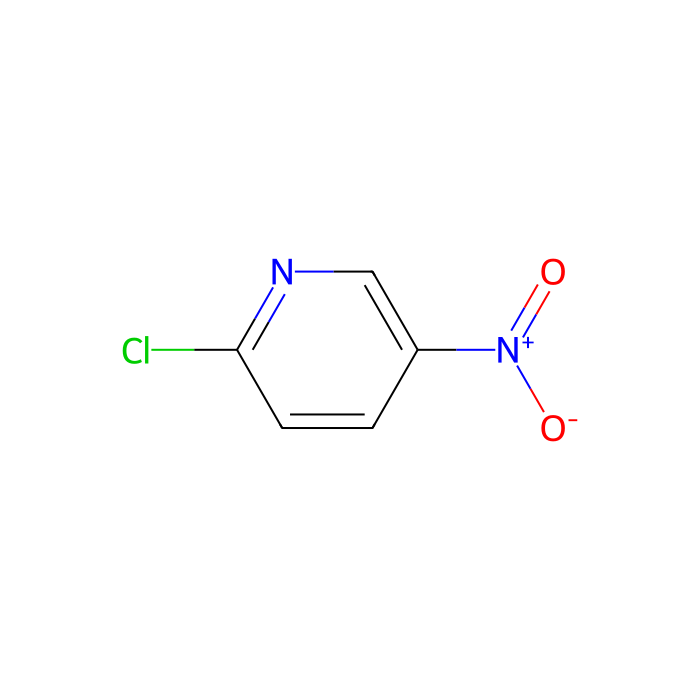
2-Chloro-5-nitropyridine is a nitro-substituted chloropyridine used as an electrophilic heteroaromatic building block.

  • Item-specific identifiers (from Product Data):

    • SKU: C106559
    • CAS: 4548-45-2
    • InChIKey: 20132 (as provided; not a standard InChIKey format)
    • SMILES: Not specified for this item; refer to CoA/Spec Sheet.
  • Literature/computed identifiers (for reference only; not item specifications):

    • Common literature molecular formula: C5H3ClN2O2
    • Common literature molecular weight: ~162.54 g/mol
    • Common literature SMILES (one representation): O=N+[O-]c1ccc(Cl)nc1 (positional isomerism in SMILES notations can vary; verify before use)
  • Structural features (general chemistry description):

    • Aromatic six-membered ring containing one ring nitrogen (pyridine).
    • Substituents: chloro at the 2-position (ortho to ring N) and nitro at the 5-position (meta to ring N).
    • Functional groups: aryl chloride (C–Cl on a heteroaromatic), strongly electron-withdrawing nitro (–NO2), ring nitrogen (sp2 lone pair participates in aromaticity; acts as a Lewis base/H-bond acceptor).
    • No stereogenic centers; planar heteroaromatic system.
    • The 2-chloro substituent adjacent to the pyridine N is deactivated toward electrophilic substitution but amenable to nucleophilic aromatic substitution and cross-coupling under appropriate conditions.
Synthetic Utility

Functional-group set: aryl chloride at C2 (reactive handle) and nitro at C5 (strong EWG, convertible to amine) on a pyridine ring. This combination enables orthogonal strategies.

Key transformations (literature/general):

  • C–N formation:
    • SNAr with amines to furnish 2-aminopyridines; conditions: polar aprotic solvent, base, heat; catalytic variants with Cu or Pd.
    • Buchwald–Hartwig amination using Pd(0/II) and biaryl phosphines or NHC ligands for broader amine scope at lower temperature.
  • C–C formation:
    • Suzuki–Miyaura coupling at C2 to form 2-aryl-5-nitropyridines; subsequent nitro reduction delivers 2-aryl-5-aminopyridines.
    • Negishi/Stille couplings for sensitive boronic partners or when protodeboronation is problematic.
  • Nitro group manipulations:
    • Reduction to anilines (Pd/C–H2, Fe/NH4Cl, SnCl2/HCl, catalytic transfer hydrogenation) enabling diazotization, Sandmeyer-type diversifications, or coupling via Buchwald–Hartwig at C5 after conversion.
    • N–O bond chemistry (e.g., formation of N-oxides on the ring nitrogen separately) to direct further functionalizations.

Retrosynthetic value:

  • Provides an electron-poor 2-chloropyridine synthon where leaving-group activation is enhanced relative to unsubstituted chloropyridines.
  • Serves as a lynchpin for two-directional diversification: first modify C2 (cross-coupling or SNAr), then transform the nitro to unlock C5 amine chemistry.
Target Specificity

Not applicable. This product is a small-molecule chemical building block and not a biological targeting reagent. No antigen/epitope or species reactivity data are provided for this item.

¿Quieres que te enviemos un mensaje cuando tengamos descuentos disponibles?

Recordármelo más tarde

¡Gracias! Por favor, revisa tu bandeja de entrada de correo electrónico para confirmar.

¡Vaya! Las notificaciones están desactivadas.