Determine the necessary mass, volume, or concentration for preparing a solution.
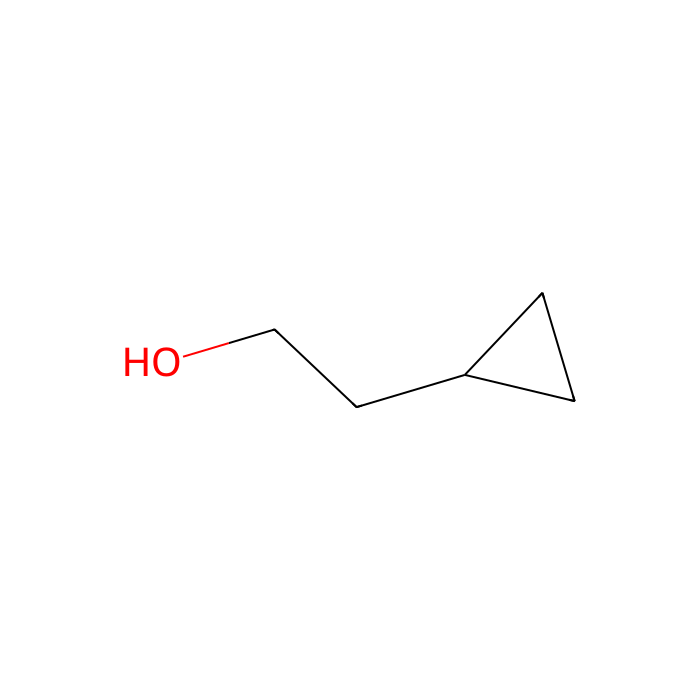
2-Cyclopropylethanol is used to prepare (2-bromo-ethyl)-cyclopropane by reacting with phosphorus tribromide.
Taxonomy Tree
| Kingdom | Organic compounds |
|---|---|
| Superclass | Organic oxygen compounds |
| Clase | Organooxygen compounds |
| Subclass | Alcohols and polyols |
| Intermediate Tree Nodes | Not available |
| Direct Parent | Primary alcohols |
| Alternative Parents | Hydrocarbon derivatives |
| Molecular Framework | Aliphatic homomonocyclic compounds |
| Substituents | Hydrocarbon derivative - Primary alcohol - Aliphatic homomonocyclic compound |
| Descripción | This compound belongs to the class of organic compounds known as primary alcohols. These are compounds comprising the primary alcohol functional group, with the general structure RCOH (R=alkyl, aryl). |
| External Descriptors | Not available |
Find and download the COA for your product by matching the lot number on the packaging.
| Lot Number | Certificate Type | Fecha | Articulo |
|---|---|---|---|
| Certificate of Analysis | Mar 05, 2025 | C175916 | |
| Certificate of Analysis | Mar 05, 2025 | C175916 | |
| Certificate of Analysis | Mar 05, 2025 | C175916 | |
| Certificate of Analysis | Mar 05, 2025 | C175916 |
| Solubilidad | Miscible with water. |
|---|---|
| Índice de refracción | 1.4325 - 1.4385 |
| Punto de inflamación (°F) | 116.6 °F |
| Punto de inflamación (°C) | 47 °C |
| Punto de ebullición (°C) | 137 - 138 °C(278.6 - 280.4 °F) |
| Peso molecular | 86.13 |
| XLogP3 | 1.000 |
| Hydrogen Bond Donor Count | 1 |
| Hydrogen Bond Acceptor Count | 1 |
| Rotatable Bond Count | 2 |
| Exact Mass | 86.0732 Da |
| Monoisotopic Mass | 86.0732 Da |
| Topological Polar Surface Area | 20.200 Ų |
| Heavy Atom Count | 6 |
| Formal Charge | 0 |
| Complexity | 39.200 |
| Isotope Atom Count | 0 |
| Defined Atom Stereocenter Count | 0 |
| Undefined Atom Stereocenter Count | 0 |
| Defined Bond Stereocenter Count | 0 |
| Undefined Bond Stereocenter Count | 0 |
| The total count of all stereochemical bonds | 0 |
| Covalently-Bonded Unit Count | 1 |
H226:Flammable liquid and vapor
H315:Causes skin irritation
H319:Causes serious eye irritation
H335:May cause respiratory irritation
P210:Keep away from heat, hot surface, sparks, open flames and other ignition sources. - No smoking.
P233:Keep container tightly closed.
P240:Ground/bond container and receiving equipment.
P241:Use explosion-proof [electrical/ventilating/lighting/.../] equipment.
P242:Use only non-sparking tools.
P243:Take precautionary measures against static discharge.
P261:Avoid breathing dust/fume/gas/mist/vapors/spray.
P264:Wash hands [and …] thoroughly after handling.
P271:Use only outdoors or in a well-ventilated area.
P280:Wear protective gloves/protective clothing/eye protection/face protection.
P321:Specific treatment (see ... on this label).
P302+P352:IF ON SKIN: wash with plenty of water.
P303+P361+P353:IF ON SKIN (or hair): Take off Immediately all contaminated clothing. Rinse SKIN with water [or shower].
P304+P340:IF INHALED: Remove person to fresh air and keep comfortable for breathing.
P305+P351+P338:IF IN EYES: Rinse cautiously with water for several minutes. Remove contact lenses if present and easy to do - continue rinsing.
P362+P364:Take off contaminated clothing and wash it before reuse.
P370+P378:In case of fire: Use ... to extinguish.
P405:Store locked up.
P403+P233:Store in a well-ventilated place. Keep container tightly closed.
P403+P235:Store in a well-ventilated place. Keep cool.
P501:Dispose of contents/container to an approved waste disposal plant.
P264+P265:Wash hands [and …] thoroughly after handling. Do not touch eyes.
P337+P317:If eye irritation persists: Get medical help.
P332+P317:If skin irritation occurs: Get medical help.
P319:Get medical help if you feel unwell.