≥98%, mixture of 2-Ethyl-5-methylpyrazine and 2-ethyl-6-methylpyrazine for sensitive chromatographic and analytical workflows requiring minimal baseline interference.
🌡
Storage & shipping
Room temperature Ships Normal Check lot-specific COA for exact specifications.
📋
Quality documents
SDS, COA, datasheet, and spec sheet available for download. Lot-specific COA accessible via lot number lookup.
📚
Literature proof
Cited in 7 peer-reviewed publications across chromatography, organic synthesis, and cross-coupling reactions.
This compound belongs to the class of organic compounds known as pyrazines. These are compounds containing a pyrazine ring, which is a six-member aromatic heterocycle, that consists of two nitrogen atoms (at positions 1 and 4) and four carbon atoms.
External Descriptors
Not available
1. Djoumbou Feunang Y, Eisner R, Knox C, Chepelev L, Hastings J, Owen G, Fahy E, Steinbeck C, Subramanian S, Bolton E, Greiner R, and Wishart DS. ClassyFire: Automated Chemical Classification With A Comprehensive, Computable Taxonomy. Journal of Cheminformatics, 2016, 8:61.
Determine the necessary mass, volume, or concentration for preparing a solution.
Dilution Calculator
Determine the dilution needed to prepare a stock solution.
Reconstitution Calculator
Reseñas
Reseñas de cliente
Application Protocols
Not applicable. No immunoassay or cell-based application protocols (e.g., WB, IHC, IF, FC) are associated with this small-molecule building block. For analytical use, typical protocols would follow standard GC/LC method development for volatile heteroaromatics and are assay-specific.
Biological Roles
General biochemistry context (literature; no clinical claims):
Alkylpyrazines, including 2-ethyl-5-methylpyrazine, are well-known Maillard reaction products formed during thermal processing of amino acid–sugar mixtures. They contribute to roasted/nutty aroma notes in foods and are frequently used as analytical reference standards in flavor chemistry.
Metabolism and fate: Small pyrazines are typically oxidized and/or conjugated in biological systems; the ring nitrogens confer moderate hydrophilicity but overall low molecular weight favors volatility and exhalation/rapid clearance. Specific metabolic pathways for this exact isomer are not comprehensively mapped, but N-oxidation and side-chain oxidation are plausible.
Receptor interactions: Odor-active pyrazines bind broadly to olfactory receptors; no selective biochemical target is recognized for this compound in a research signaling context.
Laboratory implications
When used in cell-free assays or biosensor calibration, its volatility and odor require closed systems and appropriate ventilation.
For environmental fate studies, expect moderate air–water partitioning and appreciable adsorption to organic phases due to the dialkyl substituents.
Note: The above reflects general literature on alkylpyrazines; consult primary sources for organism-specific behavior and quantitative kinetics.
Buffer Applications
This compound is not a buffering reagent and is not typically used to prepare biological or analytical buffers. If your workflow requires buffered conditions when working with 2-ethyl-5-methylpyrazine (e.g., extractions or bioreactor studies), select an appropriate buffer system (phosphate, citrate, HEPES) based on your target pH and compatibility with heteroaromatics, and verify that the buffer does not form adducts or salts under your experimental conditions.
Green Alternatives
Because 2-ethyl-5-methylpyrazine is a target molecule rather than a process solvent, “green alternatives” mainly concern solvent/reagent choices in its synthesis, handling, and purification.
Greener solvent choices (literature-guided)
Prefer ethyl acetate, 2-MeTHF, CPME, or toluene over chlorinated solvents when feasible for reactions and extractions.
For chromatography, heptane/EtOAc gradients reduce VOC toxicity relative to hexane/DCM; consider supercritical CO2 for scalable purifications.
Greener oxidation/functionalization of side chains
Replace stoichiometric Cr(VI) or Se reagents with catalytic aerobic oxidations (e.g., TEMPO/O2, Pd-catalyzed aerobic systems) where compatible with the azine ring.
Electrochemical oxidation offers halogen- and metal-free pathways for benzylic functionalization (emerging literature).
Energy and waste minimization
Micellar catalysis or solvent-free conditions may enable certain alkylation/oxidation steps on pyrazines; consider flow chemistry to reduce solvent hold-up and improve heat/mass transfer.
Note: Selection must be balanced against reaction selectivity on an electron-poor heteroaromatic ring; validate greener swaps at small scale before scale-up.
Pharmaceutical Uses
Item-specific regulatory/grade status: Not specified for this item; refer to CoA/Spec Sheet.
General formulation/manufacturing context (no therapeutic claims):
2-Ethyl-5-methylpyrazine can serve as a process intermediate or impurity reference standard in API manufacture where pyrazine motifs are present. Its volatility and distinct chromatographic behavior make it useful for method development and validation (GC/LC retention indexing, impurity tracking).
Excipients: This molecule is not a common pharmaceutical excipient. However, in analytical flavor/fragrance testing of consumer health products, it may be employed as a calibration standard.
Quality considerations in GMP environments: If used around regulated processes, seek documentation on residual solvents, GC purity, identity confirmation (1H/13C NMR), and elemental impurities per ICH Q3D. Establish robust purge and hold-time studies due to odor and volatility.
Always verify suitability against relevant pharmacopeial monographs or internal specifications when used in any cGMP-adjacent context.
Physical Properties
Item-specific specifications (this SKU):
Appearance: Not specified for this item; refer to CoA/Spec Sheet.
Grade/Purity: Not specified for this item; refer to CoA/Spec Sheet.
Literature/computed properties (typical for 2-ethyl-5-methylpyrazine; not guaranteed for this lot):
Molecular formula: C7H10N2 (computed from structure)
Molecular weight: 122.17 g/mol (computed)
Physical state: Typically a low-viscosity liquid at ambient temperature (literature, common for C7 dialkylpyrazines).
Odor: Characteristic nutty/roasty pyrazine aroma (literature, flavor chemistry context; for information only).
Polarity/solubility: Moderately polar heteroaromatic; expected to be miscible with many organic solvents (e.g., alcohols, ethers, chlorinated solvents) and sparingly soluble in water (literature, qualitative).
Acid/base: Weakly basic ring nitrogens (pKaH of pyrazines typically ~0–1; literature, general for pyrazines).
Volatility: Lower volatility than unsubstituted pyrazine; vapor pressure moderate at room temperature (literature, qualitative).
Notes
Where exact numerical values (bp, mp, density, refractive index, solubility) are required for your process, consult primary literature or request the CoA/SDS for this specific lot. Do not treat the above as specifications.
Quality and Grades
Item-specific grade/purity: Not specified for this item; refer to CoA/Spec Sheet.
How to interpret grades (general guidance):
Research/technical grade: Suitable for most synthetic and screening work. May contain trace non-volatile residues or isomeric impurities that do not affect exploratory chemistry but can influence analytical baselines.
High-purity or GC/HPLC grade (if offered): Tighter control of volatile/non-volatile impurities and UV background for trace analysis or flavor/aroma quantitation. Low peroxide and low metal content may be specified to protect sensitive catalysts — verify on the CoA.
Residual solvents/water: For heteroaromatic liquids, Karl Fischer water and GC area% purity are common reportables. If critical to your application (e.g., organometallics or fragrance standards), request lot-specific values.
Stabilizers: Not typically required for dialkylpyrazines; if any stabilizer is present for oxidation control, it will be declared on the CoA/label.
Aladdin Scientific practices
Each lot is quality controlled against an internal specification. For regulated or method-development use (flavor reference standards, impurity profiling), request a full analytical package (CoA with chromatogram, KF water, residue on evaporation), as available.
Reaction and Applications
Typical roles (literature):
Building block in heteroaromatic chemistry and flavor/fragrance research; reference standard in Maillard reaction product studies.
Ligating heteroarene for weak coordination to transition metals in catalytic systems or as a probe molecule for adsorption/porosity studies.
Reactivity profile (general for pyrazines):
The pyrazine ring is electron-deficient; it is deactivated toward electrophilic aromatic substitution (EAS) but can undergo EAS under forcing conditions (e.g., nitration/sulfonation) with poor regioselectivity.
More amenable to nucleophilic aromatic substitution (SNAr) if ring is pre-activated (e.g., by halogenation or N-oxidation). Direct SNAr on the parent 2-ethyl-5-methylpyrazine is not typical without activation.
Metalation strategies (e.g., directed ortho-lithiation adjacent to N) can enable subsequent electrophile trapping; strong bases (s-BuLi/TMEDA) at low temperature are commonly used in azine chemistry.
Oxidation of side chains: Benzylic-style oxidation of the 2-ethyl group to the corresponding acetyl derivative using SeO2, MnO2, or catalytic oxo-systems has precedent for alkylpyrazines (literature).
Practical tips:
Rigorous exclusion of moisture/oxygen is recommended for lithiation/metalation routes; quench carefully to avoid ring reduction.
When planning cross-couplings, introduce a halogen (e.g., via N-oxide activation followed by halogenation) to access Suzuki/Negishi variants from the pyrazine core.
Analytical monitoring: GC-FID/GC-MS are highly effective due to volatility and characteristic mass fragments of alkylpyrazines.
Reaction Conditions
General literature guidance for transformations involving 2-ethyl-5-methylpyrazine or closely related alkylpyrazines (not item-specific specifications):
Benzylic oxidation (ethyl → acetyl)
Reagents: SeO2 (cat.) with tert-butyl hydroperoxide (TBHP) or t-BuOOH; or MnO2 (stoichiometric); or Pd/C with O2 under mild pressure.
Solvents: Toluene, 1,4-dioxane, or acetic acid; greener alternatives include EtOAc or 2-MeTHF when compatible.
Temperature/time: 60–110°C, 2–16 h depending on system.
N-oxidation of pyrazine
Reagents: mCPBA (1.1–1.5 equiv) in DCM or EtOAc at 0–25°C; monitor by TLC/LC-MS. Work up with aqueous Na2CO3 to remove acids.
Directed lithiation / electrophile trapping
Base: s-BuLi (1.1–1.5 equiv) with TMEDA in anhydrous THF or ether at −78 to −40°C under N2/Ar.
Electrophiles: CO2 (to give acids after workup), I2/Br2 (for halogenation), trialkyl borates (followed by oxidative workup to boronic acids/esters).
Quench cautiously; warm slowly to avoid exotherms.
Analytical/handling
GC-FID/GC-MS with nonpolar columns (DB-5ms) at oven ramps from 40→220°C typically resolve alkylpyrazine isomers.
For purification, normal-phase silica with hexanes/EtOAc (9:1→7:3) plus 0.5–1% TEA reduces tailing of basic heteroarenes.
Note: Reaction outcomes on electron-poor azines are sensitive to base strength, temperature, and N-oxidation state. Optimize at small scale and consult primary literature for the specific transformation desired.
Safety and Handling
Item-specific hazard data (this SKU):
GHS classification: Not specified for this item; refer to SDS.
Signal word: Not specified for this item; refer to SDS.
Hazard (H-) statements and pictograms: Not specified for this item; refer to SDS.
General safety information (literature/analogous substances; for guidance only — defer to SDS):
Likely hazards: Combustible liquid; may cause skin/eye irritation and respiratory irritation on vapor exposure typical of small heteroaromatic amines/azines.
Precautions: Handle in a fume hood. Avoid inhalation of vapors and skin contact. Use secondary containment to minimize spill spread.
Recommended PPE: Lab coat, safety glasses or splash goggles, and appropriate chemical-resistant gloves (e.g., nitrile). Where splash or aerosol is possible, use face shield. For bulk transfers, consider flame-resistant lab coat and anti-static precautions.
Incompatibilities: Strong oxidizers, strong acids (can lead to salt formation and exotherm), strong bases (may promote ring reactions under forcing conditions). Keep away from ignition sources.
First aid (overview): Remove to fresh air if inhaled; rinse skin/eyes with water for at least 15 minutes if contacted; seek medical attention if symptoms persist. If ingested, rinse mouth; do not induce vomiting; obtain medical help.
Spill/Fire response: For small spills, absorb with inert material and ventilate area. Use CO2, dry chemical, or alcohol-resistant foam for fires. Cool containers with water spray.
Always consult the product-specific SDS for authoritative, up-to-date hazard classifications and response procedures.
Solvent Selection
This product is a small-molecule heteroaromatic building block rather than a process solvent. Solvent selection is typically about dissolving it or using it as a substrate in reactions.
Polarity and miscibility (literature, qualitative)
Expected to dissolve readily in common organic solvents: ethanol, methanol, isopropanol, acetone, ethyl acetate, THF, DCM, toluene.
Water solubility is expected to be limited but non-negligible due to two ring nitrogens; salt formation under acidic conditions can increase aqueous solubility.
Choosing solvents for synthesis and handling
For nucleophilic additions or metalations on the pyrazine ring: ethereal solvents (THF, MTBE), hydrocarbons (hexanes/toluene), or glymes under strictly anhydrous, oxygen-free conditions.
For electrophilic functionalization at side chains (e.g., benzylic-type oxidations on ethyl): polar aprotic solvents (MeCN, DMF, DMSO) may aid reagent solubility.
For purification: normal-phase silica gel with hexanes/EtOAc or toluene/EtOAc gradients typically separates dialkylpyrazines; add 0.5–1% TEA to suppress tailing if needed.
Comparison hints (literature, qualitative)
Versus more polar azines (e.g., pyrazine, methylpyrazines), the 2-ethyl substituent lowers polarity and increases solubility in nonpolar media, aiding extractions into organics.
For GC-based analytics, non-polar to mid-polar stationary phases (DB-5ms, DB-624) typically give sharp peaks for alkylpyrazines.
Storage and Reconstitution
Storage conditions (item-specific): Room temperature (per Product Data). Store tightly closed in a cool, well-ventilated place away from ignition sources and incompatible materials (oxidizers, strong acids/bases). Minimize headspace to limit volatilization.
Shipping (item-specific): Shipped at ambient conditions (Normal), per Product Data.
Reconstitution: Not applicable; supplied neat. If dilution is required for analytical standards, prepare stock solutions in a suitable solvent (e.g., methanol, ethanol, isopropanol, acetonitrile) under clean conditions.
Stability considerations (general): Keep container tightly sealed to prevent loss due to volatility and to limit oxidative changes. For long-term storage, consider inert gas blanket (N2/Ar) and amber glass to mitigate light exposure.
Freeze–thaw: Not relevant to neat liquid. If stored as frozen aliquots of solutions, avoid repeated freeze–thaw cycles to minimize concentration drift from solvent evaporation.
Research use note: For research use only (per Product Data).
Structure and Identity
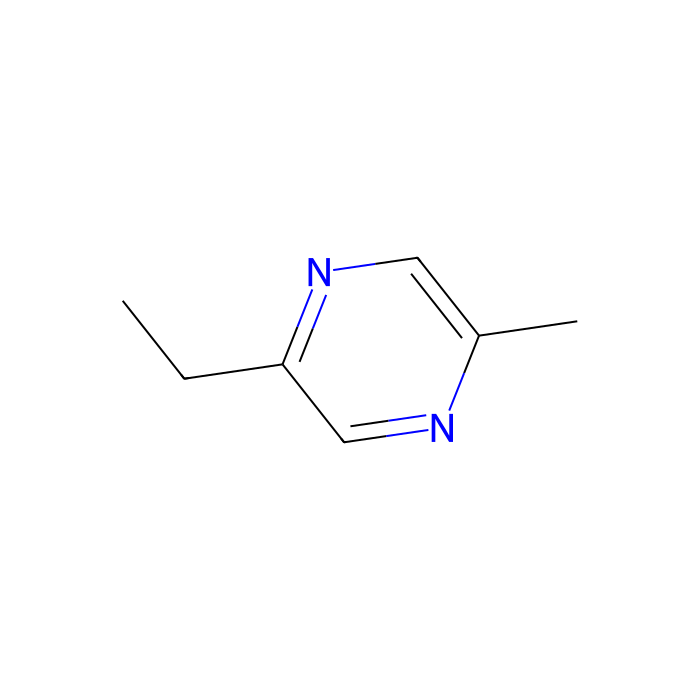
Brief description: 2-Ethyl-5-methylpyrazine is a disubstituted pyrazine (diazine) bearing an ethyl group at C-2 and a methyl group at C-5 on the aromatic N,N-diazine ring.
Item-specific (from Product Data)
CAS: 13360-64-0
PubChem CID: 25915
Literature/computed identifiers and composition (for reference; not item-specific specifications)
InChIKey (literature): Not specified for this item; refer to CoA/Spec Sheet.
Structural features (general chemistry description)
Core ring: Aromatic pyrazine (1,4-diazine) with two ring nitrogens para to each other.
Substitution pattern: Ethyl at C-2 (adjacent to N) and methyl at C-5 (adjacent to the other N), giving an unsymmetrical 2,5-disubstituted pattern.
Functional groups: Aromatic heteroaromatic ring (electron-deficient relative to benzene), two ring nitrogens capable of weak H-bond acceptance and coordination to Lewis acids/transition metals.
2D description: Six-membered aromatic ring with N atoms at positions 1 and 4; ethyl substituent on C-2 extends as –CH2–CH3; methyl substituent on C-5 as –CH3. No stereocenters; planar aromatic system predominates.
Synthetic Utility
Functional group landscape
Two ring nitrogens (aza-heteroarene) provide sites for coordination and modulate ring electronics (electron-poor arene). Side chains (ethyl, methyl) offer benzylic C–H positions for oxidation/functionalization.
Transformations (literature):
Benzylic oxidation: Convert the 2-ethyl substituent to acetyl or carboxyl derivatives using MnO2, SeO2, or aerobic catalytic systems (e.g., Pd/O2), enabling further elaboration via nucleophilic addition or amide formation.
N-oxidation: Formation of pyrazine N-oxides (mCPBA, peracids) activates the ring toward subsequent substitution or rearrangement; the N-oxide can be reduced back after functionalization.
Directed metalation: s-BuLi/TMEDA at low temperature can deprotonate positions adjacent to N, allowing trapping with electrophiles (CO2, halogens, trialkylborates), followed by cross-coupling after halogenation.
The 2-ethyl and 5-methyl substituents can arise from selective alkylation strategies on a prefunctionalized pyrazine (e.g., 2-methyl-5-halopyrazine → cross-coupling, or acyl → reduce → alkyl).
Alternatively, build the ring via cyclocondensation of 1,2-dicarbonyls with diamines, introducing the substituents from the dicarbonyl component.
Practical notes
Handle under inert atmosphere if strong bases or sensitive catalysts are present; the azine can coordinate and poison catalysts in some cases — adjust catalyst loadings accordingly.
Target Specificity
Not applicable. This product is a small-molecule heteroaromatic, not a biological targeting reagent (e.g., antibody, ligand with defined biomolecular target). No antigen/epitope, clone, isotype, or species reactivity is associated with this item.
Preguntas frecuentes
What is the purity of this product?
This product is supplied at ≥98% purity (chemical assay). Lot-specific values are stated on the Certificate of Analysis.
How should this product be stored?
Store at room temperature.
How is this product shipped?
This product ships under standard ambient conditions. No temperature-controlled packaging is required.
What are the CAS number, molecular formula and molecular weight?
The CAS Number is 13360-64-0, the molecular formula is C7H10N2, and the molecular weight is 122.17 g/mol. InChIKey OXCKCFJIKRGXMM-UHFFFAOYSA-N.
We use cookies to ensure the website functions properly and, where permitted, to improve your experience. You can manage your preferences at any time in Settings. Learn more in our Cookie Policy.
Shall we send you a message when we have discounts available?
Remind me later
Thank you! Please check your email inbox to confirm.
Products are supplied to verified businesses, institutions, and qualified professionals for research and development use only. Not for use in humans, animals, diagnosis, or therapy.

 K2115064