This compound belongs to the class of organic compounds known as benzoyl derivatives. These are organic compounds containing an acyl moiety of benzoic acid with the formula (C6H5CO-).
External Descriptors
Not available
1. Djoumbou Feunang Y, Eisner R, Knox C, Chepelev L, Hastings J, Owen G, Fahy E, Steinbeck C, Subramanian S, Bolton E, Greiner R, and Wishart DS. ClassyFire: Automated Chemical Classification With A Comprehensive, Computable Taxonomy. Journal of Cheminformatics, 2016, 8:61.
Determine the necessary mass, volume, or concentration for preparing a solution.
Dilution Calculator
Determine the dilution needed to prepare a stock solution.
Reconstitution Calculator
Reseñas
Reseñas de cliente
Application Protocols
Not applicable. No validated bioassay protocols (e.g., WB, IHC, IF, FC) are provided for this small-molecule reagent. For synthetic protocols, see the Reaction Conditions, Reaction & Applications, and Synthetic Utility sections for literature-style guidance.
Biological Roles
This product is an aromatic aldehyde used as a chemical building block; it is not a metabolite or biological buffer.
General biochemical considerations (literature; not item-specific)
Aromatic aldehydes can react with biomolecular amines (e.g., lysine side chains) to form imines/Schiff bases, a basis for some bioconjugation and sensing chemistries in vitro. Such reactions are generally reversible and pH-dependent.
The presence of a ring fluorine increases lipophilicity and can influence membrane partitioning in model systems; however, 2-fluorobenzaldehyde is primarily a synthetic intermediate rather than a probe molecule.
No known natural biosynthetic role is associated with 2-fluorobenzaldehyde; fluorinated aromatics are rarely encountered in nature and are typically man-made.
Research-use note
Per Product Data: For research use only. No food, drug, or household use. Avoid any implication of clinical or diagnostic application without appropriate validation and approvals.
Buffer Applications
Not typically applicable. 2-Fluorobenzaldehyde is not a buffering agent and is not used to prepare biochemical buffers or electrophoresis/cell culture media. For aqueous work, select a compatible buffer based on your reaction (e.g., phosphate, acetate) only when needed for quenching or bioconjugation studies, while recognizing that the aldehyde may react with amines present in many buffers.
Green Alternatives
Context: The reagent itself is a fluorinated aromatic aldehyde and does not have a direct “green substitute” for its core structure. Greening strategies therefore focus on solvent and reagent choices, waste minimization, and safer reaction conditions when using 2-fluorobenzaldehyde.
Greener solvent choices (literature-guided)
Replace DCM/chloroform with ethyl acetate, 2-MeTHF, CPME, or toluene where feasible (e.g., for extractions or condensations).
Use bio-derived ethers (2-MeTHF) for organometallic additions instead of THF, recognizing potential differences in reaction rates and selectivity.
Favor MeOH/EtOH/IPA over DMF/DMAc/NMP when performing reductive aminations or hydrogenations, provided solubility and catalyst tolerance are acceptable.
Comparison (general)
Chlorinated solvents: excellent solvency and phase behavior but higher environmental/safety burdens.
2-MeTHF/CPME: renewable or safer alternatives, better water immiscibility, higher boiling points; may influence kinetics and organometallic stability.
Toluene/EtOAc: widely accepted greener choices for workup and crystallization.
Process considerations
Minimize excess strong bases and choose catalytic, atom-economical transformations (e.g., transfer hydrogenation, catalytic Wittig variants) when possible.
Implement in-line solvent recovery and distillation; design workups to reduce salt waste (e.g., solvent swaps instead of aqueous neutralizations when appropriate).
Pharmaceutical Uses
Scope: No therapeutic claims. Discussion limited to roles in formulation/manufacturing chemistry as a building block.
General roles (literature)
Intermediate in medicinal chemistry synthesis where an ortho-fluoro substituent modulates electronic and steric properties of benzyl motifs; used to introduce 2-fluorobenzyl alcohol/amine fragments after reduction or reductive amination.
Useful handle for structure–activity relationship (SAR) exploration: the aldehyde enables rapid derivatization to imines, oximes, hydrazones, and alkenes (via Wittig/HWE), facilitating library synthesis.
Excipient status
Not an excipient; not recognized as a pharmacopeial excipient. Typically handled as a starting material or process intermediate under GMP when relevant.
Process considerations
Aldehyde carryover controls are essential in GMP workflows (validated analytical methods such as GC-HS or LC-UV). Ensure purge of residual aldehyde in downstream steps through robust workup and crystallization controls.
Physical Properties
Item-specific specs for this lot
Boiling point, melting point, density, refractive index, water/peroxide/metal limits, UV cutoff: Not specified for this item; refer to CoA/Spec Sheet.
General physicochemical profile (literature; for planning only)
Phase at ambient lab conditions: typically a colorless to pale yellow liquid for ortho-fluorinated benzaldehydes.
Polarity/solubility: moderately polar aromatic compound. Expected to be miscible with common organic solvents such as dichloromethane, ethyl acetate, toluene, diethyl ether, THF, acetonitrile; low solubility in water (aromatic aldehydes are sparingly soluble).
Acidity/basicity: no ionizable groups in the neutral range; aldehyde hydrogen is weakly acidic; does not form stable salts under neutral conditions.
Volatility: lower volatility than benzaldehyde analogs with lighter substituents; handle in a fume hood to minimize exposure.
Spectroscopic handles: strong IR C=O stretch for aryl aldehydes typically near 1690–1710 cm⁻¹ (literature); characteristic 1H NMR aldehydic singlet near 10 ppm (literature); 19F NMR signal sensitive to ring substitution pattern (literature).
Notes
Use the CoA for exact physical constants of the supplied material. Literature values from databases and handbooks are suitable for preliminary method design but should not be treated as product specifications.
Quality and Grades
Item-specific grade/purity
Grade/Purity: Not specified for this item; refer to CoA/Spec Sheet for assay, GC purity, and trace impurity profile.
What grade typically implies (general guidance)
Synthetic/intermediate grade: Common for building blocks; emphasizes GC/HPLC purity and low residual solvents.
Analytical/AR grade: Tight control of non-volatile residue and identified impurity thresholds.
HPLC grade (for solvents): Not applicable here; 2-fluorobenzaldehyde is a reagent/substrate rather than a chromatographic solvent.
Stabilizers/inhibitors
None are indicated for this item. If stabilizers were used, they would be declared on the CoA/label. Aldehydes are sometimes supplied under inert gas (as here) to suppress oxidation to the corresponding benzoic acids.
Quality control considerations (general)
Typical tests: GC or GC–MS purity and identity, water by Karl Fischer (if relevant to application), residual solvents, and verification by 1H/13C/19F NMR.
UV absorbance profile: Not specified for this item; refer to CoA/Spec Sheet.
Practical note
For moisture- or air-sensitive transformations (e.g., organometallic additions), consider brief sparging with argon and using anhydrous solvents to maintain substrate integrity.
Reaction and Applications
Use cases (literature; expandability of the ortho-fluoro handle)
Electrophilic carbonyl chemistry: Undergoes nucleophilic additions (RMgX, RLi) to give secondary alcohols; reduction (NaBH4, DIBAL-H) affords 2-fluorobenzyl alcohols; oxidation (Ag2O, Tollens not recommended at scale) to 2-fluorobenzoic acid.
Condensation chemistry: Forms imines/Schiff bases with primary amines; engages in Wittig/Horner–Wadsworth–Emmons reactions to provide 2-fluorostyrenes and related alkenes; participates in Knoevenagel condensations with active methylenes.
Ortho-fluoro as a leaving group: The C–F bond activates the ring toward nucleophilic aromatic substitution (SNAr) at the ipso position when appropriately activated; however, the aldehyde also deactivates the ring to electrophilic substitution.
Cross-coupling after halogen exchange: The aryl fluoride can be transformed to aryl boronates/silanes via metalation–borylation sequences (e.g., directed ortho-metalation or halogen/metal exchange is less straightforward for aryl fluorides; alternative routes often start from bromide precursors).
Directed metalation: Ortho-fluorine and aldehyde can direct lithiation at adjacent positions under strong bases (s-BuLi/TMEDA), enabling further functionalization (literature reports; exercise caution due to aldehyde sensitivity).
Applications landscape
Useful intermediate for agrochemical, materials, and fine-chemical synthesis where fluorine confers metabolic and thermal robustness; the ortho arrangement offers steric bias in downstream cyclizations and cross-couplings.
Practical tips
Protect the aldehyde (as acetal) when performing strong-base manipulations; exclude moisture/oxygen for organometallic steps; use inert atmosphere transfer to align with the product’s argon-packed supply.
Reaction Conditions
General conditions (literature guidance; optimize per substrate and scale)
Organometallic addition: RMgX or RLi (1.1–1.5 equiv) in THF or Et2O, −78 to 0 °C, 0.5–2 h, then quench with saturated NH4Cl. Protect aldehyde if competing metalation is anticipated.
Reduction to alcohol: NaBH4 (1.2–2.0 equiv) in MeOH/EtOH at 0–25 °C, 0.5–2 h; or DIBAL-H in toluene at −78 to 0 °C. Work up cautiously to avoid over-reduction.
Oxidation to acid: Pinnick oxidation (NaClO2, NaH2PO4, 2-methyl-2-butene) in t-BuOH/H2O, 0–25 °C; or Ag2O-based methods (less green). Control pH 3.5–4.5 to suppress side reactions.
Imine formation/reductive amination: Amine (1.1–1.5 equiv), molecular sieves or Dean–Stark in toluene; reduction with NaBH3CN (MeOH, pH 6–7 with AcOH) or H2 (1–3 bar) over Pd/C in alcohol at 25–50 °C.
Wittig/HWE olefination: Ylide/phosphonate (1.2–1.5 equiv) in THF/DCM; base (NaH, t-BuOK, or DBU) as appropriate; 0–25 °C to reflux. E/Z selectivity depends on reagent set and conditions.
SNAr at aryl–F (if applicable): Strong nucleophiles (e.g., alkoxides, amines) in polar aprotic solvents (DMF/DMSO) at elevated temperatures; note that additional ring activation often required. Aldehyde protection recommended.
Yields
Expected yields vary widely (40–90% typical depending on transformation and protection strategy). Always confirm on small scale and adjust stoichiometry, temperature, and solvent for selectivity.
Safety and Handling
Authoritative safety classification
GHS classification, signal word, H-statements, and pictograms: Not specified for this item; consult the product SDS for definitive information.
General hazards and precautions (aromatic aldehydes; literature-based)
Hazards: May cause skin/eye irritation and respiratory irritation; aldehydes can be sensitizers in some cases. Avoid inhalation and contact. Aromatic aldehydes are combustible; keep away from ignition sources.
Special risks: Aldehydes can undergo air-oxidation to acids; minimize headspace oxygen exposure. While ethers form peroxides, aryl aldehydes are not peroxide-formers; however, they may polymerize/condense with nucleophiles if contaminated.
Incompatibilities: Strong bases (may cause aldol-type side reactions), strong oxidizers (oxidation to acid), strong reducing agents (reduction to alcohol). Reacts with primary amines to form imines/Schiff bases.
PPE and handling
Recommended PPE: lab coat, safety glasses or face shield, and nitrile gloves; work in a fume hood.
First aid (overview; refer to SDS): Eye/skin contact—rinse with water for at least 15 minutes; Inhalation—move to fresh air; Ingestion—rinse mouth, seek medical attention. Provide SDS to responders.
Storage guidance
Per Product Data: Store at room temperature under argon (inert atmosphere) to limit oxidative degradation. Keep container tightly closed; segregate from oxidizers and bases.
Solvent Selection
Applicability: 2-Fluorobenzaldehyde is a substrate, not a solvent. This section discusses solvent choice for reactions and manipulations involving this aldehyde.
Polarity and miscibility (general)
Medium polarity aromatic substrate; dissolves well in chlorinated solvents (DCM, chloroform), ethereal solvents (THF, diethyl ether), esters (EtOAc), aromatics (toluene), and polar aprotic media (MeCN, DMF). Poorly soluble in water.
Choosing solvents by transformation type (literature-guided)
Nucleophilic additions (Grignard/organolithium): Anhydrous ethers (THF, diethyl ether); low temperatures (−78 to 0 °C) to control addition to the aldehyde.
Reductive amination/imine formation: Toluene or MeOH/EtOH with molecular sieves or Dean–Stark (toluene) to drive water removal; hydrogenation steps often in MeOH/EtOH or IPA.
Condensations (Knoevenagel, Wittig/HWE): Toluene, THF, DCM, or DMF depending on base and ylide/phosphonate solubility.
Electrophilic aromatic substitutions (nitration/sulfonylation): Strongly deactivated ring relative to benzaldehyde due to –F/–CHO; use powerful electrophiles and non-nucleophilic acids in DCM or nitromethane.
Workup and purification tips
Aqueous bicarbonate can hydrolyze imines; quench thoughtfully. Acidic washes can protonate amines before separation. Column chromatography with hexanes/EtOAc or hexanes/DCM systems is common; monitor by 19F and 1H NMR.
Storage and Reconstitution
Storage
Per Product Data: Store at room temperature under argon (argon-charged container). Keep tightly closed in a dry, well-ventilated place. Protect from prolonged air exposure to limit oxidation to the corresponding acid.
Shipping: Normal (no special cold-chain requirement per Product Data).
In-use handling
Minimize headspace oxygen; consider backfilling with argon or nitrogen after each use. For sensitive transformations, pre-dry and degas solvents and transfer under inert atmosphere.
Reconstitution
Not applicable. The product is supplied neat (appearance not specified). If a stock solution is desired for automated dosing, prepare in a dry, oxygen-poor solvent compatible with the intended reaction (e.g., anhydrous toluene, THF, DCM), label with concentration/date, and store under inert gas at controlled temperature. Verify stability of solutions empirically before scale-up.
Shelf-life
Specific retest/expiry date: Not specified for this item; refer to CoA/label. Periodically check by GC or NMR for oxidation (appearance of acid/benzylic alcohol signals) if stored for extended periods.
Structure and Identity
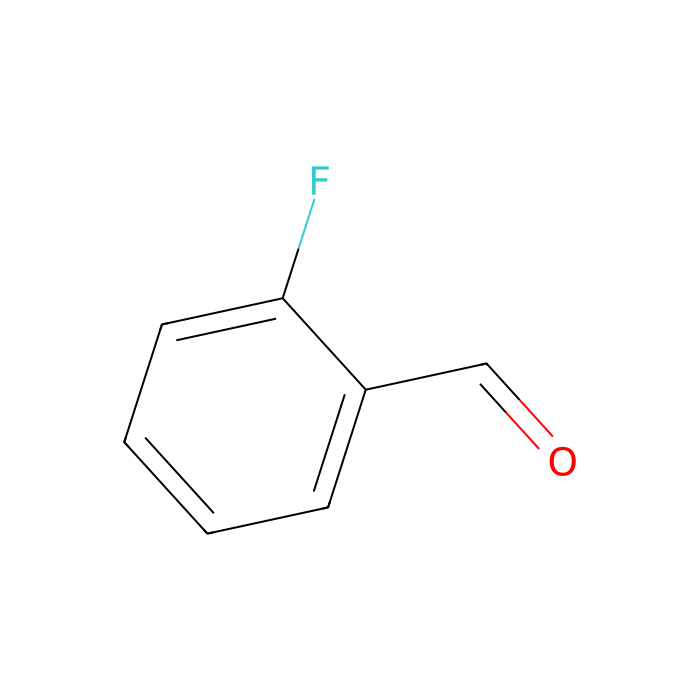
Overview: 2-Fluorobenzaldehyde is an ortho-fluorinated aromatic aldehyde, a useful electrophilic building block where the ring fluorine exerts strong inductive effects on the carbonyl and ring reactivity.
Item-specific (from Product Data)
SKU: F107119
Product name: 2-Fluorobenzaldehyde
CAS: 446-52-6
Storage: Room temperature, Argon charged; Shipped in: Normal
InChIKey: 468031 (as provided; refer to CoA for the complete identifier)
Computed/literature identity (general reference; not item-specific specs)
Molecular formula (literature): C7H5FO
Molecular weight (literature): ~124.11 g/mol
Common structural descriptors (literature): an aromatic benzene ring bearing adjacent substituents — an aldehyde group (–CHO) and a fluorine atom at the ortho position relative to each other.
The benzene ring carries two substituents on neighboring carbons: one is the aldehyde (planar, sp2-hybridized carbonyl carbon), the other is fluorine. The ortho arrangement imparts distinct steric and electronic effects versus the meta/para isomers, often influencing rates and regioselectivity in electrophilic/nucleophilic aromatic transformations and carbonyl addition chemistry.
Aryl fluoride: electronically deactivating but activates positions for SNAr under appropriate conditions; serves as a directing element for ortho-metalation strategies.
Named/typical transformations (literature)
Wittig/Horner–Wadsworth–Emmons: access to 2-fluorostyrenes and vinyl derivatives.
Reductive amination: 2-fluorobenzylamines via imine formation/hydrogenation (H2/Pd, NaBH3CN, or BH3-based systems).
Nucleophilic additions: Grignard or organolithium to furnish secondary alcohols; careful temperature control prevents over-reaction.
Oxime/hydrazone formation: precursors to Beckmann- or Wolff–Kishner-type transformations.
Protection: acetalization for base-sensitive sequences, enabling directed metalation or halogen–lithium exchange maneuvers nearby.
Retrosynthetic value
Strategic handle for installing ortho-fluoro-aryl moieties; aldehyde permits divergent downstream functionalizations, streamlining route scouting in discovery and early process optimization.
Target Specificity
Not applicable. This product is a small-molecule reagent, not a biological targeting agent (e.g., antibody, ligand with defined biomolecular selectivity). No antigen, epitope, species reactivity, clone, or isotype information applies.
We use cookies to ensure the website functions properly and, where permitted, to improve your experience. You can manage your preferences at any time in Settings. Learn more in our Cookie Policy.
Shall we send you a message when we have discounts available?
Remind me later
Thank you! Please check your email inbox to confirm.
Products are supplied to verified businesses, institutions, and qualified professionals for research and development use only. Not for use in humans, animals, diagnosis, or therapy.

 D23111131