Determine the necessary mass, volume, or concentration for preparing a solution.
anhydrous, ≥99%, Containing molecular sieves,with molecular sieves, stabilized with 200ppm MEHQ,Water≤50 ppm Anhydrous Grade for sensitive chromatographic and analytical workflows requiring minimal baseline interference.
Store at 2-8°C Ships Wet ice Check lot-specific COA for exact specifications.
SDS, COA, datasheet, and spec sheet available for download. Lot-specific COA accessible via lot number lookup.
Cited in 383 peer-reviewed publications across chromatography, organic synthesis, and cross-coupling reactions.
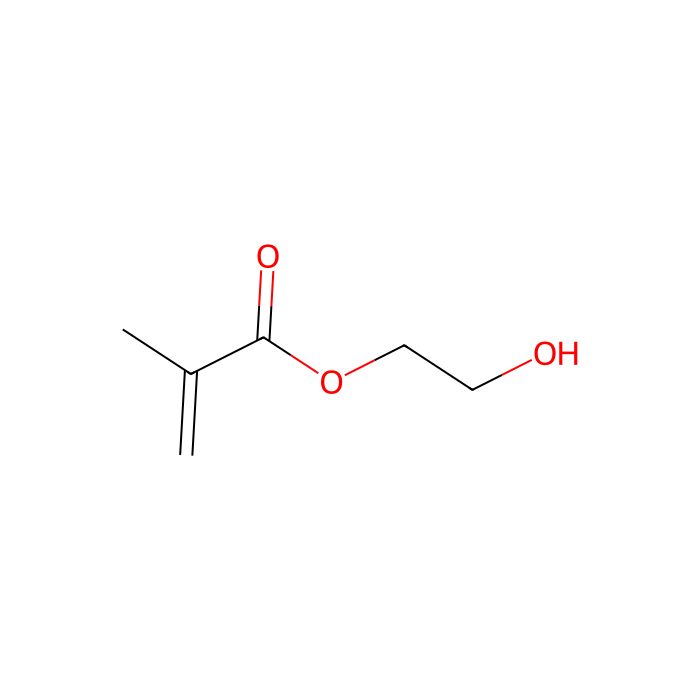
2-Hydroxyethyl methacrylate (HEMA) was the first monomer to be used to synthesize hydrogels for biomedical applications.The water swelling properties of HEMA are enhanced by copolymerization with more hydrophilic monomers.HEMA finds wide applications for drug delivery.
HEMA is used in the synthesis of biologically functional poly (2-hydroxyethyl methacrylate) (PHEMA) coplymers.It is also used to prepare light responsive membranes of PHEMA,HEMA/ acrylamide based specific drug release hydrogel,and water soluble HEMA/methacrylic acid hydrogel for drug delivery.Effects of HEMA on the migration of dental pulp stem cells (in vitro) may be studied.
Comprehensive hazard, handling, storage, and regulatory compliance document.
Download SDS →Lot-specific quality data. Enter your lot number to retrieve the exact COA.
Look up COA →Full quality attributes and acceptance criteria for this grade.
View spec sheet →Taxonomy Tree
| Kingdom | Organic compounds |
|---|---|
| Superclass | Organic acids and derivatives |
| Clase | Carboxylic acids and derivatives |
| Subclass | Carboxylic acid derivatives |
| Intermediate Tree Nodes | Carboxylic acid esters - Alpha,beta-unsaturated carboxylic esters |
| Direct Parent | Enoate esters |
| Alternative Parents | Monocarboxylic acids and derivatives Primary alcohols Organic oxides Hydrocarbon derivatives Carbonyl compounds |
| Molecular Framework | Aliphatic acyclic compounds |
| Substituents | Enoate ester - Monocarboxylic acid or derivatives - Organic oxygen compound - Organic oxide - Hydrocarbon derivative - Primary alcohol - Organooxygen compound - Carbonyl group - Alcohol - Aliphatic acyclic compound |
| Descripción | This compound belongs to the class of organic compounds known as enoate esters. These are an alpha,beta-unsaturated carboxylic ester of general formula R1C(R2)=C(R3)C(=O)OR4 (R4= organyl compound) in which the ester C=O function is conjugated to a C=C double bond at the alpha,beta position. |
| External Descriptors | enoate ester |
Find and download the COA for your product by matching the lot number on the packaging.
| Lot Number | Certificate Type | Fecha | Articulo |
|---|---|---|---|
| Certificate of Analysis | Sep 03, 2026 | H140644 | |
| Certificate of Analysis | Sep 03, 2026 | H140644 | |
| Certificate of Analysis | Sep 03, 2026 | H140644 | |
| Certificate of Analysis | Aug 28, 2025 | H140644 | |
| Certificate of Analysis | Aug 28, 2025 | H140644 | |
| Certificate of Analysis | Jul 29, 2024 | H140644 | |
| Certificate of Analysis | Jul 29, 2024 | H140644 | |
| Certificate of Analysis | Jul 29, 2024 | H140644 | |
| Certificate of Analysis | Nov 13, 2023 | H140644 | |
| Certificate of Analysis | Nov 13, 2023 | H140644 | |
| Certificate of Analysis | Nov 13, 2023 | H140644 | |
| Certificate of Analysis | Nov 13, 2023 | H140644 | |
| Certificate of Analysis | Nov 13, 2023 | H140644 | |
| Certificate of Analysis | Oct 18, 2023 | H140644 | |
| Certificate of Analysis | Oct 18, 2023 | H140644 | |
| Certificate of Analysis | Oct 18, 2023 | H140644 | |
| Certificate of Analysis | Jul 12, 2023 | H140644 | |
| Certificate of Analysis | Jul 12, 2023 | H140644 | |
| Certificate of Analysis | Jul 12, 2023 | H140644 | |
| Certificate of Analysis | Jun 29, 2022 | H140644 | |
| Certificate of Analysis | Jun 29, 2022 | H140644 | |
| Certificate of Analysis | Jun 29, 2022 | H140644 |
| Sensibilidad | Light&Air Sensitive |
|---|---|
| Índice de refracción | 1.451-1.453 |
| Punto de inflamación (°F) | 222.8 °F |
| Punto de inflamación (°C) | 101℃ |
| Punto de ebullición (°C) | 85°C/5mmHg |
| Punto de fusión (°C) | -12℃ |
| Peso molecular | 130.139 g/mol |
| XLogP3 | 0.500 |
| Hydrogen Bond Donor Count | 1 |
| Hydrogen Bond Acceptor Count | 3 |
| Rotatable Bond Count | 4 |
| Exact Mass | 130.063 Da |
| Monoisotopic Mass | 130.063 Da |
| Topological Polar Surface Area | 46.500 Ų |
| Heavy Atom Count | 9 |
| Formal Charge | 0 |
| Complexity | 117.000 |
| Isotope Atom Count | 0 |
| Defined Atom Stereocenter Count | 0 |
| Undefined Atom Stereocenter Count | 0 |
| Defined Bond Stereocenter Count | 0 |
| Undefined Bond Stereocenter Count | 0 |
| The total count of all stereochemical bonds | 0 |
| Covalently-Bonded Unit Count | 1 |
Our grade selection guide covers purity, stabilizer status, and application suitability for all variants in our catalog.
View Anhydrous Grade grade guide →