This compound belongs to the class of organic compounds known as imidazoles. These are compounds containing an imidazole ring, which is an aromatic five-member ring with two nitrogen atoms at positions 1 and 3, and three carbon atoms.
External Descriptors
Not available
1. Djoumbou Feunang Y, Eisner R, Knox C, Chepelev L, Hastings J, Owen G, Fahy E, Steinbeck C, Subramanian S, Bolton E, Greiner R, and Wishart DS. ClassyFire: Automated Chemical Classification With A Comprehensive, Computable Taxonomy. Journal of Cheminformatics, 2016, 8:61.
Determine the necessary mass, volume, or concentration for preparing a solution.
Dilution Calculator
Determine the dilution needed to prepare a stock solution.
Reconstitution Calculator
Reseñas
Reseñas de cliente
Application Protocols
No manufacturer-validated application protocols are provided for this item. The following are general starting points for research use only:
N-Alkylation screening (general):
Charge a dry flask with 2-propylimidazole (1.0 equiv) and K2CO3 (2.0 equiv) in anhydrous MeCN (0.05–0.2 M). Add alkyl bromide (1.2 equiv). Stir at 50–60 °C for 4–8 h. Monitor by LC–MS. Quench with water, extract with EtOAc, wash brine, dry, concentrate, and purify by silica gel.
Acylimidazole formation (general):
In dry DCM at 0–5 °C, combine 2-propylimidazole (1.05 equiv) and triethylamine (2.0 equiv). Add acyl chloride (1.0 equiv) dropwise. Warm to rt, stir 1–2 h. Wash with dilute HCl, sat. NaHCO3, brine; dry and concentrate. Characterize acylimidazole intermediate by IR/NMR before further coupling.
Metal complex preparation (general):
Dissolve metal salt (e.g., Cu(OAc)2) and 2-propylimidazole (2–3 equiv) in EtOH. Stir at rt 1–3 h. Isolate complex by slow solvent evaporation or precipitation with ether. Confirm coordination by UV–Vis/IR and elemental analysis.
Adapt stoichiometry and conditions to substrate reactivity. Always perform small-scale trials and consult the primary literature for system-specific optimization.
Biological Roles
Item-specific biological claims: None. For research use only.
General context (biochemistry, literature):
Imidazole is the side chain of the amino acid histidine and is ubiquitous in enzyme active sites where it participates in general acid–base catalysis and metal binding (e.g., zinc proteases, hemoproteins).
2-Propylimidazole is a synthetic imidazole; it is not an endogenous metabolite. Nonetheless, the imidazole ring retains key properties relevant in biochemical systems:
pH-responsive behavior near neutrality (conjugate-acid pKa of imidazoles typically ~7), enabling proton shuttling.
Bidentate H-bonding capability and metal coordination through the pyridinic nitrogen.
Structure–property tuning: The n-propyl substituent increases hydrophobicity relative to imidazole, which can modulate membrane partitioning, binding to hydrophobic protein pockets, or incorporation into materials.
Research utility:
Model compound for studying imidazole-mediated catalysis or proton transfer with altered hydrophobicity.
Potential ligand fragment in metalloprotein mimics or metal–organic assemblies, where substituted imidazoles help tune geometry and solubility.
No clinical or therapeutic claims are made. Any biological experimentation should incorporate appropriate toxicology controls and reference standards (e.g., compare to imidazole or 2-methylimidazole) to delineate substituent effects.
Buffer Applications
Not typically applicable. While imidazole itself is widely used in protein purification (e.g., Ni–NTA elution at 10–500 mM) and can act as a buffering agent near neutral pH, 2-propylimidazole is not commonly used as a buffer component.
Guidance for researchers (general):
If the goal is His-tag protein elution or neutral pH buffering, standard imidazole or histidine-based buffers are preferred due to established pKa and compatibility data.
Substituted imidazoles can display shifted pKa and lower water solubility; thus, buffer capacity and clarity may be inferior.
If exploring 2-propylimidazole in bespoke buffer systems (research only):
Verify aqueous solubility at the target pH and ionic strength.
Determine acid–base parameters empirically (titration) to ensure adequate buffer capacity.
Assess interference with metal-affinity systems; substituted imidazoles may chelate Ni2+/Co2+ differently than imidazole, potentially perturbing purification.
No standardized buffer recipes are provided for this item.
Green Alternatives
Context: The compound itself is the desired heterocycle; greener choices typically concern solvents and process conditions rather than replacing the scaffold.
Greener process considerations (general):
Solvent substitution:
Replace DMF/NMP with MeCN, ethanol, isopropanol, or water/ethanol mixtures when compatible with solubility and reactivity.
For extractions and crystallizations, prefer ethyl acetate or isopropyl acetate over chlorinated solvents.
Reaction intensification:
Use catalytic loadings of 2-propylimidazole when serving as acylation catalyst; recycle via aqueous acid/base partitioning.
Explore solvent-free or mechanochemical (ball-milling) N-alkylations when feasible to reduce solvent volumes.
Energy efficiency: Microwave or flow conditions can reduce time/energy for N-functionalization steps.
Illustrative comparison (general, not item-specific):
Conventional vs greener setup for N-alkylation of imidazoles:
Conventional: Substrate + alkyl halide in dry DMF, K2CO3, 60–80 °C.
Greener: Substrate + alkyl sulfate/tosylate in MeCN or EtOH, K2CO3 or Na2CO3, 25–60 °C; or phase-transfer catalysis in 2-MeTHF.
Waste minimization:
Select bases that generate benign salts (e.g., carbonates).
Avoid excess halogenated electrophiles; use stoichiometric control and in-line monitoring to limit over-alkylation.
Note: When regulatory or EHS drivers exist, consider whether unsubstituted imidazole (higher aqueous solubility) or 1,2-disubstituted analogs (if lower volatility is desired) better aligns with process safety.
Pharmaceutical Uses
No pharmacopeial grade or excipient designation is provided for this item; Not specified for this item. For research use only.
General formulation context (non-clinical, literature):
Imidazole derivatives are common scaffolds in medicinal chemistry due to their tunable basicity and H-bonding properties. 2-Propyl substitution increases hydrophobicity, which can be leveraged in structure–activity relationship (SAR) studies or as a lipophilicity-tuning handle.
Potential non-therapeutic roles in development-stage research:
As a building block/intermediate to prepare N-alkylated imidazoles or imidazolium salts (e.g., ionic liquids, phase-transfer media) for process applications.
As a metal-binding ligand fragment in catalyst formulations used for API synthesis (not in final drug product).
Excipient use: No established use as a pharmaceutical excipient is known; standard buffering agents (histidine, phosphate, citrate) and ligands are typically preferred.
Any use in GMP or clinical settings requires appropriate qualification, toxicology assessment, and compliance with relevant pharmacopeial and regulatory standards, which are outside the scope of this research-only product.
Physical Properties
Item-specific specifications (exact values):
Boiling point, melting point, density, refractive index, water/peroxide/metal limits, UV cutoff: Not specified for this item; refer to CoA/Spec Sheet.
Appearance: Not specified for this item; refer to CoA/Spec Sheet.
Literature/general expectations for 2-alkylimidazoles (for context only; not item specifications):
Acid–base: Imidazole conjugate-acid pKa typically near 7; 2-alkyl substitution can modestly shift basicity and reduce water solubility relative to imidazole.
Polarity/solubility: Dual H-bond donor/acceptor behavior supports solubility in polar organics (e.g., alcohols, DMF, DMSO). Water solubility declines as the alkyl chain length increases; n-propyl substitution yields moderate water solubility and good solubility in many organics.
Volatility: 2-alkylimidazoles generally show lower volatility than imidazole due to increased molecular weight and hydrophobic surface.
Partitioning: Alkylation increases logP relative to imidazole; expect moderate lipophilicity for the propyl derivative.
Practical notes (general):
Hygroscopicity: Unsubstituted imidazole is moderately hygroscopic; 2-alkyl substitution may reduce but not eliminate moisture uptake. Store tightly closed to prevent moisture absorption.
Spectroscopy: The aromatic heterocycle exhibits characteristic IR bands for N–H (~3100–3400 cm⁻¹) and C=N/C–N stretches; 1H NMR shows downfield N–H and aromatic protons alongside aliphatic signals for the propyl chain.
Quality and Grades
Item-specific grade/purity: Not specified for this item; refer to CoA/Spec Sheet.
Interpretation and guidance (general):
If provided as "Analytical Reagent (AR)" or similar, the material typically meets stringent assay and impurity profiles appropriate for quantitative analysis and demanding synthesis.
If provided as a defined purity percentage (e.g., ≥98%), that figure generally reflects GC/LC or 1H NMR assay on an anhydrous basis; confirm the analytical method in the CoA.
For chromatographic or spectroscopic applications, low UV baseline and trace metal control may be relevant; such specifications, when applicable, will be stated explicitly on the CoA.
Stabilizers/inhibitors: None indicated for this item in the Product Data. If any stabilizer is present in a particular lot, it will be listed on the CoA and may influence certain reactions (e.g., acid chloride couplings or sensitive catalysis).
Recommendations:
Consult the CoA for exact assay, water content, and residual solvent profile before use in moisture- or catalyst-sensitive steps.
For scale-up or regulated environments, retain batch-specific documentation (CoA, SDS) and perform incoming verification (e.g., quick 1H NMR/GC).
Reaction and Applications
Role in synthesis (general for 2-alkylimidazoles):
Nucleophilic catalysis: Imidazoles can catalyze acyl transfer (e.g., anhydride/ester formation) via acylimidazole intermediates. The 2-propyl group modulates solubility and sterics without blocking the ring nitrogens.
Base/additive: Functions as a mild, non-nucleophilic base in some transformations, especially where bifunctional H-bonding accelerates reactions (e.g., carbonyl activations).
Building block:
N1-functionalization: Alkylation, acylation, sulfonylation at the ring nitrogen (after deprotonation) gives N-substituted imidazolium salts or neutral derivatives.
Quaternization: Alkylation can lead to imidazolium salts, enabling ionic-liquid precursors with tailored hydrophobicity due to the propyl at C2.
Ligand behavior: The pyridinic nitrogen binds metal centers (e.g., Cu, Zn, Pd) forming N-donor complexes used in catalysis or materials.
Practical tips:
Maintain anhydrous conditions for N-alkylation (moisture competes for electrophiles). A mild base (K2CO3, Cs2CO3) or strong base (NaH) may be selected depending on electrophile reactivity.
For acyl transfer catalysis, operate in dry polar solvents; monitor formation of acylimidazole intermediates by IR (C=O shift) or MS.
Workup: If used catalytically, remove by aqueous acid wash (to protonate and extract) or by silica plug; imidazoles often show strong UV at 210–230 nm, facilitating LC monitoring.
Applications expansion (no manufacturer specifics provided): suitable for method development where a slightly more hydrophobic imidazole is advantageous (e.g., phase-partitioning or material embedding).
Reaction Conditions
General literature guidance (not item specifications):
N-Alkylation:
Typical solvents: DMF, MeCN, or acetone (anhydrous).
Base: K2CO3 or Cs2CO3 (1.5–2.0 equiv) for primary alkyl halides; NaH (60% in oil, 1.1–1.5 equiv) for less reactive electrophiles.
Temperature/time: 25–80 °C, 1–16 h depending on electrophile; monitor by TLC/LC–MS.
Notes: Exclude moisture; use phase-transfer catalysts for secondary halides to improve rates.
N-Acylation/Sulfonylation:
Solvents: DCM, THF, or MeCN.
Base: Triethylamine or DIPEA (2–3 equiv).
Electrophiles: Acyl chlorides, anhydrides, sulfonyl chlorides; 0–25 °C to control exotherm.
Acyl transfer catalysis:
Catalyst loading: 5–20 mol% 2-propylimidazole in dry MeCN or THF.
Substrates: Carboxylic acids with carbodiimides (e.g., DIC) or anhydrides; room temp to 50 °C.
Metal complexation:
Solvents: EtOH, MeOH, MeCN.
Conditions: Mix with metal salts (e.g., Cu(II), Zn(II)) at ambient temperature; adjust pH if needed. Isolate complexes by slow evaporation or anion exchange.
Workup and purification:
Aqueous acid wash (e.g., 0.5–1 M HCl) removes unreacted imidazole by protonation; basify to recover if desired.
Column chromatography on silica gel (avoid strong acid sites for imidazolium salts).
Expected outcomes:
Yields vary with electrophile and conditions; primary halides/acyl chlorides typically give high conversions under the above conditions per general imidazole literature.
Safety and Handling
Item-specific hazard details from Product Data:
Signal Word: Not specified for this item; refer to SDS.
H-Statements: Not specified for this item; refer to SDS.
GHS Classification/Pictograms: Not specified for this item; refer to SDS.
General safety guidance for imidazoles (literature/practice; consult SDS for authoritative instructions):
Likely hazards: Many low-mass imidazoles are classified as irritants; they can cause skin/eye irritation and respiratory tract irritation if dusts/vapors are generated. Avoid ingestion and prolonged exposure.
Personal protective equipment (PPE): Use lab coat, nitrile gloves, and chemical splash goggles. Employ local exhaust ventilation or fume hood when handling powders or during reactions that may release vapors.
Handling: Avoid contact with strong oxidizers and strong acids; bases and nucleophiles may react under forcing conditions. Prevent moisture ingress to maintain material integrity.
First aid (overview):
Skin/eye contact: Rinse with water for 15 minutes; remove contaminated clothing; seek medical attention if irritation persists.
Inhalation: Move to fresh air, monitor breathing; obtain medical attention if symptoms occur.
Ingestion: Rinse mouth; do not induce vomiting unless directed by medical personnel; seek medical attention.
Fire safety: Many heterocycles are combustible; use CO2, dry chemical, or foam. Combustion may produce nitrogen oxides and carbon oxides.
Always review the product-specific SDS and institutional safety protocols before use.
Solvent Selection
Applicability: 2-propylimidazole is a heteroaromatic base with both H-bond donor and acceptor sites. Solvent choice impacts its solubility, ionization, and reactivity.
General miscibility/solubility (literature/general):
Polar aprotic: Typically highly soluble in DMSO, DMF, NMP, and acetonitrile; these solvents enhance nucleophilicity for N-alkylations and acylations.
Protic solvents: Good solubility in lower alcohols (MeOH, EtOH, i-PrOH). Hydrogen bonding can attenuate basicity/nucleophilicity.
Nonpolar: Limited solubility in hydrocarbons; may be increased by heating or by forming salts with lipophilic counterions.
Selection guidance by use-case:
N-alkylation or acylation: Prefer dry polar aprotics (DMF/MeCN) to maximize nucleophilicity; add a mild inorganic base (e.g., K2CO3) if needed.
Metal coordination/complex formation: Alcohols or MeCN often suitable; consider weakly coordinating solvents to favor binding through the pyridinic N.
Buffer-like or bioconjugation settings: Use aqueous alcohol mixtures or buffered water if solubility allows; adjust pH to maintain the free base or conjugate acid as required.
Quick comparison (general):
DMF vs MeCN: DMF offers highest solubility but is less preferred environmentally; MeCN is more volatile and easier to remove. DMSO maximizes solubility for screening but can complicate workups.
Keep container tightly closed in a dry, well-ventilated place. Protect from excessive moisture and strong acids/oxidizers.
If the material is a solid, minimize exposure to ambient humidity; if a liquid, ensure cap integrity to limit volatilization and moisture uptake.
For solution preparation (research use): dissolve in anhydrous solvents appropriate to the application (e.g., DMSO, DMF, MeCN, alcohols). Prepare fresh solutions where possible; for stock solutions, store in sealed amber vials under inert gas if long-term stability is a concern.
Reconstitution specifics (concentration limits, vehicle selection): Not specified for this item; refer to CoA/Spec Sheet or perform a small-scale solubility screen.
Always refer to the product’s SDS and CoA for lot-specific guidance on stability, compatibility, and any additional storage constraints.
Structure and Identity
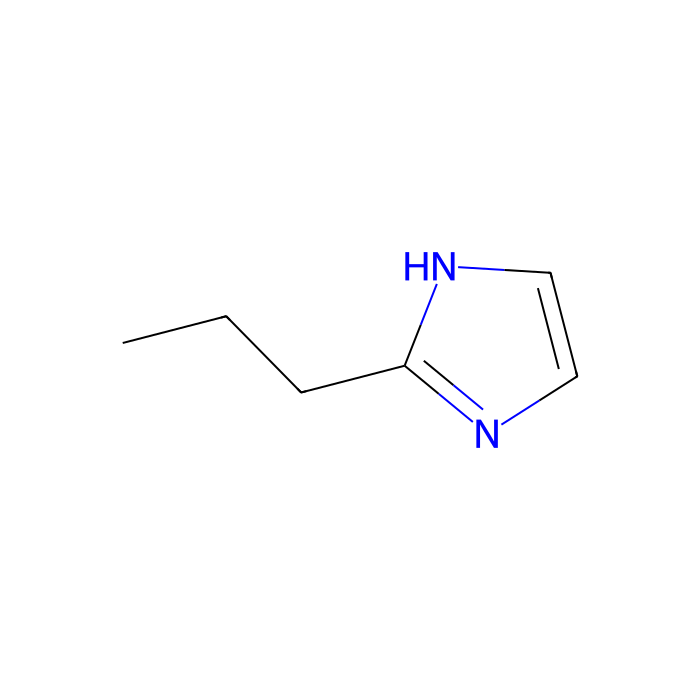
Concise overview: 2-propylimidazole is an imidazole ring bearing a linear n-propyl substituent at the C2 position, combining a basic heteroaromatic core with a small aliphatic chain to tune lipophilicity and basicity.
Item-specific (from Product Data):
SKU: P135164
Product Name: 2-propylimidazole
CAS: 50995-95-4
PubChem CID: 162617
InChIKey: 221155 (as provided)
SMILES: Not specified for this item; refer to CoA/Spec Sheet.
Molecular Formula: Not specified for this item; refer to CoA/Spec Sheet.
Molecular Weight: Not specified for this item; refer to CoA/Spec Sheet.
Structural features (general chemistry description):
Core ring: Imidazole (five-membered aromatic ring with two nitrogens: one pyridinic N and one pyrrolic [N–H]).
Substitution pattern: n-Propyl group at C2 (the carbon between the two ring nitrogens), increasing hydrophobicity relative to imidazole.
Functional groups: Heteroaromatic base, H-bond donor (via N–H) and acceptor (pyridinic N), capable of metal coordination.
Tautomerism: Imidazole systems exhibit tautomerism between N1–H and N3–H forms; substitution at C2 does not eliminate this tautomerism but influences acidity/basicity distribution.
2D structure (verbal description): a planar imidazole ring (two adjacent ring nitrogens separated by a C2 carbon) with a straight –CH2–CH2–CH3 chain attached at that C2 carbon; one ring nitrogen bears a labile proton.
Synthetic Utility
Transformation modes (general for 2-alkylimidazoles):
N1 Deprotonation and functionalization: Treatment with strong base (e.g., NaH, KH) enables N-alkylation/acylation to afford N1-substituted imidazoles or imidazolium salts. The C2 position is blocked by the propyl substituent, providing regioselectivity.
Acylimidazole chemistry: Reaction with acyl chlorides/anhydrides affords acylimidazoles—useful activated esters for coupling to alcohols/amines. 2-Propylimidazole can act as a nucleophile or catalyst in such steps.
Salt formation: Protonation with mineral or sulfonic acids yields crystalline salts useful for purification or as precursors to ionic liquids with varied counterions.
Metal coordination: Acts as an N-donor ligand in coordination complexes (Cu, Zn, Ni, Pd), often modifying catalyst solubility and activity via the propyl substituent.
Strategic value:
The propyl group increases lipophilicity and steric profile without eliminating key imidazole reactivity. This can improve phase behavior (e.g., extraction into organics) and attenuate over-alkylation/polymerization.
In retrosynthesis, 2-propylimidazole can serve as a convergent fragment for constructing more elaborate heterocycles via N-functionalization, or as a masked base in organocatalysis frameworks.
Operational notes:
Protect moisture-sensitive reagents during N-functionalization; imidazoles can sequester acids and water.
Monitor reactions by LC–MS or 1H NMR; characteristic N–CH3 (when formed) and aliphatic propyl resonances aid in assigning substitution patterns.
Target Specificity
Not applicable. This product is a small-molecule heterocycle, not an antibody, enzyme, or affinity reagent. No target, epitope, clone, or species reactivity information is associated with this item.
For metal-binding or catalytic studies, "specificity" relates to coordination preferences (e.g., binding through the pyridinic nitrogen) rather than biological targets. Such preferences should be determined empirically for each system.
Preguntas frecuentes
What is the purity of this product, and how is it determined?
This product is supplied at ≥95% purity, determined by gas chromatography (GC). Lot-specific values are stated on the Certificate of Analysis.
How should this product be stored?
Store at room temperature.
How is this product shipped?
This product ships under standard ambient conditions. No temperature-controlled packaging is required.
What are the CAS number, molecular formula and molecular weight?
The CAS Number is 50995-95-4, the molecular formula is C6H10N2, and the molecular weight is 110.16 g/mol. InChIKey MKBBSFGKFMQPPC-UHFFFAOYSA-N.
What documentation is provided?
Available product documentation, including Certificates of Analysis (COA), Safety Data Sheets (SDS), and specification sheets, is shown in the product document area. Document availability and access follow the current site policy.
Utilizamos cookies para garantizar el correcto funcionamiento del sitio web y, cuando esté permitido, para mejorar su experiencia. Puede gestionar sus preferencias en cualquier momento en Configuración. Más información en nuestra Política de Cookies.
¿Quieres que te enviemos un mensaje cuando tengamos descuentos disponibles?
Recordármelo más tarde
¡Gracias! Por favor, revisa tu bandeja de entrada de correo electrónico para confirmar.
Products are supplied to verified businesses, institutions, and qualified professionals for research and development use only. Not for use in humans, animals, diagnosis, or therapy.

 G1513091