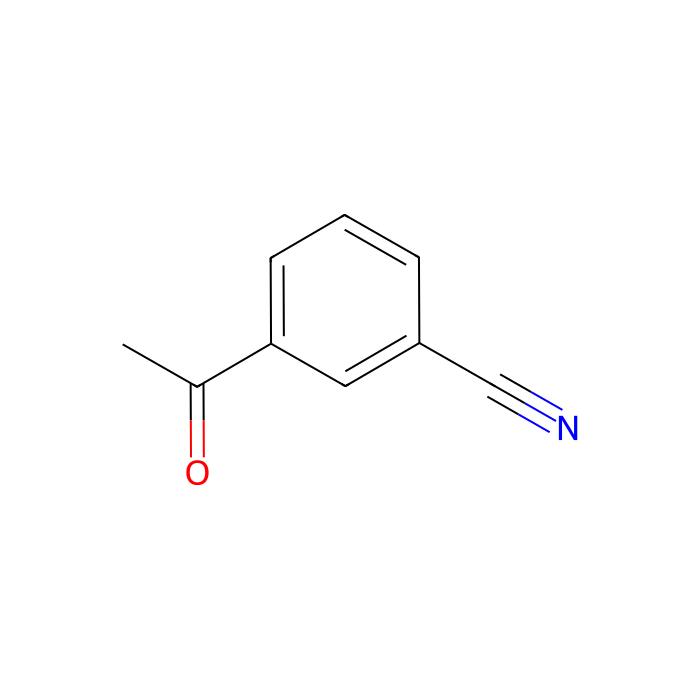
3-Acetylbenzonitrile - ≥98% , CAS No.6136-68-1

CAS: 6136-68-1 Cat. No.: A113380 Fórmula: C9H7NO Peso molecular: 145.16 Beilstein Registry Number: 10(4)2769 Número EC: 228-110-6
Disponible para pedir
CALIDAD & PUREZA ≥98%
Synonyms
Benzonitrile, 3-acetyl-|m-acetylbenzonitrile|(2S)-2-[(2,4-dinitrophenyl)amino]-3-hydroxypropanoic acid|2,4-Dnp-GABA|(2S)-2-[[(2S)-2-aminopropanoyl]amino]-4-methylpentanoic acid|DNP-Pro|3-acetyl benzonitrile|m-Cyanoacetophenone|3-acetylbenzenecarbonitrile|3'-Cyanoacetophenone|3-cyanoacetophenone|3-Acetylbenzonitrile|3-acetyl-benzonitrile|3-CN-C6H4-COCH3
Storage
Room temperature
Shipped In
Normal
★
Talla
Alemania (EU)
USA*
Precio
Cantidad
1g
A113380-1g
—
Disponible ≥10
8,59€
5g
A113380-5g
—
6 Disponible
19,00€
25g
A113380-25g
—
4 Disponible
69,33€
100g
A113380-100g
—
1 Disponible
231,60€
Enter a quantity for the sizes you want to add.

Especificaciones

Sinónimos
Benzonitrile, 3-acetyl- | m-acetylbenzonitrile | (2S)-2-[(2,4-dinitrophenyl)amino]-3-hydroxypropanoic acid | 2,4-Dnp-GABA | (2S)-2-[[(2S)-2-aminopropanoyl]amino]-4-methylpentanoic acid | DNP-Pro | 3-acetyl benzonitrile | m-Cyanoacetophenone | 3-acetylbenzenecarbonitrile | 3'-Cyanoacetophenone | 3-cyanoacetophenone | 3-Acetylbenzonitrile | Show more
Especificaciones y pureza
≥98%
Condiciones de almacenamiento de almacenamiento
Room temperature
Enviado en
Normal
Pureza
≥98%
Nombres e identificadores
Pubchem Sid
Pubchem Sid Url
https://pubchem.ncbi.nlm.nih.gov/substance/488185827
SMILES
CC(=O)C1=CC=CC(=C1)C#N
IUPAC Name
3-acetylbenzonitrile
InChIKey
SBCFGFDAZCTSRH-UHFFFAOYSA-N
InChI
1S/C9H7NO/c1-7(11)9-4-2-3-8(5-9)6-10/h2-5H,1H3
Isómeros SMILES
CC(=O)C1=CC=CC(=C1)C#N
WGK Alemania
3
Peso molecular
145.16
Beilstein
10(4)2769
Reaxys
2079629
Reaxys-RN_link_address
https://www.reaxys.com/reaxys/secured/hopinto.do?context=S&query=IDE.XRN=2079629&ln=

Datos avanzados

Taxonomic Classification

Taxonomy Tree

KingdomOrganic compounds
SuperclassOrganic oxygen compounds
ClaseOrganooxygen compounds
SubclassCarbonyl compounds
Intermediate Tree Nodes Ketones - Aryl ketones - Phenylketones
Direct ParentAlkyl-phenylketones
Alternative Parents Acetophenones  Benzoyl derivatives  Benzonitriles  Aryl alkyl ketones  Nitriles  Organopnictogen compounds  Organic oxides  Hydrocarbon derivatives  
Molecular FrameworkAromatic homomonocyclic compounds
Substituents Alkyl-phenylketone - Acetophenone - Aryl alkyl ketone - Benzoyl - Benzonitrile - Benzenoid - Monocyclic benzene moiety - Nitrile - Carbonitrile - Organic nitrogen compound - Organopnictogen compound - Organic oxide - Hydrocarbon derivative - Organonitrogen compound - Aromatic homomonocyclic compound
DescripciónThis compound belongs to the class of organic compounds known as alkyl-phenylketones. These are aromatic compounds containing a ketone substituted by one alkyl group, and a phenyl group.
External Descriptors Not available
Estructura 3D
Modelo de Estructura Química Interactiva


Objetivos asociados (no humanos)
Pseudomonas aeruginosa (123386 Activities)
Activity TypeRelationActivity valueUnitsAction TypeJournalPubMed IddoiAssay Aladdin ID
Mecanismos de acción
Certificados (CoA, COO, BSE/TSE y tabla de análisis)
C of A & Other Certificates(BSE/TSE, COO):
Analytical Chart:

Find and download the COA for your product by matching the lot number on the packaging.

14 results found

Lot NumberCertificate TypeFechaArticulo
J2213017J2213017Certificate of AnalysisJul 06, 2026 A113380
J2213064J2213064Certificate of AnalysisJul 06, 2026 A113380
J2213065J2213065Certificate of AnalysisJul 06, 2026 A113380
J2213072J2213072Certificate of AnalysisJul 06, 2026 A113380
E1214017E1214017Certificate of AnalysisAug 09, 2024 A113380
A2416127A2416127Certificate of AnalysisNov 25, 2023 A113380
A2416129A2416129Certificate of AnalysisNov 25, 2023 A113380
A2416130A2416130Certificate of AnalysisNov 25, 2023 A113380
A2416131A2416131Certificate of AnalysisNov 25, 2023 A113380
A2416133A2416133Certificate of AnalysisNov 25, 2023 A113380
E2311033E2311033Certificate of AnalysisMay 18, 2023 A113380
H1905124H1905124Certificate of AnalysisMay 08, 2023 A113380
B2327304B2327304Certificate of AnalysisMar 07, 2023 A113380
B2327303B2327303Certificate of AnalysisMar 07, 2023 A113380
Propiedades químicas y físicas
Punto de ebullición (°C)120°C
Punto de fusión (°C)97-101°C
Peso molecular145.16
XLogP31.200
Hydrogen Bond Donor Count0
Hydrogen Bond Acceptor Count2
Rotatable Bond Count1
Exact Mass145.053 Da
Monoisotopic Mass145.053 Da
Topological Polar Surface Area40.900 Ų
Heavy Atom Count11
Formal Charge0
Complexity201.000
Isotope Atom Count0
Defined Atom Stereocenter Count0
Undefined Atom Stereocenter Count0
Defined Bond Stereocenter Count0
Undefined Bond Stereocenter Count0
The total count of all stereochemical bonds0
Covalently-Bonded Unit Count1
Seguridad y peligros (GHS)
Pictogramas
Señal
Warning
Indicaciones de peligro

H302:Harmful if swallowed

H312:Harmful in contact with skin

H315:Causes skin irritation

H319:Causes serious eye irritation

H332:Harmful if inhaled

H335:May cause respiratory irritation

Precauciones

P261:Avoid breathing dust/fume/gas/mist/vapors/spray.

P264:Wash hands [and …] thoroughly after handling.

P270:Do not eat, drink or smoke when using this product.

P271:Use only outdoors or in a well-ventilated area.

P280:Wear protective gloves/protective clothing/eye protection/face protection.

P321:Specific treatment (see ... on this label).

P330:Rinse mouth.

P302+P352:IF ON SKIN: wash with plenty of water.

P304+P340:IF INHALED: Remove person to fresh air and keep comfortable for breathing.

P305+P351+P338:IF IN EYES: Rinse cautiously with water for several minutes. Remove contact lenses if present and easy to do - continue rinsing.

P362+P364:Take off contaminated clothing and wash it before reuse.

P405:Store locked up.

P403+P233:Store in a well-ventilated place. Keep container tightly closed.

P501:Dispose of contents/container to an approved waste disposal plant.

P264+P265:Wash hands [and …] thoroughly after handling. Do not touch eyes.

P301+P317:IF SWALLOWED: Get medical help.

P317:Get emergency medical help.

P337+P317:If eye irritation persists: Get medical help.

P332+P317:If skin irritation occurs: Get medical help.

P319:Get medical help if you feel unwell.

WGK Alemania
3
Reaxys
2079629
Reaxys-RN_link_address
https://www.reaxys.com/reaxys/secured/hopinto.do?context=S&query=IDE.XRN=2079629&ln=
Calculadoras de soluciones
Reseñas

Reseñas de cliente

Application Protocols

Not applicable as a biological reagent. There are no WB/IHC/IF/FC protocols for this small-molecule building block. For synthetic use, see the Reaction Conditions and Synthetic Utility sections for general laboratory guidance.

Biological Roles

This compound is a synthetic organic building block, not a biomolecule.

  • Applicability: It does not have established physiological roles; any biological interactions would be context-specific to research assays and are not intrinsic “roles.”

  • Literature context (general, non-clinical):

    • Aromatic nitriles and aryl ketones can serve as fragments or intermediates in medicinal chemistry, but 3-acetylbenzonitrile itself is typically used as a precursor rather than as a probe.
  • Guidance:

    • For biochemical experiments, evaluate DMSO stock compatibility, final assay solvent percentages, and potential nonspecific binding typical of hydrophobic aromatics.
    • No clinical/therapeutic statements are made for this product; For research use only (per Product Data).
Buffer Applications

Not typically applicable. 3-Acetylbenzonitrile is not a buffering agent and lacks acid/base groups with pKa values in the physiological range. For experimental use in aqueous systems, prepare stocks in compatible organic cosolvents (e.g., DMSO, MeCN, EtOH) and dilute into buffered media while keeping organic content low to avoid precipitation.

Green Alternatives

While 3-acetylbenzonitrile itself is the target building block, greener choices can be applied to the processes that use or make it.

  • Solvent choices (literature, general):

    • Prefer ethyl acetate, 2-MeTHF, cyclopentyl methyl ether (CPME), or toluene over chlorinated solvents where feasible. MeCN has favorable properties but consider recovery/recycling.
  • Reagent/catalyst options (literature):

    • Reductive amination: Use catalytic hydrogenation (H2, Pd/C) in EtOH instead of NaBH3CN in MeOH when selectivity allows.
    • Nitrile hydration: Employ homogeneous Ru, Pt, or base-free Mo catalysts in water-rich media, or heterogeneous catalysts enabling easy recovery; enzymatic nitrile hydratases are green alternatives when substrate scope permits.
    • Oxime formation: Conduct in aqueous ethanol with catalytic acid; remove water azeotropically or with molecular sieves instead of stoichiometric dehydrating agents.
  • Workup/waste minimization:

    • Use solvent-switch crystallizations to avoid chromatographic silica waste where possible.
    • Recycle mother liquors and recover high-boiling green ethers (2-MeTHF/CPME) via distillation.

Comparison (general):

  • Chlorinated solvents (DCM): excellent solubility, low bp; environmental/health concerns, disposal burdens.
  • 2-MeTHF/CPME: bio-based or recyclable ethers; form fewer peroxides than THF; broader liquid range; may change reaction rates/selectivities—pilot trials recommended.
  • EtOAc/toluene: greener profiles and easy recovery; may require higher temperatures vs DCM.
Pharmaceutical Uses
  • Item-specific: None specified; For research use only.

  • General formulation context (non-clinical):

    • 3-Acetylbenzonitrile is not an established excipient. Its typical role is as a synthetic intermediate in discovery and process chemistry.
    • If used in screening collections, it is handled as a small-molecule research reagent; prepare DMSO stocks (e.g., 10–100 mM) with appropriate plate handling. Ensure compatibility of containers (glass preferred over reactive plastics) and control for adsorption typical of aromatic hydrophobes.

No claims are made regarding therapeutic applications or clinical use.

Physical Properties
  • Item-specific (from Product Data):

    • Appearance: Not specified for this item; refer to CoA/Spec Sheet.
    • Molecular Formula: Not specified for this item; refer to CoA/Spec Sheet.
    • Molecular Weight: Not specified for this item; refer to CoA/Spec Sheet.
  • Literature values (general reference, not item-specific; verify against CoA/SDS for your lot):

    • Molecular formula: C9H7NO (derived from structure)
    • Formula mass (Mr): ~145.16 g/mol (literature)
    • Acid/base character: neutral; no titratable protons in nitrile or ketone; very weakly basic nitrile nitrogen (pKaH << 0, literature qualitative)
    • Polarity: moderately polar aromatic due to carbonyl and nitrile dipoles; non-ionizable under neutral conditions
    • Solubility profile (qualitative, literature): typically soluble in common organic solvents (e.g., dichloromethane, ethyl acetate, toluene, acetonitrile, THF); low aqueous solubility
    • Spectroscopic handles: strong IR bands expected for C≡N (~2220–2260 cm−1) and C=O of aryl methyl ketone (~1680–1715 cm−1) (literature ranges)
  • Not specified for this item; refer to CoA/Spec Sheet for any of the following if required for your method validation:

    • Melting point / boiling point
    • Density
    • Refractive index
    • UV/Vis cutoff or ε
    • Purity assay and residual solvent levels
Quality and Grades
  • Item-specific (from Product Data):

    • Grade/Purity: Not specified for this item; refer to CoA/Spec Sheet.
  • How to interpret grades (general guidance):

    • Research or Reagent grade indicates suitability for synthetic and analytical laboratory use; impurity profiles (e.g., residual solvents, isomeric content, water content) vary by manufacturer and lot.
    • HPLC/GC grade (if applicable) emphasizes low UV/background and low volatile/semivolatile impurities; useful where spectroscopic baselines matter.
    • Screening/medchem grade focuses on practical purity with acceptable impurity levels for SAR campaigns; often supplied with LC/MS purity data.
  • Considerations specific to 3-acetylbenzonitrile as a building block:

    • Isomeric purity: meta-regioisomer purity vs possible ortho/para isomers can be important for structure–activity or polymer property studies.
    • Carbonyl/nitrile integrity: Monitor for hydrolytic byproducts (acids/amides) or aldol-type dimers under basic storage/handling.
    • Documentation: Request CoA including assay (e.g., GC, HPLC), identity (NMR, IR showing C≡N and C=O), and residual solvent/moisture. Any unstated specifications should be treated as Not specified for this item; refer to CoA/Spec Sheet.
Reaction and Applications

3-Acetylbenzonitrile offers orthogonal reactivity from its two functional groups, enabling divergent synthesis.

  • Ketone-directed transformations (literature):

    • Oxime/hydrazone formation with hydroxylamine/hydrazines; useful for derivatization, protection, or analytical confirmation.
    • Reductive amination to aryl ethyl amines using amines plus NaBH3CN or catalytic hydrogenation.
    • Alpha-functionalization: Enolate formation under LDA/NaHMDS enables halogenation, aldol, or Michael additions; meta nitrile can influence acidity and regiochemistry.
    • Baeyer–Villiger oxidation to the corresponding aryl acetate (peracids or mCPBA), giving an acylated phenyl cyanide derivative.
  • Nitrile-directed transformations (literature):

    • Hydrolysis to amide (m-benzamide acetyl derivative) under acidic (H2SO4/H2O, reflux) or basic (NaOH, H2O/EtOH) conditions; extended conditions yield the corresponding acid.
    • Reduction to imine/amine: DIBAL-H or catalytic hydrogenation (Raney Ni/Pd/C) affords benzylamines after further workup; selective reduction of nitrile vs ketone requires careful choice (e.g., BH3·THF reduces nitriles faster than ketones under some conditions).
    • Pinner reaction to imidates (acidic alcohol media), enabling subsequent amidine formation.
  • Aromatic ring elaboration (literature):

    • Electrophilic substitution is deactivated by both nitrile and acyl groups; directed metalation (e.g., ortho-lithiation relative to nitrile) can be exploited under strong bases and low temperature, enabling halogenation or borylation.
  • Use cases:

    • Medchem and materials libraries leveraging bifunctional handles for late-stage diversification.
    • Synthetic intermediates toward heterocycles (e.g., via oxime → Beckmann rearrangement; nitrile → amidine/cyclizations).
Reaction Conditions

General literature guidelines (verify and optimize for your system):

  • Oxime formation (ketone → oxime):

    • Reagents: Hydroxylamine·HCl (1.2–1.5 eq), pyridine or NaOAc as base.
    • Solvent: EtOH or MeOH; 0.1–0.5 M.
    • Conditions: Reflux 1–4 h or rt overnight; remove water to drive to completion if needed.
  • Reductive amination (ketone → secondary amine):

    • Reagents: Amine (1.2–2.0 eq), NaBH3CN (1.5 eq) or H2/Pd-C (5–10 wt%).
    • Solvent: MeOH, EtOH, or MeCN with 1–2% AcOH.
    • Conditions: rt to 50 °C; 2–16 h; monitor by LC/MS; work up with bicarbonate then extract.
  • Enolate chemistry (alpha-functionalization):

    • Base: LDA or NaHMDS (1.1–1.5 eq) in THF at −78 to −20 °C.
    • Electrophiles: Halogens, aldehydes (aldol), Michael acceptors.
    • Quench: NH4Cl or AcOH; protect nitrile if using highly nucleophilic conditions.
  • Nitrile hydrolysis (to amide/acid):

    • Acidic: H2SO4/H2O or HCl/H2O, 80–120 °C; amide at shorter times, acid with extended heating.
    • Basic: NaOH or KOH (2–5 eq) in EtOH/H2O, reflux; acid workup to isolate acid.
  • Nitrile reduction (to amine):

    • Catalytic hydrogenation: H2 (20–50 bar), Raney Ni or Pd/C, alcohol solvent, 25–80 °C; ketone may also reduce—use conditions/selectivity controls as needed.
    • Hydride: BH3·THF or DIBAL-H at 0 to 25 °C; can stop at imine/aluminum amide then hydrolyze.
  • Baeyer–Villiger (ketone → ester):

    • Reagent: mCPBA (1.2–2.0 eq) in DCM or CHCl3, 0 to rt; buffer acids generated (Na2CO3 wash).

Note: Choose chemoselective conditions to address the nitrile vs ketone as required; protect the alternate functionality when necessary.

Safety and Handling
  • Item-specific (from Product Data):

    • GHS classification, signal word, H-statements, pictograms: Not specified for this item; refer to SDS.
    • Storage conditions: Room temperature
  • General safety considerations for aromatic nitriles/aryl methyl ketones (literature guidance; not a substitute for the SDS):

    • Likely hazards: May cause skin/eye irritation and respiratory tract irritation upon dust/vapor exposure. Avoid inhalation, ingestion, and skin contact.
    • PPE: Use lab coat, safety glasses or chemical splash goggles, and appropriate chemically resistant gloves (e.g., nitrile). Handle in a fume hood to control vapors and dust.
    • Incompatibilities: Strong oxidizers (risk of exotherm), strong bases (can promote aldol-type reactions and enolization), strong reducing agents (may reduce carbonyl or nitrile), and strong acids (can catalyze hydrolysis of the carbonyl or nitrile under forcing conditions).
    • Thermal/chemical stability: Aromatic nitriles are generally stable; avoid prolonged heating at elevated temperatures and exposure to strong acid/base.
    • First aid (overview):
      • Inhalation: Move to fresh air; seek medical attention if symptoms persist.
      • Skin/eye contact: Rinse with water for at least 15 minutes; remove contaminated clothing; seek medical advice if irritation persists.
      • Ingestion: Rinse mouth; do not induce vomiting; obtain medical attention.
    • Spill response: Absorb with inert material (vermiculite, sand), collect for disposal. Prevent entry to drains.

Always consult the product’s SDS for definitive hazard classification, exposure limits, and emergency procedures.

Solvent Selection

This product is a solid organic building block rather than a solvent; solvent selection pertains to its use in reactions, purifications, and analyses.

  • General polarity/handling (literature):

    • Moderately polar aromatic compound bearing both C=O and C≡N dipoles; typically dissolves in DCM, EtOAc, MeCN, acetone, THF, toluene; sparingly soluble in alkanes; low solubility in water.
  • Choosing solvents by application (literature guidance):

    • NMR: CDCl3 or DMSO-d6 provide good solubility with well-resolved signals for methyl ketone and aromatic protons; nitrile carbon appears downfield in 13C (~115–125 ppm region for C≡N carbon, method-dependent).
    • Carbonyl chemistry (oxime/hydrazone formation, reductive amination): EtOH, MeOH, or MeCN with catalytic acid are typical; remove water to drive equilibria (Dean–Stark or molecular sieves) as needed.
    • Nitrile transformations: Aqueous-organic mixtures (MeOH/H2O, MeCN/H2O) under acid or base for hydrolysis; polar aprotic solvents (DMF/DMSO/MeCN) for metal-catalyzed hydration or reduction.
    • Cross-coupling on the aryl ring (if further halogenation or metalation is performed): Toluene, 1,4-dioxane, or Me-THF with Pd/Ni catalysts are common.
  • Workup/purification:

    • Normal-phase silica chromatography typically effective; elute with hexanes/EtOAc or toluene/EtOAc gradients. Trace acidity on silica can promote ketone hydration—pre-treat with 1–2% Et3N if needed.
Storage and Reconstitution
  • Item-specific (from Product Data):

    • Storage Conditions: Room temperature
    • Shipped In: Normal
  • General handling guidance (literature; not item-specific):

    • Keep container tightly closed in a dry, well-ventilated place. Protect from moisture and strong acids/bases that could promote hydrolysis or side reactions.
    • If long-term storage is planned, maintain in amber glass away from heat/light to minimize any potential degradation; inert headspace (N2/Ar) is prudent for sensitive applications.
    • Reconstitution/stock solutions: Prepare stocks in dry organic solvents (e.g., DMSO, MeCN, DCM, EtOAc) appropriate to your application. Filter through PTFE syringe filter if particulates are present. Record solvent, concentration, and preparation date.
    • Solution stability: Evaluate by LC/HPLC; many aryl ketone/nitrile solutions are stable for weeks at 2–8 °C under inert atmosphere, but confirm for your system.

For any unstated, item-specific storage specifics (e.g., stabilizers, protected-from-light notices), Not specified for this item; refer to CoA/Spec Sheet and SDS.

Structure and Identity

Brief overview: 3-Acetylbenzonitrile is an aromatic building block bearing both a ketone (acetyl) and a nitrile on a benzene ring in the meta relationship, useful for divergent functionalization on either handle.

  • Item-specific (from Product Data):

    • Product Name: 3-Acetylbenzonitrile
    • CAS: 6136-68-1
    • SKU: A113380
    • Storage: Room temperature; shipped under normal conditions
    • SMILES: Not specified for this item; refer to CoA/Spec Sheet.
    • InChIKey: Provided value appears truncated in Product Data; authoritative identifier not specified for this item; refer to CoA/Spec Sheet.
    • Grade/Purity: Not specified for this item; refer to CoA/Spec Sheet.
  • Literature/computed identity (general reference, not item-specific):

    • Molecular formula: C9H7NO (literature)
    • Molecular weight: ~145.16 g/mol (literature)
    • Representative SMILES: N#Cc1cccc(C(=O)C)c1 (literature)
    • Structural features: one benzene ring; one nitrile (–C≡N) and one acetyl (–COCH3) substituent; substituents in meta arrangement relative to each other; no stereocenters.
  • 2D structural description (general):

    • A benzene core bearing a nitrile at the reference position and an acetyl at the 3-position (meta). The nitrile introduces a linear –C≡N group; the acetyl is a carbonyl bearing a methyl substituent.
Synthetic Utility

Strategic value stems from the orthogonal nitrile and aryl methyl ketone, enabling bidirectional synthesis.

  • Retrosynthetic disconnections (literature):

    • Carbonyl handle: Accessible via Friedel–Crafts acylation of meta-directing precursors or via cross-coupling from acyl equivalents (e.g., acyl chlorides/anhydrides) on suitably protected benzonitriles.
    • Nitrile handle: Introduce via Sandmeyer-type cyanation, metal-catalyzed cyanation (Pd/Ni with Zn(CN)2 or K4[Fe(CN)6]) on a meta-substituted aryl halide, or dehydration of amides/oximes.
  • Forward transformations:

    • Divergent two-step routes to amides, acids, amines, or heterocycles by selective manipulation of one handle while masking the other (e.g., ketone protection as ketal during nitrile hydrolysis).
    • Directed metalation/functionalization on the ring exploiting nitrile as a directing group, enabling regioselective halogenation, borylation, or formylation.
  • Characterization cues:

    • IR: C≡N stretch (~2220–2260 cm−1); aryl ketone C=O (~1680–1715 cm−1).
    • 1H NMR: Methyl singlet (~2.4–2.7 ppm) and four aromatic protons (meta pattern). 13C NMR: Signals for carbonyl (~195–200 ppm) and nitrile carbon (~115–125 ppm, often low intensity).
  • Protecting group strategies:

    • Ketone as ketal (ethylene glycol/PTSA) to withstand basic nitrile transformations; or temporarily convert nitrile to imidate/amidine to survive strong nucleophiles acting at the carbonyl.
Target Specificity

Not applicable. This product is a small-molecule building block and is not an antibody, enzyme, or biologic. No target specificity, epitope, clone, or isotype information applies.

Preguntas frecuentes

What is the purity of this product?
This product is supplied at ≥98% purity (chemical assay). Lot-specific values are stated on the Certificate of Analysis.
How should this product be stored?
Store at room temperature.
How is this product shipped?
This product ships under standard ambient conditions. No temperature-controlled packaging is required.
What are the CAS number, molecular formula and molecular weight?
The CAS Number is 6136-68-1, the molecular formula is C9H7NO, and the molecular weight is 145.16 g/mol. InChIKey SBCFGFDAZCTSRH-UHFFFAOYSA-N.
What documentation is provided?
Available product documentation, including Certificates of Analysis (COA), Safety Data Sheets (SDS), and specification sheets, is shown in the product document area. Document availability and access follow the current site policy.

¿Quieres que te enviemos un mensaje cuando tengamos descuentos disponibles?

Recordármelo más tarde

¡Gracias! Por favor, revisa tu bandeja de entrada de correo electrónico para confirmar.

¡Vaya! Las notificaciones están desactivadas.