This compound belongs to the class of organic compounds known as aminobenzoic acids and derivatives. These are benzoic acids (or derivative thereof) containing an amine group attached to the benzene moiety.
External Descriptors
Not available
1. Djoumbou Feunang Y, Eisner R, Knox C, Chepelev L, Hastings J, Owen G, Fahy E, Steinbeck C, Subramanian S, Bolton E, Greiner R, and Wishart DS. ClassyFire: Automated Chemical Classification With A Comprehensive, Computable Taxonomy. Journal of Cheminformatics, 2016, 8:61.
Determine the necessary mass, volume, or concentration for preparing a solution.
Dilution Calculator
Determine the dilution needed to prepare a stock solution.
Reconstitution Calculator
Reseñas
Reseñas de cliente
Application Protocols
Item-specific tested applications
Not specified for this item; refer to CoA/Spec Sheet.
General procedural outlines (literature-based examples; adjust per your system)
Hydrazone ligation to an aldehyde-functional polymer/protein:
Prepare substrate with aldehyde groups (e.g., periodate-oxidized glycoprotein).
Dissolve 3-aminobenzhydrazide in DMSO (50–200 mM stock).
Dilute into acetate buffer (pH 5.0) to 1–10 mM (final DMSO ≤10%).
Incubate at RT for 1–2 h; monitor by UV or MS. Optionally add 10–20 mM aniline catalyst.
For stability, reduce with 10–50 mM 2-picoline borane at pH 5.5–6.0 for 1 h, then purify (dialysis/SEC).
Synthesis of an aryl hydrazone intermediate:
Combine aldehyde (1.0 eq) and 3-aminobenzhydrazide (1.1–1.5 eq) in EtOH with a catalytic drop of AcOH.
Stir at 40–60 °C for 2–4 h; remove solvent and triturate with cold Et2O to isolate product.
Note
These are generic literature-style procedures provided for research planning. Optimize conditions and consult primary literature for your specific substrates.
Biological Roles
Applicability note
3-Aminobenzhydrazide is a synthetic small molecule for research and synthesis. It is not a natural metabolite, enzyme, or cofactor.
General biochemical context (literature/general)
Hydrazides react selectively with aldehydes under mildly acidic conditions to form hydrazones, a reaction exploited in bioconjugation to oxidized carbohydrates (e.g., periodate-oxidized glycans on proteins and cell surfaces). Resulting hydrazones can be further stabilized by reduction (NaBH3CN or 2-picoline borane) to form stable secondary amines.
The aniline substituent can act as a nucleophilic catalyst for hydrazone formation in certain scaffolds; para/ortho anilines are commonly used as catalysts. While this molecule bears a meta-aniline, its proximity may still influence rates relative to aliphatic hydrazides.
In analytical chemistry, hydrazides serve as derivatization reagents for carbonyl detection/quantitation (e.g., DNPH analogs). 3-Aminobenzhydrazide can, in principle, derivatize carbonyls to enhance UV or MS detectability via introduction of an aniline chromophore.
Boundaries
No therapeutic, diagnostic, or clinical roles are claimed or implied for this product. Any biological application should be validated case-by-case, with attention to reaction selectivity, pH dependence, and potential off-target reactions with activated esters or electrophiles in complex samples.
Buffer Applications
Not typically applicable
3-Aminobenzhydrazide is not a buffering agent and is not used to prepare defined buffer systems.
Where it may intersect with buffers (general/literature)
Bioconjugation workflows often occur in mildly acidic buffers (e.g., acetate or citrate, pH 4.5–6.0) to accelerate hydrazone formation with aldehyde-bearing biomolecules. In such cases, the compound is a reactive solute, not the buffer component.
Suggested practice: dissolve in a minimal amount of DMSO or DMF, then dilute into the target buffer (5–20% cosolvent) while maintaining pH control. Monitor reaction progress by UV/LC-MS.
Item-specific information
No item-specific buffer roles or recipes are provided; refer to application literature for protocol development.
Green Alternatives
Greener practice considerations (literature/general)
Solvent selection has the largest impact. Favor lower-toxicity, renewable or recyclable media when compatible with reactivity and solubility.
Comparison (general guidance; not item-specific specs)
| Use case | Conventional choice | Greener alternative | Trade-offs |
|---|---|---|---|
| Hydrazone formation | DMF, DMSO | EtOH/H2O (acidic), 2-MeTHF (with acid), propylene carbonate | Aqueous EtOH is safer, but may reduce solubility; 2-MeTHF less polar—may need heat. |
| Acylation/coupling | DCM, DMF | Me-THF, CPME, EtOAc | May require base/temperature optimization; coupling reagents’ solubility can limit greener media. |
| Cyclodehydration to heterocycles | POCl3, SOCl2 | Dehydrative cyclizations using green reagents (e.g., T3P in EtOAc), polyphosphate ester | Sometimes lower yields or longer times vs classical reagents; thermal profiles differ. |
| Workup/extraction | DCM | EtOAc, MTBE | EtOAc generally safer; density < water eases phase handling vs DCM. |
Operational strategies
Use solvent screening to identify the minimum amount of polar aprotic cosolvent needed in aqueous EtOH systems.
Recycle solvents where feasible; azeotropic drying (EtOH or toluene) reduces need for high-boiling DMSO/DMF.
Employ catalytic acid (AcOH, citrate buffer) to accelerate hydrazone formation at ambient temperature in aqueous media, reducing energy input.
Pharmaceutical Uses
Not specified for this item; refer to CoA/Spec Sheet.
General formulation/manufacturing context (non-clinical; literature)
Small hydrazide building blocks like 3-aminobenzhydrazide are used in medicinal chemistry for SAR exploration, linker installation, and heterocycle formation (e.g., oxadiazoles/triazoles), but they are not typical excipients.
If incorporated into preclinical API candidates, handling follows standard GMP/GxP rules for intermediates/reference standards: identity by orthogonal methods (NMR, MS, IR), purity by HPLC, and controlled storage to prevent oxidation or hydrolysis.
Salt formation: While hydrazides can form salts via protonation of the aniline/hydrazide nitrogens (e.g., HCl salts), such forms and their pharmacopeial status are specific to the API candidate and are not applicable to this catalog item absent explicit specification.
Compliance reminder
For research use only. No claims are made regarding suitability for human or veterinary use, drug substance, or excipient status.
Physical Properties
Item-specific specs
Not specified for this item; refer to CoA/Spec Sheet.
Literature/computed (reference values; not product specifications)
Physical state: typically an off-white to beige crystalline solid (literature, hydrazide/anilide class).
Approximate molecular weight: ~151.16 g/mol (from formula C7H9N3O).
Acidity/basicity: anilinium pKaH typically ~4.5–5.5; hydrazide conjugate acid pKaH often ~10–11 (literature ranges for anilines and acyl hydrazides; exact values for this compound may differ).
LogP/logD: expected low to moderate polarity (estimated cLogP ~0.3–0.8 for similar aminobenzohydrazides; literature estimation only).
Solubility profile (qualitative, literature):
Good solubility in polar aprotic solvents (DMSO, DMF, NMP) and hot alcohols.
Limited solubility in water at neutral pH; increased solubility in acidic media due to anilinium formation.
Poor solubility in nonpolar solvents (hexanes, toluene) unless heated or with cosolvents.
UV characteristics: aromatic π–π* absorption expected around 200–280 nm with additional n–π* bands from amide/hydrazide (literature/general for aminobenzamides; no item-specific cutoff available).
General notes for practitioners
The multiple H-bond donors/acceptors may cause strong lattice energies and higher melting points relative to benzhydrazide; recrystallization typically succeeds from EtOH/EtOAc or EtOH/H2O mixtures.
Hygroscopicity is generally low to moderate for acyl hydrazides, but they can adsorb moisture; dry before moisture-sensitive uses.
Quality and Grades
Item-specific grade/purity
Not specified for this item; refer to CoA/Spec Sheet for assay, residual solvents, and impurity profile.
General guidance on quality for synthetic building blocks (literature/practice)
Typical quality parameters for hydrazide building blocks include: assay by HPLC/GC, water content by Karl Fischer, identity by NMR/IR/MS, and residual inorganic content (metals) if catalytic steps were used during synthesis.
UV-Vis baseline behavior can be relevant if the compound is intended for use as a tagging reagent or in analytical derivatization; low baseline absorbance in the working wavelength range is desirable.
Stabilizers: Hydrazides are commonly offered without stabilizers. If any stabilizer is present, it should be stated on the CoA; absence of such note usually implies none added.
Practical advice
For moisture- or oxygen-sensitive applications, request the latest CoA and, if needed, an anhydrous, argon-packed lot. The Product Data indicate argon-charged packaging, aligning with such needs.
If you require materials meeting specific pharmacopeial or chromatography grades, contact technical support for availability or custom specifications. Without an explicit grade on this listing, treat it as a research-grade reagent.
Reaction and Applications
General application domains (literature/practice)
Carbonyl condensations: The terminal –NH2 of the hydrazide reacts readily with aldehydes/ketones to give hydrazones (and with diacid derivatives to give acylhydrazides/diacylhydrazides). These hydrazones can serve as protecting/derivatizing groups or as intermediates to heterocycles.
Heterocycle synthesis: Acylation of the hydrazide followed by cyclodehydration furnishes 1,3,4-oxadiazoles; alternative pathways yield 1,2,4-triazoles or 1,3,4-thiadiazoles depending on reagents (e.g., POCl3, SOCl2, Lawesson’s reagent). The aniline ring offers further diversification (diazotization, electrophilic substitution, cross-coupling after diazonium formation).
Bioconjugation/derivatization: The hydrazide selectively forms hydrazones with aldehydes on oxidized glycans (e.g., periodate-oxidized sialic acid termini), enabling immobilization or labeling—typically accelerated by anilinium catalysis or acyl hydrazide activation.
Linker chemistry: As a bifunctional nucleophile (aniline and hydrazide), it can be orthogonally protected and leveraged as a handle in multistep synthesis, giving access to amides, ureas, and acyl azides (via nitrosylation; Curtius-type rearrangements from acyl azides prepared from hydrazides).
Practical tips
Chemoselectivity: The hydrazide –NH2 is generally more nucleophilic than the aniline –NH2; protect the aniline (e.g., as acetanilide or Boc-carbamate via BOP/di-tert-butyl dicarbonate with appropriate activation) if selective acylation is required.
Activation: Carbodiimides (EDC/HOBt), CDI, or acid chlorides efficiently acylate the hydrazide. Maintain anhydrous conditions to limit hydrolysis.
Workup: Hydrazones often crystallize; if not, acidify slightly to promote precipitation; verify E/Z isomer ratios by NMR.
Reaction Conditions
General literature guidance (not product specifications)
Hydrazone formation (with aldehydes):
Solvent: EtOH/H2O (1:1) or MeOH; 0.5–2 mol% AcOH or citrate buffer at pH 4.5–5.5.
Temperature/time: RT to 50 °C, 0.5–6 h depending on carbonyl partner; water removal (azeotrope or molecular sieves) accelerates.
Workup: filtration or concentration; optional reductive amination (NaBH3CN, pH ~5–6) to fix linkage.
Oxadiazole formation (two-step):
Step 1 (acylation): acid chloride (1.1 eq) in DCM or MeCN, base (Et3N or DIPEA), 0–25 °C.
Step 2 (cyclodehydration): POCl3 (neat or as solvent), 60–90 °C, 1–4 h; or T3P (50% in EtOAc), 80–120 °C (solvent dependent).
Reagents: EDC·HCl (1.1–1.5 eq) with HOBt/HOAt or Oxyma, base (NMM/DIPEA), DMF/MeCN.
Temperature/time: 0–25 °C, 1–12 h.
Formation of acyl azides (for Curtius):
Conditions: NaNO2, mineral acid (HCl), 0–5 °C to form acyl azide from the corresponding acylated hydrazide; then thermal rearrangement in toluene or chlorinated solvent with nucleophile trapping.
Selectivity tactics
Preferential acylation at the terminal hydrazide –NH2; suppress aniline acylation by using milder acylating agents, lower temperatures, and bases that preferentially deprotonate the more nucleophilic site.
Expected outcomes
Many hydrazone and acylation reactions of aryl hydrazides afford good to excellent yields (60–95%) under optimized conditions; actual yields depend on substrates and should be verified experimentally.
Safety and Handling
Item-specific hazard data
GHS classification, signal word, pictograms, and H-statements: Not specified for this item; refer to SDS.
General safety guidance (literature/analog-based; defer to SDS for authoritative information)
Likely hazards: Aromatic hydrazides and anilides can cause skin/eye irritation and may be harmful if swallowed or inhaled. Avoid dust generation and aerosol formation.
PPE: Wear lab coat, safety glasses or splash goggles, and appropriate chemically resistant gloves (e.g., nitrile). Use in a fume hood to control dust/vapor exposure.
First aid (overview):
Inhalation: Move to fresh air; seek medical attention if symptoms persist.
Skin contact: Wash with soap and water; remove contaminated clothing.
Eye contact: Rinse cautiously with water for several minutes; remove contact lenses if present and easy; get medical advice if irritation continues.
Ingestion: Rinse mouth; do not induce vomiting; seek medical attention.
Storage incompatibilities: Keep away from strong oxidizers and strong acids/bases that may lead to decomposition or uncontrolled reactions (general for hydrazides/anilines).
Stability considerations: Hydrazides are generally stable solids but can slowly oxidize; minimize air/oxygen exposure when storing for extended periods.
Store at room temperature, protected from light, under an argon atmosphere (argon charged). Maintain container tightly closed. Refer to the product SDS for full safety information.
Solvent Selection
Applicability
3-Aminobenzhydrazide is a polar, hydrogen-bonding-capable aromatic hydrazide; solvent choice should balance solubility with reaction compatibility.
General (literature-based) solvent behavior
Polarity/miscibility: Best dissolved in polar aprotics (DMSO, DMF, NMP) and protic solvents (MeOH, EtOH) upon heating. Limited in water at neutral pH; solubility increases under acidic conditions (anilinium formation) and sometimes under basic conditions (deprotonation of hydrazide N–H in strong base).
Dielectric constant context (literature): DMSO (~47), DMF (~37), EtOH (~25) are commonly effective for hydrazides.
When to choose which solvent
Hydrazone/oxime-type condensations: EtOH, MeOH, or aqueous EtOH with catalytic acid for aldehydes/ketones.
Cyclodehydrations to 1,3,4-oxadiazoles: high-boiling polar aprotics (POCl3-mediated or SOCl2-mediated conditions often used under anhydrous conditions in DCM/CH2Cl2/PhMe as reaction medium for preceding acylation, then cyclization in neat POCl3 or similar).
N-acylation or carbamoylation: DCM/DMF or MeCN with base and coupling reagents (EDC/HOBt or CDI). DMF/NMP facilitate reagent solubility.
Bioconjugation (hydrazone ligation to aldehyde-bearing biomolecules): aqueous buffers (pH 4.5–6.0) with 10–50% DMSO or DMF cosolvent to aid solubility.
Comparison snapshot (general)
DMSO: maximum solubility; can complicate workup.
EtOH/MeOH: greener profile; suitable for condensations; may require heat.
MeCN: cleaner workups; moderate solubility; good for acylation steps.
Water (buffered): only for conjugations where substrate bears aldehydes and pH is optimized.
General handling recommendations (literature/practice)
Upon receipt, if long-term storage is planned, consider subdividing into aliquots in airtight vials under inert gas to minimize repeated air exposure.
If moisture uptake is suspected, dry under high vacuum at ambient temperature or over P2O5/silica in a desiccator; avoid heating to prevent decomposition.
Solution stability: Prepare solutions fresh when possible. In dry DMSO or DMF, store working solutions at 2–8 °C and use within days. Avoid prolonged exposure to basic aqueous media, which may lead to hydrolysis or oxidation.
Light sensitivity: Store in amber containers or foil-wrap primary container to comply with “protected from light.”
Reconstitution guidance
For stock solutions, dissolve in anhydrous DMSO or DMF (10–200 mM typical for screening or conjugation workflows). For aqueous use, first dissolve in a minimal amount of organic solvent, then dilute into buffer while mixing to avoid precipitation. Filter (0.22 µm) if needed for bioconjugation applications.
Specifications note
Any numeric specifications (assay, water, metals, UV cutoff) are not provided here. Not specified for this item; refer to CoA/Spec Sheet.
Structure and Identity
Item-specific (from Product Data)
Product name: 3-Aminobenzhydrazide (SKU: A299884)
CAS: 14062-34-1
InChIKey: 168783 (as provided)
Storage notes: Protected from light; Room temperature; Argon charged
Shipped in: Normal
Literature/Computed identity (for reference; verify against CoA/SDS)
Structural features (general chemistry description)
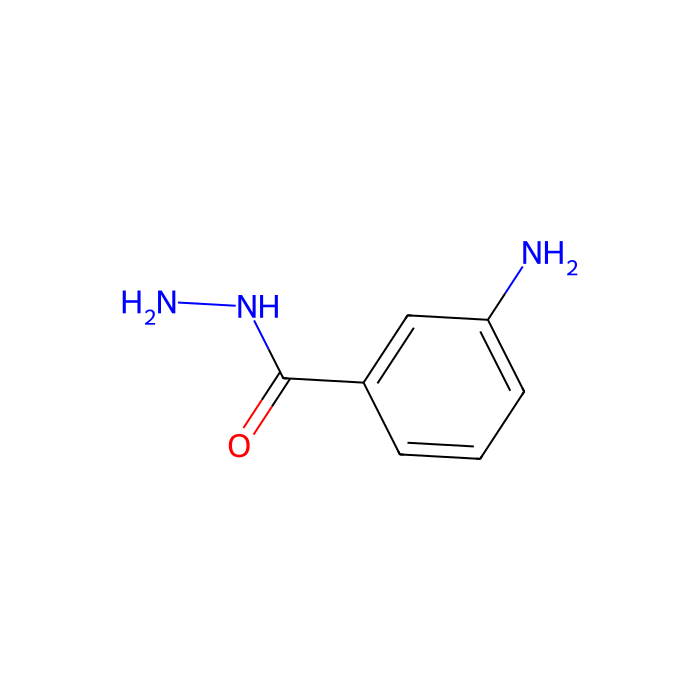
Aromatic ring: a benzene core bearing two substituents in the meta (3-) relationship.
Functional groups: primary aniline (–NH2) on the ring; acyl hydrazide (–CONH–NH2) para/meta substituted relative to each other on the ring framework.
Donor/acceptor pattern: three hydrogen-bond donors (aniline NH2, hydrazide NH, terminal NH2) and two acceptors (carbonyl O, hydrazide imide N), conferring polarity and multiple H-bonding modes.
2D description: A monosubstituted aniline (meta-amino) directly connected to a benzamide whose amide nitrogen is further substituted with a terminal –NH2 (hydrazide). No stereogenic centers; planar aromatic core with a rotatable C(=O)–N–N fragment.
Synthetic Utility
General reactivity map (literature/practice)
Nucleophilicity hierarchy: hydrazide terminal –NH2 > hydrazide –NH– (acylated) > aniline –NH2. This enables selective transformations when properly controlled.
Transformations:
Hydrazone formation with aldehydes/ketones (reversible; driven by removal of water or by acid catalysis; reductive stabilization possible).
Acylation to diacylhydrazides; subsequent cyclodehydration to 1,3,4-oxadiazoles (Freund–Moureu type) or to 1,2,4-triazoles via appropriate acyl/imidoyl partners.
Conversion to acyl azides via nitrosation (e.g., NaNO2/HCl then rearrangement conditions) enabling Curtius rearrangements to isocyanates and downstream ureas/carbamates.
Urea/carbamate formation with carbonyl diimidazole (CDI) or phosgene equivalents.
3-Aminobenzhydrazide is a “two-handle” synthon: an aniline for aromatic diversification and a hydrazide for carbonyl capture or heterocycle formation. It streamlines parallel library synthesis by enabling orthogonal protection strategies (e.g., protect aniline as acetanilide/Boc; temporarily mask hydrazide as a hydrazone).
Practical notes
Protecting groups: Boc or Cbz on the aniline; benzaldehyde or acetone hydrazones to mask the hydrazide during harsh steps.
Analysis: distinguish E/Z hydrazones by 1H NMR (imine proton coupling, NOE) and 13C NMR (C=N shifts).
Target Specificity
Not applicable
This product is a small-molecule reagent, not a biological targeting reagent (e.g., antibody, enzyme inhibitor with defined biological target for this listing). No antigen/epitope or species reactivity applies.
We use cookies to ensure the website functions properly and, where permitted, to improve your experience. You can manage your preferences at any time in Settings. Learn more in our Cookie Policy.
Shall we send you a message when we have discounts available?
Remind me later
Thank you! Please check your email inbox to confirm.
Products are supplied to verified businesses, institutions, and qualified professionals for research and development use only. Not for use in humans, animals, diagnosis, or therapy.

 K2211085