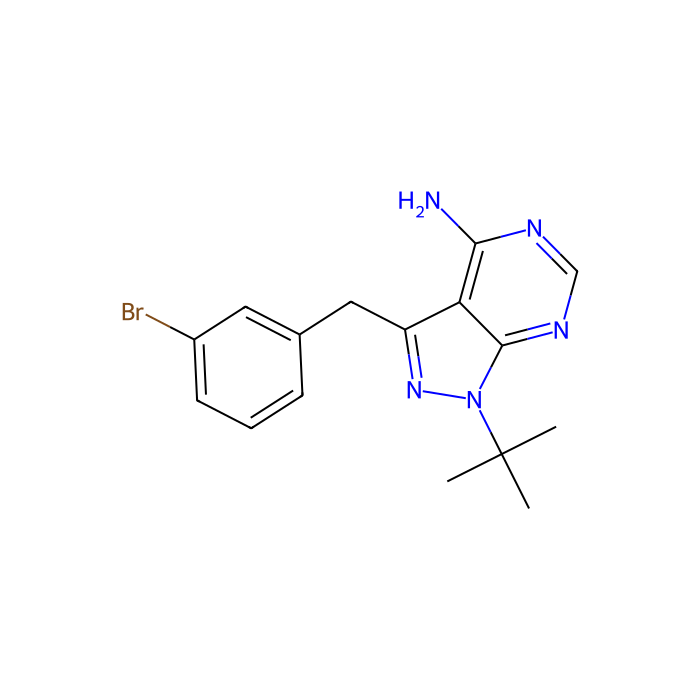
Store at +4°C. Store under desiccating conditions. The product can be stored for up to 12 months.
Especificaciones
Sinónimos
3-[(3-bromophenyl)methyl]-1-tert-butyl-pyrazolo[3,4-d]pyrimidin-4-amine | 3-[(3-bromophenyl)methyl]-1-tert-butylpyrazolo[3,4-d]pyrimidin-4-amine | 3-BrB-PP1 | 3BrB-PP1 | 3-[(3-Bromophenyl)methyl]-1-tert-butyl-1H-pyrazolo[3,4-d]pyrimidin-4-amine | 3-(3-Bromobenzyl)-1-Tert-Butyl-1h-Pyrazolo[3,4-D]pyrimidin-4-Amine | 3-[(3-Bromophenyl)methyl Show more
Mecanismos bioquímicos y fisiológicos
Small molecule Akt inhibitor.
Condiciones de almacenamiento de almacenamiento
Store at 2-8°C,Desiccated
Enviado en
Wet ice
Este producto requiere envío en cadena de frío. Los servicios terrestres y otros servicios económicos no están disponibles.
Nota
Wherever possible, you should prepare and use solutions on the same day. However, if you need to make up stock solutions in advance, we recommend that you store the solution as aliquots in tightly sealed vials at -20°C. Generally, these will be useable for up to one month. Before use, and prior to opening the vial we recommend that you allow your product to equilibrate to room temperature for at least 1 hour. Need more advice on solubility, usage and handling? Please visit our frequently asked questions (FAQ) page for more details.
This compound belongs to the class of organic compounds known as pyrazolo[3,4-d]pyrimidines. These are aromatic heterocyclic compounds containing a pyrazolo[3,4-d]pyrimidine ring system, which consists of a pyrazole ring fused to but and not sharing a nitrogen atom with a pyrimidine ring.
External Descriptors
Not available
1. Djoumbou Feunang Y, Eisner R, Knox C, Chepelev L, Hastings J, Owen G, Fahy E, Steinbeck C, Subramanian S, Bolton E, Greiner R, and Wishart DS. ClassyFire: Automated Chemical Classification With A Comprehensive, Computable Taxonomy. Journal of Cheminformatics, 2016, 8:61.
Determine the necessary mass, volume, or concentration for preparing a solution.
Dilution Calculator
Determine the dilution needed to prepare a stock solution.
Reconstitution Calculator
Reseñas
Reseñas de cliente
Application Protocols
Item-specific, validated application protocols are not provided in the Product Data. The following is general guidance for small-molecule tool compounds in biochemical and cell-based assays.
General protocol (biochemical kinase assay)
Prepare a 10–50 mM stock in anhydrous DMSO; store aliquots at 2–8 °C (short term) or colder if appropriate.
Assemble kinase reaction in HEPES or Tris buffer with required cofactors (e.g., Mg2+, ATP), substrate, and serial dilutions of the compound to generate concentration–response curves.
Maintain constant final DMSO across wells (e.g., 0.1% v/v). Include vehicle controls and, where relevant, non-analog-sensitive controls.
Incubate per enzyme kinetics; quantify activity via ADP formation, phosphate release, or substrate phosphorylation readouts.
General protocol (cell-based assay)
Dilute DMSO stock into culture medium to desired concentrations; keep DMSO ≤0.1–0.5% v/v as tolerated.
Treat cells for defined intervals; monitor viability and target-pathway readouts.
Documentation
Record lot number, stock concentration, dilution schemes, and assay conditions. Confirm integrity by LC–MS before critical experiments.
Note: These are non-item-specific recommendations. For validated conditions with this exact SKU, consult future technical notes or your lab’s method development.
Biological Roles
Scope: The following describes general, literature-based roles of PP1-family pyrazolopyrimidine tool compounds; it is not item-specific performance data.
Mechanistic class: ATP-competitive small molecules developed as chemical genetics probes for protein kinases. Sterically “bumped” analogs are designed to preferentially engage engineered, analog-sensitive kinase mutants while showing reduced activity on wild-type kinases.
Research utility: enable acute, reversible perturbation of kinase signaling, allowing time-resolved studies of phosphorylation-dependent cellular processes (e.g., cell cycle checkpoints, cytoskeletal dynamics, transcriptional regulation) in cells and model organisms.
Binding determinants: heteroaromatic core forms hinge-binding H-bonds; aryl substituents occupy engineered pockets created by gatekeeper mutations, increasing apparent selectivity in AS-kinase systems.
Cellular considerations: permeability is often adequate due to compact, aromatic scaffolds; solubility limitations are commonly mitigated via DMSO stocks and low final DMSO percentages in culture media.
Assay contexts: in vitro kinase assays, CETSA/DSF thermal stabilization, pull-downs with immobilized analogs, and live-cell imaging with rapid wash-in/wash-out.
Important note
Actual biological potency, selectivity, and off-target profiles for this catalog item are not provided in the Product Data and can vary with system and conditions. Users should independently determine working concentrations, exposure times, and controls for their specific assays.
Buffer Applications
Applicability: This compound is not a buffer. However, successful use in biochemical assays depends on compatible buffer systems and solvent management.
General guidance (practice-based)
Stock and dilution: dissolve in DMSO (e.g., 10–50 mM). Dilute into assay buffer with vigorous mixing to a final DMSO content typically ≤0.1–1% v/v, depending on enzyme/cell tolerance.
Common assay buffers: HEPES (pH 7.2–7.5), Tris-HCl (pH 7.5–8.0), or PBS for cell-based work. Include Mg2+/Mn2+ as needed for kinase reactions. Maintain constant ionic strength when comparing treated vs. control samples.
Additives: 0.01–0.05% Tween-20 can reduce nonspecific adsorption to plastics. BSA (0.1–0.5 mg/mL) may stabilize proteins in kinase assays but verify it does not alter apparent potency.
Filtration: if precipitation occurs after dilution, pass solutions through a 0.22 μm filter. Avoid buffers with high organic content unless required by the assay.
Light and moisture: limit exposure during assay setup; prepare fresh working solutions immediately before use.
Not specified for this item
Any validated buffer recipes or pH ranges specific to 3-BrB-PP1 are not provided in the Product Data; users should optimize empirically for their system.
Green Alternatives
Context: As a specialized research tool compound, 3-BrB-PP1 is not a solvent or commodity reagent where greener drop-in replacements are typical. Nevertheless, greener practices can be applied to its handling and use.
Greener handling strategies (general)
Solvent minimization: prepare concentrated DMSO stocks (e.g., 10–50 mM) to reduce overall solvent volumes during dilutions.
Prefer aqueous buffers: dilute stocks into water-based buffers rather than purely organic media when assay design allows.
Energy efficiency: dissolve at ambient temperature; if warming is needed, limit to ≤37 °C and short durations.
Waste reduction: aliquot stocks to avoid repeated freeze–thaw cycles and premature discard; scale experiments to minimize unused solution.
Comparison of co-solvent options (general)
DMSO: high solvating power; low volatility; readily recyclable in some facilities; potential for dermal absorption—use care.
Ethanol: bio-derived availability; higher volatility and flammability; solubility often lower than DMSO for heteroaromatics.
PEG-400/water: can aid delivery at very low DMSO; higher viscosity may complicate pipetting.
Packaging and storage considerations
Utilize desiccant and light-protective containers to extend shelf-life, reducing the need for frequent reorders and associated transport footprint.
Conclusion: No direct “green substitute” for the compound itself exists. Focus on greener solvent choices, right-sizing experiments, and responsible waste management.
Pharmaceutical Uses
This product is sold strictly for research use only (Product Data). It is not approved for human or veterinary use, diagnostic procedures, or as a drug substance/excipient.
Context (general)
PP1-family pyrazolopyrimidines are primarily employed as laboratory chemical probes rather than as formulation components. They are not typical pharmaceutical excipients.
While small-molecule kinase ligands can inform medicinal chemistry campaigns, any translation to pharmaceutical development requires independent synthesis, quality systems (cGMP), comprehensive CMC characterization, and regulatory evaluation—outside the scope of this catalog product.
Manufacturing/formulation relevance
None specified for this item; refer to CoA/Spec Sheet if any pharmacopoeial or compendial information exists (unlikely for specialized research probes).
Guidance
Do not use in humans or clinical diagnostics. For preclinical formulation R&D, handle as an investigational research chemical; establish independent specifications, impurity profiles, and stability-indicating methods as needed.
Physical Properties
Item-specific physical constants
Molecular weight: Not specified for this item; refer to CoA/Spec Sheet.
Molecular formula: Not specified for this item; refer to CoA/Spec Sheet.
Appearance: Not specified for this item; refer to CoA/Spec Sheet.
Melting point: Not specified for this item; refer to CoA/Spec Sheet.
Boiling point: Not applicable (decomposes before boiling; literature note for similar heteroaromatic solids).
Density, refractive index, UV cutoff: Not specified for this item; refer to CoA/Spec Sheet.
General/literature guidance for PP1-type pyrazolopyrimidines (not a specification)
Physical state: usually off-white to pale solid with high thermal stability until decomposition.
Solubility profile: typically sparingly soluble in water; soluble in DMSO and DMF; limited solubility in alcohols and minimal in hexanes. Aqueous solubility often increases with co-solvent (DMSO ≤1–2% v/v) or surfactant.
Ionization: the ring nitrogens are weak bases; an exocyclic amine can engage in H-bonding. Apparent pKa values vary with substitution; many pyrazolopyrimidines remain largely neutral at physiological pH, aiding membrane permeability in cells.
LogP/logD (trend): aryl-bromide substitution increases lipophilicity; many PP1 analogs exhibit logP in the moderate range, balancing target engagement and solubility.
Practical notes
Prepare concentrated DMSO stocks (e.g., 10–50 mM), then dilute into buffered media with vigorous mixing to avoid precipitation.
Filter (0.22 μm) if particulate is observed after dilution; avoid strong acids/bases that may compromise heteroaromatic integrity.
Quality and Grades
Item-specific grade/purity
Grade/Purity: Not specified for this item; refer to CoA/Spec Sheet.
Guidance for interpreting grades (general)
Research grade: typical for screening compounds and chemical probes; purity often ≥95% by HPLC/LC–MS unless otherwise stated. Verify chromatographic purity and identity (MS, NMR) before critical studies.
HPLC grade (for solvents) vs. assay/chemical purity (for solids): for small-molecule tools, the key metrics are HPLC area%, residual solvents, water content (KF), and identity confirmation by HRMS/1H NMR.
Salt form/solvate: confirm whether the item is a free base, salt, or solvate; this impacts molecular weight and solution preparation.
Stabilizers: none are indicated in the Product Data. If stability additives are present for any lot, they will be noted on the CoA.
What is specific to this listing
Storage: Store at 2–8°C, desiccated (Product Data). Shipped on wet ice. This indicates the manufacturer’s emphasis on limiting hydrolysis/oxidation and preserving assay integrity.
Best practices
For bioassays or screening, document batch/lot, purity method, and analytical traces. Re-verify purity after extended storage, especially if the container has been opened multiple times.
Reaction and Applications
This product is primarily a bioactive tool compound rather than a general synthetic reagent. As such, it is not commonly used as a stoichiometric reagent or catalyst in preparative chemistry.
General research applications (literature)
Chemical genetics: PP1-family pyrazolopyrimidines, including 3-bromobenzyl-substituted analogs, are widely used as ATP-competitive probes in analog-sensitive kinase systems to dissect signaling pathways with temporal control.
Target engagement assays: applied in cell-free kinase assays, thermal shift assays, and cellular target-validation workflows.
Structure–activity relationship (SAR) studies: the 3-bromobenzyl motif tunes sterics/electronics for engineered gatekeeper variants in AS-kinase platforms.
Practical notes (general)
Prepare fresh DMSO stock solutions and protect from light/moisture to maintain activity.
Verify compound integrity by LC–MS/1H NMR before key assays, particularly after long storage or multiple freeze–thaw events.
Use appropriate negative controls (vehicle only) and, where relevant, non-analog-sensitive wild-type enzymes to confirm selectivity attributable to engineered binding pockets.
If using in chemistry contexts
The aryl bromide substituent could, in principle, participate in cross-coupling (e.g., Suzuki, Buchwald–Hartwig) on appropriately protected scaffolds; however, such transformations are not typical end-user applications for this catalog item.
Reaction Conditions
Not a routine reagent: This product is not generally used as a catalyst or stoichiometric reagent; thus, standardized reaction conditions are not applicable.
General conditions for potential derivatization of aryl bromides on PP1-like scaffolds (literature guidance; not item-specific)
Suzuki–Miyaura coupling: Pd(PPh3)4 or Pd2(dba)3/XPhos; base K2CO3 or K3PO4; solvent dioxane/H2O or toluene/H2O; 60–100 °C; 4–18 h. Protect exocyclic amines if necessary.
Buchwald–Hartwig amination: Pd2(dba)3 or Pd(OAc)2 with BINAP/XPhos/BrettPhos; NaOtBu or Cs2CO3; toluene or dioxane; 80–110 °C.
Sonogashira: Pd(PPh3)2Cl2/CuI; Et3N or DIPEA; THF/DMF; 25–70 °C.
Assay preparation conditions (general for bioactivity work)
Stock: dissolve in dry DMSO (e.g., 10–50 mM), vortex and, if needed, sonicate briefly. Protect from light and moisture.
Working solutions: dilute into assay buffer to final DMSO typically ≤0.1–1% v/v; mix thoroughly to avoid precipitation. Prepare fresh immediately before use.
Notes
Expected yields/kinetics for derivatization will vary with substitution pattern and protection strategy; optimization is required.
No item-specific reaction conditions or performance data are provided in the Product Data.
Safety and Handling
Item-specific safety data
GHS classification: Not specified for this item; refer to SDS.
Signal word / H-statements / pictograms: Not specified for this item; refer to SDS.
General safe handling (professional laboratory practice)
Personal protective equipment: lab coat, safety glasses (ANSI Z87.1 or EN166), and appropriate chemically resistant gloves (e.g., disposable nitrile). Handle powders in a fume hood to minimize inhalation exposure.
Avoid: inhalation of dust, skin/eye contact, ingestion. Wash thoroughly after handling. Do not pipette by mouth.
First aid overview: in case of skin contact, wash with soap and water; for eye contact, rinse with water for ≥15 minutes and seek medical attention; if inhaled, move to fresh air; if ingested, rinse mouth and seek medical advice. Always follow SDS instructions.
Storage incompatibilities: separate from strong oxidizers and strong acids/bases. Avoid prolonged exposure to light and moisture which may promote degradation.
Spill/accidental release: avoid dust formation; collect with dampened disposable towels or HEPA-filtered vacuum; dispose of in accordance with institutional and local regulations.
Waste: treat as organic laboratory chemical waste; do not discharge to drains.
Special considerations for heteroaromatic kinase-tool compounds (general)
Many are bioactive; minimize environmental release and use closed systems where feasible.
If preparing DMSO stocks, prevent dermal exposure; DMSO can facilitate dermal absorption of solutes.
Authoritative information: always defer to the product’s SDS and institutional EHS guidelines.
Solvent Selection
Applicability: 3-BrB-PP1 is a heteroaromatic, moderately lipophilic research tool compound; solvent choice is driven by dissolution and downstream assay compatibility.
General guidance (literature/practice)
Stock preparation: DMSO is the primary solvent due to excellent solvating power for pyrazolopyrimidines and compatibility with biochemical assays. DMF can be used for intermediate solutions but is less preferred for biological assays.
Aqueous work: dilute DMSO stocks into phosphate- or HEPES-buffered saline with vigorous mixing; keep final DMSO ≤0.1–1% v/v depending on system tolerance.
Miscibility profile: DMSO is miscible with water and most organics; DMF and acetonitrile can assist co-solvency; avoid nonpolar solvents (e.g., hexanes) which provide negligible solubility.
Solubility troubleshooting: warm gently (≤37 °C), sonicate, or add small amounts of co-solvents (PEG-400, ethanol) if required. Filter if turbidity persists.
When to choose alternatives
Aqueous-first systems (cells/enzymes) with very low DMSO tolerance: consider cyclodextrin inclusion or small percentages of ethanol/PEG-400 in buffer to aid solubilization.
Spectroscopy: use DMSO-d6 or CD3OD for NMR; ACN/H2O (0.1% formic acid) for LC–MS.
Comparison snapshot (general)
DMSO: highest solubility, best for stocks; broadly assay-compatible.
Ethanol: moderate solubility, higher volatility; keep ≤0.5% v/v in cells.
DMF: strong solvent; limit in bioassays due to cytotoxicity and odor.
Storage and Reconstitution
Item-specific storage and shipping (Product Data)
Storage conditions: Store at 2–8 °C, desiccated.
Shipped in: Wet ice.
General reconstitution guidance (for small-molecule tool compounds; not a specification)
Solvent: dissolve in anhydrous DMSO to prepare a concentrated stock (e.g., 10–50 mM). Vortex and, if needed, sonicate briefly. If a salt form is present, verify the correct molecular weight before calculating concentrations.
Aliquoting: dispense into single-use, low-bind microtubes under dry atmosphere if possible. Minimize headspace and cap tightly.
Working solutions: dilute the DMSO stock into assay buffer or culture medium with thorough mixing. Aim for final DMSO ≤0.1–1% v/v depending on system tolerance.
Stability and handling (general)
Protect from moisture and light. Return to 2–8 °C promptly after use. Avoid repeated freeze–thaw; thaw aliquots only once.
Inspect for discoloration or precipitate upon dilution; if present, discard or refilter (0.22 μm) and re-prepare.
Unspecified item details
Appearance, exact solubility limits, and stability duration at 2–8 °C: Not specified for this item; refer to CoA/Spec Sheet.
Research use note
For research use only (Product Data). Not for human or veterinary use.
Structure and Identity
Brief overview: 3-BrB-PP1 is a member of the PP1 pyrazolopyrimidine chemotype commonly used as a small-molecule research tool in kinase chemical genetics.
Item-specific identifiers (Product Data)
CAS: 956025-99-3
CID: 24865027
InChIKey: Not specified for this item; refer to CoA/Spec Sheet.
SMILES: Not specified for this item; refer to CoA/Spec Sheet.
Molecular formula: Not specified for this item; refer to CoA/Spec Sheet.
Molecular weight: Not specified for this item; refer to CoA/Spec Sheet.
Structural features (general/literature, describing the PP1 chemotype, not a specification for this exact lot)
Substitution pattern: PP1 analogs typically bear an exocyclic amino at C4 and an N-1 substituent; “3-BrB” denotes a 3-bromobenzyl-type appendage in many literature derivatives that tunes sterics for analog-sensitive kinase pockets.
Functional groups: multiple ring nitrogens (H-bond acceptors), one exocyclic amino (H-bond donor/acceptor), and an aryl bromide (lipophilicity and polarizability modulator).
Stereochemistry: none typically present; PP1 analogs are achiral unless chiral substituents are introduced.
2D description in words (general)
A bicyclic, planar, N-rich heteroaromatic core bearing an exocyclic NH2 and an N1-bound substituent leading to a meta-brominated benzyl ring; overall a compact, moderately rigid, heteroaromatic kinase-tool scaffold.
Notes: Exact structural identifiers for this catalog item were not provided in the Product Data; consult the product CoA/SDS or spectral data for definitive identity details.
Synthetic Utility
Primary role: 3-BrB-PP1 is supplied as a finished small-molecule tool compound, not as a general synthetic building block. Nonetheless, understanding functional-group behavior can aid in derivatization or probe development.
General reactivity of PP1-type scaffolds (literature)
Aryl bromide: potential handle for Pd-catalyzed cross-couplings (Suzuki–Miyaura, Buchwald–Hartwig, Sonogashira) if protecting groups and chemoselectivity are managed. Steric environment adjacent to the heterocycle can influence oxidative addition rates.
Exocyclic amino (if present): nucleophilic and basic; can be protected (e.g., Boc, Cbz) to enable selective cross-couplings or acylations.
Ring nitrogens: relatively deactivated toward further N-alkylation under mild conditions; strong bases may induce undesired side reactions or ring opening—typically avoided.
Applications
Late-stage diversification: introduction of probe handles (alkynes/azides) for click chemistry, photoaffinity tags, or biotin for chemoproteomics.
SAR exploration: systematic modification of the aryl substituent to tune lipophilicity and sterics for engineered kinase pockets.
Caveats
Such transformations are advanced, research-only modifications and are not typical end-user workflows for this catalog item.
Item-specific reaction behavior and yields are not provided in the Product Data; any derivatization should be validated experimentally.
Target Specificity
Item-specific targeting information was not provided in the Product Data. Therefore:
Target(s): Not specified for this item; refer to CoA/Spec Sheet or primary literature for PP1-family analogs.
Species reactivity, epitope, clone/isotype: Not applicable (small molecule).
General note (literature)
PP1-type pyrazolopyrimidines are widely used in analog-sensitive (AS) kinase systems to achieve engineered selectivity. Actual selectivity and potency are system- and context-dependent and must be empirically determined for the specific kinase variant under study.
Preguntas frecuentes
How should this product be stored?
Store at 2–8 °C, desiccated. Keep the container tightly closed with desiccant — the material is moisture-sensitive.
How is this product shipped?
This product ships chilled on wet ice. Unpack on arrival and transfer it to the storage condition stated above.
What are the CAS number, molecular formula and molecular weight?
The CAS Number is 956025-99-3, the molecular formula is C16H18BrN5, and the molecular weight is 360.25 g/mol. InChIKey FTICVONBLRGQJW-UHFFFAOYSA-N.
What documentation is provided?
Available product documentation, including Certificates of Analysis (COA), Safety Data Sheets (SDS), and specification sheets, is shown in the product document area. Document availability and access follow the current site policy.
Utilizamos cookies para garantizar el correcto funcionamiento del sitio web y, cuando esté permitido, para mejorar su experiencia. Puede gestionar sus preferencias en cualquier momento en Configuración. Más información en nuestra Política de Cookies.
¿Quieres que te enviemos un mensaje cuando tengamos descuentos disponibles?
Recordármelo más tarde
¡Gracias! Por favor, revisa tu bandeja de entrada de correo electrónico para confirmar.
Products are supplied to verified businesses, institutions, and qualified professionals for research and development use only. Not for use in humans, animals, diagnosis, or therapy.