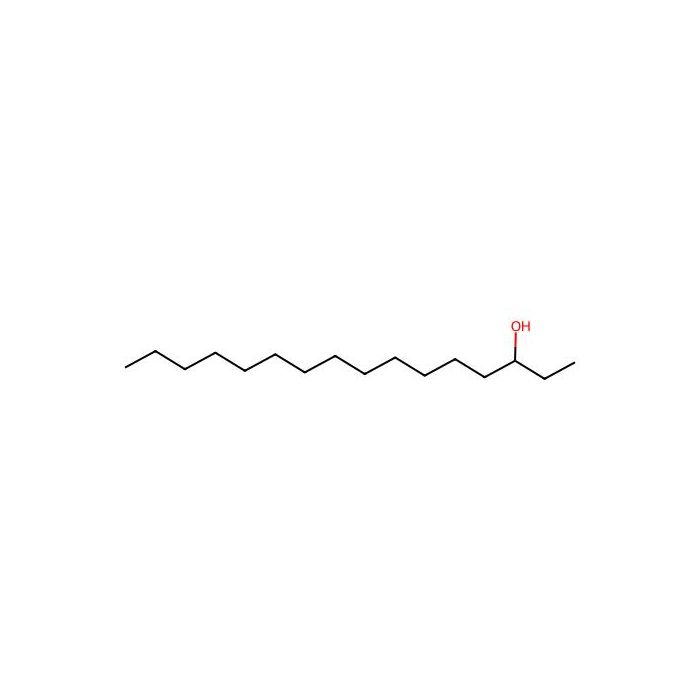
This compound belongs to the class of organic compounds known as long-chain fatty alcohols. These are fatty alcohols that have an aliphatic tail of 13 to 21 carbon atoms.
External Descriptors
Not available
1. Djoumbou Feunang Y, Eisner R, Knox C, Chepelev L, Hastings J, Owen G, Fahy E, Steinbeck C, Subramanian S, Bolton E, Greiner R, and Wishart DS. ClassyFire: Automated Chemical Classification With A Comprehensive, Computable Taxonomy. Journal of Cheminformatics, 2016, 8:61.
Certificados (CoA, COO, BSE/TSE y tabla de análisis)
C of A & Other Certificates(BSE/TSE, COO):
Analytical Chart:
Propiedades químicas y físicas
Peso molecular
242.44
XLogP3
7.100
Hydrogen Bond Donor Count
1
Hydrogen Bond Acceptor Count
1
Rotatable Bond Count
13
Exact Mass
242.261 Da
Monoisotopic Mass
242.261 Da
Topological Polar Surface Area
20.200 Ų
Heavy Atom Count
17
Formal Charge
0
Complexity
133.000
Isotope Atom Count
0
Defined Atom Stereocenter Count
0
Undefined Atom Stereocenter Count
1
Defined Bond Stereocenter Count
0
Undefined Bond Stereocenter Count
0
The total count of all stereochemical bonds
0
Covalently-Bonded Unit Count
1
Calculadoras de soluciones
Molarity Calculator
Determine the necessary mass, volume, or concentration for preparing a solution.
Dilution Calculator
Determine the dilution needed to prepare a stock solution.
Reconstitution Calculator
Reseñas
Reseñas de cliente
Application Protocols
No item-specific tested protocols are provided for this reagent. Typical laboratory uses are described in Reaction & Applications and Reaction Conditions. If you plan to use 3‑hexadecanol in surface science (e.g., Langmuir–Blodgett films) or as a reaction substrate, consult peer‑reviewed procedures and optimize for scale, solvent, temperature, and purity of this specific lot. For analytical work (GC/GC–MS), convert to a TMS ether prior to injection to improve volatility and peak shape.
Biological Roles
General biochemistry context (literature; not item-specific):
Long‑chain fatty alcohols occur in nature predominantly as primary alcohols (e.g., cetyl alcohol) within wax esters and cuticular lipids. 3‑Hexadecanol is a secondary isomer and is less commonly found in natural matrices but shares hydrophobic character and surfactant‑like behavior when derivatized.
Metabolism: Alcohol dehydrogenases oxidize secondary alcohols to ketones (here, hexadecan‑3‑one), which can be further processed via ω‑oxidation/β‑oxidation pathways after additional functionalization to acids. Due to chain length and hydrophobicity, cellular uptake is typically membrane‑associated or carrier‑mediated in model systems.
Biophysical properties: As a single‑OH amphiphile with a very long tail, it can insert into lipid bilayers, altering fluidity and phase behavior in model membranes; secondary hydroxyl placement slightly changes packing relative to primary fatty alcohols.
Use as a probe: Secondary long‑chain alcohols and their fluorescent or isotopically labeled derivatives serve as tools to study membrane partitioning, interfacial rheology, and enzyme selectivity (e.g., lipases’ preference for primary vs secondary alcohols in esterification).
Note: The above reflects general biochemical knowledge. This product is supplied strictly for research use only (per Product Data). No claims are made regarding biological activity or suitability for in vivo use.
Buffer Applications
Not typically applicable. 3‑Hexadecanol is a hydrophobic long‑chain alcohol without acid/base pairs in the physiological pH range and does not serve as a buffering agent. For aqueous work, it is generally insoluble and is handled in organic or biphasic systems. Refer instead to the Solvent Selection and Reaction & Applications sections for relevant guidance.
Green Alternatives
Context: 3‑Hexadecanol is a high molecular weight, hydrophobic reagent. Green considerations center on sourcing, solvent choice, and oxidation/activation chemistry rather than the alcohol itself.
Greener strategies (literature/general):
Bio‑based sourcing: Fatty alcohols can be sourced from renewable lipids via hydrogenation of fatty acids/esters or fermentation routes. When sustainability is critical, specify bio‑derived supply chains and request documentation.
Solvent selection: Prefer greener solvents for processing/dissolution when feasible—e.g., toluene over chlorinated solvents; 2‑MeTHF or CPME over THF/ether; ethyl acetate for extractions. For oxidations or acylations, acetonitrile or toluene can replace DCM in some protocols.
Catalysis and benign reagents: Use catalytic DMAP at low loadings for acylations; explore organocatalytic or enzyme‑catalyzed esterifications in solvent‑free or biphasic systems. For oxidation to ketone, choose milder, catalytic methods (e.g., TEMPO/bleach or O2 with nitroxyl catalysts) over chromium(VI).
Energy minimization: Many transformations proceed at room temperature with appropriate catalysts; warming slightly (35–45 °C) often suffices to dissolve without reflux.
Concise comparison (general):
Traditional: PCC/Dess–Martin in DCM; sulfonylation in DCM; extractions with hexane.
Greener: TEMPO/NaOCl in MeCN–H2O (biphasic, PTC), or O2/NOxyl catalyst in toluene; sulfonylation in MeCN; use heptane or cyclopentyl methyl ether instead of hexane/diethyl ether.
Trade‑offs:
Greener solvents may reduce solubility of very hydrophobic substrates; mild oxidations can be slower or require careful phase management. Validate on small scale.
Pharmaceutical Uses
Item-specific regulatory or pharmacopeial status: Not specified for this item; refer to CoA/Spec Sheet.
General formulation context (literature; not item-specific):
Long‑chain alcohols are used in topical and solid dosage forms as consistency agents, hydrophobic structuring materials, and co‑emulsifiers. While cetyl (1‑hexadecanol) and stearyl (1‑octadecanol) alcohols are common excipients, secondary isomers like 3‑hexadecanol can serve as model compounds or specialty structuring agents in research formulations.
Functions in formulation research: viscosity modification in semisolids; modulation of lipid matrix crystallinity; precursor for esters and ethers that act as emollients, penetration‑modulating lipids, or solid‑lipid nanoparticle constituents.
Processing notes: Melt incorporation at 50–70 °C with shear mixing is typical for long‑chain alkanols; compatibility screening with oils, waxes, and surfactants is recommended due to isomer‑dependent melting and crystallization behavior.
Important: This product is for research use only (per Product Data) and not intended for human or animal therapeutic or diagnostic use.
Physical Properties
Item-specific specs: Not specified for this item; refer to CoA/Spec Sheet.
Literature/general properties for 3‑hexadecanol (for planning only; verify experimentally):
Physical state: Waxy solid or low‑melting solid at ambient laboratory temperatures; may appear as white to off‑white flakes or needles when pure (literature trend for C16 secondary alcohols).
Solubility: Practically insoluble in water; soluble in nonpolar and moderately polar organic solvents such as hexane, heptane, toluene, dichloromethane, chloroform, diethyl ether, and hot alcohols (literature).
Polarity/logP: Strongly hydrophobic, high logP typical of C16 alkanols; the OH provides limited polarity and hydrogen‑bond donor capacity (literature).
Boiling behavior: Very high normal boiling point typical of C16 alcohols; distillation generally requires reduced pressure to avoid thermal decomposition (literature guidance).
Melting behavior: Long‑chain secondary alcohols exhibit melting transitions in the 20–40 °C range depending on isomerism and purity; polymorphism and supercooling can occur (literature trends).
Density/refractive index: Values for the liquid (above mp) are typical of long‑chain alcohols (nD ~1.43–1.45), but specific values for this isomer should be obtained from primary sources (literature ranges; not item‑specific).
Practical notes (general):
Warming to 35–45 °C often improves solubility and handling for weighing/dissolution.
For analytic prep (GC), derivatization to trimethylsilyl (TMS) ethers lowers bp and sharpens peaks.
Quality and Grades
Item-specific grade/purity and appearance: Not specified for this item; refer to CoA/Spec Sheet.
Guidance on grades for this compound class (general, not item-specific):
Research grade long-chain alcohols are typically supplied at high purity for synthetic use. Trace moisture is usually not critical for many transformations, but water-sensitive downstream reactions (e.g., sulfonylation followed by SN2) benefit from drying prior to use.
For chromatographic or surface science applications, isomeric purity (positional isomer and enantiomeric composition at C‑3) may matter. If stereochemical purity is required, request CoA details or chiral analysis.
Peroxide content is not typically a concern for saturated alcohols (unlike ethers). Metal content and UV cutoff are generally irrelevant unless the alcohol will be used for surface/monolayer studies or spectroscopy; if so, request low-UV/low-fluorescence material.
Verification recommendations:
Confirm identity by 1H/13C NMR (secondary alcohol signature: methine ~3.5–3.7 ppm), IR (broad O–H ~3300 cm−1), and GC–MS as TMS ether for sharper analysis.
If required, dry before use by azeotropic removal (toluene) or brief vacuum drying at 40–50 °C over P2O5 or molecular sieves. Document any additional internal QC on your batch records.
Reaction and Applications
This secondary fatty alcohol is a versatile hydrophobic building block. Common research‑scale applications (literature/general; adapt to your system):
Ketone synthesis: Selective oxidation at C‑3 to yield hexadecan‑3‑one using Dess–Martin periodinane (DCM, rt), PCC (DCM), Swern (DMSO/oxalyl chloride), or catalytic TEMPO/bleach variants. The long chain tolerates many conditions.
Ester formation: Acylation with acyl chlorides or anhydrides (pyridine/TEA, DMAP catalysis) gives long‑chain secondary esters used as model waxes and phase‑change materials. Steglich esterification (EDC/DMAP or DCC/DMAP) is effective in DCM.
Sulfonate activation: Conversion to tosylate/mesylate enables subsequent substitution or elimination. For secondary centers, expect more E2 (to internal alkenes) under strong base; SN2 requires soft nucleophiles and conditions mitigating elimination.
Ether synthesis: Williamson etherification via the corresponding alkoxide (NaH/KOtBu) with alkyl halides (primary better) leads to unsymmetrical dialkyl ethers; phase‑transfer catalysis can help with long chains.
Dehydration: Acid‑catalyzed elimination affords internal hexadecene isomers. Control of regioselectivity may require bulky acids or milder dehydrating agents.
Surface science: Long‑chain alcohols are used to prepare model monolayers, Langmuir–Blodgett films, and as hydrophobizing agents on inorganic surfaces after derivatization (e.g., as chlorosilanes formed downstream from oxidized derivatives).
Analytical standards: Useful as a model secondary alkanol in studies of alcohol reactivity, partitioning, and chromatography; often derivatized to TMS ethers for GC.
Practical tips:
Warm gently to improve mixing. For reactions requiring anhydrous conditions, generate the alkoxide with NaH in dry THF or toluene and maintain inert atmosphere.
Reaction Conditions
General conditions from literature for secondary long‑chain alcohols (adapt to your system; not item-specific):
Oxidation to ketone (hexadecan‑3‑one):
Dess–Martin periodinane (1.2–1.5 eq) in dry CH2Cl2, 0 °C to rt, 1–3 h; typical isolated yields high (70–90%).
Acid chloride (1.1 eq) with Et3N (2 eq) and catalytic DMAP (5–10 mol%) in DCM or toluene, 0 °C to rt, 1–6 h; near‑quantitative conversions typical.
Steglich (DCC or EDC) with catalytic DMAP in DCM at rt; 4–16 h.
Tosylation/mesylation:
TsCl (1.2–1.5 eq), Et3N (2 eq), DMAP (5–10 mol%) in DCM/MeCN, 0 °C to rt, 2–6 h. For secondary centers, monitor to limit elimination.
Williamson etherification:
Generate alkoxide with NaH (1.2 eq) in dry THF or toluene at 0–25 °C; add primary alkyl halide (1.2–2 eq); heat to 50–70 °C if needed; 4–18 h. Compete with E2 if secondary electrophiles used.
Dehydration:
POCl3/pyridine (0–25 °C) or catalytic acid (H2SO4, p‑TsOH) with heat; gives internal alkenes.
Operational tips:
Solubility can limit rates; warm gently and use concentrated organic phases. For biphasic oxidations, vigorous stirring and PTC (e.g., TBAB) improve mass transfer.
Purification often by silica gel chromatography using hexane/EtOAc gradients or by crystallization/melting–recrystallization depending on product mp.
Safety and Handling
Item-specific hazard data: Not specified for this item; refer to the SDS for authoritative information.
General GHS expectations for long‑chain aliphatic alcohols (literature-based guidance; not item-specific):
May cause skin and eye irritation; prolonged contact can defat skin. Inhalation hazard is low due to very low volatility, but avoid generating aerosols.
Typically combustible rather than highly flammable; high flash point. Keep away from ignition sources when heated or in melt.
PPE and engineering controls:
Wear safety glasses with side shields, lab coat, and appropriate chemically resistant gloves (e.g., nitrile). Use local exhaust if melting, spraying, or processing at elevated temperature to avoid fumes/aerosols.
Handling and storage precautions:
Store tightly closed at room temperature (per Product Data), in a dry place away from strong oxidizers and strong acids.
Long-chain alcohols can adsorb to plastics; glass containers are preferred for quantitative recovery.
When melting for transfer, use a temperature‑controlled water or oil bath; avoid overheating and open flames.
First‑aid overview (general):
Skin: Wash with soap and water; remove contaminated clothing.
Eyes: Rinse cautiously with water for several minutes; remove contact lenses if present and easy; continue rinsing. Seek medical attention if irritation persists.
Ingestion: Rinse mouth; do not induce vomiting; seek medical advice.
Waste and spills:
Absorb small spills with inert material (vermiculite); collect as non‑halogenated organic waste. Prevent entry into drains. Dispose in accordance with local regulations.
Solvent Selection
Applicability: As a hydrophobic long‑chain alcohol, solvent choice impacts dissolution, reaction rates, and analytical handling rather than serving as a solvent itself.
General solvent compatibility (literature):
Good solubility: nonpolar and moderately polar organics (hexane, heptane, toluene, xylene, cyclohexane, dichloromethane, chloroform, diethyl ether). Solubility improves notably upon warming.
Limited to poor solubility: acetonitrile, acetone (room temp), methanol/ethanol (cold). Hot alcohols can dissolve effectively.
Insoluble in water; forms emulsions with surfactants.
Selection guidance by task:
Esterification/Acylation: Use toluene, DCM, or THF with catalytic DMAP/TEA and acyl chloride/anhydride; remove water by azeotrope (toluene) or use molecular sieves (DCM, THF).
Sulfonylation (tosyl/mesyl): DCM or acetonitrile with base (TEA/DIPEA); include catalytic DMAP for rate enhancement.
Oxidation to ketone: Use acetone, DCM, or acetonitrile depending on oxidant (e.g., Dess–Martin in DCM; Swern in DMSO/CH2Cl2; TEMPO/Oxone in MeCN–H2O biphasic with phase transfer).
Ether formation: Williamson protocols often require DMF/DMSO or phase‑transfer in toluene/CH2Cl2 due to low nucleophilicity and steric hindrance of the secondary alkoxide.
Comparison note:
For fast analytics (HPLC/GC prep), dissolve in isooctane/hexane for GC or in isopropanol:acetonitrile mixtures for LC of derivatized forms. For surface deposition, high‑boiling alkanes (dodecane) or toluene minimize rapid evaporation streaks.
Storage and Reconstitution
Item-specific storage: Room temperature (per Product Data). Shipped-in container: Not specified for this item; refer to CoA/Spec Sheet. Appearance: Not specified for this item; refer to CoA/Spec Sheet.
General handling guidance (literature; not item-specific):
Keep tightly closed in a dry place. Protect from strong oxidizers and strong acids. Due to low volatility and high flash point, ambient storage is typically suitable.
If solidified, warm the container in a 35–45 °C water bath to liquefy for accurate dispensing; mix thoroughly to ensure homogeneity before sampling.
Drying (if needed): Brief vacuum drying at 40–50 °C or stirring over activated 3 Å molecular sieves in a compatible solvent (toluene, heptane) can reduce adventitious moisture for water‑sensitive steps.
Freeze–thaw: Not applicable; material is a nonaqueous waxy solid/liquid near ambient temperatures. Avoid repeated heating above necessary melting point to minimize oxidative discoloration.
Shelf life: For longest stability, minimize air exposure and store under inert gas if the material will be heated frequently in use. Inspect periodically for haze or particulate contamination and confirm identity by quick IR/NMR if critical.
Research Use Note: For research use only (per Product Data).
Structure and Identity
Brief description: 3‑Hexadecanol is a long, saturated C16 aliphatic chain bearing a single secondary alcohol at C‑3 (chiral), making it a hydrophobic fatty‑alcohol isomer useful as a waxy building block and surface‑active intermediate.
Item-specific (from Product Data):
SKU: H694650
CAS: 593-03-3
CID: 79052
InChIKey: 1606 (as provided)
Storage conditions: Room temperature
Grade/Purity: Not specified for this item; refer to CoA/Spec Sheet.
Appearance: Not specified for this item; refer to CoA/Spec Sheet.
Literature/computed identity (general information for 3‑hexadecanol, not item-specific):
Synonym(s): Hexadecan-3-ol; secondary cetyl alcohol (positional isomer of cetyl alcohol)
Structural features: linear n‑alkyl chain (C16) with a secondary alcohol at carbon 3; single stereogenic center at C‑3 (exists as R/S or racemate unless specified). No rings, no heteroatoms other than oxygen; fully saturated hydrocarbon backbone.
2D structure in words (literature): A 16‑carbon straight chain where the second carbon from the terminus is substituted with a hydroxyl (–OH): CH3–CH(OH)–CH2–(CH2)12–CH3. The OH is secondary and capable of hydrogen bonding; the long tail confers strong hydrophobicity.
Synthetic Utility
Functional handles and reactivity (literature; not item-specific):
Secondary alcohol (R2CHOH): readily oxidized to ketone; acylated to esters; converted to sulfonates (e.g., tosylate/mesylate) for substitution or elimination; forms alkoxides for etherification.
Hydrophobic scaffold: The C16 chain provides a lipophilic tail for surfactant analogs, phase‑change materials, and surface modifiers. Its length approximates many lipid acyl chains, aiding in biomimetic materials.
Ether synthesis: Williamson conditions with primary halides; Mitsunobu etherification is possible with appropriate nucleophiles, though less common for sterically hindered centers.
Dehydration/isomerization: Acid‑catalyzed E1/E2 to internal alkenes; subsequent hydrofunctionalization gives access to diversified mid‑chain derivatives.
Retrosynthetic value:
As a masked ketone (via mild oxidation) embedded in a hydrophobic matrix; as a precursor to mid‑chain functionalized long‑alkyl building blocks after activation (e.g., to halides via Appel‑type or sulfonate → halide routes).
Practical considerations:
Secondary center favors elimination over substitution after activation; choose nucleophiles/conditions accordingly.
Heterogeneous behavior (poor solubility) can limit kinetics—use warm, concentrated organic media or phase‑transfer catalysis.
Target Specificity
Not applicable. This product is a small‑molecule chemical reagent, not a biological targeting reagent or antibody. No antigen/epitope, species reactivity, clone, or isotype information is relevant.
Utilizamos cookies para garantizar el correcto funcionamiento del sitio web y, cuando esté permitido, para mejorar su experiencia. Puede gestionar sus preferencias en cualquier momento en Configuración. Más información en nuestra Política de Cookies.
¿Quieres que te enviemos un mensaje cuando tengamos descuentos disponibles?
Recordármelo más tarde
¡Gracias! Por favor, revisa tu bandeja de entrada de correo electrónico para confirmar.
Products are supplied to verified businesses, institutions, and qualified professionals for research and development use only. Not for use in humans, animals, diagnosis, or therapy.