This compound belongs to the class of organic compounds known as nitrobenzenes. These are compounds containing a nitrobenzene moiety, which consists of a benzene ring with a carbon bearing a nitro group.
External Descriptors
C-nitro compound
1. Djoumbou Feunang Y, Eisner R, Knox C, Chepelev L, Hastings J, Owen G, Fahy E, Steinbeck C, Subramanian S, Bolton E, Greiner R, and Wishart DS. ClassyFire: Automated Chemical Classification With A Comprehensive, Computable Taxonomy. Journal of Cheminformatics, 2016, 8:61.
Solubility in Acetic acid almost transparency;solubility acetone: soluble 0.5 g/10 mL, clear, yellow
Sensibilidad
Air sensitive
Punto de fusión (°C)
218°C
Peso molecular
181.150 g/mol
XLogP3
0.300
Hydrogen Bond Donor Count
2
Hydrogen Bond Acceptor Count
4
Rotatable Bond Count
1
Exact Mass
181.049 Da
Monoisotopic Mass
181.049 Da
Topological Polar Surface Area
101.000 Ų
Heavy Atom Count
13
Formal Charge
0
Complexity
206.000
Isotope Atom Count
0
Defined Atom Stereocenter Count
0
Undefined Atom Stereocenter Count
0
Defined Bond Stereocenter Count
0
Undefined Bond Stereocenter Count
0
The total count of all stereochemical bonds
0
Covalently-Bonded Unit Count
1
Calculadoras de soluciones
Molarity Calculator
Determine the necessary mass, volume, or concentration for preparing a solution.
Dilution Calculator
Determine the dilution needed to prepare a stock solution.
Reconstitution Calculator
Reseñas
Reseñas de cliente
Application Protocols
No vendor-validated biological assay protocols (e.g., WB, IHC, IF, FC) apply to this small-molecule reagent.
General laboratory use examples (literature/guidance only; adapt to your system):
Hydrazone formation (analytical derivatization):
Dissolve carbonyl analyte and 4-nitrobenzhydrazide (1.1–2.0 equiv) in ethanol; add AcOH (5 mol%); stir at rt–reflux for 1–4 h; evaporate and analyze by LC–MS/HPLC.
Bioconjugation to oxidized glycans (research):
Oxidize glycoprotein/polysaccharide with NaIO4 under ice-bath conditions; remove excess oxidant; incubate with hydrazide in acetate buffer pH 5.0 with optional aniline catalyst; purify by dialysis/SEC; optionally stabilize by NaBH3CN.
For any critical application, develop and validate a fit-for-purpose SOP. Always consult primary literature and safety documentation for reaction-specific parameters.
Biological Roles
Not a natural metabolite; 4-nitrobenzhydrazide is a synthetic nitroaromatic acyl hydrazide used in research. No endogenous biological role is established.
Chemical biology utility (general, research-only):
Carbonyl capture: Hydrazides form hydrazones with aldehyde/ketone groups on biomolecules (e.g., oxidized glycans on glycoproteins after periodate treatment), enabling immobilization, labeling, or conjugation. The para-nitro substituent modulates electron density, which can influence hydrazone formation rates and stability relative to unsubstituted benzhydrazide.
Probing/derivatization: As a derivatizing agent for carbonyl-containing metabolites in analytical workflows (e.g., LC–MS improvement via chromophore formation). Use is strictly in vitro/instrumental; not for clinical use.
Transformability for probe synthesis:
Nitro-to-amino reduction affords p-aminobenzhydrazide, enabling further coupling to reporter groups (e.g., isothiocyanates, NHS esters) while retaining the hydrazide handle for aldehyde conjugation.
Safety and compliance note: No medical or clinical claims are made. All uses are for research purposes only, and suitability must be validated in the intended assay or bioconjugation context.
Any statements herein reflect general chemical behavior of hydrazides and nitroaromatics; consult primary literature for application-specific kinetics, stability of hydrazone linkages at physiological pH, and strategies such as aniline catalysis for accelerated conjugation.
Buffer Applications
4-Nitrobenzhydrazide is not a buffering reagent and is not used to prepare classical biochemical buffers. It lacks a well-defined pKa pair suitable for maintaining pH in aqueous systems.
Practical note: When using this hydrazide in aqueous or semi-aqueous derivatizations (e.g., hydrazone formation with oxidized glycans), select an appropriate external buffer system such as:
Acetate buffer (pH 4.5–5.5) to promote hydrazone formation.
Phosphate buffer (pH 6–7.4) for subsequent stabilization steps or reductive amination, often with aniline catalysis if faster kinetics are required (literature practice).
Recipe specifics (molarities, ionic strengths) are application-dependent and should be drawn from the chosen protocol; this compound itself does not define a buffer system.
Green Alternatives
Sustainability considerations focus on solvent and reagent choices, as the substrate is a nitroaromatic hydrazide (intrinsically not “green”). Optimize around it:
Preferred solvents (greener, where feasible):
Ethanol or isopropanol for hydrazone formation; these offer good EHS profiles and easy recovery.
Ethyl acetate for extractions and some reductions; low toxicity and favorable environmental profile.
Alternatives to DMF/DMSO:
Replace DMF with MeCN, 2-MeTHF, or Cyrene (dihydrolevoglucosenone) where solubility allows. Note: strong hydrogen bonding of hydrazides may still necessitate DMF/DMSO for dissolution.
Dehydration/cyclization reagents:
Traditional reagents like POCl3 and SOCl2 are effective but hazardous. Consider milder dehydrations using EDC/HOBt or CDI in greener solvents, though yields may vary depending on substrate electronics.
Reduction strategies:
Prefer catalytic hydrogenation (H2/Pd) in EtOH over stoichiometric tin or iron salts to minimize inorganic waste. If metal-mediated reductions are necessary, Fe/NH4Cl in water/EtOH can be more benign than SnCl2/HCl.
Comparison (literature/general):
Process aspect | Conventional | Greener alternative | Trade-offs
Solvent for condensation | DMF | EtOH/iPrOH | Solubility may limit
Cyclodehydration | POCl3 | CDI/EDC (substrate-dependent) | Often lower activity
Note: Verify performance on your substrate set; greener swaps can impact rates and selectivity.
Pharmaceutical Uses
This product is provided for research use only.
Role in drug discovery/manufacturing (general, no therapeutic claims):
Building block: Acyl hydrazides are common intermediates for generating heterocycles (e.g., 1,3,4-oxadiazoles) and as linkers in structure–activity relationship (SAR) libraries.
Prodrug or conjugation chemistry: Hydrazide termini can form hydrazone linkages with carbonyl-bearing drug candidates or excipients for targeted release studies in formulation research.
Nitro group as a handle: Reduction to the aniline provides a para-aminobenzhydrazide scaffold for coupling to activated esters (NHS), isocyanates, or sulfonyl chlorides—useful in tagging or polymer–drug conjugates under development.
Excipient status: No pharmacopeial excipient status is indicated for this compound; Not specified for this item; refer to CoA/Spec Sheet for any regulatory notes.
Process considerations:
Control of residual metals and solvents is important if material is advanced into GMP-adjacent research; such specifications are Not specified for this item; refer to CoA/Spec Sheet.
Hydrolytic stability should be assessed during pre-formulation; hydrazides can undergo hydrolysis under strong acid/base or prolonged aqueous exposure.
Physical Properties
Item-specific specs (from Product Data):
Appearance: Not specified for this item; refer to CoA/Spec Sheet.
Molecular Formula: Not specified for this item; refer to CoA/Spec Sheet.
Molecular Weight: Not specified for this item; refer to CoA/Spec Sheet.
Physical state: crystalline organic solid (aromatic acyl hydrazides typically form pale yellow to off-white solids due to the nitroaromatic chromophore).
Thermal behavior: hydrazides typically decompose on strong heating; nitroaromatic hydrazides may melt with decomposition. A “boiling point” is generally not applicable (literature: decomposes before boiling under ambient pressure).
Solubility profile (literature, qualitative):
Good: polar aprotic solvents (DMF, DMSO, NMP), hot alcohols (MeOH, EtOH), acetonitrile to moderate extent.
Limited to poor: water (unless heated or with acid/base), nonpolar solvents (hexanes, toluene) due to strong H-bonding and polarity.
Acid–base behavior: terminal –NH2 and acylated –NH can engage in H-bonding; overall weakly basic/nucleophilic at the terminal N. No well-defined, high-basicity pKa; protonation typically requires strong acid (general hydrazide behavior, literature).
UV–vis: aromatic nitro group gives a modest π→π* band in near-UV; no defined HPLC-grade UV cutoff available here.
Important: Any exact numerical values for MP, BP, density, refractive index, water content, or UV cutoff are Not specified for this item; refer to CoA/Spec Sheet.
Quality and Grades
Item-specific grade/purity: Not specified for this item; refer to CoA/Spec Sheet.
What the grade typically implies (general guidance):
Research-grade organics are suitable for synthetic and analytical laboratory use. If designated as “>98%” or similar on a specific lot CoA, such purity supports most synthetic applications, including coupling and derivatization, while lower absorbance grades (e.g., HPLC grade) are relevant only when solvent behavior or UV background is critical.
Absence/presence of stabilizers: Not specified for this item; refer to CoA/Spec Sheet. Hydrazides are commonly supplied neat without stabilizers; always confirm on the label/CoA.
Trace specifications:
Metal limits, water content (Karl Fischer), residual solvents, and peroxide levels: Not specified for this item; refer to CoA/Spec Sheet.
Lot-specific documentation:
Request CoA/Spec Sheet for assay, chromatographic purity profile, residual solvent data, and any applicable spectroscopic identity verification (1H/13C NMR, IR, MS). These define the fitness-for-use in sensitive applications (e.g., SAR studies, derivatization standards).
Practical notes for professional users:
If performing quantitative derivatizations (e.g., hydrazone formation for analytical workflows), verify assay and water content for stoichiometric accuracy.
For moisture-sensitive transformations (e.g., acyl azide generation), dry the solid under vacuum at ambient temperature if permitted by the CoA before use.
Reaction and Applications
4-Nitrobenzhydrazide is a bifunctional building block combining a reactive hydrazide with a para-nitro handle for further transformations.
Derivatization chemistry:
Hydrazone formation with aldehydes/ketones (Schiff-type condensation). Typically promoted by mild acid (AcOH, p-TsOH) in EtOH/MeOH or in DMF for poorly soluble substrates. Useful for carbonyl capture, analytical derivatization, and as intermediates to heterocycles.
Heterocycle synthesis (literature):
1,3,4-Oxadiazoles by dehydrative cyclization of acyl hydrazones or diacylhydrazides (e.g., POCl3, SOCl2, P2O5, or Burgess reagent conditions). These motifs are prevalent in medicinal chemistry.
1,3,4,2-Benzothiadiazine or related scaffolds via further functionalization after nitro reduction to para-anilide hydrazides.
Curtius-type pathways from hydrazides:
Conversion of acyl hydrazides to acyl azides via nitrosation (NaNO2/HCl, 0–5 °C), enabling Curtius rearrangement to isocyanates and downstream ureas/carbamates. Strict temperature control and exclusion of excess moisture improve selectivity.
Nitro group transformations:
Chemoselective reduction (H2/Pd-C; Fe/NH4Cl; SnCl2/HCl) to the p-amino analogue, enabling diazotization, coupling, or amide bond formation on the aniline while retaining or modifying the hydrazide.
Crosslinking/bioconjugation (general research use):
Reacts with aldehyde-functionalized polymers, carbohydrates (after periodate oxidation), or surfaces to form hydrazone linkages, which can be stabilized by reductive amination (NaBH3CN) if desired.
Practical tips:
Dry conditions minimize hydrolysis during acyl azide generation.
Buffer trace acids carefully: strong acid can over-protonate the hydrazide, slowing nucleophilic steps; too little acid can slow condensation.
Reaction Conditions
General laboratory conditions reported in the literature for reactions of aryl acyl hydrazides like 4-nitrobenzhydrazide (guidance only; optimize per substrate):
Hydrazone formation with aldehydes/ketones:
Solvent: EtOH/MeOH (0.05–0.2 M); alternative DMF/DMSO for solubility.
Catalyst: AcOH (1–10 mol%) or p-TsOH (1–5 mol%).
Temperature/time: rt to reflux, 1–16 h.
Workup: filtration or aqueous quench; optional NaBH3CN reduction to stabilize imine linkage.
Diacylhydrazide/oxadiazole synthesis:
Step 1 (acylation): acyl chloride (1.0–1.2 equiv), base (Et3N or pyridine), CH2Cl2/THF, 0 °C to rt.
Step 2 (cyclodehydration): POCl3 (3–6 equiv) or SOCl2, 60–90 °C, 2–6 h; quench onto ice then neutralize.
Acyl azide (Curtius) from hydrazide:
Reagents: NaNO2 (1.1–1.5 equiv) in water; HCl (2–4 N), 0–5 °C.
Solvent: biphasic with CH2Cl2 or neat aqueous depending on substrate; keep cold.
Follow-on: isolate or generate isocyanate thermally and trap with ROH/RNH2.
Nitro group reduction:
H2 (1–3 bar), Pd/C (5–10 wt%), EtOH or EtOAc/EtOH, rt–50 °C, 2–8 h; or Fe (3–5 equiv) + NH4Cl/H2O/EtOH, 60–80 °C.
Analytical monitoring:
LC–MS or HPLC-UV (nitroaromatic chromophore aids detection); TLC in EtOAc/hexane with 1–5% MeOH or EtOAc/EtOH.
Note: No item-specific guaranteed conditions are implied. Always consult safety guidance when employing nitrosation, dehydrating agents, or hydrogenation.
Safety and Handling
GHS classification, signal word, pictograms, and H-statements: Not specified for this item; refer to SDS for authoritative safety information.
General hazards (literature/generic for nitroaromatic hydrazides):
May cause skin/eye/respiratory irritation; avoid dust generation and inhalation.
Nitroaromatic compounds can be harmful if swallowed; hydrazide functionality can be irritating to mucous membranes.
PPE and lab practices:
Wear safety glasses, lab coat, and suitable chemically resistant gloves (e.g., nitrile). Use in a fume hood to control dust and vapors during heating or reactions.
Avoid contact with strong oxidizers and strong reducing agents in uncontrolled conditions; segregate from nitrosating agents unless intentionally used under controlled synthesis.
Storage and incompatibilities:
Storage conditions (Product Data): Room temperature, under argon (argon charged). Keep tightly closed and dry, away from light and moisture to minimize degradation.
Incompatibilities (general): strong acids/bases (may cause degradation), nitrosating systems (uncontrolled acyl azide formation), powerful oxidants or reductants.
First aid (overview, defer to SDS):
Inhalation: move to fresh air; seek medical attention if symptoms persist.
Skin/eye contact: rinse with water for ≥15 minutes; remove contaminated clothing; obtain medical advice if irritation continues.
Ingestion: rinse mouth; do not induce vomiting; seek medical attention.
Fire response: Use CO2, dry chemical, or alcohol-resistant foam. Combustion may produce NOx/CO/CO2; firefighters should wear SCBA.
Solvent Selection
Choosing solvents for 4-nitrobenzhydrazide should balance its H-bonding capacity and polarity with reaction needs.
Polarity class (general): polar, protic/amphiprotic solute; best dissolved in polar aprotic solvents or hot polar protic solvents.
Hydrazone formation with aldehydes/ketones: EtOH/MeOH, sometimes with catalytic acetic acid; DMSO or DMF if substrates are poorly soluble.
Cyclodehydrations to 1,3,4-oxadiazoles: use polar aprotic media (DMF, POCl3 as both reagent and medium, or sulfonyl chlorides in chlorinated solvents under controlled conditions).
Reductions of the nitro group: alcoholic solvents (EtOH, iPrOH) with metal/acid systems, or ethyl acetate/EtOH under catalytic hydrogenation.
Comparison (general guidance):
DMSO vs DMF: DMSO often dissolves more strongly but is harder to remove; DMF offers good solubility with easier workup via aqueous quench and extraction.
Green alternatives: ethanol and ethyl acetate are preferred where feasible; 2-MeTHF or CPME may serve in downstream steps once hydrazide is derivatized to less polar products.
Drying/degassing:
For moisture-sensitive steps (e.g., acyl azide formation), use anhydrous DMF/MeCN and dry glassware; degas if radical/metal-catalyzed steps are involved.
Storage and Reconstitution
Storage (Product Data): Store at room temperature under an inert atmosphere (argon charged). Keep container tightly closed in a dry place. Protect from moisture and prolonged light exposure.
Stability considerations (general):
Solid hydrazides are typically stable when dry. Avoid prolonged exposure to strong acids/bases or nitrosating conditions. If using for moisture-sensitive transformations (e.g., acyl azide formation), consider drying under vacuum at ambient temperature before use (verify permissibility on CoA/SDS).
Reconstitution/dissolution (general guidance):
Readily dissolved in DMSO or DMF to prepare stock solutions (e.g., 0.1–0.5 M for screening). For less polar applications, use hot ethanol/methanol to aid dissolution.
Filter through 0.2 µm PTFE/NYLON if particulate is observed. Avoid aqueous stocks unless immediately used; hydrazides may hydrolyze slowly under aqueous conditions, especially at extreme pH.
Freeze–thaw: Not generally applicable to dry solids. If preparing DMSO stocks for screening, aliquot and store at 2–8 °C or −20 °C protected from moisture; minimize freeze–thaw cycles.
Shipping: Shipped via FedEx DG Service (Product Data). Inspect packaging upon receipt; equilibrate to room temperature in a dry environment before opening to prevent condensation.
For definitive shelf-life and impurity profile, consult the lot-specific CoA/Spec Sheet. Research use only.
Structure and Identity
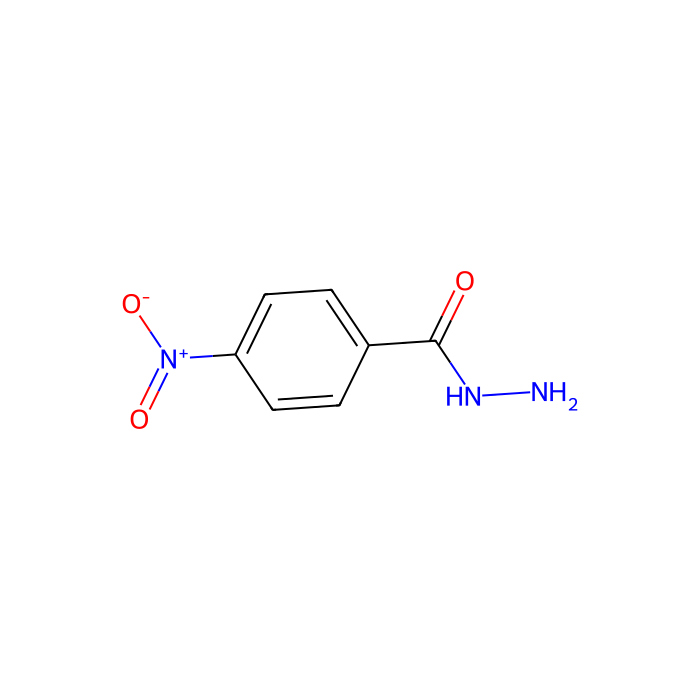
Brief overview: 4-Nitrobenzhydrazide is an aromatic acyl hydrazide bearing a para-nitro substituent on the benzoyl ring, combining a strongly electron-withdrawing nitro group with a nucleophilic hydrazide terminus.
Item-specific identifiers from Product Data:
CAS: 636-97-5
CID: 3693744
InChIKey: Not specified for this item; refer to CoA/Spec Sheet.
SMILES: Not specified for this item; refer to CoA/Spec Sheet.
Literature/computed identity data (non-spec, for reference):
Common name: 4-nitrobenzohydrazide (p-nitrobenzohydrazide)
Contains a monosubstituted benzene ring para-substituted with a nitro group (–NO2) relative to the benzoyl carbonyl.
The carboxamide is converted to a hydrazide functionality: –C(=O)–NH–NH2.
Functional groups: aromatic nitro (strong –I/–M), amide carbonyl, hydrazide N–N bond with one acylated and one terminal amino nitrogen.
2D description: a planar p-nitrobenzoyl fragment connected through the carbonyl to a –NH–NH2 tail; no stereocenters.
Notes: Literature identifiers are provided for context and typical reference only; consult the product CoA/Spec Sheet for definitive, item-specific identity details.
Synthetic Utility
Functional group synopsis:
Hydrazide: nucleophilic terminal –NH2 and an acylated –NH bound to a carbonyl; engages in condensations with carbonyls, acylations to diacylhydrazides, and nitrosation to acyl azides.
Para-nitro aryl: strongly deactivating/–M substituent; directs electrophilic substitution meta and facilitates later transformation via reduction to the corresponding aniline.
Key transformations (literature/general):
Carbonyl capture: formation of hydrazones from aldehydes/ketones; equilibria driven by removal of water (Dean–Stark), molecular sieves, or azeotropic solvents.
Oxadiazole synthesis: diacylation followed by dehydration/cyclization (POCl3, SOCl2, P2O5) providing 1,3,4-oxadiazoles, valuable bioisosteres for amide/ester.
Curtius pathway from hydrazide: in situ acyl azide generation (NaNO2/HCl, 0–5 °C), Curtius rearrangement to isocyanate, and capture by nucleophiles to form ureas/carbamates.
Reductive manipulations: nitro-to-amino (H2/Pd-C or Fe/NH4Cl), enabling diazotization/Sandmeyer diversification or coupling to electrophiles (sulfonyl chlorides, acyl chlorides) to tailor electronics prior to further hydrazide chemistry.
Polymer/solid-phase conjugation: hydrazide handles react with aldehyde-functional supports or oxidized polysaccharides to forge reversible/stabilizable linkages.
Practical guidance:
Control stoichiometry and pH for clean hydrazone formation; mild acid catalysis accelerates without over-protonating the nucleophile.
For acyl azide chemistry, exclude excess water and maintain cold temperatures to suppress side reactions; handle with appropriate precautions.
Target Specificity
This product is a small-molecule reagent, not a biological targeting agent. No antigen/epitope, species reactivity, clone, or isotype applies.
Item-specific targeting data: Not applicable.
For applications requiring specificity (e.g., antibodies, ligands), please refer to reagents designed for biological targeting. This compound is intended for chemical synthesis/derivatization work.
Preguntas frecuentes
What are the CAS number, molecular formula and molecular weight?
The CAS Number is 636-97-5, the molecular formula is C7H7N3O3, and the molecular weight is 181.15 g/mol. InChIKey FKZXYJYTUSGIQE-UHFFFAOYSA-N.
We use cookies to ensure the website functions properly and, where permitted, to improve your experience. You can manage your preferences at any time in Settings. Learn more in our Cookie Policy.
Shall we send you a message when we have discounts available?
Remind me later
Thank you! Please check your email inbox to confirm.
Products are supplied to verified businesses, institutions, and qualified professionals for research and development use only. Not for use in humans, animals, diagnosis, or therapy.

 F2523546