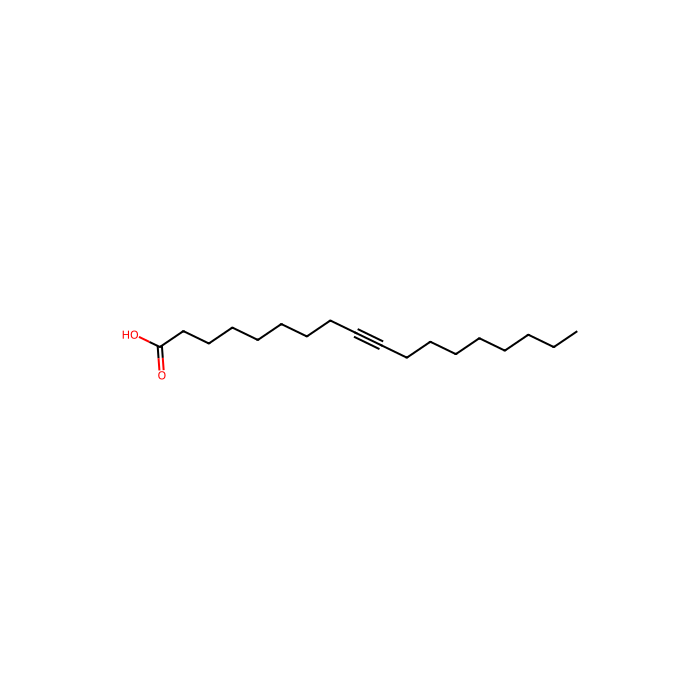
This compound belongs to the class of organic compounds known as long-chain fatty acids. These are fatty acids with an aliphatic tail that contains between 13 and 21 carbon atoms.
External Descriptors
Unsaturated fatty acids
1. Djoumbou Feunang Y, Eisner R, Knox C, Chepelev L, Hastings J, Owen G, Fahy E, Steinbeck C, Subramanian S, Bolton E, Greiner R, and Wishart DS. ClassyFire: Automated Chemical Classification With A Comprehensive, Computable Taxonomy. Journal of Cheminformatics, 2016, 8:61.
Certificados (CoA, COO, BSE/TSE y tabla de análisis)
C of A & Other Certificates(BSE/TSE, COO):
Analytical Chart:
Propiedades químicas y físicas
Punto de ebullición (°C)
189-190° C at 2 mmHg
Punto de fusión (°C)
46-47° C
Peso molecular
280.400 g/mol
XLogP3
6.300
Hydrogen Bond Donor Count
1
Hydrogen Bond Acceptor Count
2
Rotatable Bond Count
13
Exact Mass
280.24 Da
Monoisotopic Mass
280.24 Da
Topological Polar Surface Area
37.300 Ų
Heavy Atom Count
20
Formal Charge
0
Complexity
282.000
Isotope Atom Count
0
Defined Atom Stereocenter Count
0
Undefined Atom Stereocenter Count
0
Defined Bond Stereocenter Count
0
Undefined Bond Stereocenter Count
0
The total count of all stereochemical bonds
0
Covalently-Bonded Unit Count
1
Calculadoras de soluciones
Molarity Calculator
Determine the necessary mass, volume, or concentration for preparing a solution.
Dilution Calculator
Determine the dilution needed to prepare a stock solution.
Reconstitution Calculator
Reseñas
Reseñas de cliente
Application Protocols
No assay protocols are specified for this item. As a general small-molecule reagent/building block, experimental procedures will depend on the intended synthetic or materials application.
General handling suggestions:
Prepare stock solutions (e.g., 10–100 mg/mL) in dry CH2Cl2, THF, EtOAc, ethanol, or DMSO as suitable for your reaction/system.
For coupling, ensure anhydrous conditions and appropriate base/catalyst selection (see Reaction Conditions tab).
For dispersion into aqueous media, pre‑dissolve in a water‑miscible cosolvent and add slowly under vigorous mixing; consider forming sodium/potassium salts to aid dispersion.
For any specific application, consult relevant literature and adapt conditions to your substrate, scale, and equipment.
Biological Roles
This product is provided for research use only. The following describes general biochemical context for long-chain fatty acids and internal-alkyne analogs; it is not specific to any medical or clinical application.
Long-chain fatty acids (LCFAs) are core metabolites involved in energy storage (triacylglycerols), membrane architecture (phospholipids), and signaling (acylation of proteins and lipid mediators). Their carboxylate forms can be activated to acyl‑CoAs and enter β‑oxidation or lipid biosynthetic pathways (literature, general biochemistry).
Internal-alkyne fatty acid analogs can mimic chain length and hydrophobicity while altering reactivity at the site of unsaturation. The C≡C bond resists many desaturation/isomerization enzymes relative to alkenes and can participate in alternative chemical transformations during analytical derivatization (general observation).
In biochemical method development, modified fatty acids are used as substrates or probes to study enzyme selectivity (e.g., acyltransferases, lipases) or to tailor biophysical properties of model membranes and nanoparticles. Internal alkynes, unlike terminal alkynes, are not directly amenable to Cu(I)-catalyzed azide–alkyne click tagging without additional activation or alternative catalysts (literature note).
Note: For any in vitro or ex vivo biological experimentation, ensure appropriate controls, verify cytotoxicity/compatibility in the intended system, and consult institutional guidelines. No clinical or diagnostic use is intended or implied.
Buffer Applications
Not typically applicable. 9‑Octadecynoic acid is a hydrophobic fatty acid and does not serve as a conventional buffering agent. In aqueous systems, it exhibits very low solubility at neutral pH and forms micelles/soaps only upon neutralization with base and in the presence of surfactants.
Practical notes (if dispersion is required):
Prepare stock solutions in DMSO, ethanol, or isopropanol and dilute into buffered media with vigorous mixing; final cosolvent content should be minimized and controlled.
Alternatively, convert to its sodium/potassium salt to increase apparent solubility, using mild base (e.g., NaHCO3) and surfactants or serum proteins to aid dispersion.
For pH-sensitive experiments, titrate the acid in controlled conditions and account for the pKa of long-chain fatty acids (~4.7–5.0, literature) when calculating neutralization.
Green Alternatives
Greener strategy revolves around solvent/reagent selection and process design rather than replacing the substrate (the alkyne-bearing fatty acid is the desired functionality). Consider the following improvements:
Solvent choices (comparative, literature-based):
Replace chlorinated solvents (CH2Cl2/CHCl3) with EtOAc, 2‑MeTHF, cyclopentyl methyl ether (CPME), or toluene where compatible with coupling or hydrogenation steps.
Use ethanol or isopropanol as hydrogenation media instead of MeOH or chlorinated solvents.
Coupling chemistry:
Prefer EDC·HCl or DIC with catalytic DMAP in greener solvents (EtOAc, 2‑MeTHF) over DCC in CH2Cl2 to reduce urea waste handling and chlorinated emissions.
Explore enzymatic esterification (lipases) in solvent-free or ionic-liquid systems for ester formation at lower temperatures.
Workup and purification:
Employ minimal solvent and switch to biobased solvents (2‑MeTHF) for chromatography. Consider crystallization or solvent‑swap trituration when feasible to avoid silica waste.
Oxidations/cleavages:
For oxidative cleavage, ozone with careful capture/destruction or H2O2-based systems can reduce heavy-metal waste relative to permanganate/chromate protocols (process- and scale-dependent).
Tradeoffs: Greener solvents can alter rates/selectivities (e.g., amidation rates in 2‑MeTHF vs CH2Cl2). Internal alkynes may require higher temperatures or specialized catalysts for cycloadditions; greener media must be balanced against catalytic efficiency and product isolation.
Pharmaceutical Uses
No pharmacopeial grade or specific excipient designation is provided for this item. The following notes are general and for research/formulation development context only (no therapeutic claims).
Potential roles in research formulations (general):
As a hydrophobic tail component in experimental lipid nanoparticles, emulsions, and self-assembled systems where an internal alkyne provides a latent handle for post-assembly chemical modification.
As an acyl donor to prepare prodrugs (esters/amides) in medicinal chemistry studies exploring membrane permeability and depot effects (requires appropriate purity and toxicological evaluation).
Considerations:
Item-specific grade/purity: Not specified for this item; refer to CoA/Spec Sheet. For any formulation work, assess residual solvents, peroxides, and metal content per internal specifications.
Regulatory status: Not established for this product. Not intended for human or veterinary use.
Stability: Unsaturation may render the material more susceptible to autoxidation than saturated analogs; consider antioxidants and oxygen control in formulation studies.
For process development or scale-up, define acceptance criteria (acid value, peroxide value, GC/HPLC purity, identity) and qualify suppliers/grades accordingly.
Physical Properties
Item-specific specifications are not provided in the Product Data. The following values are general/literature information for 9‑octadecynoic acid and closely related long-chain fatty acids; they are NOT guaranteed specifications for this catalog item.
Molecular formula (literature): C18H32O2
Molecular weight (literature): ~280.45 g/mol
Physical state at ambient conditions: typically an oily liquid or soft solid depending on purity and temperature (literature, analogous C18 mono‑unsaturated acids)
Density: not specified for this item; literature values for C18 fatty acids are commonly around 0.89–0.92 g/mL at 20–25 °C (general guidance)
Melting point: not specified for this item; long-chain mono‑unsaturated/alkynyl acids often melt near/below room temperature (literature, general trend)
Boiling point: not practical under atmospheric pressure due to thermal decomposition; distillation (if attempted) is typically under high vacuum (literature)
Solubility (literature):
Water: very low (practically insoluble at neutral pH)
Organic: soluble in chlorinated solvents (CH2Cl2, CHCl3), ether/THF, acetone, toluene; miscible with DMSO and alcohols; forms soaps in basic aqueous media
pKa (carboxylic acid, literature): ~4.7–5.0 (long-chain fatty acids; medium and microenvironment dependent)
LogP (literature, estimate): high hydrophobicity typical of C18 fatty acids (logP >6; method-dependent)
Refractive index: Not specified for this item; refer to CoA/Spec Sheet.
For precise QC values (mp, RI, acid value, GC/HPLC purity), consult the lot-specific CoA/Spec Sheet.
Quality and Grades
Item-specific grade/purity: Not specified for this item; refer to CoA/Spec Sheet.
What to expect in the CoA (typical for fatty acids):
GC or HPLC area % purity; acid value (mg KOH/g); iodine value (degree of unsaturation); residual solvents; possibly water (Karl Fischer) and identity by NMR/IR/MS.
For alkyne-bearing lipids, some suppliers also report the positional isomer ratio and peroxide value; check the lot-specific documents.
Stabilizers: Not specified for this item; refer to CoA/Spec Sheet. In general, unsaturated lipids are sometimes packaged under inert atmosphere and/or with trace antioxidant to minimize autoxidation; verify if present before sensitive applications.
Grade guidance (general):
Research grade: suitable for organic synthesis, method development, and materials research.
High-purity (>98% area) material is recommended for precise structure–property or enzymology studies; low-UV or LC-MS grades may be desirable for analytical applications.
Practical tips for quality control (user-side):
Inspect by 1H NMR (diagnostic alkyne-adjacent methylene shifts; absence of olefinic signals if fully alkynyl), IR (sharp C≡C stretch ~2100–2140 cm⁻¹; C=O ~1700–1725 cm⁻¹), and GC/MS if volatility permits. Monitor peroxide value if storing long-term.
If performing coupling (amide/ester formation), assay acid content by titration or 31P NMR derivatization to confirm functional integrity.
Reaction and Applications
As a C18 fatty acid with an internal alkyne, 9‑octadecynoic acid serves as a versatile building block in lipid chemistry, polymer/materials science, and synthetic methodology.
Transformations of the carboxyl group:
Esterification: Fischer (acid-catalyzed in toluene/Dean–Stark) or DCC/EDC/DMAP couplings to install tags (chromophores, fluors, PEGs) or to prepare lipid esters.
Amide formation: HATU/EDC/DIC with DIPEA and catalytic DMAP or HOAt; generates alkynyl-fatty amides (useful for membrane-active materials and surfactants).
Alkyne-centered chemistry (internal alkyne):
Partial hydrogenation (Lindlar) to furnish the corresponding cis‑Δ9‑octadecenoate; full hydrogenation (Pd/C) to stearate derivatives.
Electrophilic additions: halogenation (Br2/Cl2) or hydrohalogenation across the triple bond (regiochemistry depends on conditions).
Cycloadditions: thermal Huisgen [3+2] with azides (slow, non‑selective) or metal-catalyzed annulations suited to internal alkynes (e.g., Ru-catalyzed azide–alkyne cycloaddition variants).
Radical thiol–yne addition under photoinitiation to install thioether functionality (internal alkynes are less reactive than terminal, may give mono‑addition to an alkene).
Oxidative cleavage (ozonolysis/oxidative workup; Lemieux–Johnson) to generate shorter-chain fragments (e.g., a medium-chain acid and a ketone/acid counterpart), enabling position-specific editing of the lipid chain.
Applications (general):
Synthesis of functionalized lipids, surfactants, and coatings where a latent reactive site (C≡C) is desired within the aliphatic matrix.
Model substrate to study reactivity/selectivity differences between internal vs terminal alkynes in long-chain amphiphiles.
Reaction Conditions
The following are representative literature-style conditions for common transformations of internal-alkynyl fatty acids; they are general guidance only and not specifications for this item.
Notes: For sterically hindered amines, DIC/HOAt or EDC/HOAt can improve rates; monitor by TLC/LC-MS.
Esterification (Fischer):
Catalyst: p‑TsOH (1–5 mol%)
Solvent: neat alcohol or toluene with Dean–Stark
Temperature/time: reflux, 4–24 h
Notes: Remove water continuously; protect from oxygen to limit autoxidation.
Partial hydrogenation to cis‑Δ9 alkene:
Catalyst: Lindlar Pd (5–10 wt% of substrate)
Solvent: EtOAc, MeOH, or heptane
Conditions: 1 atm H2, 0–25 °C, 1–6 h
Notes: Avoid over‑reduction by careful monitoring; charcoal filtration removes catalyst.
Full hydrogenation to saturated acid:
Catalyst: Pd/C (5–10 wt%)
Solvent: EtOH or AcOEt; 1–3 atm H2; 25–50 °C, 2–8 h.
Thiol–yne addition (mono‑addition favored with internal alkynes):
Initiation: UV (365 nm) with photoinitiator (e.g., DMPA 1–2 mol%)
Solvent: CH2Cl2 or bulk
Temperature/time: ambient, minutes to 1 h
Oxidative cleavage (ozonolysis):
O3 in CH2Cl2 at −78 to −40 °C to faint blue, then oxidative workup (H2O2) or reductive (Me2S) depending on desired fragments.
Safety and Handling
Classification and labeling:
GHS classification (item-specific): Not specified for this item; refer to SDS.
Signal word, pictograms, H-statements: Not specified for this item; refer to SDS.
General hazards (literature/analogous materials): Long-chain fatty acids are generally of low acute toxicity but can cause skin/eye irritation; heated material may cause thermal burns; spills create slip hazards.
PPE: Wear lab coat, safety glasses, and appropriate chemical-resistant gloves (e.g., nitrile). Use in a well‑ventilated area or fume hood when heating, aerosolizing, or handling reagents for derivatization.
Incompatibilities: Strong oxidizers (risk of exothermic reaction), strong bases/alkoxides (rapid soap formation), strong reducing agents (in presence of unsaturation), halogenating agents (electrophilic addition to alkyne). Avoid nitrating or powerful acyl activation conditions without temperature control.
Reactivity notes (general): Contains an internal alkyne susceptible to halogenation, hydrogenation (partial or full), hydroboration/oxidation (specialized), and oxidative cleavage. Carboxyl function reacts with bases to form soaps; with alcohols/amines to form esters/amides.
First aid (overview; defer to SDS):
Skin/eyes: Rinse with water for at least 15 minutes; remove contaminated clothing; seek medical attention if irritation persists.
Inhalation: Move to fresh air; seek medical attention if symptoms occur.
Ingestion: Rinse mouth; do not induce vomiting; seek medical attention.
Fire safety: Combustible organic. Use CO2, dry chemical, or foam. Thermal decomposition may produce CO/CO2; firefighters wear SCBA.
Solvent Selection
9-Octadecynoic acid is a highly hydrophobic, long-chain carboxylic acid with an internal alkyne. Solvent choice is driven by its poor water solubility and by the needs of activation/coupling chemistry.
Polarity/miscibility profile (general):
Water: practically insoluble at neutral pH; soluble as carboxylate soaps in basic aqueous media with surfactants.
Organic: soluble in nonpolar and moderately polar aprotic solvents (hexanes, toluene, CH2Cl2, CHCl3, THF, Et2O). Also soluble in polar aprotics (DMF, DMSO) and lower alcohols.
Choosing solvents by task:
Esterification/Amidation: CH2Cl2 or DMF with DCC/EDC/HATU/HOAt/DMAP; to minimize side reactions, use dry, oxygen-free solvents.
Hydrogenation: alcohols (MeOH/EtOH), EtOAc, or hexanes under H2 with Pd/C or Lindlar (for partial, cis‑alkene formation).
Oxidative cleavage at the alkyne: CH2Cl2 or MeOH for ozonolysis; acetone/water for KMnO4 systems (conditions adjusted for internal alkynes).
Purification: normal-phase silica gel with hexanes/EtOAc or hexanes/MTBE; add 0.1–1% acetic acid to suppress tailing of the acid.
Comparison notes:
Versus terminal alkynes, internal alkynes do not require strong bases for deprotonation, simplifying solvent choice (no need for amide bases). However, they are less reactive in some cycloadditions; solvent/catalyst choices should reflect this.
Practical tips:
Warm mildly (30–40 °C) to aid dissolution; avoid prolonged heating in air to limit autoxidation. Degas for oxygen-sensitive transformations.
Storage and Reconstitution
Storage (item-specific from Product Data): Room temperature. Ship under normal conditions.
General storage guidance (literature/practice for unsaturated fatty acids):
Keep tightly closed in a dry container. Minimize exposure to air, heat, and light to reduce autoxidation of the unsaturated chain.
For long-term storage, consider inert gas blanketing (N2/Ar) and amber glass. Refrigeration (2–8 °C) can further slow oxidation, though not required per item data.
Stabilizers/antioxidants: Not specified for this item; refer to CoA/Spec Sheet. If none are present and long storage is anticipated, handle under inert atmosphere when opening/aliquoting.
Reconstitution/solubilization:
Soluble in common organic solvents such as CH2Cl2, CHCl3, THF, toluene, EtOAc, ethanol, isopropanol, and DMSO. Warm gently (30–40 °C) if needed to fully dissolve.
For aqueous use, convert to the sodium/potassium salt in situ or use surfactants/protein carriers; maintain pH above pKa (~4.7–5.0, literature) to keep the carboxylate ionized.
Freeze–thaw: Generally not applicable to neat liquids/solids; if preparing concentrated solutions, store aliquots to avoid repeated warming cycles.
Research Use: For research use only (as stated in Product Data).
Structure and Identity
9-Octadecynoic acid is a C18 monocarboxylic fatty acid bearing one internal carbon–carbon triple bond centered at the 9-position (between C9–C10 when numbered from the carboxyl carbon). The molecule is a linear, unbranched chain terminated by a carboxyl group and a methyl group, with no rings or stereocenters.
Item-specific identifiers (from Product Data):
SKU: O346306
CAS: 506-24-1
PubChem CID: 68167
InChIKey: 315956 (as provided; consult CoA/SDS for full InChIKey)
Structure description (general/literature):
Core features: carboxylic acid (–CO2H) headgroup; internal alkyne (–C≡C–) at C9–C10; linear C18 chain; terminal methyl (ω-end)
Stereochemistry: none (no chiral centers; alkyne linear at sp carbons)
Molecular formula (literature): C18H32O2
Molecular weight (literature): ~280.45 g/mol
SMILES (literature, representative): Not specified for this item; refer to CoA/Spec Sheet.
InChI (literature): Not specified for this item; refer to CoA/Spec Sheet.
Notes: Internal alkynes differ reactivity-wise from terminal alkynes (no acidic alkyne proton; no direct CuAAC). The position of unsaturation makes this a useful handle for selective transformations (e.g., partial hydrogenation to a Δ9-alkene or oxidative cleavage at the triple bond).
Synthetic Utility
9‑Octadecynoic acid offers two orthogonal handles—an acid group for condensation and an internal alkyne for selective π‑bond transformations—making it valuable in modular synthesis and materials design.
Carboxyl function:
Amide synthesis to install amines (surfactants, ionizable lipids). Use coupling reagents (HATU/EDC/DIC) with bases (DIPEA) and catalytic DMAP/HOAt for high conversions.
Ester synthesis for polymer precursors, macrocycles, or lipid tags; enzymatic routes possible for mild conditions.
Activation as acid chloride (SOCl2, oxalyl chloride) for subsequent acylations; control temperature to avoid alkyne side reactions.
Alkyne function (internal):
Hydrogenation: Lindlar for cis‑alkene (Δ9) in high selectivity; Pd/C for full saturation to stearic derivatives.
Halogenation/hydrohalogenation to generate vic‑dihalo or haloalkene intermediates for further substitution/elimination.
Hydrofunctionalizations (radical thiol–yne, hydrosilylation, hydroboration under specialized catalysts) to append functionality at mid‑chain.
Oxidative cleavage to tailor chain length or introduce carbonyl endpoints; useful in iterative lipid editing or for preparing mixed-length libraries.
Retrosynthetic value:
Serves as an internal alkyne motif embedded in a hydrophobic matrix—useful to probe how mid-chain modifications affect packing, melting behavior, and membrane interactions without altering headgroup chemistry.
Analytical leverage:
IR (C≡C stretch) and Raman signatures provide convenient confirmation of incorporation into polymers/coatings; 13C NMR shows characteristic sp‑carbon resonances around 70–90 ppm (solvent- and reference-dependent).
Target Specificity
Not applicable. This product is a small-molecule fatty acid, not an antibody, enzyme, or affinity reagent. No antigen/epitope/clone/isotype information applies.
We use cookies to ensure the website functions properly and, where permitted, to improve your experience. You can manage your preferences at any time in Settings. Learn more in our Cookie Policy.
Shall we send you a message when we have discounts available?
Remind me later
Thank you! Please check your email inbox to confirm.
Products are supplied to verified businesses, institutions, and qualified professionals for research and development use only. Not for use in humans, animals, diagnosis, or therapy.