Determine the necessary mass, volume, or concentration for preparing a solution.
| Activity Type | Activity Value -log(M) | Mechanism of Action | Activity Reference | Publications (PubMed IDs) |
|---|

Taxonomy Tree
| Kingdom | Organic compounds |
|---|---|
| Superclass | Organoheterocyclic compounds |
| Clase | Imidazopyrimidines |
| Subclass | Purines and purine derivatives |
| Intermediate Tree Nodes | Not available |
| Direct Parent | Purinones |
| Alternative Parents | Pyrimidines and pyrimidine derivatives N-substituted imidazoles Benzene and substituted derivatives Tertiary carboxylic acid amides Heteroaromatic compounds Ureas Azacyclic compounds Organonitrogen compounds Organic oxides Hydrocarbon derivatives Carbonyl compounds |
| Molecular Framework | Aromatic heteropolycyclic compounds |
| Substituents | Purinone - Monocyclic benzene moiety - N-substituted imidazole - Benzenoid - Pyrimidine - Azole - Imidazole - Heteroaromatic compound - Tertiary carboxylic acid amide - Carboxamide group - Urea - Carboxylic acid derivative - Azacycle - Organic nitrogen compound - Hydrocarbon derivative - Organic oxide - Carbonyl group - Organic oxygen compound - Organonitrogen compound - Organooxygen compound - Aromatic heteropolycyclic compound |
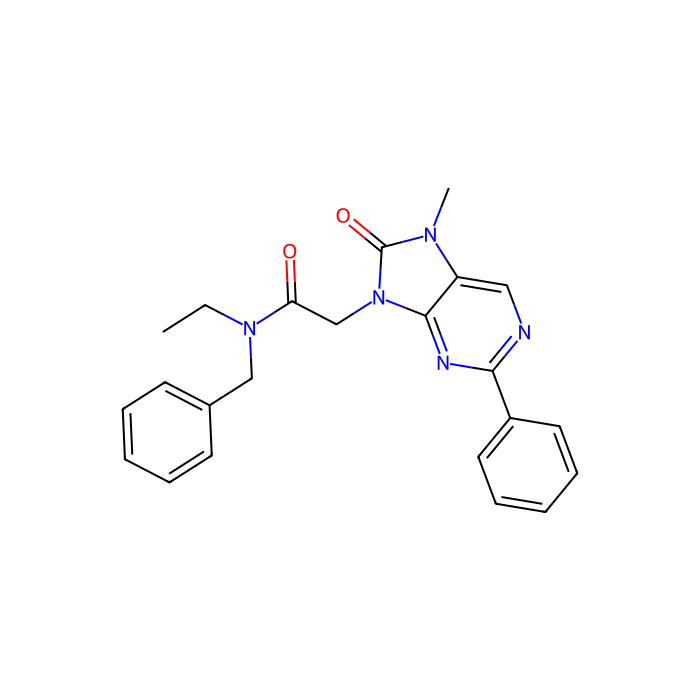
| Descripción | This compound belongs to the class of organic compounds known as purinones. These are purines in which the purine moiety bears a C=O group. Purine is a bicyclic aromatic compound made up of a pyrimidine ring fused to an imidazole ring. |
| External Descriptors | Not available |
| Activity Type | Activity Value -log(M) | Mechanism of Action | Activity Reference | Publications (PubMed IDs) |
|---|
| Activity Type | Activity Value -log(M) | Mechanism of Action | Activity Reference | Publications (PubMed IDs) |
|---|
| Activity Type | Relation | Activity value | Units | Action Type | Journal | PubMed Id | doi | Assay Aladdin ID |
|---|
| Activity Type | Relation | Activity value | Units | Action Type | Journal | PubMed Id | doi | Assay Aladdin ID |
|---|
| Activity Type | Relation | Activity value | Units | Action Type | Journal | PubMed Id | doi | Assay Aladdin ID |
|---|
| Activity Type | Relation | Activity value | Units | Action Type | Journal | PubMed Id | doi | Assay Aladdin ID |
|---|
| Activity Type | Relation | Activity value | Units | Action Type | Journal | PubMed Id | doi | Assay Aladdin ID |
|---|
| Activity Type | Relation | Activity value | Units | Action Type | Journal | PubMed Id | doi | Assay Aladdin ID |
|---|
Find and download the COA for your product by matching the lot number on the packaging.
| Lot Number | Certificate Type | Fecha | Articulo |
|---|---|---|---|
 K2229071 | Certificate of Analysis | Oct 09, 2022 | A286555 |
| K2229096 | Certificate of Analysis | Oct 09, 2022 | A286555 |
| K2229097 | Certificate of Analysis | Oct 09, 2022 | A286555 |
| K2229102 | Certificate of Analysis | Oct 09, 2022 | A286555 |
| K2229103 | Certificate of Analysis | Oct 09, 2022 | A286555 |
| Solubilidad | Solvent:DMSO, Max Conc. mg/mL: 40.15, Max Conc. mM: 100 |
|---|---|
| Peso molecular | 401.500 g/mol |
| XLogP3 | 2.600 |
| Hydrogen Bond Donor Count | 0 |
| Hydrogen Bond Acceptor Count | 4 |
| Rotatable Bond Count | 6 |
| Exact Mass | 401.185 Da |
| Monoisotopic Mass | 401.185 Da |
| Topological Polar Surface Area | 69.600 Ų |
| Heavy Atom Count | 30 |
| Formal Charge | 0 |
| Complexity | 602.000 |
| Isotope Atom Count | 0 |
| Defined Atom Stereocenter Count | 0 |
| Undefined Atom Stereocenter Count | 0 |
| Defined Bond Stereocenter Count | 0 |
| Undefined Bond Stereocenter Count | 0 |
| The total count of all stereochemical bonds | 0 |
| Covalently-Bonded Unit Count | 1 |
The following protocol outlines general, literature‑based practices for using lipophilic TSPO ligands like AC 5216 in common assay formats. Adapt and validate for your system. These are not product specifications.
Context (literature): AC 5216 is widely cited as a high‑affinity ligand for the 18‑kDa translocator protein (TSPO), an evolutionarily conserved outer mitochondrial membrane protein implicated in cholesterol trafficking and various mitochondrial functions.
Key biological themes associated with TSPO modulation (literature discussion; no clinical claims):
Use considerations:
Not a buffering agent. This product does not form classical buffer systems, and no pKa information is provided for recipe development.
Practical notes for assay buffer use (general guidance for small‑molecule ligands):
Item‑specific pKa and solubility parameters are Not specified for this item; refer to CoA/Spec Sheet and confirm empirically.
Because AC 5216 is a research ligand used at micromole to milligram scales rather than a bulk solvent or commodity reagent, “green” considerations center on solvent choice, waste minimization, and handling practices rather than replacement of the compound itself.
Greener handling strategies (general, literature/context):
Small comparison (general guidance):
Note: There is no practical “green substitute” for the ligand itself when the research objective is TSPO engagement. Focus on solvent reduction, microscale experimentation, and appropriate waste segregation.
This product is provided strictly for research use only and is not intended for human or veterinary applications.
Relevant non‑clinical uses (general context):
Not applicable/Not provided:
If your use case requires regulated‑grade material (GMP/API/excipient), this research‑grade Moligand™ product is not appropriate; contact your QA group for sourcing guidance.
Item-specific physicochemical specifications are not provided in the current record.
General (literature/contextual) guidance for library TSPO ligands like AC 5216:
Important: Do not treat these general notes as product specifications. For method validation or regulatory documentation, obtain the lot-specific CoA/Spec Sheet.
What Moligand™ typically signifies (general information):
Item‑specific notes:
Practical implications for users:
Regulatory note: Research‑use only; not tested for pharmaceutical excipient compliance or clinical use.
This product is offered as a bioactive small molecule/ligand for research and screening, rather than as a general synthetic reagent. As such, it is not typically used as a stoichiometric reagent or catalyst in preparative chemistry.
Relevant research applications (literature/context for AC 5216‑like TSPO ligands):
Not typically applicable:
Practical tips:
This section is generally not applicable, as AC 5216 is used as a bioactive small molecule in assays rather than as a reagent in chemical transformations.
If employing AC 5216 in chemical biology assays (general guidance; literature context):
Important: The above are general literature practices for TSPO ligands and are not product‑specific specifications. Optimize empirically for your system. For true chemical reaction conditions (solvent, temperature, catalysts), this product is not typically used.
Primary safety data are not provided in this listing. Always consult the SDS for authoritative information.
General laboratory safety for small, lipophilic bioactive ligands:
Note: This product is for research use only. Not for human or veterinary use.
Applicability: AC 5216 is supplied as a research small molecule rather than a process reagent or bulk solvent. Solvent considerations therefore focus on preparing analytical/biological stock solutions and ensuring assay compatibility.
General guidance for lipophilic small‑molecule ligands (literature/context):
Selection rationale versus alternatives:
Item‑specific solubility and stability in these solvents are Not specified for this item; refer to CoA/Spec Sheet and confirm empirically.
Reconstitution and handling (general guidance for small‑molecule ligands):
Disposal: Dispose of unused material, solutions, and contaminated consumables as organic hazardous waste in accordance with institutional and local regulations.
Research use note: For research use only; not for human or veterinary use.
Brief overview: AC 5216 (often referenced in the literature as a high‑affinity TSPO ligand) is supplied here as a Moligand™ small‑molecule library member for research screening and target engagement studies.
Structural features (general, literature context):
2D structure (verbal description):
AC 5216 is sold as a finished small‑molecule ligand rather than as a functionalized building block. It is not typically employed as a reagent or synthon in routine organic synthesis.
Potential roles in discovery chemistry (general context):
Not typically applicable:
Note: Any chemical modification strategy should begin with confirmed structural data (SMILES/InChI) for the specific lot; these details are Not specified for this item and must be taken from the CoA/Spec Sheet or primary literature before planning synthesis.
This section (clone/isotype/antigen) applies to biologics/antibodies and is not directly applicable to a small‑molecule ligand.
General literature context for AC 5216:
No item‑specific target binding constants or selectivity panels are provided here; for quantitative values, consult the primary literature and verify experimentally with your lot.
Nuestra guía de selección de calidades cubre la pureza, el estado del estabilizador y la idoneidad de la aplicación para todas las variantes de nuestro catálogo.
Ver la guía de calidades Moligand™ →