This compound belongs to the class of organic compounds known as n-acyl-alpha amino acids and derivatives. These are compounds containing an alpha amino acid (or a derivative thereof) which bears an acyl group at its terminal nitrogen atom.
External Descriptors
Not available
1. Djoumbou Feunang Y, Eisner R, Knox C, Chepelev L, Hastings J, Owen G, Fahy E, Steinbeck C, Subramanian S, Bolton E, Greiner R, and Wishart DS. ClassyFire: Automated Chemical Classification With A Comprehensive, Computable Taxonomy. Journal of Cheminformatics, 2016, 8:61.
Determine the necessary mass, volume, or concentration for preparing a solution.
Dilution Calculator
Determine the dilution needed to prepare a stock solution.
Reconstitution Calculator
Reseñas
Reseñas de cliente
Application Protocols
No antibody or assay-specific application protocols are provided for this item. For general analytical use:
Prepare stock solutions in water, MeOH, or DMSO as appropriate; filter (0.2 μm) before LC analysis.
For LC method development, use water/MeCN (0.1% FA or ammonium formate) gradients; monitor at 210–220 nm and confirm by MS.
Item-specific, validated protocols are not specified for this item; refer to CoA/Spec Sheet and develop method conditions suited to your instrumentation and goals.
Biological Roles
Context (general)
L-Valine is an essential branched-chain amino acid involved in protein biosynthesis and energy metabolism. Ac-L-Val-NH2 is a capped, nonnatural analogue (N-acetylated, C-terminal amide) and is not incorporated into proteins. It is primarily a research tool/standard for studying physicochemical properties of peptide-like scaffolds.
Research uses (no clinical claims)
Model for peptide backbone interactions: the dual amide motif (secondary + primary amide) provides a convenient system to probe hydrogen bonding, retention in RP-HPLC, and conformational effects of a branched hydrophobic side chain.
Enzyme/protease studies: capped dipeptidic surrogates like Ac–AA–NH2 are often used to evaluate binding preferences absent of ionizable termini; Ac-L-Val-NH2 can function as a minimal fragment in such structure–activity explorations (literature context).
Physicochemical implications
Neutral overall charge across physiological pH due to amide capping minimizes electrostatic interactions and highlights hydrophobic and H-bonding contributions.
The isopropyl side chain mimics hydrophobic residues in protein cores, enabling calibration of hydropathy indices or partition trends in model systems.
Note: All uses are for research and laboratory investigations only.
Buffer Applications
This compound is not a buffering agent and lacks a useful acid/base pair in the physiological pH range due to amide capping at both termini.
Practical guidance
Do not use as a primary buffer. If dissolution in aqueous media is needed, prepare solutions in an appropriate external buffer (e.g., phosphate, HEPES, MOPS) at the desired pH.
The compound is largely non-ionizable from pH ~2–12 (literature context), so solution pH will be governed by the chosen buffer, not by this solute.
Green Alternatives
While Ac-L-Val-NH2 itself is a solid building block, greener choices mainly concern solvent and coupling reagent selection in its use.
Greener solvent options (literature guidance)
Replace DMF/NMP with N-butylpyrrolidinone (NBP), propylene carbonate (PC), Cyrene, or γ-valerolactone (GVL) for solution-phase manipulations when compatible with reagents.
Use 2-MeTHF or CPME in workups/recrystallizations instead of dichloromethane or THF where solubility permits.
Coupling chemistry considerations
Favor less hazardous activators such as CDI or DMTMM in aqueous or green-organic media for forming downstream linkages, minimizing azabenzotriazole-based additives.
Employ water-assisted or micellar catalysis (e.g., TPGS-750-M systems) to reduce organic solvent volumes for ancillary transformations.
Comparison snapshot (general)
DMF/NMP: excellent solvency; reproductive toxicity concerns; difficult to remove. Greener alternatives (NBP, Cyrene) offer lower toxicity and improved sustainability, with sometimes higher viscosity and different reagent solubilities.
DCM vs. 2-MeTHF: DCM has high volatility and environmental burden; 2-MeTHF is bio-derived and exhibits good extraction/crystallization performance but can form peroxides over long storage—manage accordingly.
Always verify reaction performance and impurity profiles when switching to greener media.
Pharmaceutical Uses
Status
No pharmacopeial monograph or excipient designation is provided for this item. Not specified for this item; refer to CoA/Spec Sheet.
Research/manufacturing context (general)
Capped amino-acid amides such as Ac-L-Val-NH2 may be used as synthetic intermediates or reference standards during process development, chromatographic method qualification, or impurity profiling for peptide-like APIs.
Their neutral character can aid in studying permeability surrogates or adjusting physicochemical properties in pro-moiety ideation during early discovery chemistry.
Note: Not for human or veterinary use. No therapeutic or clinical claims are made or implied.
Physical Properties
Item-specific specifications
Appearance: Not specified for this item; refer to CoA/Spec Sheet.
Exact MP/BP, density, refractive index, UV cutoff: Not specified for this item; refer to CoA/Spec Sheet.
Literature/general characteristics (for context; not item specifications)
State at ambient conditions: typically a crystalline solid for small, neutral amino-acid amides.
Solubility (qualitative, literature): expected to be soluble/miscible in polar protic/aprotic media (water, MeOH, EtOH, DMSO, DMF) and poorly soluble in nonpolar solvents (hexanes, toluene).
Acid/base behavior: terminal amide functions are weakly basic/acidic and largely non-ionizable across pH 2–12; compound remains neutral in most aqueous systems.
Hygroscopicity: small amides can show mild hygroscopic behavior; store tightly closed to minimize moisture uptake (general guidance).
These properties are provided as general literature context for N-acetylated amino-acid amides. For assay-critical parameters and lot-specific values, consult the product CoA/Spec Sheet.
Quality and Grades
Item-specific quality information
Grade/Purity: Not specified for this item; refer to CoA/Spec Sheet.
How to interpret grades for this class of material (general guidance)
Peptide/building-block grade: emphasizes chiral purity (L-configuration), low residual solvents, low inorganic ash, and tight control of related substances (unacetylated amine, over-acylated species, racemization products).
Analytical grades (if specified): may include HPLC assay with UV trace purity, residual solvent GC, and water content (KF). For optical activity, [α]D may be reported to confirm L-stereochemistry.
Biochemical/research grade: suited for assay development and synthesis; not certified for clinical or GMP use unless explicitly stated.
Stabilizers/additives
None typically required for neutral amide solids; if any stabilizer/anti-caking agent were used it would be disclosed on the CoA. Not specified for this item; refer to CoA/Spec Sheet.
What to verify on receipt (practical tips)
Confirm identity by 1H/13C NMR and HRMS; check HPLC purity and enantiomeric integrity (chiral HPLC). Verify water content if moisture sensitivity affects your process.
Match lot-specific specifications on the CoA to your application needs (e.g., peptide synthesis vs. biophysical assays).
Reaction and Applications
Use profile (research)
Model substrate/standard: Ac-L-Val-NH2 serves as a neutral, hydrophobic, N- and C-capped amino-acid amide useful for studying amide hydrogen bonding, conformational preferences, and chromatographic behavior of peptide fragments.
Building block: a protected L-valine derivative for SAR probes, fragment elaboration, and pro-moiety design where free ionizable termini are undesirable.
Typical transformations (general literature)
N-acyl stability: the N-acetyl cap is stable to bases and mild acids; deprotection requires hydrolytic or enzymatic strategies and is generally not used as a temporary protecting group.
Amide coupling at side-chain or through linker installation: activation of carboxylic acids (e.g., EDC·HCl/HOBt, HATU, T3P) to couple onto nucleophiles preattached to the valine backbone via spacers.
Urea/carbamate formation: reaction of the terminal amide is not nucleophilic; transformations proceed via the remaining backbone nitrogen (blocked here) or by functionalizing adjacent positions through preinstalled handles.
Practical tips
Maintain L-stereochemistry: perform transformations at ≤25 °C in neutral-to-slightly basic media to minimize epimerization at the α-center.
Dry conditions: while the solid is generally stable, coupling reagents are moisture sensitive—use anhydrous solvents and inert atmosphere where appropriate.
Analytics: chiral HPLC and derivatization (e.g., Marfey’s reagent on hydrolyzed samples) can confirm stereochemical integrity after reactions.
Reaction Conditions
General literature guidance for preparation and downstream use (not item specifications):
N-Acetylation of L-valinamide
Reagents: acetic anhydride (1.1–1.5 equiv) or acetyl chloride (1.1–1.3 equiv).
Solvent: aqueous NaHCO3 (pH ~8–9) or anhydrous MeOH/THF/DMF.
Temperature/time: 0–5 °C addition, then 1–3 h at 20–25 °C.
Workup: quench excess anhydride, extract (if nonaqueous), or isolate by concentration and recrystallization from EtOH/EtOAc.
Alternative coupling route
Couple acetic acid to L-valinamide using EDC·HCl (1.1–1.5 equiv) with catalytic HOBt/HOAt or DMAP in DMF at 0–25 °C for 2–6 h; partition into water/EtOAc and crystallize from alcohols.
Handling and purification
Avoid strong base and elevated temperature to minimize α-epimerization.
Purify by recrystallization or RP-HPLC (water/MeCN with 0.1% formic acid or ammonium formate), monitoring by UV 210–220 nm and MS.
MS (ESI+): expected [M+H]+ at m/z ~159.2 (literature for MW ~158.2).
Adjust conditions to your scale and compliance requirements; verify with small-scale trials.
Safety and Handling
GHS/SDS
Signal word, hazard statements, GHS classification, pictograms: Not specified for this item; refer to SDS.
General handling (good laboratory practice)
Avoid inhalation of dusts and contact with skin/eyes. Use in a fume hood when weighing/handling powders that can become airborne.
Recommended PPE: lab coat, safety glasses, and suitable gloves (e.g., nitrile). Wash hands thoroughly after handling.
Storage and incompatibilities
Storage: Room temperature per Product Data; keep container tightly closed and desiccated to prevent moisture uptake and clumping.
Incompatibilities (general for amides): strong oxidizers; concentrated mineral acids or strong bases can hydrolyze amide linkages under forcing conditions.
First-aid overview (refer to SDS for complete guidance)
Inhalation: move to fresh air; seek medical attention if symptoms persist.
Skin/eye contact: rinse with water for at least 15 minutes; remove contaminated clothing; obtain medical attention if irritation occurs.
Ingestion: rinse mouth; do not induce vomiting; seek medical advice.
Additional notes
Dust control: minimize generation of particulate. Consider local exhaust during transfers.
Thermal stability: typical amides are thermally stable solids but should not be heated above decomposition; avoid drying at elevated temperatures unless validated.
Always consult the product SDS for authoritative hazard and response information.
Solvent Selection
This product is a neutral, moderately polar amide. Solvent choice depends on the operation (dissolution for assays vs. use as a reagent in coupling reactions).
Polarity/miscibility profile (literature)
Good solubility: water, methanol, ethanol, isopropanol, DMSO, DMF, NMP.
Analytical stock solutions: water or aqueous buffers (pH 5–8), MeOH, or DMSO for high-concentration stocks; filter (0.2 μm) if needed.
Solution-phase reactions/couplings: DMF, NMP, or greener DMF replacements (e.g., NBP, Cyrene) to dissolve coupling reagents and bases.
Crystallization/recrystallization: alcohols (EtOH/IPA) or alcohol/EtOAc mixtures can be effective; add a nonpolar antisolvent to induce crystallization.
Comparison (general)
DMSO vs. DMF: DMSO excels for assay stocks and stability; DMF is preferred for coupling reagent solubility. Consider NBP or PC/2-MeTHF cosolvents for greener profiles.
Note: Always validate solubility and stability experimentally for your specific lot and application.
Storage and Reconstitution
Storage (from Product Data)
Store at room temperature. Ship under normal conditions.
Container and environment (general guidance)
Keep tightly sealed in a clean, dry container; protect from prolonged exposure to ambient moisture. Use a desiccator for long-term bench storage.
Stability
Neutral amide solids are typically stable for extended periods at ambient temperature when dry. Avoid strong acids/bases and high heat that can promote amide hydrolysis or racemization (general literature guidance).
Reconstitution and stock preparation (general)
Aqueous: dissolve in water or buffered aqueous media (pH 5–8). If needed, warm gently and sonicate to assist dissolution.
Organic: DMSO, MeOH, or DMF provide high solubility for concentrated stocks.
Typical working concentrations: 1–100 mM in DMSO or 1–20 mg/mL in water/alcohols (optimize to application).
Freeze–thaw
If preparing aqueous stocks for repeated use, aliquot and store refrigerated or frozen to minimize microbial growth; avoid multiple freeze–thaw cycles that may change concentration by condensation/evaporation.
For lot-specific stability and any additional handling instructions, consult the CoA/Spec Sheet and SDS. Research use only.
Structure and Identity
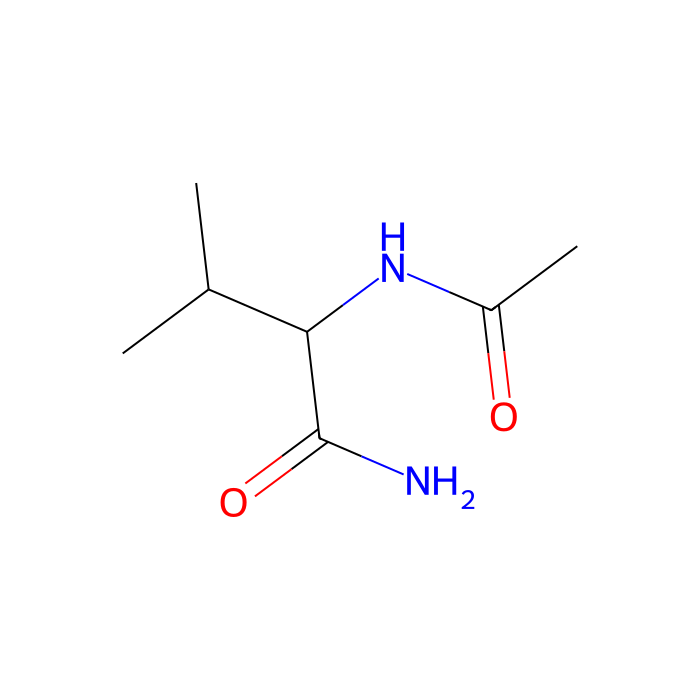
Ac-L-Val-NH2 is the N-acetyl-capped amide of L-valine (N-acetyl-L-valinamide), a neutral, capped amino-acid derivative useful as a peptide/amide model and hydrophobic building block.
Item-specific identifiers (from Product Data)
SKU: A354415
CAS: 37933-88-3
CID: 7021426
InChIKey: 396138 (as provided)
Storage conditions: Room temperature; shipped under normal conditions
Structural features (general/literature description)
Core motif: L-valine backbone bearing an N-terminal acetyl cap (Ac–) and a C-terminal primary amide (–CONH2)
Stereochemistry: single chiral center at the α-carbon; L-configuration (S at the α-carbon under standard CIP for L-valine)
2D description in words: Acetyl carbonyl linked to the α-amino nitrogen; α-carbon bears an isopropyl side chain and is bonded to a carbonyl carbon of a terminal carboxamide.
Note: Where item-specific identifiers (e.g., InChIKey string format) are atypical or incomplete, consult the CoA/Spec Sheet and SDS for definitive identity information.
Synthetic Utility
Functional group logic
N-Acetyl cap: blocks the α-amino functionality, suppressing undesired N-acylations and salt formation; stable under many conditions.
C-terminal primary amide: neutralizes the carboxylate, improving hydrophobicity relative to the acid and enabling hydrogen-bond donor/acceptor interactions in supramolecular assemblies.
Side chain: isopropyl confers hydrophobic bulk typical of valine, influencing conformational bias and packing.
Applications (general literature)
Fragment growing: use as a hydrophobic amide fragment, appending linkers via acylation/alkylation of auxiliary handles preinstalled on a scaffold.
Standards and retention markers: suitable for calibrating peptide LC methods where capped mono-residue standards help normalize retention and assess column performance.
Solid-state studies: dual-amide systems facilitate crystallographic or DSC investigations of H-bond networks and polymorphism in small-molecule peptide mimetics.
Retrosynthetic perspective
Disconnection to L-valine → valinamide → N-acetylation (acetic anhydride or acetyl chloride) preserves stereochemistry when conducted under mild, non-basic conditions.
Alternative route: direct coupling of acetic acid to L-valinamide using carbodiimide chemistry (EDC/DIC) with catalytic DMAP or HOAt/HOBt suppresses racemization.
Note: Because both termini are capped, this derivative is not directly extendable by standard peptide coupling at the α-positions without prior deprotection or functionalization.
Target Specificity
Not applicable. This product is a small-molecule amino-acid derivative, not a biological affinity reagent. No antigen/epitope, species reactivity, clone, or isotype information applies.
We use cookies to ensure the website functions properly and, where permitted, to improve your experience. You can manage your preferences at any time in Settings. Learn more in our Cookie Policy.
Shall we send you a message when we have discounts available?
Remind me later
Thank you! Please check your email inbox to confirm.
Products are supplied to verified businesses, institutions, and qualified professionals for research and development use only. Not for use in humans, animals, diagnosis, or therapy.
 C2226340
