Certificados (CoA, COO, BSE/TSE y tabla de análisis)
C of A & Other Certificates(BSE/TSE, COO):
Analytical Chart:
Calculadoras de soluciones
Molarity Calculator
Determine the necessary mass, volume, or concentration for preparing a solution.
Dilution Calculator
Determine the dilution needed to prepare a stock solution.
Reconstitution Calculator
Reseñas
Reseñas de cliente
Application Protocols
No item‑specific tested applications or protocols are provided for this SKU. The following general procedures are common for short peptides; adjust to your assay and verify experimentally.
Preparing stock solutions
Bring vial to room temperature in a desiccator. Briefly spin down.
Add an initial small volume of degassed, slightly acidic water (e.g., 1–10 mM HCl or 0.1% TFA), mix gently to dissolve, then dilute with buffer to desired concentration.
Typical stock range: 1–10 mM (limited by solubility and assay needs). Filter through 0.22 μm if sterility is required.
LC‑MS reference standard use
Prepare 0.1–10 μg/mL in water/0.1% formic acid or mobile phase. Store aliquots cold and protected from light/air. Verify retention time and mass daily in system suitability.
Conjugation (EDC/NHS) quick‑start
Dissolve peptide (1–5 mM) in MES buffer (50 mM, pH 5.5). Add NHS and EDC (2–5 eq each). React 30–60 min at 0–25°C. Quench and purify by RP‑HPLC.
Adsorption minimization for low‑ng/mL work
Include 0.01–0.1% carrier (BSA) or non‑ionic surfactant where compatible. Use low‑binding plastics or glass vials.
Consult the CoA/Spec Sheet for any item‑specific directions if provided.
Biological Roles
Context (literature; not an item specification):
Origin: ACTH (adrenocorticotropic hormone) is a pituitary peptide derived from proopiomelanocortin (POMC). ACTH(1‑4) represents its N‑terminal tetrapeptide (Ser–Tyr–Ser–Met).
Structural motif: The SYSM sequence is shared within the melanocortin family’s N‑terminus and is frequently used to probe minimal structural elements influencing receptor interactions and peptide processing.
Physicochemical profile: Combination of polar residues (Ser), an aromatic phenol (Tyr), and a thioether (Met) imparts moderate hydrophilicity with UV absorbance at 274–276 nm due to Tyr (literature).
Enzymatic processing: Short N‑terminal fragments can arise from proteolysis or aminopeptidase trimming; ACTH(1‑4) may serve as a model for studying N‑terminal modifications, oxidation of Met, and peptide degradation pathways.
Binding/biochemical relevance: While full‑length ACTH engages melanocortin receptors, very short fragments like (1‑4) are commonly employed as negative controls or to dissect contributions of the N‑terminus. Any observed activity is typically weak or context‑dependent (assay‑specific). No clinical claims are implied.
Usage note: For laboratory research only. When employing this fragment in biochemical studies, validate activity, stability, and adsorption behavior under your assay conditions, as short peptides may adhere to plastics or surfaces and can undergo rapid oxidative changes at Met.
Buffer Applications
This product is not a buffering agent and is not typically used to set or maintain pH. Instead, it is an analyte/standard or reagent dissolved in buffers.
Practical guidance for buffer use with this peptide (general):
Recommended pH range for dissolution: ~pH 3–7.4 to limit Met oxidation and backbone hydrolysis. Slightly acidic solutions (e.g., 10 mM acetate or phosphate at pH 5–6) often improve stability and solubility.
Additives: 0.1% carrier proteins (e.g., BSA) or surfactants (e.g., 0.01% Tween‑20) can reduce adsorption losses in low‑concentration assays, if compatible. Avoid oxidizing preservatives.
Ionic strength: Moderate ionic strength (50–150 mM) can minimize nonspecific interactions without salting out.
Filtration: Use low‑protein‑binding membranes (PVDF, PES) for sterile filtration.
If you need formulation‑quality buffer compositions, prepare using analytical‑grade reagents, degas to reduce dissolved oxygen, and document pH/temperature. For exact compatibility of this specific item with particular buffers/salts, refer to the CoA/Spec Sheet or perform a small‑scale solubility/stability check.
Green Alternatives
As a solid peptide analyte, ACTH(1‑4) is not a process solvent; green considerations focus on solvent choices for dissolution, purification, and analysis.
Greener handling choices (general):
Prefer water or aqueous buffers whenever possible; avoid unnecessary organic cosolvents.
If organic is required, choose lower toxicity, higher biodegradability options (e.g., ethanol) over chlorinated solvents. For analytical LC, minimize acetonitrile by using water‑rich gradients or consider methanol where chromatographically acceptable.
Reduce waste through micro‑scale preparations and reusable glassware; adopt inline filters instead of single‑use plastics when feasible.
Comparative notes (literature/general)
Water vs. DMSO: Water is non‑flammable, non‑toxic, and benign; DMSO offers high solvating power but has worker‑exposure considerations and can accelerate certain oxidative processes.
Acetonitrile vs. Methanol (LC): ACN affords lower backpressure and sharper peaks; MeOH is less toxic and more sustainable but may change selectivity and increase pressure. Optimize columns and gradients accordingly.
Small comparison (general)
Criterion | Water/Buffer | DMSO/ACN/MeOH
Safety | Highest | Moderate (flammable/toxic concerns for ACN/MeOH)
Environmental impact | Lowest | Higher
Performance | Often sufficient | Needed for high‑conc. stocks or specific LC methods
Note: Select solvents consistent with your assay and regulatory/safety requirements.
Pharmaceutical Uses
No therapeutic or clinical use is claimed. The following notes describe common research/formulation contexts for small peptides (general; not item‑specific):
Reference standard: Short peptides like ACTH(1‑4) are often used as analytical standards for method development (e.g., LC‑MS, peptide mapping), including system suitability checks and retention time/mass calibration.
Excipients/compatibility studies: Employed in model studies to evaluate peptide stability (oxidation of Met, adsorption, pH dependence) and to screen formulation variables such as buffer species, ionic strength, and antioxidants.
Device/surface interaction tests: Used to assess adsorption to vials, stoppers, and tubing due to its combination of polar and aromatic residues.
Regulatory status: No pharmacopeial monograph is asserted here. If pharmacopeial compliance (USP/EP/JP) is required for your project, confirm with Aladdin Scientific whether a compliant grade or detailed characterization is available.
Any incorporation into drug product development must be supported by your own suitability assessments and compliance checks. For research use only.
Physical Properties
Item-specific values
Appearance: Not specified for this item; refer to CoA/Spec Sheet.
Molecular weight (spec): Not specified for this item; refer to CoA/Spec Sheet.
Literature/general properties (for context; not item specification)
Form: Typically a white to off‑white solid peptide
Solubility: Readily soluble in water and aqueous buffers; high solubility often achieved in slightly acidic water (e.g., 0.1% TFA or dilute HCl). Also soluble in polar organics (e.g., DMSO) if needed.
Ionization/pKa (typical peptide values):
C‑terminal –COOH pKa ~2.0–3.0 (literature)
N‑terminal –NH3+ pKa ~7.5–9.0 (literature)
Tyr phenolic OH pKa ~10.1 (literature)
Charge state (approx., literature): Predominantly zwitterionic near neutral pH; overall charge depends on pH and ionic strength.
Hygroscopicity: Peptides can be hygroscopic; protect from moisture to maintain mass accuracy.
Thermal behavior: No true boiling point; solids generally melt/decompose rather than boil. Peptides often show gradual decomposition on heating.
Stability considerations:
Susceptible to oxidation at the Met residue; minimize exposure to air/oxidants and use oxygen‑poor storage when possible.
Aqueous solutions may undergo hydrolysis on prolonged storage, especially at elevated temperature or extreme pH.
For exact numeric values (mp, density, water content, residual solvents, UV cutoff), consult the CoA/Spec Sheet; not specified for this item.
Quality and Grades
Item-specific grade/purity: Not specified for this item; refer to CoA/Spec Sheet.
Guidance on peptide quality (general; for context)
Typical peptide grades:
Crude: Direct from synthesis, suitable for preliminary screening where minor impurities are tolerable.
Desalted: Low salt/SM impurities, improved MS performance.
Purified (e.g., >90%, >95%, >98% by HPLC): For bioassays, standards, and analytical applications.
Identity confirmation: Commonly by ESI/LC‑MS or MALDI‑TOF; sequence integrity may be supported by MS/MS. CoA typically lists observed mass and purity by HPLC.
Counter‑ion/salt form: Peptides are often isolated as trifluoroacetate (TFA) salts or acetate salts; counter‑ion content influences mass, solubility, and bioassay background. Verify salt form on the CoA.
Water and residual solvent content: Critical for accurate gravimetric dosing. If your application is mass‑critical (e.g., calibration), consider drying under vacuum and using Karl Fischer for water determination, if not already stated on the CoA.
Oxidation state: Because ACTH(1‑4) contains methionine, the oxidation state (Met, Met(O), Met(O2)) should be monitored. CoA/Spec Sheet may indicate oxidation levels or provide MS data showing major species.
Recommendation: Select grade based on end‑use (screening vs. quantitative assay). Confirm salt form, purity, and water content on the item’s CoA/Spec Sheet.
Reaction and Applications
This product is most relevant as a peptide standard or biochemical tool rather than a classical small‑molecule reagent. Typical research applications (general, literature):
Analytical standards: Use as a retention/mass reference in LC‑MS method development for peptides; SYSM provides a test case with polar residues, an aromatic ring (Tyr), and a sulfur‑containing residue (Met).
Receptor/structure–activity studies: The N‑terminal motif of ACTH and melanocortins can be evaluated in binding or enzymology assays using ACTH(1‑4) as a minimal fragment control (no clinical/therapeutic claims implied).
Conjugation chemistry: Free N‑terminus and C‑terminus enable coupling to carriers or surfaces via EDC/NHS (carboxyl) or NHS‑esters/aldehydes (N‑terminus). Tyr phenol allows diazonium coupling in specialized protocols.
Oxidation studies: Met oxidation kinetics and analytical detection can be assessed using this peptide as a model substrate for forced‑degradation method development.
Enzymatic assays: Serves as a substrate or negative control for aminopeptidases/endopeptidases probing N‑terminal processing (application‑dependent).
Practical tips
Minimize oxidation: Work under nitrogen/argon when preparing concentrated stocks; add scavengers (e.g., methionine as a sacrificial additive) where compatible.
Avoid strong base: Backbone cleavage and Tyr deprotonation at high pH can alter chromatography and assay behavior.
Quantitation: Use peptide‑appropriate extinction (Tyr, ε280 ≈ 1490 M−1 cm−1 in water, literature) or amino acid analysis/UV‑MS for accurate concentration; verify counter‑ion content for gravimetric dosing.
Reaction Conditions
Representative, literature‑style conditions for common transformations of unprotected peptides (for guidance only; not item‑specific specifications):
EDC/NHS amide coupling at C‑terminus
Solvent: Aqueous MES (50 mM, pH 5.5) or phosphate buffer (pH 6.0) with 0–20% DMF
Reagents: EDC·HCl (1–5 eq), NHS (1–5 eq) relative to peptide
Temperature/time: 0–25°C, 0.5–4 h
Notes: Keep pH ≤6.0 to reduce N‑terminus acylation; remove urea byproducts by desalting or RP‑HPLC. Protect from air to limit Met oxidation.
N‑terminal labeling with NHS‑ester dyes/tags
Solvent: Sodium bicarbonate or HEPES buffer, pH 7.5–8.3
Reagents: NHS‑ester (1.1–5 eq)
Temperature/time: 0–25°C, 15–60 min
Notes: Compete with Tyr phenol at higher pH; use minimal organic cosolvent. Quench with Tris/glycine.
Reductive amination at N‑terminus
Solvent: Acetate buffer (100 mM, pH 5.0–6.0) with 10–30% MeOH
Reagents: Aldehyde (1–10 eq), NaBH3CN (2–10 eq)
Temperature/time: 4–25°C, 2–16 h
Notes: Monitor by LC‑MS; avoid strong acids. Work under inert atmosphere.
Oxidation stress study (Met)
Solvent: Phosphate buffer, pH 7.0
Reagents: H2O2 (0.01–1%)
Temperature/time: 25°C, 5–60 min
Notes: For method development only; rapidly quenched with catalase or methionine.
Yields and kinetics are system‑dependent; optimize empirically. Always verify product integrity by LC‑MS/HPLC.
Safety and Handling
Authoritative safety data are provided in the SDS; the following is general guidance for peptide handling.
Item-specific hazard data
Signal Word: Not specified for this item; refer to SDS.
H‑Statements: Not specified for this item; refer to SDS.
GHS Classification: Not specified for this item; refer to SDS.
Pictograms: Not specified for this item; refer to SDS.
General laboratory precautions (peptides)
PPE: Lab coat, safety glasses, and suitable gloves (e.g., nitrile). Avoid generating dust or aerosols when weighing lyophilized material.
Handling: Work in a clean, dry area. Peptides can be hygroscopic; open vials briefly and reseal promptly. Use antistatic measures if needed for accurate weighing.
Incompatibilities: Strong oxidizers (risk of Met oxidation); strong acids/bases (accelerated hydrolysis). Avoid prolonged exposure to elevated temperatures.
First aid (general): If inhaled, move to fresh air. In case of skin or eye contact, rinse with water. If ingested, rinse mouth. Seek medical attention if symptoms persist. Always consult the SDS for detailed measures.
Environmental: Prevent release to the environment; dispose of in accordance with institutional and local regulations for organic laboratory waste.
Special risks for this peptide class: Methionine oxidation to sulfoxide/sulfone can occur in solution or upon air exposure; consider degassing solutions, adding compatible antioxidants, and minimizing light/air contact during long manipulations.
Research use note: For research use only. Not for human or veterinary use.
Solvent Selection
Use case: small, largely hydrophilic tetrapeptide (Ser–Tyr–Ser–Met) intended for aqueous work.
Polarity/miscibility (general):
Water: Preferred solvent; dissolution often improved by slightly acidic media (e.g., 0.1% TFA or 1–10 mM HCl) to fully protonate the N‑terminus and suppress Tyr ionization.
Buffers: Phosphate, HEPES, or acetate buffers effective within pH 3–8. Avoid high pH to limit Met oxidation and backbone hydrolysis.
Organic cosolvents: DMSO or acetonitrile can assist if high concentrations are needed; keep organic fraction minimal for biological assays.
Practical dissolution workflow (general):
Allow vial to equilibrate to room temperature in a desiccator before opening.
Briefly centrifuge to collect material.
Start with a small volume of slightly acidic water or buffer, then bring to final volume.
Filter (0.22 μm) if required for sterile applications.
Comparison to alternatives (context):
Water/buffer vs. DMSO: Water avoids DMSO‑related assay artifacts; DMSO allows higher stock concentrations but may accelerate oxidation of Met in presence of air/trace metals.
Note: Exact solubility limits for this specific item are not specified; refer to CoA/Spec Sheet or determine empirically.
Storage and Reconstitution
Item-specific storage and shipping
Storage Conditions: Store at 2–8°C, desiccated (per Product Data). Keep tightly closed to protect from moisture.
Shipped In: Wet ice (per Product Data).
Research Use Note: For research use only.
General guidance (supplementary; verify against your application)
Dry material handling: Allow vial to warm to room temperature in a desiccator before opening to prevent condensation. Reseal promptly after use.
Reconstitution: Use degassed, slightly acidic water or buffer (e.g., 1–10 mM HCl, acetate pH ~5–6) to prepare a concentrated stock. Mix gently; avoid vigorous vortexing that can introduce air.
Aliquoting: Prepare single‑use aliquots to minimize freeze–thaw and air exposure. Use low‑binding tubes.
Short‑term storage of solutions: 2–8°C, protected from light and air; use within hours to a few days depending on assay tolerance.
Longer‑term storage of solutions (general practice): Freeze aliquots at ≤−20°C or −80°C if compatible with your assay. Avoid repeated freeze–thaw cycles; thaw on ice and use promptly.
Stability considerations: Methionine is prone to oxidation; exclude oxygen (inert gas overlay), avoid high pH, and consider adding a compatible antioxidant/scavenger if appropriate.
For exact shelf life, solution stability, and any item‑specific instructions, consult the CoA/Spec Sheet and SDS.
Structure and Identity
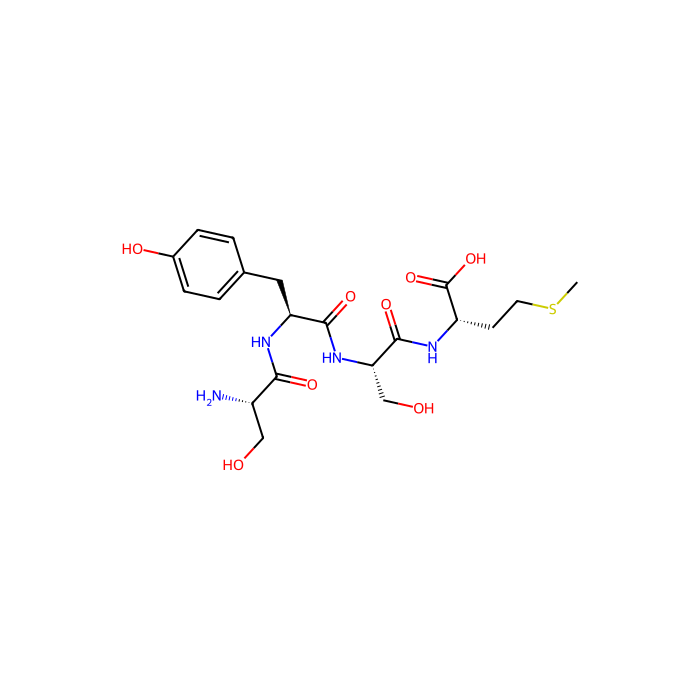
Brief description: ACTH (1-4) is the N‑terminal tetrapeptide fragment of adrenocorticotropic hormone, corresponding to the sequence H‑Ser–Tyr–Ser–Met‑OH.
Product-Data identifiers (item-specific)
CAS: 19405-50-6
SKU: A275980
InChIKey: Not specified for this item; refer to CoA/Spec Sheet.
SMILES: Not specified for this item; refer to CoA/Spec Sheet.
Molecular formula: Not specified for this item; refer to CoA/Spec Sheet.
Molecular weight: Not specified for this item; refer to CoA/Spec Sheet.
Literature/computed identity (for context; not item specification)
Peptide sequence: H‑Ser–Tyr–Ser–Met‑OH (SYSM)
Average molecular weight (literature): ~486.55 g/mol; monoisotopic mass ~486.18 Da (free N-terminus, free C-terminus)
Structural features: L‑amino acids; neutral side chains except Tyr phenolic OH; thioether in Met; free N‑terminal amine and C‑terminal carboxylate
2D description in words (general): Linear tetrapeptide with backbone –NH–CH(R)–CO– repeats. Residue order from N→C is Ser (hydroxymethyl side chain), Tyr (para‑hydroxybenzyl side chain), Ser (hydroxymethyl), Met (thioether –CH2–CH2–S–CH3). No rings other than Tyr’s phenyl ring; no formal charge at neutral pH aside from terminal groups depending on ionization.
Note: Exact stereochemistry, salt form, and terminal modifications (if any) should be confirmed on the item’s CoA/Spec Sheet.
Synthetic Utility
Although supplied as an unprotected peptide fragment, ACTH(1‑4) can be leveraged in synthesis and bioconjugation workflows (general; not item‑specific):
Coupling via C‑terminus: Activate the terminal carboxylate (e.g., EDC/NHS, DIC/HOBt alternatives) to form amide bonds with amines on carriers, surfaces, or other peptides (segment condensation). Control pH ~4.5–6.0 to favor activation and minimize N‑terminal self‑acylation.
Coupling via N‑terminus: React with activated esters (e.g., NHS esters), aldehydes (reductive amination), or isothiocyanates to label or extend the peptide. Protect Tyr phenol selectively if needed to avoid side reactions.
Side‑chain chemistry: Tyr phenol permits diazotization/azo coupling (specialized), electrophilic aromatic substitution (limited), or ether formation after prior activation. Ser hydroxyls are weakly nucleophilic; under strong activation they may form esters/ethers.
Ligation approaches: Native chemical ligation is not directly applicable without an N‑terminal cysteine or C‑terminal thioester; however, auxiliary strategies (e.g., KAHA ligation, oxime/hydrazone formation) can incorporate SYSM into larger constructs.
Analytical derivatization: Dansylation, FITC labeling, or isotopic tagging of the N‑terminus enhances detection in fluorescence/MS workflows.
Cautions
Methionine is oxidation‑prone; exclude oxygen, use chilled, mildly acidic conditions, and consider thioether‑compatible reagents. Avoid strong acids/bases that promote backbone cleavage or Tyr side reactions.
Target Specificity
Not applicable. This product is a synthetic peptide fragment and not an antibody, enzyme inhibitor with defined target profile, or affinity reagent. If you require a targeting biomolecule (e.g., an anti‑ACTH antibody), please refer to the relevant catalog section.
We use cookies to ensure the website functions properly and, where permitted, to improve your experience. You can manage your preferences at any time in Settings. Learn more in our Cookie Policy.
Shall we send you a message when we have discounts available?
Remind me later
Thank you! Please check your email inbox to confirm.
Products are supplied to verified businesses, institutions, and qualified professionals for research and development use only. Not for use in humans, animals, diagnosis, or therapy.