Determine the necessary mass, volume, or concentration for preparing a solution.
| Activity Type | Relation | Activity value | Units | Action Type | Journal | PubMed Id | doi | Assay Aladdin ID |
|---|

Standard for GC, ≥99.5%(GC) Standard for GC for sensitive chromatographic and analytical workflows requiring minimal baseline interference.
Room temperature Ships Normal Check lot-specific COA for exact specifications.
SDS, COA, datasheet, and spec sheet available for download. Lot-specific COA accessible via lot number lookup.
Cited in 141 peer-reviewed publications across chromatography, organic synthesis, and cross-coupling reactions.
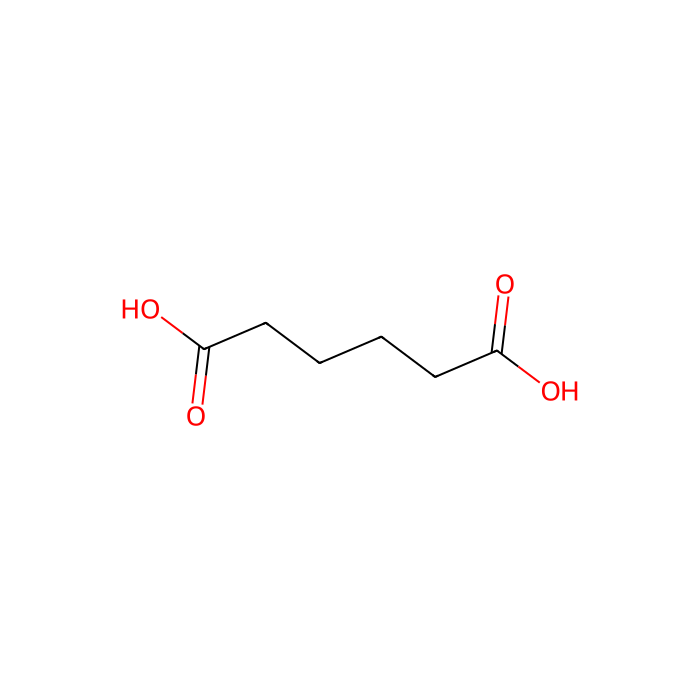
A dicarboxylic acid that is a useful synthetic reagent
Adipic acid is an organic acid used for resolving the problem of pH-dependent release of weakly basic drugs.
Comprehensive hazard, handling, storage, and regulatory compliance document.
Download SDS →Lot-specific quality data. Enter your lot number to retrieve the exact COA.
Look up COA →Full quality attributes and acceptance criteria for this grade.
View spec sheet →Taxonomy Tree
| Kingdom | Organic compounds |
|---|---|
| Superclass | Lipids and lipid-like molecules |
| Clase | Fatty Acyls |
| Subclass | Fatty acids and conjugates |
| Intermediate Tree Nodes | Not available |
| Direct Parent | Medium-chain fatty acids |
| Alternative Parents | Dicarboxylic acids and derivatives Carboxylic acids Organic oxides Hydrocarbon derivatives Carbonyl compounds |
| Molecular Framework | Aliphatic acyclic compounds |
| Substituents | Medium-chain fatty acid - Dicarboxylic acid or derivatives - Carboxylic acid - Carboxylic acid derivative - Organic oxygen compound - Organic oxide - Hydrocarbon derivative - Organooxygen compound - Carbonyl group - Aliphatic acyclic compound |
| Descripción | This compound belongs to the class of organic compounds known as medium-chain fatty acids. These are fatty acids with an aliphatic tail that contains between 4 and 12 carbon atoms. |
| External Descriptors | Dicarboxylic acids |
| Activity Type | Relation | Activity value | Units | Action Type | Journal | PubMed Id | doi | Assay Aladdin ID |
|---|
| Activity Type | Relation | Activity value | Units | Action Type | Journal | PubMed Id | doi | Assay Aladdin ID |
|---|
| Activity Type | Relation | Activity value | Units | Action Type | Journal | PubMed Id | doi | Assay Aladdin ID |
|---|
| Activity Type | Relation | Activity value | Units | Action Type | Journal | PubMed Id | doi | Assay Aladdin ID |
|---|
| Activity Type | Relation | Activity value | Units | Action Type | Journal | PubMed Id | doi | Assay Aladdin ID |
|---|
| Activity Type | Relation | Activity value | Units | Action Type | Journal | PubMed Id | doi | Assay Aladdin ID |
|---|
| Activity Type | Relation | Activity value | Units | Action Type | Journal | PubMed Id | doi | Assay Aladdin ID |
|---|
| Activity Type | Relation | Activity value | Units | Action Type | Journal | PubMed Id | doi | Assay Aladdin ID |
|---|
| Activity Type | Relation | Activity value | Units | Action Type | Journal | PubMed Id | doi | Assay Aladdin ID |
|---|
| Activity Type | Relation | Activity value | Units | Action Type | Journal | PubMed Id | doi | Assay Aladdin ID |
|---|
Find and download the COA for your product by matching the lot number on the packaging.
| Lot Number | Certificate Type | Fecha | Articulo |
|---|---|---|---|
 J2609137 J2609137 | Certificate of Analysis | Oct 13, 2026 | A108264 |
| D23061324 | Certificate of Analysis | Sep 22, 2026 | A108264 |
| D23061325 | Certificate of Analysis | Sep 22, 2026 | A108264 |
| D23061335 | Certificate of Analysis | Sep 22, 2026 | A108264 |
| F2616110 | Certificate of Analysis | Jun 23, 2026 | A108264 |
| G2502175 | Certificate of Analysis | Jul 12, 2025 | A108264 |
| A2206535 | Certificate of Analysis | Jun 09, 2025 | A108264 |
| D23061330 | Certificate of Analysis | Apr 18, 2025 | A108264 |
| A2506551 | Certificate of Analysis | Jan 08, 2025 | A108264 |
| D2419010 | Certificate of Analysis | Mar 13, 2023 | A108264 |
| G2419058 | Certificate of Analysis | Mar 13, 2023 | A108264 |
| E2107111 | Certificate of Analysis | Feb 09, 2023 | A108264 |
| L2014008 | Certificate of Analysis | Sep 21, 2022 | A108264 |
| Solubilidad | Adipic acid is freely soluble in ethanol and methanol. It also dissolves in boiling water, and acetone. Additionally, the product is slightly soluble in water and cyclohexane and is practically insoluble in benzene and petroleum ether. |
|---|---|
| Sensibilidad | Moisture sensitive. |
| Punto de inflamación (°F) | 384.8 °F |
| Punto de inflamación (°C) | 196℃ |
| Punto de ebullición (°C) | 265°C |
| Punto de fusión (°C) | 153°C |
| Peso molecular | 146.140 g/mol |
| XLogP3 | 0.100 |
| Hydrogen Bond Donor Count | 2 |
| Hydrogen Bond Acceptor Count | 4 |
| Rotatable Bond Count | 5 |
| Exact Mass | 146.058 Da |
| Monoisotopic Mass | 146.058 Da |
| Topological Polar Surface Area | 74.600 Ų |
| Heavy Atom Count | 10 |
| Formal Charge | 0 |
| Complexity | 114.000 |
| Isotope Atom Count | 0 |
| Defined Atom Stereocenter Count | 0 |
| Undefined Atom Stereocenter Count | 0 |
| Defined Bond Stereocenter Count | 0 |
| Undefined Bond Stereocenter Count | 0 |
| The total count of all stereochemical bonds | 0 |
| Covalently-Bonded Unit Count | 1 |
Our grade selection guide covers purity, stabilizer status, and application suitability for all variants in our catalog.
View Standard for GC grade guide →