GRADE & PURITYMoligand™?Moligand™ — Aladdin's line of ligands and bioactive small molecules. Use for receptor, pathway, and binding studies needing defined small-molecule tools.≥99%
Moligand™, ≥99% Moligand™ for sensitive chromatographic and analytical workflows requiring minimal baseline interference.
🌡
Storage & shipping
Store at -20°C,Argon charged,Desiccated Ships Ice chest + Ice pads Check lot-specific COA for exact specifications.
📋
Quality documents
SDS, COA, datasheet, and spec sheet available for download. Lot-specific COA accessible via lot number lookup.
📚
Literature proof
Cited in 0 peer-reviewed publications across chromatography, organic synthesis, and cross-coupling reactions.
Descripción general
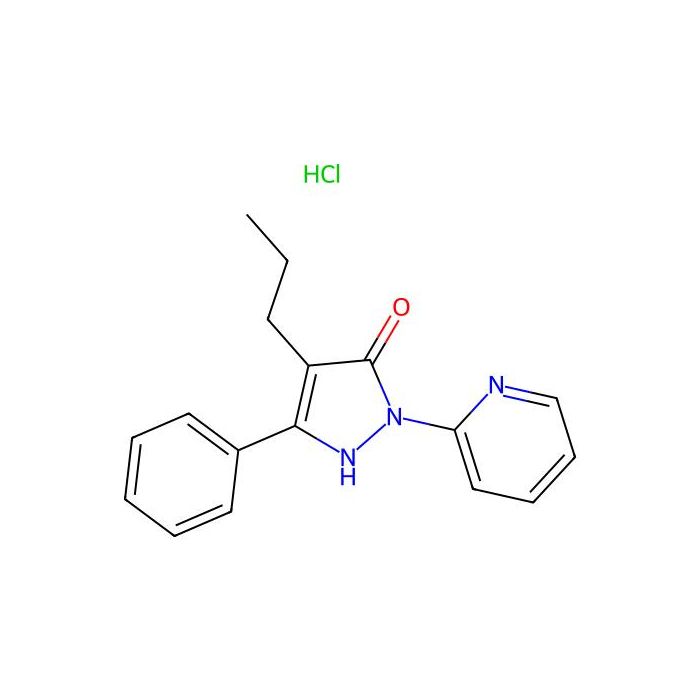
APX-115 (Ewha-18278) is a potent, non-selective Nox inhibitor with Ki values of 1.08 μM, 0.57 μM, and 0.63 μM for Nox1, Nox2 and Nox4, respectively. APX-115 effectively prevents kidney injury.
This compound belongs to the class of organic compounds known as pyrazolylpyridines. These are compounds containing a pyrazolylpyridine skeleton, which consists of a pyrazole linked (not fused) to a pyridine by a bond.
External Descriptors
Not available
1. Djoumbou Feunang Y, Eisner R, Knox C, Chepelev L, Hastings J, Owen G, Fahy E, Steinbeck C, Subramanian S, Bolton E, Greiner R, and Wishart DS. ClassyFire: Automated Chemical Classification With A Comprehensive, Computable Taxonomy. Journal of Cheminformatics, 2016, 8:61.
Certificados (CoA, COO, BSE/TSE y tabla de análisis)
C of A & Other Certificates(BSE/TSE, COO):
Analytical Chart:
Propiedades químicas y físicas
Solubilidad
DMSO : 100 mg/mL (316.66 mM; Need ultrasonic)
Sensibilidad
Moisture sensitive
Peso molecular
315.800 g/mol
XLogP3
Hydrogen Bond Donor Count
2
Hydrogen Bond Acceptor Count
3
Rotatable Bond Count
4
Exact Mass
315.114 Da
Monoisotopic Mass
315.114 Da
Topological Polar Surface Area
45.200 Ų
Heavy Atom Count
22
Formal Charge
0
Complexity
412.000
Isotope Atom Count
0
Defined Atom Stereocenter Count
0
Undefined Atom Stereocenter Count
0
Defined Bond Stereocenter Count
0
Undefined Bond Stereocenter Count
0
The total count of all stereochemical bonds
0
Covalently-Bonded Unit Count
2
Calculadoras de soluciones
Molarity Calculator
Determine the necessary mass, volume, or concentration for preparing a solution.
Dilution Calculator
Determine the dilution needed to prepare a stock solution.
Reconstitution Calculator
Reseñas
Reseñas de cliente
Application Protocols
No tested applications or protocols (e.g., assay types, recommended concentrations, positive controls) are provided in the Product Data for this item.
Researchers should establish application-specific protocols based on internal method development and validate conditions (solvent, concentration range, exposure time) with the actual lot.
Biological Roles
Biological function, target class, and mechanism are not provided in this catalog entry.
General guidance for researchers using small-molecule library members:
Establish the compound’s putative target/mechanism from your internal records or the primary literature linked to the CAS/CID, then verify against the actual lot via orthogonal assays (binding, activity, or phenotypic readouts).
Confirm absence of assay interference liabilities (e.g., aggregation, redox activity, fluorescence/absorbance overlap, detergent sensitivity) using control assays and counter-screens.
Quantify solubility limits and stability under assay conditions (pH, temperature, light, oxygen) to avoid artifactual results.
If employing in cellular systems, evaluate cytotoxicity/viability profiles and nonspecific effects at relevant exposure times and concentrations.
Note: This product is supplied strictly for research use only. No medical, diagnostic, or clinical claims are made or implied in this listing.
Buffer Applications
This listing does not describe buffer-related properties or uses. As a small-molecule library member, it is not a buffering reagent.
Practical note (general):
When preparing assay solutions, choose a buffer compatible with the biological system (e.g., PBS, HEPES, Tris) and assess compound stability across the target pH. Use minimal organic cosolvent to maintain solubility without perturbing the system.
No item-specific pKa or buffer compatibility data are provided; consult CoA/SDS and perform pilot solubility/stability tests.
Green Alternatives
Without item-specific solubility/stability data, greener choices can only be discussed generally for handling small-molecule solids.
Greener solvent considerations (general):
Replace DMF/NMP with safer high-permittivity solvents where feasible (e.g., Cyrene, propylene carbonate), noting differences in miscibility and assay compatibility.
Prefer MeCN or EtOAc over chlorinated solvents for chromatography/workups, when resolution and recovery allow.
For stock solutions, aqueous buffer with minimal DMSO (≤0.1–1% v/v) is preferable if the compound remains in solution and stable.
Comparison snapshot (general guidance):
DMSO vs PEG400/H2O: DMSO offers broad solubility and low viscosity but has higher EHS concerns; PEG400/H2O blends can be greener but may alter bioassay performance and viscosity.
MeCN vs CH2Cl2: MeCN is generally preferred from a green chemistry standpoint and is LC-compatible; CH2Cl2 provides rapid evaporation and strong eluotropic strength but with higher environmental/health impact.
Implementation tips:
Build a solvent selection matrix considering GHS, boiling point, biodegradability, and energy for removal/purification.
Validate compound stability in any alternative solvent system before wholesale adoption.
All choices should be validated experimentally for this specific item; no item-specific recommendations are provided in the Product Data.
Pharmaceutical Uses
No pharmacopeial status, excipient role, or formulation guidance is provided for this item.
General considerations for research-only compounds:
If used in pre-formulation research, determine polymorph/solvate state, hygroscopicity, and thermal behavior (DSC/TGA) and quantify aqueous/biorelevant solubility across pH 1–8.
Evaluate stability (hydrolysis, oxidation, photolysis) and potential for salt formation to modify solubility or crystallinity. These studies are research-stage only and not indicative of suitability for human or veterinary use.
Note: For research use only. Not for human or animal therapeutic, diagnostic, or clinical applications.
Physical Properties
Appearance: Not specified for this item; refer to CoA/Spec Sheet.
Molecular weight: Not specified for this item; refer to CoA/Spec Sheet.
Molecular formula: Not specified for this item; refer to CoA/Spec Sheet.
Melting point: Not specified for this item; refer to CoA/Spec Sheet.
Boiling point: Not specified for this item; refer to CoA/Spec Sheet.
Density: Not specified for this item; refer to CoA/Spec Sheet.
Refractive index: Not applicable/unknown for this solid; refer to CoA/Spec Sheet if provided.
LogP/logD, pKa: Not specified for this item; refer to CoA/Spec Sheet.
Solubility: Not specified for this item; refer to CoA/Spec Sheet.
Notes for planning experiments (general, literature-informed practices for small-molecule libraries):
In the absence of solubility data, initial dissolution screens often include DMSO, DMF, or aqueous cosolvent systems (e.g., 10–50% DMSO in buffer) for analytical evaluation only. Confirm chemical compatibility and stability prior to biological assays.
If a melting endotherm is needed for identity screening, perform DSC or capillary MP under dry conditions to avoid solvent inclusion artifacts.
Always consult the product CoA/SDS for definitive, item-specific specifications.
Quality and Grades
Grade/Purity: Not specified for this item; refer to CoA/Spec Sheet.
Interpreting quality information (guidance):
For small-molecule library members, typical quality documentation includes assay purity (e.g., HPLC/UPLC), identity confirmation (NMR, MS), and residual solvent/profile. Verify methods (detector wavelength, gradient, and acceptance criteria) on the CoA.
If salt form or solvate/hydrate state is relevant, ensure the label and CoA match your intended use (potency calculations should correct for counter-ions/solvent of crystallization).
Low-water handling: The product is specified to be stored desiccated. If using hygroscopic solids, minimize ambient exposure and re-cap promptly with desiccant present.
For analytical/bioassay use, request batch-specific CoA to confirm:
Purity basis (area% vs weight%), chromatographic conditions, and threshold.
Residual metals/halides and volatile residues if critical to your application.
Any stabilizers or antioxidants used in the formulation (none are specified here).
Reaction and Applications
This product is cataloged under small molecules/compound libraries. No item-specific synthetic or reaction applications are provided.
Typical uses for such materials (general guidance):
Reference standard or tool compound in discovery screening panels (biochemical, biophysical, or cell-based) when the target and mechanism are defined within a given research program. This listing does not provide target or mechanism—consult your internal documentation.
Analytical method development and validation (e.g., LC–MS retention time markers, recovery studies) once identity/purity are confirmed by CoA/NMR/MS.
If utilized in reactions, treat as a functionalized substrate; establish compatibility and reactivity empirically as structure-specific data are not provided here.
Practical considerations:
Prepare well-characterized DMSO stock solutions and maintain a freeze–thaw log to preserve integrity across screening campaigns.
Confirm lot-to-lot consistency by quick-check LC–MS before inclusion in critical assays.
For long experiments, perform stability-indicating analysis (e.g., LC–PDA/MS) to ensure concentration constancy and absence of degradants.
Note: No manufacturer application claims are provided for this item beyond research use. Avoid assuming a biological target without corroborating data.
Reaction Conditions
Item-specific reaction conditions are not provided. As this is a small-molecule library member, it is not primarily supplied as a reaction reagent.
General advice if employing in chemical transformations:
Establish solvent and temperature windows via small-scale screens, beginning with inert atmosphere and anhydrous conditions if moisture sensitivity is suspected.
Monitor reactions by LC–MS or TLC, and employ stability-indicating methods to detect degradants.
Typical conditions (purely general) for small-molecule modifications include:
Couplings: Amide formations (EDC/HOBt, HATU) in DMF/MeCN; Suzuki couplings in dioxane/H2O with Pd catalysts.
Redox: Mild reductions (NaBH4) or oxidations (Dess–Martin) as structure permits.
These examples are generic and must be validated for the verified structure of your lot; no yields or specific parameters are claimed for this item.
Safety and Handling
GHS classification, signal word, pictograms, and H-statements: Not specified for this item; refer to SDS.
Storage: Store at 2–8 °C, desiccated (per Product Data). Shipments are on wet ice.
General precautions:
Handle in a chemical fume hood, avoiding inhalation of dust or aerosols.
Avoid contact with oxidizers or reactive chemicals until compatibility is assessed from SDS/CoA.
Hygiene measures: Wash hands thoroughly after handling; avoid eating or drinking in the lab.
First aid overview (consult SDS for details):
Inhalation: Move to fresh air; seek medical attention if symptoms occur.
Skin contact: Wash with soap and water; remove contaminated clothing.
Eye contact: Rinse cautiously with water for several minutes; seek medical attention if irritation persists.
Ingestion: Rinse mouth; obtain medical advice.
Spill/accidental release:
Avoid dust generation; contain with inert absorbent; collect in labeled waste for disposal according to local regulations.
Fire-fighting measures: Use appropriate media (CO2, dry chemical, foam) based on surrounding materials; thermal decomposition products unknown—firefighters should wear SCBA.
Waste disposal: Dispose of in accordance with institutional and regional regulations; consult SDS for EHS guidance.
Always defer to the current SDS for authoritative safety information.
Solvent Selection
Item-specific solubility data are not provided. The following is general guidance for small-molecule screening compounds; verify experimentally with your batch.
Primary solvents for stock solutions:
DMSO: Common first choice for bioassay stocks due to broad solvating power and compatibility with aqueous dilution. Confirm absence of reactivity (e.g., with acid chlorides) if performing chemistry.
DMF or NMP: Useful alternatives for poorly soluble analytes; consider cytotoxicity and hygroscopicity if moving toward biological assays.
Aqueous compatibility:
For assay work, prepare concentrated DMSO stocks (e.g., 10–50 mM) then dilute into buffered media, keeping final DMSO ≤0.1–1% v/v as assay-appropriate. Filter if precipitation occurs.
Volatile organic options (for analytics/prep):
MeCN or MeOH for LC; THF or EtOAc for workup—use only if compatible with the compound’s stability profile.
Practical tips:
Establish a solubility/stability map by testing a small panel (DMSO, DMF, MeCN, MeOH, buffer pH 2–9 with co-solvent) and monitoring by LC–UV/MS over 24–72 h.
Use amber vials if chromophoric groups or photolability are suspected. Purge headspace with inert gas if oxidation sensitivity is observed.
Always base final solvent choice on experimental solubility/stability of the specific lot (refer to CoA/SDS for restrictions).
Storage and Reconstitution
Storage conditions: Store at 2–8 °C, desiccated (per Product Data). Protect from moisture. Shipments on wet ice.
Container handling: Keep tightly closed. Minimize headspace exchanges; consider using desiccant packs. If photolabile behavior is suspected, use amber vials.
Reconstitution (general guidance for small-molecule solids; item-specific solubility not provided):
Prepare initial stock solutions in a suitable solvent such as dry DMSO at a defined concentration (e.g., 10–50 mM) after confirming solubility/stability.
Vortex/sonicate briefly to aid dissolution; sterile-filter if solutions are intended for cell-based assays and the compound is filter-stable.
Aliquot stocks to avoid repeated freeze–thaw cycles; store aliquots at 2–8 °C for short term or at lower temperature (e.g., −20 °C) if stability permits per your internal data.
Stability monitoring: Periodically check by LC–UV/MS for degradation during storage. Discard if discoloration, precipitation, or purity loss is detected.
Always consult the batch CoA/SDS for any item-specific storage limitations, shelf life, or reconstitution instructions.
Structure and Identity
Product name: APX-115 (SKU: A650330)
CAS: 1395946-75-4 (provided)
PubChem CID: 60172240 (provided)
InChIKey: Not specified for this item; refer to CoA/Spec Sheet. (Product Data lists a numeric placeholder that is not a valid InChIKey.)
SMILES: Not specified for this item; refer to CoA/Spec Sheet.
Molecular formula: Not specified for this item; refer to CoA/Spec Sheet.
Molecular weight: Not specified for this item; refer to CoA/Spec Sheet.
Structural features (general guidance):
Specific functional groups, ring systems, and stereochemistry are not provided in this listing. For exact structural depiction, consult the CoA/Spec Sheet or primary databases (cross-check with the provided CAS and CID before use in regulated documentation).
Identification best-practices (general):
Cross-verify identity by matching at least two independent identifiers (e.g., CAS and full InChIKey) and, when possible, confirm by orthogonal analytical methods (LC–MS, 1H/13C NMR, HRMS). Ensure any salt form/hydrate state is clarified on the CoA prior to use in quantitative work.
Synthetic Utility
The product is offered as a discrete small-molecule entity rather than a general synthetic reagent. No functional-group or reactivity specifications are provided in this listing.
General guidance if using as a substrate or reference standard:
Confirm full structure (including counter-ions/solvation) by NMR and HRMS prior to derivatization.
If derivatization is intended, map compatibility with common transformations (oxidation/reduction, coupling, protection/deprotection) based on the verified functional groups from structural characterization. Absent item-specific data, such planning must be empirical.
For analytical chemistry, the compound may serve as a system suitability or retention time reference once purity and stability are confirmed for your method.
Target Specificity
Target, binding partners, and selectivity profile are not provided in the Product Data for this item. No claims are made regarding biological targets or selectivity. Consult your internal records or literature associated with the CAS/CID and verify experimentally before use in target-specific studies.
Need help choosing the grade?
Our grade selection guide covers purity, stabilizer status, and application suitability for all variants in our catalog.
We use cookies to ensure the website functions properly and, where permitted, to improve your experience. You can manage your preferences at any time in Settings. Learn more in our Cookie Policy.
Shall we send you a message when we have discounts available?
Remind me later
Thank you! Please check your email inbox to confirm.
Products are supplied to verified businesses, institutions, and qualified professionals for research and development use only. Not for use in humans, animals, diagnosis, or therapy.